
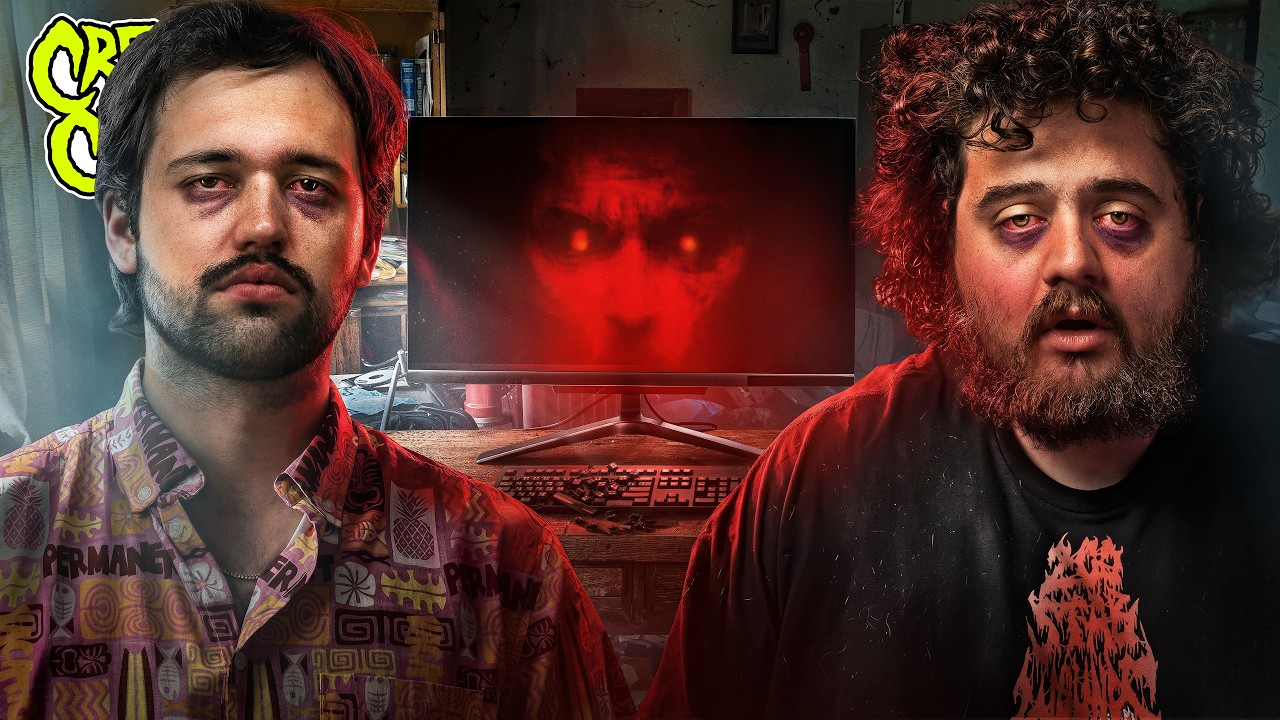
HELP. I'm Trapped in a Sitcom | Creep Cast
YouTube · -nbgjmRAaY8
Quick Read
Summary
Takeaways
- ❖The story 'HELP, I'M TRAPPED IN A SITCOM' features a protagonist experiencing a surreal, sitcom-driven reality.
- ❖Canned laughter and predictable character interactions mask underlying violence and despair.
- ❖Key characters like Bill and Stacy occasionally break character, revealing their own torment or awareness of the illusion.
- ❖Recurring imagery of blood, dirt, and infinite spaces suggests a deeper, possibly ritualistic, origin for the protagonist's predicament.
- ❖A mysterious ringing phone and the character Ida present a choice between continued entrapment and facing unknown consequences.
- ❖The hosts theorize the setting could be a personalized purgatory or a consequence of a forgotten ritual.
Insights
1The Sitcom as a Psychological Prison
The protagonist is trapped in a reality structured like a sitcom, complete with canned laughter, predictable dialogue, and recurring characters. This manufactured normalcy serves as a psychological prison, disorienting him and preventing him from understanding his true situation.
The narrative explicitly mentions 'canned laughter' () and characters performing 'practiced over-the-top motions' (). The protagonist repeatedly questions how he arrived in each new scene (, ).
2Censored Identity and Fragmented Memory
The protagonist's name is censored whenever mentioned, symbolizing a loss of identity. He also suffers from fragmented memories, unable to recall how he got to various locations or who certain people are, which is a key element of his disorientation.
When Stacy says his name, it's 'censored with the same beep they use to censor explicit songs' (). He states, 'I don't know who I am or how I got here' ().
3Characters Breaking the Illusion
Despite the sitcom facade, other characters occasionally break their roles, revealing moments of panic, despair, or awareness of their shared predicament. Bill's sudden seriousness about not answering the phone and his later confession of self-harming thoughts are prime examples.
Bill's demeanor shifts from 'cheery' to 'panicked' when warning the protagonist not to answer the phone (). Later, Bill whispers, 'I want to hurt myself. I can't sleep at night' (). Stacy also shows signs of distress, scratching her face and slamming her head ().
4Symbolism of Violence and Decay
The story is punctuated by disturbing imagery, including blood, dirt, and decaying elements, which contrast sharply with the sitcom setting. Stacy's bloody nails, the dead body in the bathroom, and the soiled wedding dresses suggest a history of violence or a deteriorating reality.
Stacy has 'Blood' and 'dirt' under her perfectly manicured nails (). A 'dead body in the bathroom' with a slit throat is discovered (). Kathy stuffs 'progressively more and more soiled' wedding dresses into a machine ().
5The Enigma of the Phone and Ida
A ringing rotary phone appears repeatedly, with some characters warning against answering it, while others, like Ida, insist it's 'for you.' Ida, initially described as beautiful, seems to be a key figure in the protagonist's past or a guiding entity, potentially offering a way out or a confrontation with his past actions.
Bill emphatically states, 'Don't answer that' (). Later, Ida, the 'attractive mid-20s woman' from the coffee shop (), hands him the phone, saying, 'It's for you' (). The hosts theorize Ida could be his dead wife or a lost love he sought through a ritual ().
6Thematic Interpretations: Purgatory or Ritualistic Consequences
The hosts discuss various interpretations, including the idea that the protagonist is in a personalized hell or purgatory, or that his situation is the repercussion of a ritual he performed. The recurring pentagram with numbers on a woman's shirt supports the ritual theory.
The host states, 'It's like a personalized hell pretty much' (). The other host notes a woman wearing a 'pentagram. Each point of the star numbered, and the star contained within a circle' (), suggesting a 'spell or a ritual' ().
Lessons
- Recognize how manufactured realities, even seemingly benign ones, can be used to control or disorient individuals.
- Consider the psychological impact of identity loss and fragmented memory in extreme situations.
- Analyze how subtle shifts in character behavior can reveal deeper truths or hidden suffering in a controlled environment.
Quotes
"HELP, I'M TRAPPED IN A SITCOM, SEASON 1, episode one."
"I want to hurt myself. I can't sleep at night. I stay awake and I look at the ceiling and I dream of hurting myself."
"I know you. I know who you are and how you got here."
Q&A
Recent Questions
Related Episodes

Ronald McDonald House | Creep Cast
"This episode features two unsettling creepypastas: one about a Ouija board that isolates players and reveals a hidden impostor, and another about a 'bad kid' trapped in a nightmarish Ronald McDonald House run by murderous clowns, culminating in a bizarre time-travel twist."

The Forest of A Thousand Legs | Creep Cast
"This episode plunges into two terrifying creepypasta narratives, exploring the psychological and physical horrors of arachnophobia, from parasitic brain spiders to a forest teeming with human-spider hybrids."
Necrosleep | Creep Cast
"Creepcast hosts dissect the creepypasta 'Necrosleep,' a tale of a reclusive drug user's descent into parasitic-induced psychosis and cannibalism after taking mysterious pills that negate the need for sleep."

The Moon Is On Fire | Creep Cast
"A man grappling with mental illness questions if the moon is truly on fire or if his reality is fracturing, leading to a terrifying discovery about mass delusion and an ancient cosmic entity."