Joe Rogan Experience #2451 - Cheryl Hines
YouTube · 0sMrvv53e9Y
Quick Read
Summary
Takeaways
- ❖Extreme political factions on both sides exhibit 'cult-like' behavior, fueled by fear of tribal rejection.
- ❖Mainstream media's narratives are often misleading, as evidenced by Joe Rogan's personal 'redpilling' experience during the pandemic.
- ❖Bobby Kennedy Jr.'s appearance on Joe Rogan's podcast significantly boosted his campaign by allowing direct, unfiltered communication with the public.
- ❖The pharmaceutical industry and government agencies have a history of misinformation and a 'revolving door' between regulators and corporations.
- ❖Hollywood, like politics, suffers from groupthink, where individuals conform to popular opinions to maintain social standing.
- ❖The 'deep state' of career bureaucrats and powerful organizations actively thwarts meaningful change, regardless of who is in office.
- ❖Congressional insider trading is a widespread, ethically questionable practice that allows politicians to amass wealth.
- ❖AI poses a greater threat than hypothetical dangers like dinosaurs, due to its potential for pervasive societal control and manipulation.
- ❖The Epstein files revealed extensive complicity among powerful elites, highlighting the dark influence of money and blackmail.
- ❖Free speech platforms, like Twitter under Elon Musk, are vital for exposing government censorship and allowing reality to 'resurface.'
Insights
1The Cult-Like Nature and Viciousness of Modern Politics
Cheryl Hines and Joe Rogan observe that extreme factions within both the political left and right exhibit 'cult-like' characteristics. This behavior is driven by a primal fear of rejection from one's 'tribe,' compelling individuals to conform to even irrational ideologies. Hines contrasts the competitive but generally less destructive nature of Hollywood with the 'mean' and 'vicious' tactics of politics, where opponents, even within the same party, actively seek to tear each other down through lies and out-of-context attacks.
Joe Rogan: 'You can make a really good argument at both the right and the left that at in a certain certain section of each one of these political parties, it's a cult.' () Cheryl Hines: 'When it comes to politics, people just get so mean... they will pull out all the stops, take things out of context, lie about you.' ()
2JRE's Impact on Political Discourse and Rogan's 'Redpilling' Experience
Cheryl Hines credits Joe Rogan's podcast with significantly changing the trajectory of Bobby Kennedy Jr.'s presidential campaign. She states that the platform allowed Kennedy to communicate directly with the public, bypassing mainstream media narratives that were actively misrepresenting his views. Rogan explains his own 'redpilling' moment during the pandemic, where he realized that 'science' and 'left-wing' academics, whom he previously trusted, were actively lying about his personal health experiences, leading him to question established authorities.
Cheryl Hines: 'When Bobby decided to run and he and I talked about this in my book Unscripted, when he came on your podcast was a game changer... people heard what Bobby had to say and it changed everything for him.' () Joe Rogan: 'Before the pandemic, I was firmly on the side of science... And then during the pandemic, I was like, 'Okay, these experts are clearly lying. I know they're lying because they're literally lying about me.'' ()
3Systemic Corruption: The Revolving Door and Congressional Insider Trading
The discussion highlights two major forms of systemic corruption: the 'revolving door' between government regulators and the industries they oversee, and congressional insider trading. They cite the example of FDA officials approving drugs and then taking lucrative jobs with the pharmaceutical companies they once regulated. Furthermore, they discuss how members of Congress and their spouses consistently profit from stock market investments, often making returns far exceeding market averages, strongly suggesting the use of privileged information gained through their positions. This practice is criticized for being ethically questionable, even if technically legal due to loopholes.
Joe Rogan: 'There's a lot of them [Congress people] and it's not a Republican or a Democrat issue. It's red blue. They're all making crazy loot.' () Joe Rogan: 'That's a gross thing that they do where there's this revolving door between the FDA and all these other departments and then these other corporations. So you leave and then you get this amazing job working for the very corporation that you were regulating.' ()
4The 'Deep State' and Impeding Political Change
Rogan and Hines discuss the reality of a 'deep state' – a network of career bureaucrats and powerful organizations that operate independently of elected officials. These entrenched entities, often supported by large corporations, can effectively 'hit the brakes' on presidential agendas, making it incredibly difficult for politicians to enact meaningful change. This system ensures continuity regardless of election outcomes and can manipulate policy for self-serving interests, leaving elected officials feeling powerless.
Joe Rogan: 'The deep state is real... If there are a bunch of people that are in charge of enormous organizations and these enormous organizations exist regardless of who the president is, and they are in office for 10, 20, 30, 40 years... That's real.' () Cheryl Hines: 'When you get in, you see things that are just like, whoa, this is bigger. The bigger has been happening for a long time and you're just a little tiny piece that's not going to change that.' ()
5AI as a Societal Threat and the Erosion of Purpose
Cheryl Hines expresses a greater fear of AI's potential for pervasive societal control and manipulation than even the hypothetical return of dinosaurs, citing concerns over targeted ads and potential thought control. Rogan elaborates on the societal implications of AI, discussing Elon Musk's prediction of universal high income due to AI-driven productivity. However, they question the psychological impact of such a future, where many people might lose their sense of purpose and identity derived from work, leading to widespread unhappiness and existential crises.
Cheryl Hines: 'I would rather die from being squashed by a dinosaur than just go crazy from thoughts of things that have been put into my head from AI.' () Joe Rogan: 'You have this real problem of what do people do with their time... how do so many people really identify with whatever they do as a job... it gives you a sense of purpose.' ()
6The Personal Cost of Public Life and Political Campaigns
Cheryl Hines describes the profound personal toll of Bobby Kennedy Jr.'s presidential campaign, which brought constant chaos, public scrutiny, and even threats to his safety. She recounts how her own career, friendships, and public perception were irrevocably altered, with people assuming negative things about her due to her husband's political stance. The experience forced her to develop a heightened sense of awareness for potential threats, constantly scanning rooms for suspicious individuals, and highlighted the immense stress of being a public figure in a hostile political environment.
Cheryl Hines: 'I was worried about Bobby's safety... it was interesting to watch people change their attitude about me or that they I'm not the person they thought I was type of feeling... the safety Bobby's safety was the most stressful every day all day.' () Cheryl Hines: 'Now you walk into a room and you look at people and you're like, 'Okay, that guy's sweating a lot for no reason.' You look to see what's suspicious.' ()
Bottom Line
The 'redpilling' phenomenon, where individuals shift from trusting mainstream narratives to questioning them, is a significant and growing trend, driven by personal experiences that contradict official stories.
This indicates a fundamental erosion of trust in traditional institutions and media, creating a fertile ground for alternative media and independent voices to gain influence.
Content creators and platforms that offer uncensored, open dialogue and encourage critical thinking will continue to attract large audiences seeking unfiltered information and diverse perspectives.
The weaponization of 'cooks' (unstable individuals) through political rhetoric, encouraging them to 'do something,' is a dangerous and escalating tactic.
This suggests a heightened risk of politically motivated violence and domestic extremism, as emotionally charged language can incite vulnerable individuals.
There is a critical need for media literacy initiatives and platforms that promote responsible discourse, de-escalation, and mental health support to counter the harmful effects of such rhetoric.
The FBI's conclusion that Jeffrey Epstein was not running a sex trafficking ring for powerful men, despite extensive evidence, exemplifies institutional gaslighting.
This highlights the deep-seated corruption and protective mechanisms within powerful systems, where inconvenient truths are actively suppressed or denied to protect elites.
Independent investigative journalism and decentralized information networks are essential to uncover and disseminate truths that mainstream institutions may attempt to bury, fostering public accountability.
Key Concepts
Groupthink
The psychological phenomenon where individuals conform to the majority opinion of a group to avoid conflict or ostracization, often suppressing their own critical thinking. This is discussed in the context of both political parties and Hollywood culture.
Information Warfare
The strategic manipulation of public perception through media, rumors, censorship, and targeted narratives. The podcast highlights how political campaigns and powerful entities engage in this to control public discourse and discredit opponents.
Revolving Door Syndrome
The movement of individuals between government regulatory agencies and the private sector industries they regulate. This model explains how former regulators can leverage their inside knowledge for personal gain, leading to conflicts of interest and potential corruption.
Tribalism
The human tendency to form strong in-groups and out-groups, leading to loyalty and conformity within one's group and hostility or suspicion towards others. This is presented as a driving force behind extreme political polarization and the fear of social rejection.
Lessons
- Cultivate critical thinking and question narratives from all political sides, recognizing the tendency for groupthink and tribalism.
- Seek out diverse sources of information, especially independent platforms that allow for uncensored discourse, to counter mainstream media biases.
- Be aware of the 'revolving door' between government and industry, as well as potential insider trading by politicians, to understand underlying motivations behind policy decisions.
- Recognize the personal toll of public life and the constant scrutiny faced by public figures, fostering empathy and informed judgment.
- Prioritize personal purpose and meaning outside of work, as AI advancements may significantly alter traditional employment structures and societal roles.
Notable Moments
Joe Rogan recounts his early dislike for the 'groupthink' mentality in Hollywood, where people felt compelled to agree with popular opinions on films or issues.
This illustrates a pervasive social pressure in creative industries to conform, mirroring similar pressures observed in political tribalism and highlighting the challenge of authentic expression.
Cheryl Hines reveals that Bobby Kennedy Jr. was initially denied Secret Service protection during his presidential campaign, despite the inherent risks.
This points to a politically motivated decision that put a candidate's life at risk and underscores the unequal playing field in high-stakes politics, where protection can be weaponized.
Joe Rogan plays a clip of President Eisenhower's 1961 farewell address, warning against the 'military-industrial complex' and its potential for 'disastrous rise of misplaced power.'
This historical warning serves as a powerful validation of long-standing concerns about unelected power structures, reinforcing the idea of a 'deep state' and its influence on national policy, particularly regarding war.
Quotes
"You can make a really good argument at both the right and the left that at in a certain certain section of each one of these political parties, it's a cult."
"When Bobby decided to run and he and I talked about this in my book Unscripted, when he came on your podcast was a game changer... people heard what Bobby had to say and it changed everything for him."
"Before the pandemic, I was firmly on the side of science... And then during the pandemic, I was like, 'Okay, these experts are clearly lying. I know they're lying because they're literally lying about me.'"
"I firmly believe that when you have this sort of a visceral reaction to any sort of a subject like that without a a rational examining of what is objective truth... something's happened. You've been co-opted."
"The potential for the disastrous rise of misplaced power exists and will persist. We must never let the weight of this combination endanger our liberties or democratic processes. We should take nothing for granted."
"The deep state is real. And if there you want a conspiracy theory that a lot of people like to dismiss, just think about it logically. If there are a bunch of people that are in charge of enormous organizations and these enormous organizations exist regardless of who the president is, and they are in office for 10, 20, 30, 40 years, whatever it is, acquiring power, using their influence... That's real."
"I am a conspiracy theorist. Yes. Because by the way, what is a conspiracy? It's two or more people working together to do something nefarious. It's always happened. It's been going on forever."
"I would rather die from being squashed by a dinosaur than just go crazy from thoughts of things that have been put into my head from AI."
Q&A
Recent Questions
Related Episodes

Alex Jones: Epstein Files, Bondi Hearing + El Paso Shutdown | PBD #737
"Alex Jones details his conspiratorial view of the Epstein files, alleging deep state involvement and a political cover-up, while also recounting his personal legal battles, including the Sandy Hook lawsuit, which he frames as a weaponized attack on free speech."
Jimmy Kimmel Gets Emotional Admitting Political Differences w/ Adam Carolla
"Dave Rubin, Dr. Drew, and Sage Steele discuss how personal relationships can transcend political divides, critique LA's failed homelessness policies, and debunk media-fueled public health scares, all while sharing personal stories of overcoming financial struggles."
Basement #002: Mike Bara | JFK Assassination, Secret Space Program & Cities on Mars
"Aerospace insider Mike Bara connects the JFK assassination to a deep state cover-up of alien technology and a secret space program, arguing current UAP disclosure is a curated narrative to militarize space."
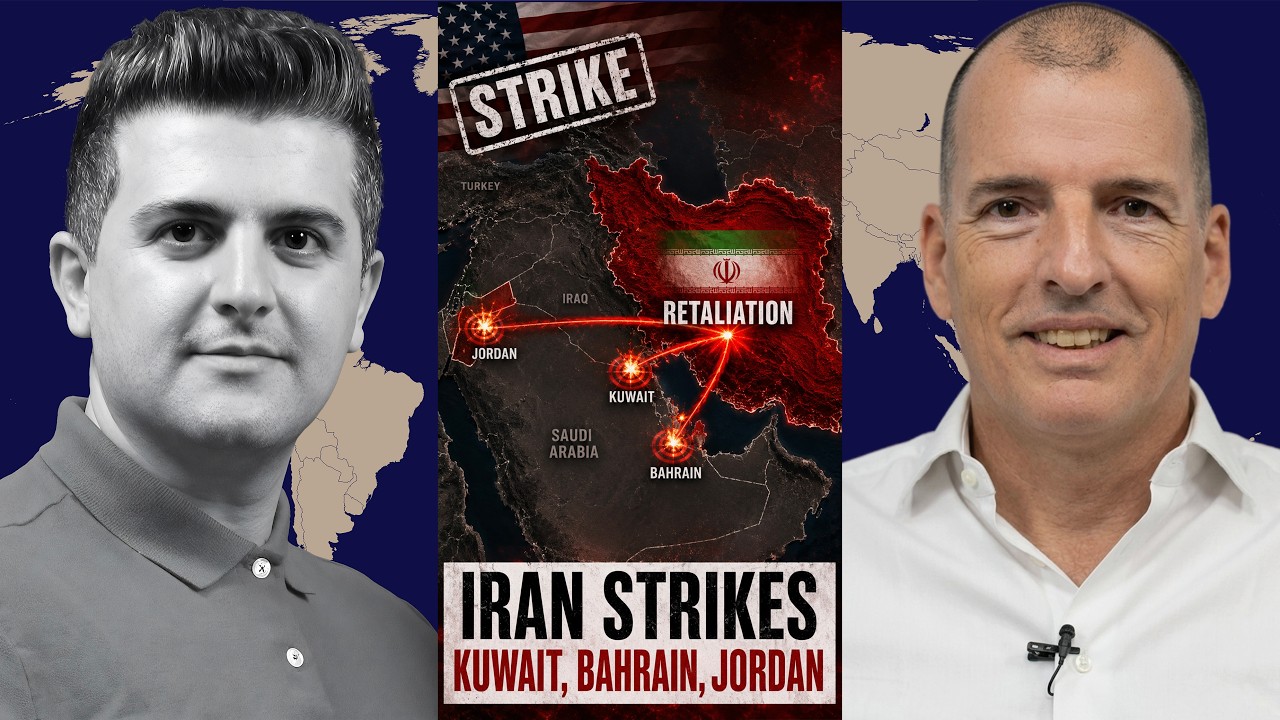
Alex Krainer: US STRIKES Iran – Iran RETALIATES Against Kuwait, Bahrain & Jordan!
"Amidst escalating US-Iran conflict and Iranian retaliation against regional US allies, this episode argues that US foreign policy is deeply controlled by an 'Anglo-Zionist conspiracy' led by the Rothschild banking dynasty, prioritizing Israeli interests over American ones."