Highlights from BillOReilly.com’s No Spin News | January 16, 2026
YouTube · 1V2wNlddNcM
Quick Read
Summary
Takeaways
- ❖President Trump governs non-collaboratively, believing he has a mandate to correct past administration failures and establish a 'new world order.'
- ❖Trump's foreign policy relies on national security authority to bypass congressional approval for military actions, citing precedents like the Soleimani strike.
- ❖The Justice Department's investigation into Fed Chair Jerome Powell is viewed as having both legitimate grounds (e.g., $2.5 billion Fed HQ renovation) and potential political retribution.
- ❖Protests against ICE are characterized as 'very well-organized far-left generated' rather than organic, with 10 states in 'active rebellion' against federal immigration laws.
- ❖The Greenland situation is framed as Trump's 'negotiating ploy' to secure US military bases and mineral rights without a full military invasion, which O'Reilly advises against.
- ❖The 'Don Roe Doctrine' is presented as a modern equivalent to the Monroe Doctrine, asserting US hegemony in the Americas, particularly against drug cartels and hostile regimes.
Insights
1Trump's Non-Collaborative Governing Style and Mandate
President Trump operates with a 'non-collaborative' approach, believing his 77 million votes grant him a mandate to swiftly correct issues from the previous administration, particularly the border crisis, and impose a 'pro-American new world order' globally. He aims to bypass Congress and courts, viewing them as obstacles to rapid action.
O'Reilly states, 'President Trump is governing in a non-collaborative way... his way or the highway.' He believes Trump has 'a mandate. 77 million Americans voted for him to correct what the Biden administration screwed up.' Trump 'doesn't need Congress to do it' and 'doesn't need the courts because you can litigate all day long, but it just holds it up. Trump wants to go fast.'
2Unilateral Foreign Policy Under National Security Pretext
Trump's administration justifies military actions, such as potential strikes in Iran or interventions in Venezuela, under the 'national security banner.' This approach allows the president to act without explicit congressional approval, leveraging precedents established after 9/11 to neutralize perceived threats like global terrorism and drug trafficking.
In a debate with Chris Cuomo, O'Reilly argues, 'Under the national security banner... Iran continues to fund worldwide terrorism... That's a national security threat to the United States. So, under national security, if you can neutralize somebody like Soleimani or ISIS... you can do it without congressional approval.' He adds, 'Drug dealing into the United States, massive amounts of narcotics, national security. Mullahs funding Hezbollah, Hamas, all the terror groups, national security.'
3Greenland as a High-Stakes Negotiating Ploy
The US engagement with Denmark and Greenland is interpreted as a dangerous but strategic negotiating tactic by President Trump. O'Reilly believes Trump's public stance on potentially invading Greenland is a 'huff and puff' maneuver to secure military bases and mineral rights through a deal, rather than actual military intervention, which would fracture NATO and face domestic opposition.
O'Reilly advises Trump, 'You can't do this. This would fracture the NATO alliance.' He suggests, 'It's not that hard to get military bases up there... Denmark's not going to object to that. Mineral rights, we'll get them. We don't need to put military boots on the ground there.' He concludes, 'This is his negotiating ploy. Huff and puff and blow the house down and then we'll get a deal.'
4Justice Department Investigation into Fed Chair Powell: Retribution and Legitimacy
The Justice Department's investigation into Fed Chair Jerome Powell is presented as a situation with dual motivations: a legitimate inquiry into the $2.5 billion renovation of Fed headquarters and a potential element of political retribution from President Trump, who views Powell as a 'deep state guy' who manipulated the economy against him.
O'Reilly notes, 'The Justice Department is investigating Jerome Powell, the Fed chair... Trump hates this guy. And so a lot of people saying it's another revenge play.' He questions the '$2.5 billion renovation of Fed headquarters.' Guest Anthony Esposito states, 'Jerome Powell has positioned himself in a really bad way with the president cuz he's done two things that President Trump despises. First, he's attacked America. Second, he's attacked President Trump... through his seat at the Fed and monetary policy.'
Lessons
- Understand that a presidential administration, particularly one with a strong mandate, may prioritize executive action over traditional legislative processes, especially in areas deemed 'national security.'
- Recognize that federal investigations can have multiple layers of motivation, potentially combining legitimate concerns with political animus.
- Consider how 'negotiating ploys' can be used in international relations to achieve strategic goals without resorting to overt military conflict, but also the inherent risks involved.
- Be aware of the arguments for and against unilateral presidential power in foreign policy, particularly when framed under national security doctrines.
Quotes
"President Trump is governing in a non-collaborative way. All right? That means his way or the highway."
"If you can get them out of there, Mr. President, the mullahs, if you can get them on that flight to Moscow, by say wiping out the revolutionary guard headquarters, I'd do it in a heartbeat."
"Iran continues to fund worldwide terrorism and gives them millions of dollars, billions with a B. That's a national security threat to the United States. So, under national security, if you can neutralize somebody... you can do it without congressional approval."
"Trump believes, and I think you're right, that number one uh Powell is a deep state guy who favors uh the Democratic Party and was manipulating the US economy to get Democrats elected."
"This is his negotiating ploy. Huff and puff and blow the house down and then we'll get a deal. That's what he always does, but this one is very dangerous."
Q&A
Recent Questions
Related Episodes
🚨 THEY… F*CKING... FOUND… OUT… 😂😂😂
"The host delivers a fiery, unfiltered commentary on global and domestic political events, framing them as a battle between a 'collapsing globalist order' and a 'resurgent new right' that prioritizes national sovereignty and traditional Western values."
Dems Celebrate George Floyd on Memorial Day, and AOC 2028 Rumblings, with Rich Lowry & Charles Cooke
"Megyn Kelly and guests Rich Lowry and Charles Cooke lambaste Democratic politicians for prioritizing George Floyd's commemoration over Memorial Day, expose the 'revisionist history' of BLM riots, and critique the political posturing of Kamala Harris, AOC, and other progressive figures."
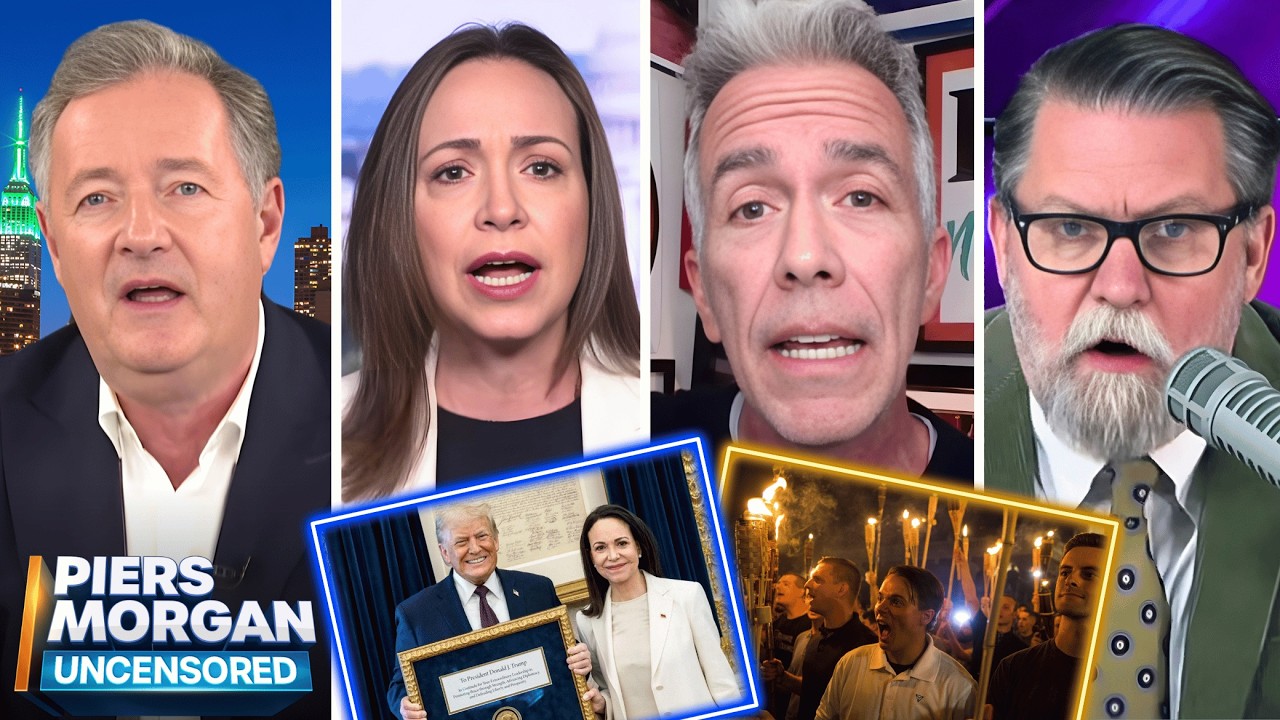
"Fighting Solves EVERYTHING!" Who's To Blame For Political Violence? + Maria Machado On Trump
"This episode dissects the escalating political violence in the US, with panelists fiercely debating the role of partisan rhetoric and media in radicalization, alongside an interview with Venezuelan opposition leader Maria Machado on US intervention and her country's future."

Markets PANIC As Trump Threatens Fed Chair w Prosecution
"Donald Trump's alleged threat to criminally prosecute Fed Chair Jerome Powell over a building renovation project has sent shockwaves through financial markets and ignited a political firestorm over the independence of the Federal Reserve and the Department of Justice."