
Epstein, Atlantis & Ark of the Covenant | Dan Richards
YouTube · 1osA51kvzgg
Quick Read
Summary
Takeaways
- ❖The Giza Plateau's carbon dating suggests pyramids are 150-300 years older than traditional written records, a discrepancy often 'massaged' by Bayesian modeling.
- ❖Archaeology is criticized for prioritizing established narratives over scientific method, akin to 'lamping as scientists.'
- ❖Ghislaine Maxwell's 'TerraMar Foundation' and Jeffrey Epstein's interest in Atlantis point to a desire for autonomous ocean civilizations, possibly linked to ancient history.
- ❖Max's study on Egyptian vases, suggesting modern forgeries, is countered by arguments of selection bias and historical artifact looting.
- ❖'Cocaine mummies' from ancient Egypt (21st dynasty, ~1000 BC) provide strong evidence for pre-Columbian transcontinental contact, often dismissed by mainstream archaeology.
- ❖Jeffrey Drum's 'Land of Chem' theory posits that Egyptian pyramids functioned as chemical manufacturing plants for agriculture and metallurgy, a more 'mundane' yet compelling alternative to 'free energy' theories.
- ❖Muon scans revealing a hidden chamber in the Great Pyramid remain uninvestigated, possibly due to Egyptian authorities prioritizing tourism revenue over discovery.
- ❖The Baghdad Battery may have been an ancient alchemy device for separating precious metals from mine runoff, rather than an electrical power source.
- ❖Widespread evidence of artificially elongated skulls across coastal regions globally suggests suppressed transcontinental contact, with modern maps omitting historical data.
- ❖The simulation of a fruit fly's brain, capable of autonomous behavior in a physics engine, raises profound questions about consciousness and the nature of reality, echoing themes from 'Max Headroom'.
Insights
1Discrepancies in Egyptian Pyramid Dating and Archaeological Dogma
Traditional archaeological dating of the Great Pyramids relies on written records, not carbon dating. However, two independent carbon dating expeditions on the Giza Plateau found the pyramids to be 150-300 years older than the accepted timeline. This discrepancy is often 'massaged' using methods like Bayesian modeling, which eliminates inconvenient data points to fit the established narrative, indicating a prioritization of story over scientific rigor.
Carbon dating results from expeditions financed by the Edgar Cayce Foundation and David Koch, showing pyramids older than written records. Use of Bayesian modeling to 'massage' data by eliminating dates not corresponding to known rulers and favoring recent dates.
2Social Media Algorithms and the Monetization of Conflict
Social media algorithms are designed to incentivize content that generates engagement, often leading creators to produce polarizing or sensational material. This dynamic fuels conflict between opposing viewpoints, such as ancient archaeology skeptics and promoters, because controversy drives clicks and revenue, even at the expense of nuanced discussion or factual accuracy.
Algorithms favor content that generates high views, incentivizing creators to 'hammer' on what works, which is often conflict. Influencers can monetize both followers and 'haters' clicks, leading to a focus on divisive content.
3Epstein, Maxwell, and the Pursuit of Ocean Autonomy
Jeffrey Epstein and Ghislaine Maxwell harbored a deep interest in ancient history, particularly Atlantis, and sought to establish autonomous civilizations in the ocean. Maxwell's 'TerraMar Foundation' aimed to create a seafaring society, even attempting to acquire an abandoned military platform off Spain to form an independent country, highlighting a desire to operate outside conventional laws and governance.
Ghislaine Maxwell's 'TerraMar Foundation' focused on escaping ocean laws and creating a seafaring civilization. She sought an abandoned military platform off Spain for an autonomous country and had a submarine named 'Atlantis.' Her alias 'Janet Atlantis' while in hiding.
4The 'Cocaine Mummies' and Evidence of Pre-Columbian Transcontinental Contact
Svetlana Balabanova's research found traces of cocaine, hashish, and nicotine in ancient Egyptian mummies from the 21st dynasty (~1000 BC). These substances are native to the New World (cocaine from coca leaves, nicotine from tobacco), suggesting transcontinental contact long before Columbus. Mainstream archaeology often dismisses these findings as contamination or outright lies, despite the rigorous cleaning protocols used in the analysis.
Svetlana Balabanova's tests on nine mummies in the Munich Museum, including Henut Taui, revealed cocaine, hashish, and nicotine. Peruvian mummies also show high levels of coca. Debunkers claim contamination despite samples being washed with water and alcohol.
5Pyramids as Ancient Chemical Manufacturing Plants
Jeffrey Drum's 'Land of Chem' theory proposes that pyramids like the Bent, Red, and Step pyramids were not just tombs but sophisticated chemical manufacturing facilities. These structures, utilizing natural resources, extracted and produced chemicals like ammonia and nitrogen for agriculture and metallurgy. The design of the Red Pyramid, for instance, shows striking parallels to Fritz Haber's device for ammonia synthesis.
Jeffrey Drum's 'Land of Chem' theory suggests pyramids manufactured chemicals for agriculture and metallurgy. A replica of the Red Pyramid matched the mechanism of Fritz Haber's device for ammonia creation. Drum has photos of iron veins within pyramid cavities.
6Suppression of Archaeological Discovery for Tourism and Control
Archaeological discoveries, such as a hidden chamber found via muon scans in the Great Pyramid, are often left uninvestigated by authorities like Zahi Hawass (Egypt's Minister of Tourism and Antiquities). The rationale appears to be that preserving the 'mystery' generates more tourism revenue than fully excavating and potentially demystifying a site. Similarly, researchers who publicly share geophysical scan data, like Merlin Burrows regarding the Egyptian Labyrinth, face blacklisting to maintain control over information.
Muon scans revealed a second grand gallery-like chamber in the Great Pyramid, uninvestigated for 8-9 years. Zahi Hawass's statements prioritizing 'quality' tourism and acknowledging that 'New Age people will come' for the mystery. Merlin Burrows' scans of the Labyrinth, showing a 40m metallic object, were kept secret to avoid blacklisting by Hawass, who views public sharing of geophysical results as a 'breach of national security protocol.'
7The Baghdad Battery as an Alchemy Device
The Baghdad Battery, a 2,000-year-old pot containing copper and an iron rod, is often theorized as an ancient electrical battery. However, a more plausible explanation, aligning with historical records of alchemy, is that it was used to separate precious metals. By filling the galvanic cell with acidic mine runoff containing gold and silver, the copper would attract noble metals, effectively 'peeling' gold out and making it 'magically appear' on the copper, while the iron rod corroded.
The Baghdad Battery's components (copper tube, iron rod, potential vinegar residue) form a galvanic cell. If filled with acidic mine runoff, this setup would separate noble metals (gold, silver) onto the copper cathode, while the iron anode corrodes, suggesting an alchemical process.
8The Cover-Up of Elongated Skulls and Transcontinental Contact
Evidence of artificially modified (elongated) craniums is widespread globally, particularly in coastal regions, suggesting ancient transcontinental contact. However, modern archaeological maps omit significant data from historical records, such as thousands of elongated skulls reported by Lewis and Clark in the Pacific Northwest or those in Hawaii. The 'cultural sensitivity' argument used by Western museums to hide these artifacts is questioned, implying a deliberate suppression of information that challenges established narratives of isolated civilizations.
Lewis and Clark reported a grave site with 3,000 above-ground elongated skulls in the Pacific Northwest. 8.6% of ancient Hawaiian skulls were artificially modified. Modern maps of modified cranium distribution omit Pacific islands, parts of the US, and Asia. Rockefeller cherry-picked the 'best' elongated skulls from Paracas, which are now untraceable. Museums cite 'cultural sensitivity' for not displaying or documenting these skulls.
Bottom Line
The discovery of Xenon 129, an isotope found at nuclear test sites on Earth, in Mars' atmosphere could suggest an ancient nuclear event or war on Mars, challenging conventional understandings of extraterrestrial history.
This finding, if interpreted as evidence of a past nuclear event, would drastically alter our perception of life and civilization beyond Earth, implying advanced, self-destructive societies could have existed in our solar system.
Further research into Mars' atmospheric composition and geological history, specifically targeting isotopes linked to nuclear reactions, could provide groundbreaking insights into the potential for ancient extraterrestrial civilizations and their fate.
The ability to simulate a fruit fly's entire brain in a physics engine, allowing it to exhibit autonomous, 'alive' behavior, suggests that consciousness and complex behavior might be reducible to a complete wiring diagram (connectome).
This breakthrough blurs the lines between biological and artificial life, raising profound philosophical questions about the nature of consciousness, free will, and the potential for advanced AI to replicate or even surpass biological intelligence.
Accelerated research into human connectomes and advanced neural simulations could lead to breakthroughs in understanding and treating neurological disorders, developing truly intelligent AI, or even creating digital consciousness, with ethical implications requiring urgent consideration.
Key Concepts
The Pendulum Swing of Belief
People often overcorrect in their beliefs, swinging from one extreme to another without settling in a balanced middle ground. This is seen when individuals initially embrace fantastical theories and then, upon realizing their flaws, completely reject all related concepts, even those with merit.
Cultural Lens Interpretation
Ancient myths and historical accounts, like the story of Atlantis or flood narratives, are often interpreted through the cultural lens of the society retelling them. This means details are added or altered to align with contemporary values, beliefs, and societal structures, making it difficult to extract the original core event.
Denial of Mystery
The deliberate refusal to acknowledge or investigate unexplained phenomena, often driven by ego, academic dogma, or financial interests. This 'denial of mystery' acts as a significant blocker to scientific advancement and understanding, as it prevents inquiry into potentially groundbreaking discoveries.
Lessons
- Question narratives, especially those presented by 'experts' or mainstream media, by seeking out original sources and diverse perspectives, recognizing how ego and financial incentives can distort information.
- Cultivate open-minded skepticism, distinguishing it from cynicism. Be open to mysteries and anomalies, as the 'denial of mystery' can be the biggest blocker to new knowledge and scientific advancement.
- Support interdisciplinary research and communication. Actively seek out information that bridges different fields (e.g., archaeology and astronomy) to gain a more holistic understanding of complex topics.
Notable Moments
Carl Sagan's alleged involvement with the NSA, as observed by a podcast guest at an NSA meeting, suggests a deeper, potentially classified, connection between prominent public scientists and national security interests.
This anecdote highlights the potential for government influence or co-option of scientific figures, raising questions about the independence and transparency of scientific communication, especially on sensitive topics like extraterrestrial life.
The successful simulation of a fruit fly's entire brain in a physics engine, enabling it to exhibit autonomous, 'alive' behaviors like walking and cleaning itself, marks a significant leap in understanding consciousness and AI.
This achievement demonstrates that complex biological functions can be replicated digitally, challenging our understanding of life and intelligence. It also raises concerns about the rapid advancement of AI and its potential implications, echoing dystopian themes from science fiction.
Quotes
"Most people can't tell the difference between different sciences. They just think all scientists are boneheads."
"There's a certain cross-section of humanity that's just not going to go with science. They're going to have faith in something. And this is their this you can't change this. This is a genetic thing in my opinion."
"It's pretty rare to find somebody who is really proficient and dialed in what their profession is or what their area of research is, and also, at the same time, be a really good communicator."
"If your job is to go out and I say, 'I'm giving you the straight facts.' And you get everything wrong, you need to at least come out and tell your audience, 'Hey, man, I got some [expletive] wrong there, bro.'"
"You want to say that commerce and science are two different things, but that's not true. They're [expletive] so intertwined. It's not even funny. Every aspect of science is intertwined with money."
"If we say that God did it, you're worthless to me in the lab. And it's like, well, I'll take a step further, buddy. The minute you say that science is settled, the minute you say we know, you're worthless in the lab."
Q&A
Recent Questions
Related Episodes

Crooners Welcome | This Past Weekend w/ Theo Von #664
"Theo Von shares raw, unfiltered opinions on life's 'greasy' moments, from his unexpected Stagecoach performance as a 'crooner' to his strong stance against AI data centers and candid advice on relationships and fatherhood."

OCCUPY BAAL STREET: Iran, Albania, And The TPUSA Takeover. | Ep 347
"Candace Owens exposes alleged globalist plots, linking Ivanka Trump's Albanian island 'discovery' to Rothschild family control of strategic waterways and accusing US foreign policy of serving these interests, while also scrutinizing Turning Point USA's handling of Charlie Kirk's succession."
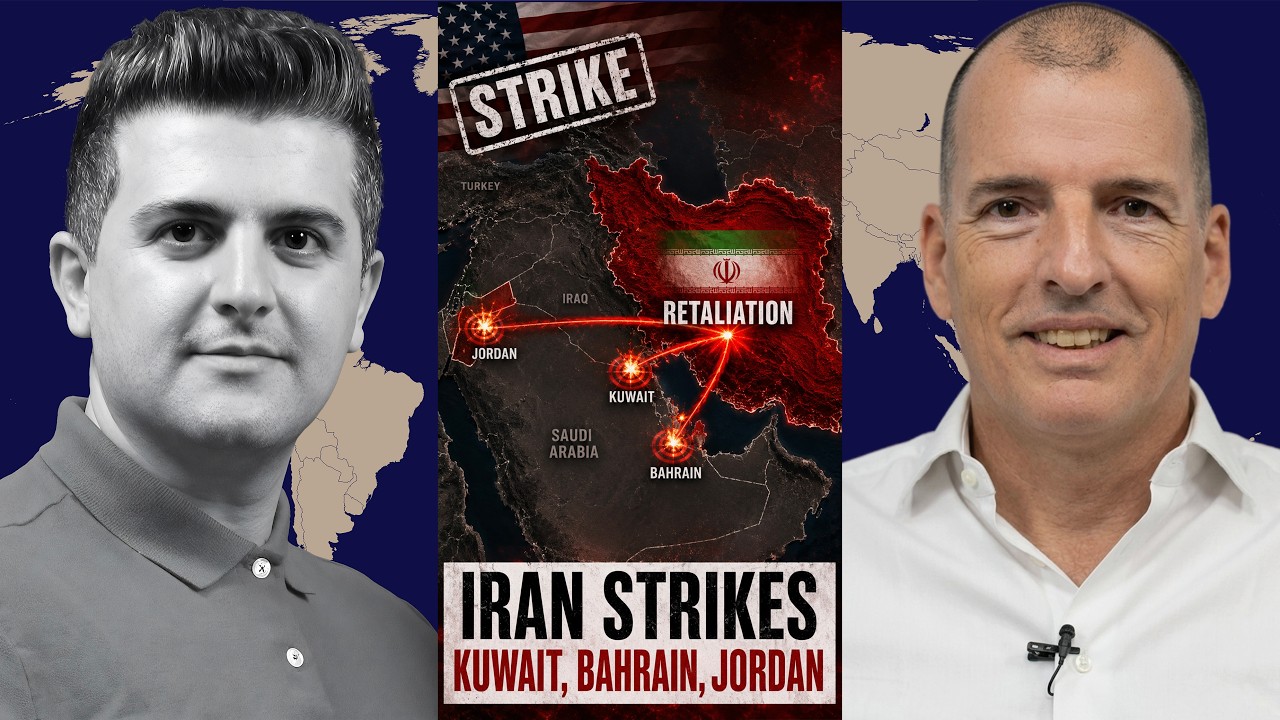
Alex Krainer: US STRIKES Iran – Iran RETALIATES Against Kuwait, Bahrain & Jordan!
"Amidst escalating US-Iran conflict and Iranian retaliation against regional US allies, this episode argues that US foreign policy is deeply controlled by an 'Anglo-Zionist conspiracy' led by the Rothschild banking dynasty, prioritizing Israeli interests over American ones."
Tim Almost Strokes Out Hearing That Big Tech STILL Likes Trump (Jason Calacanis) | Bulwark Podcast
"Silicon Valley's elite, driven by pragmatic business interests like low taxes and M&A, continue to support Donald Trump despite his erratic behavior, viewing tariffs as inconsequential and access to power as paramount."