
Richard D. Wolff & Michael Hudson: The EU Just Crossed the Line — There’s No Coming Back
YouTube · 2nuSEy9GjIM
Quick Read
Summary
Takeaways
- ❖French President Macron faces widespread public alienation due to attacks on France's robust social welfare system and his support for Ukraine.
- ❖The EU's attempt to seize 200-300 billion euros of Russian assets failed due to internal dissent, particularly from Belgium, Czech Republic, and others.
- ❖This failure, combined with the seizure of interest on Russian assets, signaled to global central banks that Western currencies are vulnerable to weaponization.
- ❖Central banks are diversifying holdings into gold, silver, and non-Western currencies (e.g., Chinese Yuan, Japanese Yen) as a direct consequence.
- ❖The US strategy, under the guise of 'Cold War' rhetoric, aims to isolate Europe from rapidly growing Asian markets (China, Russia) and force European de-industrialization.
- ❖European industries face higher energy costs and US tariffs, incentivizing relocation to the US, but this is proving difficult due to high US costs and labor issues.
- ❖Europe's current conservative governments are vulnerable to left-wing parties and labor movements as they cut social spending to fund the Ukraine conflict.
- ❖Russia's counter-threat to seize Western assets and sue in international courts deterred the full seizure of its principal assets.
- ❖The 'dialectic of colonialism' has made Western economies dependent on the very globalized system they created, now vulnerable to counter-actions from non-Western powers.
- ❖The US economy is characterized by financialization and high costs (housing, medical), making it an unattractive relocation destination for European industries despite political pressure.
Insights
1Macron's Alienation and the Erosion of French Social Welfare
French President Macron faces unprecedented public alienation due to his persistent efforts to undermine and reduce France's highly developed social welfare system. This includes attacks on five weeks of paid vacation, free university, universal medical insurance from birth to death, and public daycare. These services, established for decades, are now seen as under threat, fueling widespread discontent and protests.
Richard Wolff, having recently visited France, observed 'eager excitement for him to be gone from the scene' and widespread mockery. He detailed Macron's repeated attempts to 'undermine, reduce, attack the social welfare system of France,' citing examples like the five weeks of paid vacation, free university, and universal medical coverage. (, , )
2Failure to Seize Russian Assets Undermines Western Financial Credibility
The European Union's attempt to seize 200-300 billion euros of Russian assets to fund Ukraine failed due to a lack of unanimous consent from member states like Belgium and the Czech Republic. This failure, following the earlier seizure of interest on these assets, demonstrated the vulnerability of Western financial systems to weaponization, causing global central banks to lose trust in the Euro and Dollar as safe reserve currencies.
Wolff states that Macron and Germany's Mertz decided to 'put the inviability of private property out the window and to go after the Russian money.' He explains that Belgium and other countries 'publicly refused to go along with what would have to be a unanimous decision.' The defeat in seizing assets had 'enormous historical significance' because 'every central bank in the world watched this theater' and now knows their money 'may be weaponized against you.' (, , )
3Global Diversification Away from Euro and Dollar Accelerates
As a direct consequence of the perceived weaponization of Western currencies, central banks globally are actively diversifying their holdings. This shift involves moving away from the Euro and US Dollar and increasing investments in alternative currencies like the Japanese Yen and Chinese Yuan, as well as physical assets such as gold and silver.
Wolff notes that 'the central banks of the world are going to continue to diversify out of the euro, out of the dollar.' He points to the 'spectacular rise in the value of gold and silver over the last year, which is where the central banks are moving their holdings to.' (, )
4US Strategy to De-industrialize Europe and Redirect Industry
Michael Hudson argues that the US has implemented a 'one-two punch' strategy against Europe. First, it isolated European allies from rapidly growing Asian markets (Russia, China) under the ideological umbrella of the Cold War. Second, it imposed tariffs and demanded 'givebacks,' forcing European industries to consider relocating to the United States, thereby de-industrializing Europe and boosting US manufacturing.
Hudson explains the US strategy: 'The first punch was to isolate Europe... from trading with the most rapidly growing parts of the world economy, which are China and East Asia.' He adds that Trump then said, 'Now I'm going to pass my April 2nd Liberation Day tariffs and cut off all your trade with the United States' unless Europe agrees to 'deindustrialize your economy because now that I've closed the US market to you... you have to relocate your major industries to the United States.' (, , )
5The 'Dialectic of Colonialism' and Western Self-Inflicted Decline
The speakers apply a Hegelian concept, suggesting that the very global economy created by Western colonialism has now made the West dependent on its former dependents. This dynamic means that actions taken by Western powers (like seizing assets) can now trigger counter-actions from non-Western allies or adversaries, leading to a 'biting back' effect that undermines Western dominance and accelerates its decline.
Wolff states, 'the dialectic of creating a world economy comes back to bite the United States and Western Europe right in the rear end.' He elaborates, 'you become dependent on those you made dependent on you... the master becomes dependent on the relationship to the slave.' He concludes that 'the days of the European center of the world are over' and this extends to 'where the Europeans settled. North America, Australia, New Zealand.' (, , )
Bottom Line
Chinese electric vehicles (BYD cars and trucks) are visibly entering the French market, signaling a shift in automotive dominance that is not mirrored in the US.
This indicates Europe's increasing economic ties and openness to non-Western industrial products, contrasting with US protectionism. It highlights a potential future where European consumers and markets are increasingly served by Asian manufacturers.
Companies looking to expand in Europe should monitor the penetration of Chinese brands and consider partnerships or competitive strategies that acknowledge this growing market presence, especially in sectors like EVs.
The 'spectacular rise in the value of gold and silver over the last year' is attributed to central banks diversifying their holdings away from the Euro and Dollar.
This trend suggests a fundamental loss of confidence in fiat currencies tied to Western geopolitical actions. It indicates a strategic move by nations to secure wealth in tangible, politically neutral assets.
Investors and financial institutions should consider increasing their exposure to precious metals as a hedge against currency instability and geopolitical risk, reflecting a broader shift in global monetary policy.
Key Concepts
Weaponization of Finance
The concept that financial assets, currencies, and banking systems can be used as tools of geopolitical leverage and warfare, as demonstrated by the EU's attempt to seize Russian assets and its impact on global trust in the Euro and Dollar.
Dialectic of Dependence (Hegelian Master-Slave Dialectic)
Derived from Hegel, this model suggests that in a relationship of dependence (e.g., colonizer-colonized, master-slave), the 'master' (Western powers) eventually becomes dependent on the 'slave' (the globalized economy they created), leading to a reversal of power dynamics and vulnerability to counter-actions.
De-industrialization by Geopolitical Design
The idea that a powerful nation (US) can strategically engineer the decline of industrial capacity in allied nations (Europe) by manipulating trade, energy prices, and geopolitical alliances, to its own economic benefit.
Lessons
- Re-evaluate reliance on Western-dominated financial systems and consider diversifying currency holdings to include non-Western options or physical assets like gold.
- Assess supply chain vulnerabilities related to geopolitical tensions and US/EU trade policies, exploring diversification towards non-Western markets and production hubs.
- Monitor social and political unrest in Europe closely, as government austerity measures and declining social welfare could lead to significant market disruptions and policy shifts.
Quotes
"Every central bank knows that if you keep money in Europe... that money may be weaponized against you in the manner that the Europeans, unlike anyone else, seriously tried to do."
"The one thing worse for Europe than making the effort to do that was failing in the effort to do that because that got them all the negatives... with no positives."
"The United States strategy of restoring its former power over the world's trade and financial system is all based on the ideological umbrella of the Cold War."
"The dialectic of creating a world economy comes back to bite the United States and Western Europe right in the rear end."
"What's over in the United States and in Europe is industrial capitalism. In America, that's already evolved into finance capitalism."
Q&A
Recent Questions
Related Episodes
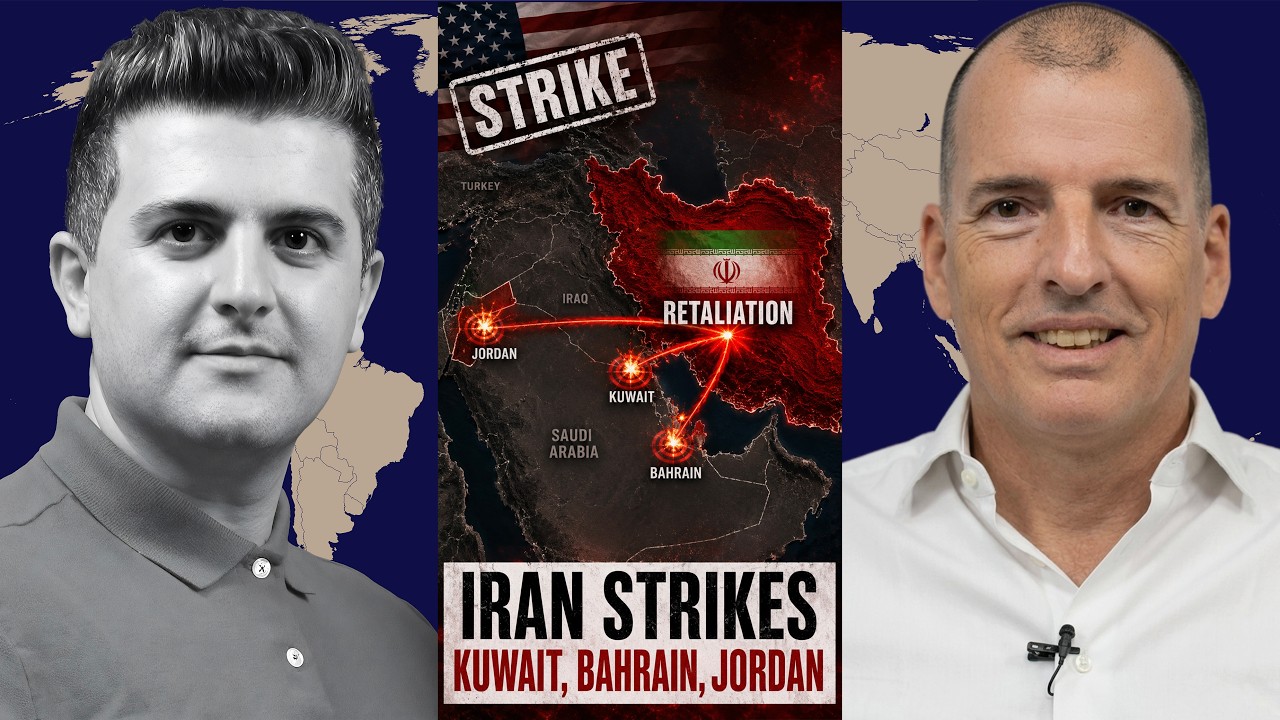
Alex Krainer: US STRIKES Iran – Iran RETALIATES Against Kuwait, Bahrain & Jordan!
"Amidst escalating US-Iran conflict and Iranian retaliation against regional US allies, this episode argues that US foreign policy is deeply controlled by an 'Anglo-Zionist conspiracy' led by the Rothschild banking dynasty, prioritizing Israeli interests over American ones."

🚨 LEFTISTS ARE F*CKING SEETHING 😂😂😂
"The host aggressively celebrates perceived 'wins' for the right-wing, from global conflicts and domestic politics to cultural shifts, framing them as a 'humiliation' for the 'leftist world order' and a testament to Donald Trump's influence."

Iran Update: Israel’s Newest Bombing Campaign, the Oncoming War With China and How to Avoid It
"Colonel Wilerson reveals how the US and Israel are actively bombing China's strategic infrastructure in Iran, escalating a covert economic war that Beijing intends to win without direct military conflict by dismantling the dollar's global dominance."

Patrick Henningsen: Hezbollah JUST Fired Back at Israel - Iran Vows to “Crush” All Attacks
"Patrick Henningsen argues that the US and Israel initiated an illegal war against Iran, driven by Trump's incompetence and Israeli influence, leading to an inevitable escalation with severe global economic repercussions."