SAVE Act Vote Threatens Voting Rights. Bondi Deflects on Epstein. Black Unemployment Still Higher
YouTube · 3JOA6aBmO7U
Quick Read
Summary
Takeaways
- ❖The proposed SAVE Act mandates passports or birth certificates for voting, effectively disenfranchising millions, particularly women and rural residents.
- ❖The Trump administration's economic reporting is criticized for downplaying low job growth and persistent high Black unemployment, focusing instead on stock market gains.
- ❖Attorney General Pam Bondi's testimony before the House Oversight Committee is characterized as evasive, deflecting questions about the President's ties to Jeffrey Epstein and the gutting of DOJ divisions.
- ❖Black civil rights leaders and the Congressional Black Caucus are urged to shift from press conferences to localized, sustained voter education and mobilization.
- ❖A 'build and battle' strategy is advocated for Black communities, focusing on developing political power and actively combating voter suppression at the local level.
- ❖White evangelical support for Donald Trump is contrasted sharply with Black Protestant views, with the former's agenda labeled as 'anti-Jesus' by the host.
Insights
1The SAVE Act as a Voter Suppression Tactic
Republicans are advancing the SAVE Act in the U.S. House, which would require proof of U.S. citizenship (passport or birth certificate in person) to vote. This measure is framed as a modern-day poll tax, designed to limit voting access. Over 140 million Americans lack a passport, and 69 million married women lack a birth certificate with their current legal name, creating significant barriers.
The bill mandates presenting a passport or birth certificate in person; 140 million Americans lack passports, and 69 million married women lack updated birth certificates. Virginia Congressman Jennifer McClellan and host Roland Martin explicitly call it a 'modern-day poll tax.'
2Economic Data Manipulation and Disparate Impact
The administration's jobs report for January showed an increase of 130,000 jobs, but revisions revealed only 15,000 jobs created monthly on average last year, totaling 180,000 for the entire year. This low growth is primarily in health and social services, not manufacturing, and the Black unemployment rate remains significantly higher at 7.2% (7.3% for Black men) compared to the overall 4.3%. The administration is accused of 'marketing mode' to spin negative economic realities.
Morgan Harper, Director of Policy and Advocacy at the American Economic Liberties Project, details the downgrade of 2024 job creation to 15,000 jobs/month average. Roland Martin cites the overall unemployment at 4.3% and Black unemployment at 7.2% (7.3% for Black men).
3Pam Bondi's Evasive Congressional Testimony
Attorney General Pam Bondi's testimony before the House Oversight Committee was marked by evasiveness, deflecting questions about the President's alleged connections to Jeffrey Epstein, the hiring of a January 6th participant (Jared Weise), and the gutting of the Public Integrity Section. Congresswoman Jasmine Crockett accused Bondi of prioritizing 'obstruction over justice' and 'fealty to the president over loyalty to the constitution,' while Congressman Jon Gates highlighted the hiring of a pardoned January 6th rioter who yelled 'kill him' at police.
Congresswoman Jasmine Crockett's exchange with Bondi, citing 38,000 references to Trump in Epstein files and accusations of protecting pedophiles. Congressman Jon Gates's questioning about Jared Weise, a pardoned January 6th participant, now working for the DOJ, and the reduction of the Public Integrity Section from 35 to 2 people.
4Need for Localized Voter Mobilization in Black Communities
The Congressional Black Caucus's press conference on Trump's policies is criticized as 'performance' without a clear action plan. Host Roland Martin and guests advocate for a shift from national conferences to sustained, micro-targeted voter education and mobilization at the local level. They urge Black fraternal organizations, churches, and civic groups to lead town halls, connect policy to voting impact, and organize door-to-door efforts and transportation to polls, focusing on specific precincts and elections.
Roland Martin's critique of the CBC's news conference and call for D9 organizations, Prince Hall Masons, and churches to lead local discussions and public policy programs. Reverend Dr. Frederick D. Haynes III describes his church's 'teach-in' with QR codes for voter registration and plans for 'freedom summer.'
5Strategic 'Build and Battle' Approach to Political Power
Reverend Dr. Frederick D. Haynes III, drawing on the Nehemiah metaphor, emphasizes the need for Black communities to simultaneously 'build' political power and community infrastructure while 'battling' against voter suppression and unjust policies. This involves long-term strategic planning beyond single election cycles, targeting specific local, county, and state seats, and grooming accountable leadership.
Reverend Dr. Frederick D. Haynes III's 'build and battle' metaphor, stating, 'We need to be planning to build our communities, build political power... and at the same time, we need to battle against voter suppression.' He also mentions planning for 2027, 2028, 2029, and 2030.
6Disparity in Christian Views on Trump
A Pew study reveals that white evangelicals remain among Donald Trump's strongest supporters, with a majority backing his plans and policies, despite a slight dip in confidence in his ethics. In stark contrast, only 7% of Black Protestants express confidence in Trump's ethical conduct. The host argues that white evangelicals are voting for an 'anti-Jesus agenda,' driven by a 'slaveholders religion' rather than biblical lines, which Black people recognize as attacks on civil rights, economic empowerment, and the poor.
Pew study data: 40% of white evangelicals are 'extremely or very confident' in Trump's ethics, compared to 7% of Black Protestants. Roland Martin's response to Eric Ericson's tweet, stating nonwhite Christians vote Democrat due to 'present day heinous policies of the GOP as well as the hypocrisy of white evangelicals.'
Bottom Line
Republican efforts to suppress votes, such as the SAVE Act, are interpreted as a sign of their fear of losing elections, indicating a lack of confidence in winning through traditional campaigning or policy appeal.
This suggests that aggressive voter restriction tactics are a defensive measure, implying that increased voter turnout, even under challenging conditions, could overcome these efforts.
Activists and political strategists can frame voter suppression as a sign of weakness, using it to motivate greater engagement and turnout among targeted demographics, rather than allowing it to discourage them.
The Democratic Party, including the Congressional Black Caucus, is criticized for engaging in 'performance' (e.g., press conferences) rather than developing and executing concrete, localized action plans.
This 'performance' approach fails to resonate with the average citizen and does not effectively mobilize the base, leading to missed opportunities for political power building.
Democratic leaders and allied organizations should shift resources and focus towards sustained, micro-targeted community engagement, education, and direct voter mobilization, leveraging existing local infrastructures like churches and fraternal organizations.
The current configuration of the U.S. Congress is attributed to only 7,000 votes out of 90 million non-voters, highlighting the disproportionate impact of low turnout.
This statistic underscores that even small shifts in voter engagement can have massive national political consequences, making every vote and every mobilization effort critically important.
Messaging should emphasize the tangible, outsized impact of individual votes and localized mobilization efforts, directly linking turnout to specific policy outcomes and legislative control.
Key Concepts
Build and Battle
Derived from the biblical story of Nehemiah, this model suggests that effective social and political change requires simultaneously building community power and infrastructure (e.g., voter education, local organizing) while actively battling against opposing forces and systemic injustices (e.g., voter suppression, corrupt policies). It emphasizes proactive development alongside defensive action.
Vision over Resistance
This model argues that while resistance to unjust policies is necessary, sustained mobilization and engagement are better driven by a clear, positive vision for the future rather than solely by a litany of grievances or opposition to an adversary. People are more likely to 'run with vision' and purpose, which provides enduring motivation.
Lessons
- Identify your state's primary election dates and voter registration deadlines, then actively inform and mobilize your local community to participate.
- Leverage existing community organizations (churches, fraternal groups, civic associations) to host regular town halls and educational sessions on local, state, and national policy issues, connecting them directly to voting impact.
- Implement micro-targeted voter mobilization strategies in your precinct or neighborhood, including door-to-door canvassing, providing transportation to polls, and educating voters on specific voting locations and early voting options.
Community-Led Voter Mobilization: The 'Build and Battle' Strategy
**Educate and Inform Locally:** Organize regular town halls and teach-ins within churches, D9 chapters, and other community groups. Simplify complex policy issues ('City Hall 101,' 'County Government 101') and clearly connect voting to public policy outcomes. Utilize social media and local networks to disseminate information.
**Micro-Target and Activate:** Focus on specific precincts and districts. Churches can pull voter data for their precinct, identify registered voters, and track turnout. Organize door-to-door campaigns within these targeted areas, without waiting for permission from political campaigns.
**Facilitate Access and Turnout:** Provide practical support for voting, such as organizing carpools and vans to polling locations, especially during early voting and on election day. Ensure voters know their assigned polling sites and available options (e.g., early voting vs. election day specific sites).
**Plan Strategically and Long-Term:** Think beyond the immediate election cycle. Identify specific seats (school board, DA, mayor, state legislature, Congress) to target for future elections. Groom and grow leadership accountable to the community. Develop a clear vision for policy changes you want to achieve, rather than just resisting current policies.
Notable Moments
Congresswoman Jennifer McClellan's floor speech detailing historical voter suppression tactics, including literacy tests and poll taxes, and equating the SAVE Act to a modern-day poll tax.
This moment powerfully connects current legislative efforts to a painful history of disenfranchisement, highlighting the systemic nature of voter suppression and its disproportionate impact on Black communities.
Cody D's personal anecdote about changing her last name after marriage and her agreement with her husband to leave the country if the SAVE Act passes, which she learned about two years prior.
This illustrates the severe personal impact and fear that proposed voter suppression laws can instill, demonstrating a deep concern for the future of democratic participation and personal rights.
Pastor Josh Carson's sermon clip denouncing racism within Christianity and challenging white conservative evangelicals to reconcile their faith with their political support for discriminatory policies.
This provides a rare public example of a white pastor directly confronting racism and hypocrisy within the white evangelical community, offering a counter-narrative to the prevailing political alignment of that demographic.
Quotes
"The Save Act is a modern-day poll tax because every ID that you would have to use to register and to vote with, maybe one exception, cost money."
"Donald Trump once asked Black America the question, 'What the hell do you have to lose?' The answer is everything under his administration."
"Voter suppression is not about big chops of chopping out big swaps of the voting populace, right? It's about scalping and cutting out the margins. It's about a couple percentage points here, couple percentage points there."
"If you only are listing out and rehearsing your grievances but not laying out for people a vision, vision is what people have to run with."
Q&A
Recent Questions
Related Episodes
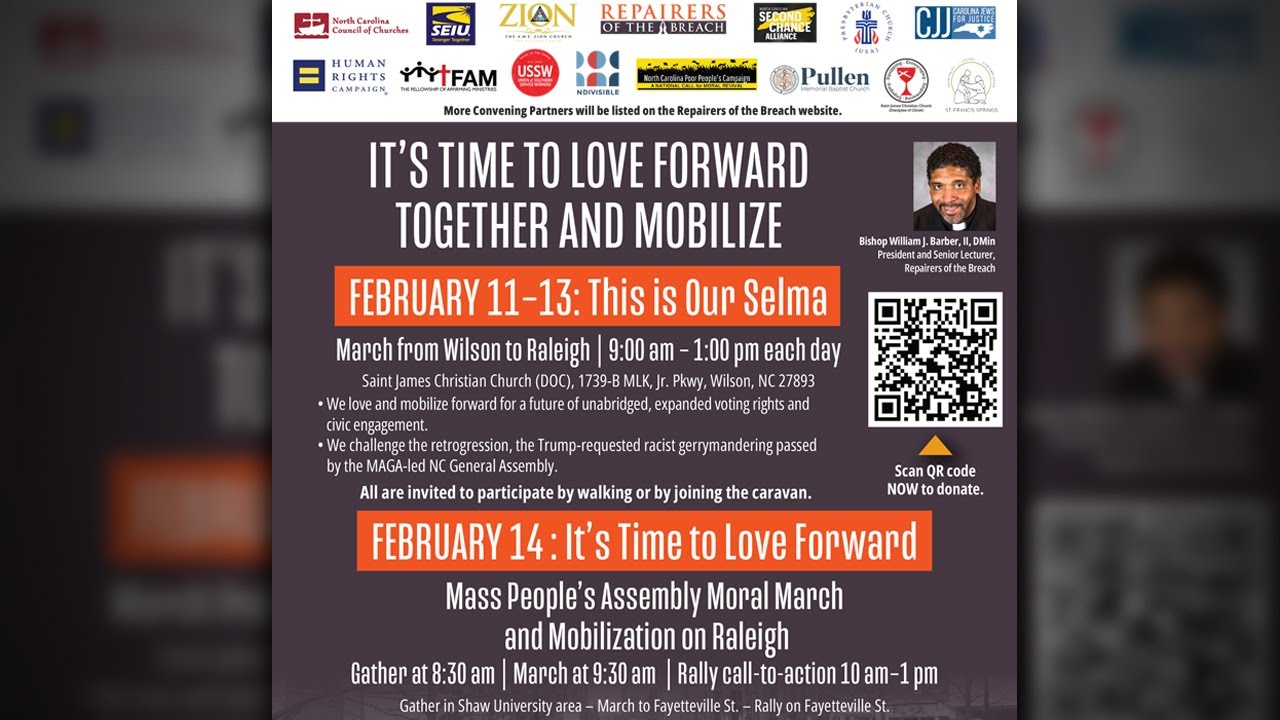
Love Forward Together Mass People’s Assembly & Moral March Mobilization | Day 2
"This episode documents Day 2 of the 'Love Forward Together' march in rural North Carolina, a mobilization against voter disenfranchisement and redistricting, emphasizing community unity and persistent activism."

🚨 Michael Wolff BREAKS HIS SILENCE on New EPSTEIN DEPOSITIONS
"Michael Wolff reveals how Bill Clinton's testimony directly contradicts Donald Trump's account of his split with Jeffrey Epstein, exposing potential money laundering and Melania Trump's deep connections to Epstein's circle."

Trump RUSHES Election Scheme as Midterms HAUNT HIM
"The hosts and guest expose the SAVE Act as a deceptive voter suppression tactic, drawing a stark contrast between the protection of gun rights and the erosion of voting rights."

Fulton Calls FBI Search Intimidation. Haitian TPS Ending. Sonya Massey Killer Sentenced.
"Fulton County officials frame an FBI search of their election center as an intimidation tactic, while Haitian TPS holders face imminent deportation, and a former Illinois deputy receives a 20-year sentence for Sonia Massie's murder, all against a backdrop of critical commentary on the Trump administration's economic and immigration policies."