
PBS News Hour full episode, May 21, 2026
YouTube · 5NwvQsyn7EY
Quick Read
Summary
Takeaways
- ❖Congressional Republicans broke with President Trump over his requests for a White House ballroom and a $1.77 billion 'anti-weaponization fund,' derailing the Secure America Act.
- ❖New Mexico's new law prohibits armed federal personnel, including ICE and National Guard, from polling places, with civil and criminal penalties for interference.
- ❖The Democratic Party's 2024 election autopsy report was released with DNC Chair Ken Martin rejecting its findings, citing issues like 'negative partisanship' and failure to position Kamala Harris for success.
- ❖Latvia's Foreign Minister Baiba Braze confirmed Ukrainian drones, misdirected by Russian electronic warfare, have entered Baltic airspace, but denied Russian claims of Latvia aiding Ukrainian attacks.
- ❖Stanford freshman Theo Baker's investigation into research misconduct led to the resignation of university President Marc Tessier-Lavigne, detailed in his book 'How to Rule the World.'
- ❖The cancellation of 'The Late Show With Stephen Colbert' by CBS, officially for financial reasons, is widely believed to be influenced by political pressure from President Trump.
Insights
1Republican Defiance on Presidential Funding
A significant number of Senate Republicans openly opposed President Trump's requests for funding a White House ballroom and a controversial $1.77 billion 'anti-weaponization fund' intended to compensate those 'politically prosecuted.' This opposition, fueled by concerns over the fund's scope (potentially including January 6 rioters) and transparency (a one-page bullet point document from the Acting Attorney General), led to the temporary collapse of the Secure America Act, a bill primarily funding ICE and CBP.
Lisa Desjardins reported that 'Republican senators en masse pushed back at the White House today, saying, at least for now, President Trump's request for funding have gone too far.' The $1.77 billion settlement was to 'establish a so-called weaponization fund to compensate those thought to be politically prosecuted.' Senator Tuberville of Alabama publicly stated that 'many January 6 defendants should be compensated.'
2States Counter Federal Election Interference
New Mexico enacted a pioneering law, Senate Bill 264, that prohibits armed federal personnel, including ICE and the National Guard, from interfering in the election process near polling places. This legislation establishes civil and criminal penalties, including a fourth-degree felony for federal agents or their superiors who violate the ban. The law was a direct response to President Trump's statements about potentially deploying federal forces to ensure 'honest elections' and concerns about voter intimidation.
New Mexico Secretary of State Maggie Toulouse Oliver stated, 'neither the National Guard nor ICE nor any federal entity has a role in the election process or a responsibility or the power to interfere.' She added, 'it will be a fourth-degree felony if either an agent of a federal agency like ICE or a superior who orders them under color of law to interfere with the election process.'
3Stanford's Entanglement with Silicon Valley and Academic Integrity
Theo Baker's book, 'How to Rule the World,' exposes how Stanford University is deeply intertwined with Silicon Valley, creating a culture where venture capitalists aggressively 'talent spot' students for start-up ideas. This environment, while fostering innovation, also 'inculcates a series of deceptive and fraudulent business practices.' Baker's own reporting as a freshman uncovered research misconduct by then-Stanford President Marc Tessier-Lavigne, leading to his resignation, despite initial attempts to deter the investigation.
Theo Baker described V.C.s 'flooding the campus, trying to pour money and time and resources into some of these students.' He noted, 'Stanford is so much more entangled with Silicon Valley... Stanford even has its own V.C. fund to seed students' new companies.' His investigation 'uncovering research misconduct in scientific papers that were co-authored by the powerful Stanford president, Marc Tessier-Lavigne,' ultimately led to his ousting.
4Democratic Party's Post-Election Reckoning
The Democratic National Committee's controversial autopsy report on its 2024 election defeat was released, with DNC Chair Ken Martin disavowing its findings. The report criticized Joe Biden's team for failing to position Kamala Harris for success and Democrats for relying too heavily on 'negative partisanship' (asking voters to fear Republicans rather than believe in Democrats). Notable omissions included President Biden's age and the war in Gaza, which strategist Faiz Shakir attributed to 'the influence of money' purchasing silence.
DNC Chair Ken Martin stated, 'I am not proud of this product. It does not meet my standards and it won't meet your standards.' The report 'blames Joe Biden's political team for not positioning Kamala Harris for success' and 'does not mention Mr. Biden's age or the war in Gaza.' Faiz Shakir commented, 'Money is buying, purchasing silence.'
5Political Pressure on Late-Night Comedy
The cancellation of 'The Late Show With Stephen Colbert' by CBS, officially cited as a financial decision, is widely perceived to be influenced by political pressure from President Trump. Trump had publicly criticized Colbert, and the cancellation occurred as CBS parent company Paramount sought government approval for a merger. This event, alongside similar pressures faced by Jimmy Kimmel, raises questions about the extent of political intervention in television programming and the future of politically charged comedy.
CBS announced 'The Late Show''s cancellation last July, 'insisting it was a purely financial decision.' However, 'many believed politics was at play' due to 'Colbert's regular roasts [drawing] the ire of President Trump,' who posted that Colbert was 'a pathetic train wreck.' Comedian Larry Wilmore noted, 'We have never had TV shows kind of be determined by the direct political intervention of the president.'
Lessons
- Citizens concerned about election integrity should research and support state-level legislation that protects polling places from unauthorized armed federal presence, similar to New Mexico's Senate Bill 264.
- Academic institutions should implement robust, independent oversight mechanisms for research integrity and transparency, ensuring that powerful figures are not immune to scrutiny, as demonstrated by the Stanford investigation.
- Political parties should critically assess their campaign strategies, moving beyond 'negative partisanship' to articulate clear, positive visions and policy agendas that resonate with a broad electorate, particularly working-class voters.
Notable Moments
Senate Republicans' unified pushback against President Trump's funding requests, particularly for the 'anti-weaponization fund,' leading to a legislative stalemate.
This signals a significant internal division within the Republican party and a willingness of some members to defy the President on controversial spending, impacting key legislative priorities like border security funding.
New Mexico's Secretary of State Maggie Toulouse Oliver detailing the state's new law that imposes civil and criminal penalties on federal agents who interfere with elections.
This establishes a legal precedent for states to actively counter perceived federal overreach and voter intimidation tactics, potentially influencing other states to adopt similar measures to protect election integrity.
Stanford student Theo Baker's account of uncovering research misconduct by the university president as a freshman reporter, leading to the president's resignation.
It highlights the power of investigative journalism, even by student reporters, to hold powerful institutions and individuals accountable, and exposes the ethical challenges within elite academic and tech ecosystems.
The DNC's 2024 election autopsy report being released with its own chairman, Ken Martin, disavowing its findings and criticizing its incompleteness and lack of verification.
This indicates deep internal disarray and an unwillingness within the Democratic Party to fully confront and transparently address the root causes of their electoral defeat, potentially hindering future strategic adjustments.
The cancellation of 'The Late Show With Stephen Colbert' and the widespread belief that political pressure from President Trump, rather than solely financial reasons, was a significant factor.
This raises serious concerns about the erosion of media independence and the potential for executive influence to silence critical voices in entertainment, impacting the landscape of political satire and public discourse.
Quotes
"Neither the National Guard nor ICE nor any federal entity has a role in the election process."
"Republican senators en masse pushed back at the White House today, saying, at least for now, President Trump's request for funding have gone too far."
"Literally tens of millions of Americans are subject to unlawful targeting."
"Democrats in the deep state, they hated Donald Trump so much that they orchestrated a coup against our government."
"We're doing it. It's -- the land is owned by Secretary -- by the Interior Department. We don't need anything from Congress."
"I am not proud of this product. It does not meet my standards and it won't meet your standards."
"Money is buying, purchasing silence. We're not even discussing the fact that 75 percent of Democrats say they want to oppose military aid to Netanyahu."
"If it was not for Russia's wars -- war against Ukraine, these incidents wouldn't happen. So it's Russia's fault."
"The truth is, none of NATO's countries has the battlefield like Ukraine has. And so we have to make sure that our transformation is faster, that it's massive, that we have all what is necessary to defend, but also to be ready."
"We have never had TV shows kind of be determined by the direct political intervention of the president."
Q&A
Recent Questions
Related Episodes

LIVE: Trump HIDES FROM PUBLIC as US SOLDIER KILLED!!! 6/2/2026
"The host exposes alleged government cover-ups regarding military casualties, Trump's unexplained public absence, and questionable political appointments, arguing these reflect a 'regime of loser babies' and a failing foreign policy."

🚨 LEFTISTS ARE F*CKING SEETHING 😂😂😂
"The host aggressively celebrates perceived 'wins' for the right-wing, from global conflicts and domestic politics to cultural shifts, framing them as a 'humiliation' for the 'leftist world order' and a testament to Donald Trump's influence."

"CATASTROPHIC Failure!" Trump Dinner Assassination Attempt & Royal Visit | With Kari Lake
"Piers Morgan and Kari Lake dissect the catastrophic security failure during an assassination attempt on Donald Trump at the White House Correspondents Dinner, blaming media rhetoric while also discussing King Charles III's high-stakes US visit."
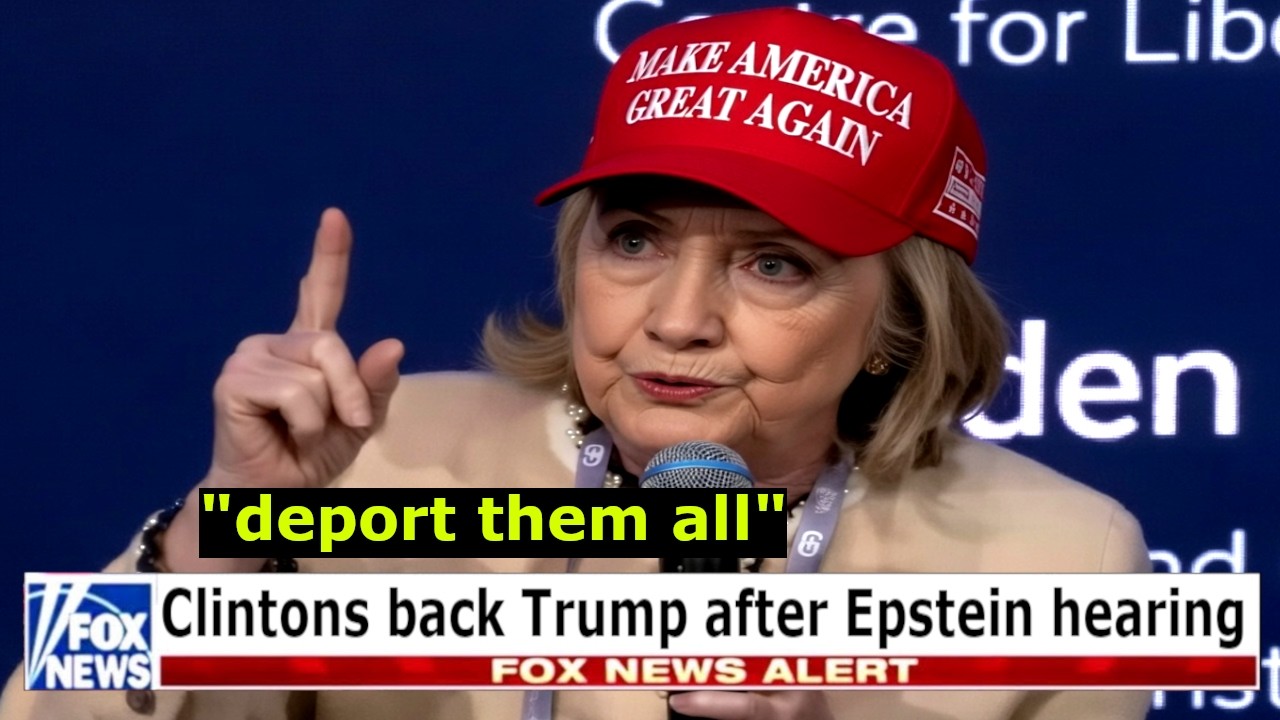
🚨 WTF!! NO ONE F*CKING SAW THIS COMING.. 😂😂😂
"The host reacts with shock and strong opinions to Hillary Clinton's unexpected stance on deportation, AOC's perceived incompetence, and Marco Rubio's 'diabolical' speech advocating for national sovereignty and Western civilization."