
Andrei Martyanov: IRAN BOMBSHELL: Hypersonic Missile Could Sink US Navy Carrier — Trump WARNED!
YouTube · 7gT4A9FO7KQ
Quick Read
Summary
Takeaways
- ❖The US military's 'way of war' is limited to short-term standoff weapon attacks, lacking the capacity for sustained ground or air operations against a peer or near-peer adversary.
- ❖Iran's air defense, including indigenous systems and Russian/Chinese long-range radars, can effectively counter US stealth aircraft and missile attacks.
- ❖US Patriot and THAAD missile defense systems are considered ineffective against Iran's maneuverable ballistic and cruise missiles, as demonstrated by past failures.
- ❖US aircraft carriers, while powerful, are vulnerable if they approach Iranian shores, and their accompanying destroyers can be overwhelmed by mass missile attacks.
- ❖Russia provides Iran with early warning intelligence and potentially advanced military technology, while China has significant oil interests in the Persian Gulf, complicating US military action.
- ❖Israel's military capabilities are largely exaggerated by PR, and it is heavily reliant on US support, operating as a 'pipsqueak country' that uses the US as its 'best proxy'.
- ❖The US military is not conditioned to take significant losses, making ground operations in Iran politically untenable and potentially catastrophic.
Insights
1US Military Incapable of Sustained Operations Against Iran
The guest argues that the US military is fundamentally unprepared for a 'real war' with Iran, which possesses a large population (90 million) and complex terrain. Unlike previous engagements against 'backward armies,' Iran has sophisticated, integrated air defenses and a significant missile arsenal. The US military-industrial complex is deemed too weak to sustain long-term operations, producing extremely expensive and ineffective weapons, with a limited stock of standoff munitions like Tomahawks.
The guest states, 'United States is incapable of sustaining longtime operations. It's due to their very weak production in the military industrial complex, extremely expensive and ineffective weapons.' He also mentions that a third of Tomahawks failed to explode in a past attack.
2Iran's Robust and Integrated Air Defense System
Iran has a formidable air defense system, capable of quickly coming back online even after sabotage. It includes indigenous systems, potentially S-300 derivatives, and long-range Russian resonance radars (1,000 km range) and Chinese HQ-9 longwave radars, which can detect stealth targets. These systems are integrated to provide targeting solutions and have demonstrated effectiveness, such as shooting down a Global Hawk drone.
The guest notes, 'the air defense of Iran went online came back online within 10 to 15 hours and by the time it was starting to go online it was already working about 70% of effectiveness.' He adds, 'Iran does have those [resonance radars].' and 'those Chinese radar will be integrated if not already there too.'
3Vulnerability of US Naval Assets to Iranian Missiles
US aircraft carriers and destroyers, even when attempting to stay out of range, remain highly vulnerable to Iran's extensive arsenal of anti-shipping, cruise, and ballistic missiles. Iran possesses thousands of missiles, including maneuverable blocks that are difficult for Patriot and THAAD systems to intercept. Deploying destroyers in the Persian Gulf is considered a 'not good idea' due to the risk of being overwhelmed by missile volleys.
The guest states, 'Iran has thousands' of missiles. He also mentions that destroyers 'are going to run out of them anyway' when facing hundreds of incoming missiles, and 'Iran has the cruise missiles and those fly very low.'
4US Military's Inability to Tolerate Casualties
The US military is not conditioned to fight and take losses, a critical weakness that Iran understands. Any significant ground operation or even substantial casualties from missile strikes would lead to political implosion for the US administration, making a Vietnam-level conflict seem like 'an easy stroll in the park' by comparison.
The guest recounts a Danish officer crying after an Iranian missile attack on a US base, and states, 'United States cannot take losses. It just can't. It never was conditioned.'
5Russia and China's Strategic Support for Iran
Russia is actively providing Iran with early warning intelligence and reconnaissance, and there's speculation about additional military deliveries from both Russia and China. China, in particular, has a critical interest in the Persian Gulf, with almost a third of its oil transiting the region, suggesting potential intervention or support if US actions threaten this supply.
The guest notes, 'Russia is providing Iran with the recon. Iran will be warned early warning.' He also highlights, 'Almost third of Chinese oil comes through the Persian Gulf and through Iran.'
Bottom Line
The US is not a sovereign country, with its government and Congress effectively controlled by Israel, leading to foreign policy decisions that prioritize Israeli interests over American national interests.
This perspective implies that US foreign policy, particularly concerning Iran, is not driven by rational self-interest but by external influence, leading to potentially disastrous military engagements.
For geopolitical analysts, this suggests a need to scrutinize US foreign policy decisions through the lens of external lobbying and influence rather than purely domestic strategic considerations.
Israel's advanced military technology and capabilities are largely a product of PR and US supply, rather than indigenous innovation, and their forces are essentially 'gendarmerie' (police force) with heavy equipment, incapable of fighting a 'real war' against a serious adversary like Iran.
This challenges the perception of Israel as a formidable, technologically superior military power, suggesting its actual combat effectiveness against a well-equipped, determined foe is limited without overwhelming US support.
Defense analysts should re-evaluate the true combat readiness and technological independence of allied nations, distinguishing between PR and actual capabilities, especially when considering regional power balances.
Key Concepts
The American Way of War
The US military's pattern of conflict involves initially hurling standoff weapons, attempting to suppress air defenses, and avoiding ground operations due to an inability to sustain long-term engagements or tolerate significant casualties. This approach is deemed ineffective against well-prepared, technologically advanced adversaries.
Fifth Column Strategy
The US and its allies often rely on internal 'fifth column' elements within target countries to destabilize regimes, rather than engaging in direct, large-scale military invasions. This is seen as a primitive strategic planning approach by the Pentagon and CIA.
Lessons
- Re-evaluate the effectiveness of US 'stealth' technology and missile defense systems (Patriot, THAAD) against modern, integrated air defense networks and maneuverable ballistic missiles.
- Consider the limitations of the US military-industrial complex in sustaining prolonged, high-intensity conflicts, and its implications for global power projection.
- Analyze geopolitical conflicts, particularly in the Middle East, through the lens of external influence and lobbying, rather than solely national interests, to understand policy drivers.
- Recognize Iran's military capabilities, including its missile arsenal and integrated air defenses, as a significant deterrent, challenging assumptions of easy military victories.
- Monitor the strategic cooperation between Russia, China, and Iran, as it directly impacts the balance of power and potential outcomes of regional conflicts.
Notable Moments
Donald Trump's statement about B2 bombers decimating Iran's nuclear potential and bringing peace to the Middle East, which the guest dismisses as having 'no clue what he's talking about'.
This highlights a perceived disconnect between political rhetoric and military reality, framing political leaders as uninformed on complex defense matters, which can lead to miscalculations.
The guest's assertion that the US cannot sustain operations beyond 35-45 days due to weak military-industrial production and expensive, ineffective weapons.
This provides a critical timeline and resource constraint for any potential US military engagement, suggesting that prolonged conflict is not feasible for the US.
The guest's claim that American generals privately warned against attacking Iran, stating 'there is no guarantee of success' and that it would only 'wreck some sites including industrial and civilians'.
This suggests internal dissent and realistic assessments within the US military establishment that contradict public hawkishness, indicating awareness of the high risks involved.
Quotes
"The last real war United States fought was Vietnam. That was the war which also involves some kind of the ground operations. I'm not talking about beating the excrement out of the semi literate and well basically backward army of Saddam Hussein."
"United States is incapable of sustaining longtime operations. It's due to their very weak production in the military industrial complex, extremely expensive and ineffective weapons."
"United States is not sovereign country. It doesn't have the American government. It's essentially Israeli government which works in the in favor of Israel."
"Patriot is a is a joke. I mean it can intercept some aircraft... but in terms of the fast even ballistic... it's a difficult target for them."
"United States cannot take losses. It just can't. It never was conditioned. United States military is not conditioned to fight and take losses. Period. Simple as that."
"SU35S is undeniably the best fighter in the world today with exception of few SU57 and it's has an enormous combat scores and extremely advanced radar and systems."
Q&A
Recent Questions
Related Episodes

Iran Update: Israel’s Newest Bombing Campaign, the Oncoming War With China and How to Avoid It
"Colonel Wilerson reveals how the US and Israel are actively bombing China's strategic infrastructure in Iran, escalating a covert economic war that Beijing intends to win without direct military conflict by dismantling the dollar's global dominance."

Alex Krainer: US STRIKES Iran – Iran RETALIATES Against Kuwait, Bahrain & Jordan!
"Amidst escalating US-Iran conflict and Iranian retaliation against regional US allies, this episode argues that US foreign policy is deeply controlled by an 'Anglo-Zionist conspiracy' led by the Rothschild banking dynasty, prioritizing Israeli interests over American ones."

Patrick Henningsen: Hezbollah JUST Fired Back at Israel - Iran Vows to “Crush” All Attacks
"Patrick Henningsen argues that the US and Israel initiated an illegal war against Iran, driven by Trump's incompetence and Israeli influence, leading to an inevitable escalation with severe global economic repercussions."
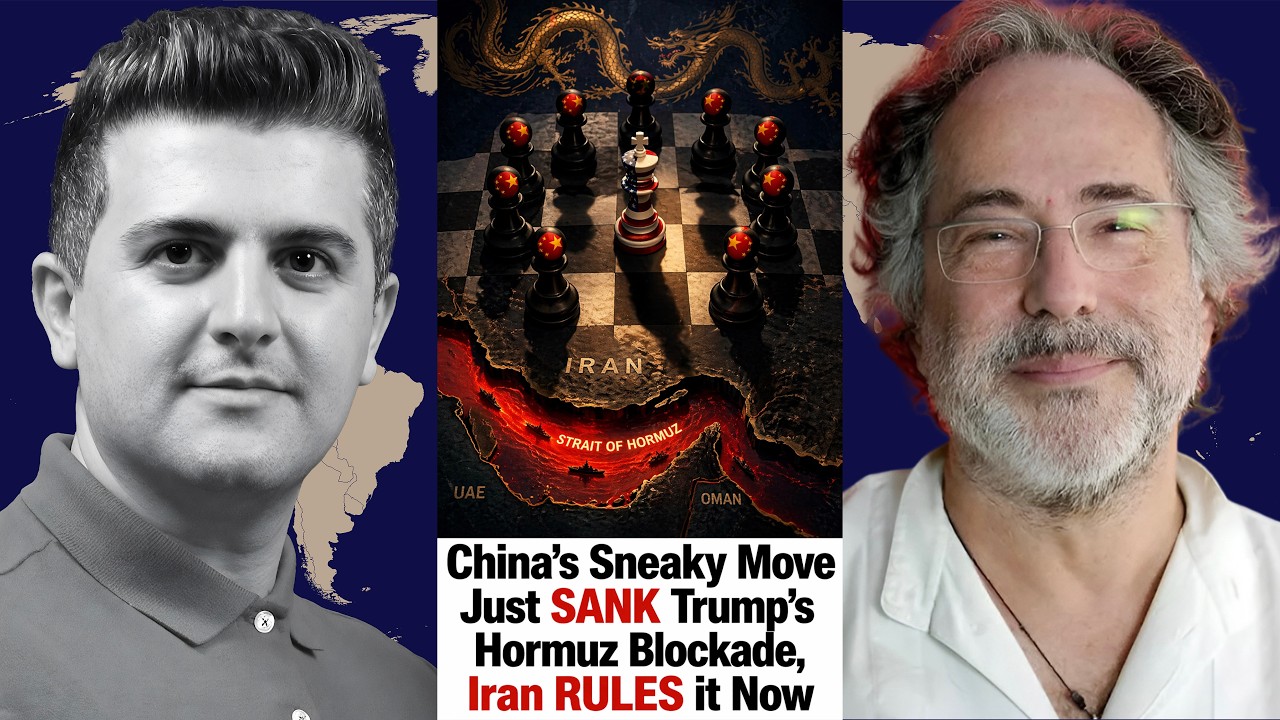
Pepe Escobar: “Total Failure”: Trump’s Blockade Just Backfired Disastrously
"Pepe Escobar argues that the US blockade against Iran, spearheaded by Donald Trump, has utterly failed and backfired, accelerating global economic chaos and challenging US geopolitical dominance."