
NO WAR WITH IRAN | 'CHOOSE YOUR FIGHTERS' ANTI-WAR RALLY LIVE
YouTube · 86mQxfbNmBY
Quick Read
Summary
Takeaways
- ❖The 'Choose Your Fighters' rally aims to support progressive candidates who are anti-war and committed to human rights-based foreign policy.
- ❖Public support for the war in Iran is significantly lower than for previous conflicts like Afghanistan and Iraq.
- ❖Kyle Kulinski outlines 10 reasons for the Iran war, including Trump's warmongering, Israeli influence, Epstein files blackmail, and resource theft.
- ❖Speakers characterize the US and Israeli governments as 'bloodthirsty imperialists' and 'terrorists,' forming an 'Axis of Epstein.'
- ❖APAC's financial influence in US politics is a major driver of the pro-war consensus, often masking its funding through shadow PACs.
- ❖There is a significant disconnect between the Democratic Party's anti-war base and its pro-war elected officials.
- ❖Foreign policy is a critical voting issue, especially when linked to domestic economic concerns like healthcare and housing.
- ❖New media platforms are crucial for progressive movements to bypass traditional gatekeepers and amplify anti-war messages.
- ❖Attacks on progressive candidates are often rooted in Islamophobia, conflating criticism of Israel with antisemitism.
- ❖The Pentagon is preparing for weeks of ground operations in Iran, indicating a high risk of escalation.
- ❖War is explicitly framed as profitable for elites, including defense contractors and politicians, at the expense of human lives and domestic well-being.
- ❖Veterans and conflict reporters highlight the horrific human cost of modern warfare, emphasizing civilian casualties and troop trauma.
- ❖The left must reclaim patriotism by aligning it with foundational American ideals of life, liberty, and the pursuit of happiness, prioritizing people over profit.
Insights
1Rally's Core Mission: Elect Anti-War Progressives
The 'Choose Your Fighters' rally is explicitly organized to fundraise for and support progressive candidates who are unequivocally against the war in Iran and committed to policies rooted in human rights. This initiative aims to counter the prevailing pro-war consensus in Washington.
Crystal Ball states, 'Everybody here is vehemently opposed to the war in Iran and is incredibly committed to having policy based on human rights.' The event supports candidates like Oliver Larkin and Hartzell Gray, partnered with Progressive Victory. (, )
2Public Opinion Overwhelmingly Against Iran War
Public support for the war in Iran is remarkably low, ranging from 35-40%, a stark contrast to the 92% approval for the Afghanistan war post-9/11 and 72% for the Iraq war. This indicates a significant lack of public conviction for the current conflict.
Kyle Kulinski presents polling data: 'The answer is between 35 and 40%... Absolutely nobody thinks this war needs to be done.' He contrasts this with 92% for Afghanistan and 72% for Iraq. ()
3Kyle Kulinski's 10 Reasons for the Iran War
Kyle Kulinski posits multiple, potentially overlapping, reasons for the war: Trump's consistent warmongering, Israel's directive (with US compliance), Trump's attempt to boost poll numbers, blackmail via Epstein files, influence from the military-industrial complex and pro-Israel donors, Trump's belief in an Iranian assassination plot, desire to steal Iranian resources, the goal of creating a failed Iranian state to ensure Israeli regional domination, religious fundamentalist influence, and Trump's naive belief in an 'easy' war for historical legacy and US expansion.
Kulinski details these 10 points, including Trump's history of drone strikes, cabinet appointments, and pardons; Marco Rubio's admission of Israeli initiative; Trump's past tweets about Obama starting wars for polls; Epstein's ties to Israel and potential blackmail; Miriam Adelson's funding; alleged Iranian threats; Venezuela's oil theft as a precedent; Israel's 'Greater Israel' plan; Mike Huckabee's religious views; and Trump's desire for US territorial expansion. ()
4US/Israel Governments Labeled 'Axis of Epstein' and 'Terrorists'
The US and Israeli governments are characterized as 'deadeyed psychopaths and sociopaths' and 'bloodthirsty imperialists' by Kyle Kulinski, who labels them the 'Axis of Epstein' and asserts they are actively engaged in terrorism, comparable to historical criminals like Mussolini and Hitler.
Kulinski states, 'We are governed by deadeyed psychopaths and sociopaths and bloodthirsty imperialists... I call Israel and the US the axis of Epstein... The US government and the Israeli government, they are the terrorists. They are doing terrorism.' (, )
5APAC's Corrupting Influence and Evolving Tactics
APAC (American Israel Public Affairs Committee) is identified as a major, right-wing financial force in US politics, particularly in Democratic primaries, driving a pro-war agenda. It has evolved its tactics to mask its funding through 'shadow PACs' (e.g., Article One PAC, Elect Women) to circumvent anti-APAC pledges and public backlash, making it harder for voters to track its influence.
Crystal Ball highlights 'the influence of big money in politics and in particular, you know, the influence of Apac.' Casey Kennedy explains that APAC is 'one of the biggest players in American politics' and they aim to make them 'as politically toxic as the NRA.' Nida Alam details how APAC-aligned donors use 'shadow packs' to funnel money into races where candidates disavow direct APAC support. (, )
6Democratic Base vs. Leadership: A Chasm on War
Despite the Democratic base being overwhelmingly anti-war and critical of current foreign policy, many elected Democratic officials maintain a pro-war consensus. This disconnect is exacerbated by the influence of money in politics, leading to a lack of democratic responsiveness from elected leaders.
Crystal Ball notes, 'on the Democratic party side there is basically no one who supports this war in the base. But among the elected officials it's a little bit of a different story.' Kasim Rasheed states, 'the number one issue... was why are we funding a genocide in Palestine right now?' Lily Greenberg Call recounts members of Congress telling Palestinian friends, 'until you bring us money or votes, nothing is going to change.' (, , , )
7New Media Challenges Old Guard Politics
Traditional politicians and legacy media struggle to adapt to the new media environment, where unfiltered voices on platforms like Twitch and YouTube gain significant broad awareness. This shift allows progressive voices to bypass traditional gatekeepers and directly engage with a wider audience, particularly young voters.
Hassan Piker observes, 'in the new media environment that we exist in, I get a lot more real uh, broad awareness out there when I appear on Theo Von show.' Oliver Larkin notes the parallel to Bernie Sanders on Joe Rogan, highlighting how online spaces are 'decisive in our elections now.' (, )
8Islamophobia as a Political Weapon
Attacks on progressive candidates like Hassan Piker and Abdul El-Sayed are often rooted in Islamophobia, cynically conflating criticism of Israel with antisemitism. This tactic aims to delegitimize anti-war voices and suppress dissent within the Democratic Party.
Hassan Piker states, 'a big part of this is is actually Islamophobia, too. The the idea that like any Muslim... is automatically anti-Semitic.' Nida Alam points out the 'dog whistles of attacking Hassan' are 'pure Islamophobia,' citing examples of politicians appearing on shows with Islamophobic hosts while refusing to engage with progressive Muslim voices. (, )
9Pentagon Prepares for Iran Ground Operations
Breaking news during the rally confirms that the Pentagon is preparing for weeks of ground operations in Iran, with thousands of American soldiers and Marines arriving in the Middle East. This indicates a dangerous new phase of the war, despite the lack of congressional approval or clear strategic objectives.
Crystal Ball reads a Washington Post scoop: 'The Pentagon is preparing for weeks of ground operations in Iran, US officials said as thousands of American soldiers and Marines arrive in the Middle East.' Congressman Ro Khanna confirms, 'It's a real possibility... they haven't ruled it out.' (, )
10War is Profitable: The Economic Incentive for Conflict
The underlying motivation for ongoing wars, including the conflict in Iran, is profit. Defense contractors, wealthy donors, and even politicians personally benefit financially from military engagements, making war a 'profitable' endeavor for the elite despite its devastating human and economic costs for the general populace.
Angie Nixon states, 'The reason that this is happening is because it's profitable... It's making folks money, the folks who are at the top, as well as Donald Trump and his family and his friends and his campaign donors.' Oliver Larkin connects this to the 'Epstein files' revealing how elites view war as a 'profitable' opportunity. (, )
11The Human Cost of Modern Warfare
Eyewitness accounts from a combat veteran and a conflict reporter highlight the horrific realities of modern warfare, including civilian casualties, the psychological and physical trauma inflicted on service members, and the desensitization of the public to these atrocities. This personal perspective underscores the moral imperative to oppose war.
Josie Caballero, a Navy veteran, recounts her experience in Iraq and the low morale of current troops, stating, 'We're exposing a new generation to the same horrors that we had to experience.' Dylan Burns, a conflict reporter, describes 'human beings hunted by the Russian army,' grandmothers blown up, and the low cost of drones used to kill soldiers, emphasizing the 'horrific' nature of 21st-century warfare. (, )
12Reclaiming Patriotism for Progressive Values
The left should reclaim the concept of patriotism by aligning it with the foundational American ideals of life, liberty, and the pursuit of happiness. This involves prioritizing universal healthcare, affordable housing, living wages, and peace over militarism and corporate profiteering, both domestically and internationally.
Hartzell Gray argues, 'We need to reclaim what it means to be a patriot... the first thing we did was the Declaration of Independence... life, liberty, and the pursuit of happiness.' He connects this to fighting for guaranteed healthcare, social housing, and jobs, contrasting it with a foreign policy 'rooted in the war machine.' ()
Bottom Line
The widespread public discontent with current US foreign policy and the Democratic Party's perceived 'feckless indifference' creates a significant political vacuum and opportunity for principled progressive candidates.
This discontent, particularly among young people and the Democratic base, can be channeled into a powerful electoral force if progressive candidates effectively articulate anti-war stances and connect foreign policy costs to domestic struggles.
Progressive movements can strategically recruit and support candidates who are authentic, deeply connected to their communities, and willing to challenge the establishment's pro-war narrative, leveraging new media to amplify their message and mobilize voters who feel unrepresented.
The conflation of anti-Zionism with antisemitism by pro-Israel groups and politicians is inadvertently fueling genuine antisemitism among young people who, in rejecting Israeli actions, may also reject Jewish identity.
This dangerous conflation undermines efforts to combat actual antisemitism and alienates a generation from Jewish communities. It also creates a false dichotomy that prevents nuanced discussion of Israeli policy.
Progressive Jewish voices and allies can actively work to differentiate between criticism of the Israeli government/Zionism and antisemitism, educating the public and fostering a more inclusive anti-war movement that embraces Jewish people while condemning genocidal policies.
The 'scarcity mindset' fostered by the corrupt campaign finance system hinders collaboration and collective power-building within progressive movements, mirroring capitalist competition.
This mindset leads to infighting and prevents the broad-based unity needed to challenge entrenched power structures, as organizations and candidates compete for limited resources rather than pooling efforts.
Progressive organizations and candidates can intentionally cultivate a culture of abundance and collaboration, sharing resources, expertise, and platforms. This 'rising tide lifts all boats' approach can create a more resilient and effective movement capable of a 'major realignment' in US politics.
Key Concepts
Oligarchy
A system where power is concentrated in the hands of a small, wealthy elite. This model is used to describe how money in politics, particularly from corporate and pro-war lobbies, dictates policy despite public opinion.
Scarcity Mindset
A belief that resources are limited, leading to competition and infighting. This is applied to American politics, where candidates and organizations often compete for limited funding and influence, hindering broader coalition-building.
Dehumanization
The process of stripping individuals or groups of their humanity. This model is used to explain how US foreign policy can disregard the human rights and dignity of people in non-Western countries, enabling actions like genocide and military interventions.
Escalation Trap
A situation where a conflict intensifies due to a series of reactive measures, often leading to unintended and catastrophic outcomes. This is applied to the US's involvement in Iran, where initial actions can quickly lead to broader, more dangerous military engagement.
Lessons
- Actively support and volunteer for progressive, anti-war candidates, especially those challenging corporate Democrats and incumbents funded by groups like APAC, by donating time, money, and sharing their message.
- Join and engage with grassroots organizations like the Democratic Socialists of America (DSA), Working Families Party (WFP), and Progressive Victory to build collective power and develop organizing skills.
- Educate communities on the direct links between US foreign policy (e.g., military spending, aid to Israel) and domestic issues (e.g., healthcare, housing, economic inequality) to mobilize a broader anti-war coalition.
Notable Moments
Introduction of the 'Choose Your Fighters' anti-war rally, emphasizing support for progressive candidates.
Sets the core purpose of the event: to directly challenge the pro-war establishment through electoral politics and grassroots action.
Kyle Kulinski's detailed breakdown of 10 reasons for the Iran war, including the 'Axis of Epstein' and religious fundamentalism.
Provides a comprehensive, albeit controversial, framework for understanding the complex motivations behind US foreign policy, moving beyond simplistic narratives.
Discussion of APAC's significant financial influence in US politics and its evolving tactics to mask funding through 'shadow PACs.'
Exposes a critical mechanism of political corruption that shapes foreign policy and highlights the need for greater transparency and accountability in campaign finance.
Lily Greenberg Call's account of resigning from the Biden administration over its Gaza policy and the disconnect between the Democratic base and leadership.
Illustrates the moral crisis within the Democratic Party and the challenges faced by principled individuals attempting to influence policy from within.
Hassan Piker's commentary on the influence of new media and the use of Islamophobia to attack progressive voices.
Highlights the changing landscape of political discourse and the cynical tactics used by the establishment to silence dissent, particularly against Muslim candidates and commentators.
Congressman Ro Khanna's update on the War Powers Resolution and the imminent threat of a US ground invasion in Iran.
Underscores the immediate danger of escalating conflict and the perceived abdication of congressional responsibility in preventing war.
Nina Turner and Cori Bush sharing their experiences as targets of APAC's aggressive campaign spending.
Provides firsthand accounts of how powerful lobbying groups attempt to silence progressive voices and maintain the political status quo.
Breaking news during the rally about the Pentagon preparing for weeks of ground operations in Iran.
Injects a stark sense of urgency and gravity into the anti-war discussions, confirming the real-time escalation of the conflict.
Hanya Jodat's emotional reflection on the meaning of war for Iranians, drawing on personal trauma and the inability to communicate with family.
Provides a deeply personal and humanizing perspective on the impact of war, grounding the political discussion in lived experience and emphasizing the global interconnectedness of suffering.
Quotes
"Everybody here is vehemently opposed to the war in Iran and is incredibly committed to having policy based on human rights."
"The empire just commits disgusting, vicious crimes right in front of your face with your tax money in your name."
"We're governed by deadeyed psychopaths and sociopaths and bloodthirsty imperialists."
"The US government and the Israeli government, they are the terrorists. They are doing terrorism."
"Donald Trump is not so much a president as he is a means to an end."
"Apac doesn't care about democracy. Apac cares about what Apac cares about, which is the corporate interest, the billionaire class, and perpetuating this US colony in the Middle East."
"The difference between Republicans and Democrats is Republicans will bomb a brown country and Democrats will put a pride flag on a plane and bomb a brown country."
"There's no democracy in the Democratic party. What the decisions that are made are made by a handful of of uh you know large donors and and you know patronage networks."
"The same spirit that does not care about bombing other people's people is the same spirit that denies us universal healthcare, that denies us clean air, clean water, clean food."
"Every dollar that we spend dropping a bomb on somebody else... is a dollar we're not spending actually solving problems here at home."
"We don't need any more drum circles. We don't need any more flower crowns. What we need is action."
"We need to reclaim what it means to be a patriot... the American promise... life, liberty, and the pursuit of happiness."
Q&A
Recent Questions
Related Episodes

Trump Just ENDED JD Vance’s White House Dreams
"A New York Times article and internal White House dynamics reveal Donald Trump's deep dissatisfaction with J.D. Vance, potentially ending Vance's 2028 presidential ambitions and highlighting a broader struggle for control within the Republican Party."
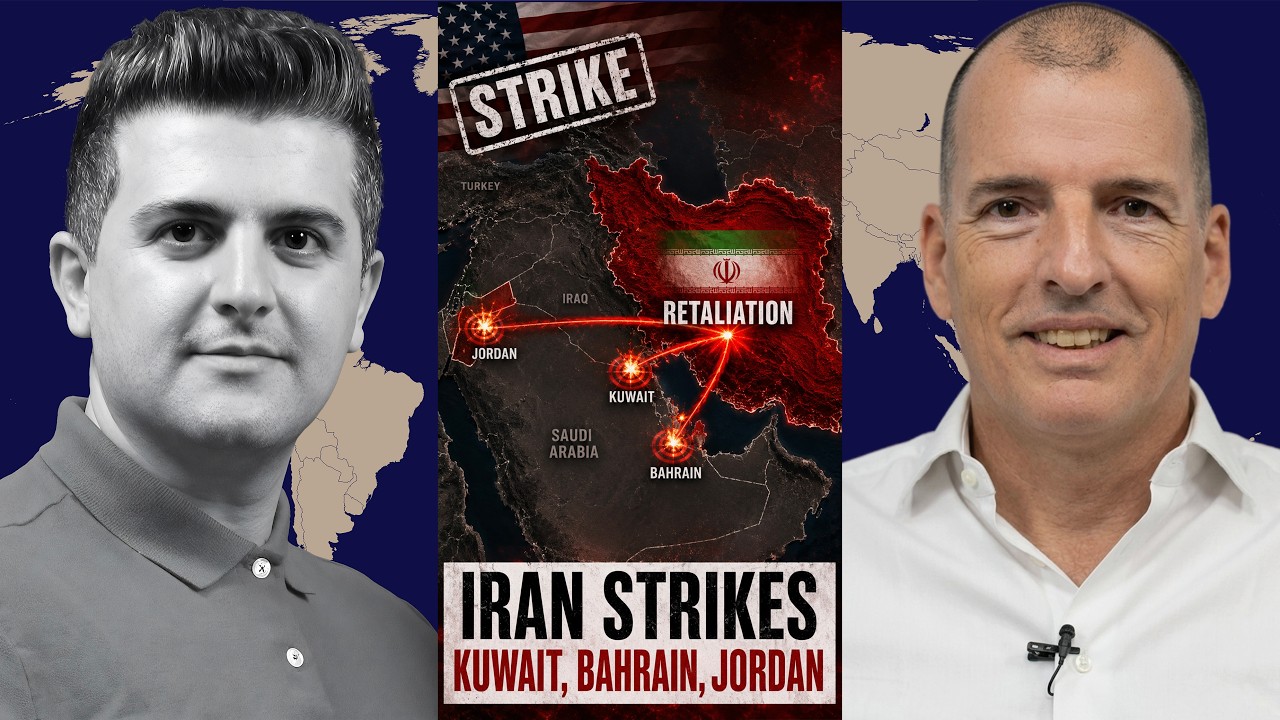
Alex Krainer: US STRIKES Iran – Iran RETALIATES Against Kuwait, Bahrain & Jordan!
"Amidst escalating US-Iran conflict and Iranian retaliation against regional US allies, this episode argues that US foreign policy is deeply controlled by an 'Anglo-Zionist conspiracy' led by the Rothschild banking dynasty, prioritizing Israeli interests over American ones."

Trump Panics As Own Lawyers Turn Against Him Over War
"Donald Trump faces scrutiny from his own Justice Department over alleged insider trading in oil markets tied to Iran war announcements, highlighting broader issues of political corruption and economic destabilization for profit."

Iran Update: Israel’s Newest Bombing Campaign, the Oncoming War With China and How to Avoid It
"Colonel Wilerson reveals how the US and Israel are actively bombing China's strategic infrastructure in Iran, escalating a covert economic war that Beijing intends to win without direct military conflict by dismantling the dollar's global dominance."