Rising Cancer Rates, the Globalist Agenda, and the Big Business Land Grab Making You Poor
YouTube · 8m5S01u7z5c
Quick Read
Summary
Takeaways
- ❖Iowa is experiencing a significant out-migration of young people (ages 25-29), ranking fourth nationally.
- ❖25% of Iowa's farmland is owned by out-of-state investors and funds, turning ancestral farmers into tenants.
- ❖Iowa has the fastest rate of new cancer in human civilization, with rural counties showing the highest incidence.
- ❖Three major companies (Bayer, Corteva, Syngenta) control 85% of the agricultural input market, with Syngenta being a wholly-owned Chinese state enterprise.
- ❖Farmers are exploited through 'regional-based pricing' where input costs are higher in more productive areas, regardless of actual product use.
- ❖The herbicide Paraquat, used on 300,000 acres in Iowa, doubles the risk of Parkinson's and is used in research to induce Parkinson's in rodents, yet is still EPA-approved.
- ❖The 'Monsanto Papers' reveal corporate capture of the EPA, including an official boasting about 'killing' independent research on glyphosate.
- ❖The 'Williams study,' the most cited research on glyphosate safety, was retracted after it was found to be written by Monsanto executives.
- ❖The 'you'll own nothing and be happy' narrative from the World Economic Forum is framed as a 'plan,' not a joke, manifesting in corporate acquisition of single-family homes and contract farming.
- ❖A critique of 'market fundamentalism' suggests that unrestrained capitalism and free trade, without protecting national interest, lead to exploitation and cultural decline.
Insights
1Iowa's Systemic Decline: Youth Exodus, Land Grab, and Cancer Epidemic
Iowa is experiencing a severe decline marked by a high net out-migration of young people (ages 25-29), ranking fourth nationally. A quarter of its farmland is now owned by out-of-state investors, forcing multi-generational farmers into tenancy. Most alarmingly, Iowa has the fastest rate of new cancer in human history, with rural counties having a one-in-two lifetime chance of diagnosis, significantly higher than states with high smoking rates.
Iowa is number four in the nation for net out-migration of kids 25-29 (). 25% of farmlands are owned by out-of-state investors (). Iowa has the fastest rate of new cancer in human civilization, with top counties being rural and a one-in-two lifetime chance of cancer (, , ).
2Big Ag Monopolies Exploit Farmers and Threaten Public Health
The agricultural input market is dominated by three companies (Bayer, Corteva, Syngenta, with Syngenta being Chinese state-owned) controlling 85% of the market. These monopolies use 'regional-based pricing' to charge Iowa farmers significantly more for the same products than Brazilian farmers, extracting wealth. Furthermore, highly toxic products like Paraquat, which doubles Parkinson's risk and is used to induce the disease in research, are still approved and widely used in Iowa.
Three companies control 85% of the input market (). Bayer and Corteva own 90% of seed technology (). Syngenta is a wholly-owned state enterprise of the Chinese government (). A University of Illinois study showed Brazilian farmers are charged $150 less per acre for corn inputs (). Paraquat doubles Parkinson's risk and is used in research to induce Parkinson's (, ).
3Regulatory Capture and Deception by Corporate Interests
The EPA and other governmental bodies have been 'captured' by corporate interests, leading to the suppression of truth about product safety. The 'Monsanto Papers' revealed that Monsanto executives wrote the most cited study on glyphosate safety (the Williams study), which was only retracted years after the deception was known. An EPA official was even quoted boasting about 'killing' independent research on glyphosate, demonstrating a deep-seated corruption that prioritizes corporate profit over public health.
The Monsanto Papers reveal corporate capture (). An EPA official said, 'if I can kill this, I should get a medal' regarding independent glyphosate research (). The Williams study, the most cited on glyphosate safety, was retracted because Monsanto executives wrote it ().
4The 'Own Nothing, Create Nothing' Agenda and Cultural Erosion
The World Economic Forum's 'you'll own nothing and be happy' is framed as a 'plan,' not a joke, manifesting in large investment firms like Blackstone buying single-family homes and contract farming where farmers don't own their livestock. This trend, combined with the loss of traditional manual labor, strips away the human drive to create and own, leading to a crisis of purpose and contributing to societal issues like the opioid epidemic. The guest argues this is a deliberate effort to defile God's creation and dismantle traditional culture.
World Economic Forum article 'you'll own nothing and you'll be happy' (). Blackstone buying single-family homes in Iowa (). Over 75% of Iowa pork farmers don't own their pigs (). The joy of creation is being taken away ().
Bottom Line
The current economic system, driven by 'market fundamentalism,' is not true capitalism but 'corporatism' or 'oligarchy,' which actively undermines the national interest and the well-being of its citizens.
This reframes the debate from capitalism vs. socialism to a fight against corporate control and for a more localized, community-focused economy. It implies that many 'conservative' economic policies actually serve corporate interests over the people.
Advocate for policies that distinguish between genuine free markets and corporate monopolies, such as robust antitrust enforcement, local ownership incentives, and protectionist measures for critical industries, aligning with a 'national interest first' economic philosophy.
The 'replacement migration' theory, often dismissed as a conspiracy, was explicitly outlined in a 2000 UN document, detailing how Western nations would address population decline through immigration rather than promoting higher birth rates among native populations.
This suggests that demographic shifts are not accidental but part of a documented, intentional strategy by international bodies, challenging the narrative that concerns about these changes are inherently bigoted or conspiratorial.
Demand transparency from international organizations and national governments regarding long-term demographic plans. Advocate for policies that support family formation and higher birth rates within existing populations as an alternative to relying solely on immigration for population maintenance.
Key Concepts
Market Fundamentalism
The belief that the market is inherently self-correcting and should be prioritized above all other considerations, including social, cultural, and environmental well-being. This podcast argues against this, stating it leads to exploitation and the erosion of community.
Corporate Capture
The process by which regulatory agencies, designed to protect public interest, become dominated or controlled by the commercial interests they are supposed to regulate. Evidenced by Monsanto's influence over the EPA regarding glyphosate safety studies.
Lessons
- Demand human-level disclosure for land ownership in your state to identify who truly controls agricultural resources and prevent exploitation by anonymous entities.
- Support political candidates who pledge to initiate antitrust suits against monopolistic agricultural input companies to restore fair competition and reduce farmer exploitation.
- Educate yourself and your community about the documented risks of agricultural chemicals like Paraquat and glyphosate, advocating for stricter regulations or bans based on independent science.
- Actively participate in local politics and community-building efforts to counter the erosion of culture and purpose, prioritizing local well-being over 'market fundamentalism' and globalist agendas.
- Question the 'labor-saving' promises of new technologies like AI, and consciously seek out opportunities for manual labor and creation in your own life to foster a sense of purpose and connection.
Restoring Iowa's Culture and Economy
Require human-level disclosure of land ownership to identify true owners and prevent anonymous corporate control.
Lead antitrust lawsuits against big agricultural companies exploiting farmers through monopolistic practices.
Prioritize good science and transparent information regarding agricultural chemicals, potentially banning harmful products like Paraquat.
Implement policies to incentivize young people to stay on farms and rebuild local agrarian communities.
Challenge 'market fundamentalism' by advocating for policies that protect local interests, culture, and the environment over unrestrained corporate profit.
Notable Moments
The guest recounts restoring his great-great-grandfather's farmhouse, board by board, using old family photos, as a personal act of cultural preservation and a catalyst for his political motivation.
This personal story grounds his political platform in a deep, tangible connection to heritage and community, illustrating the 'culture first' approach he advocates.
The guest shares the emotional impact of his father's cancer diagnosis (a crop consultant exposed to chemicals) and attending funerals of men in their 60s, highlighting the direct human cost of unchecked chemical use in agriculture.
This personal tragedy underscores the urgency and gravity of the public health crisis in Iowa, linking it directly to agricultural practices and corporate negligence, making the issue deeply personal and relatable.
The guest and host discuss Wendell Berry's essay on the Amish question: 'What will this change do to our community?'
This moment introduces a powerful mental model for evaluating policy and technological changes, emphasizing community impact over purely economic or individualistic gains, serving as a guiding principle for the guest's campaign.
Quotes
"I believe we are losing our culture and our heritage as a people. That's my honest belief. And I believe it's not just in Iowa, it's across the country."
"If you want to be radicalized on what we've lost as a culture, spend that much time going through your great-grandmother's photos. And you'll realize the community, the traditions, the pride. A lot of it's gone. It's unrecognizable."
"Our land isn't an asset class. It's actually was meant as the inheritance for the sons and daughters of our state to build their lives, their communities, and their families."
"If I can kill this, I should get a medal."
"If it wasn't safe, they wouldn't let me use it. And I'm just here to say that's a lie. Just like they were captured during COVID and the medical establishment captured agencies."
"Carbon is not the problem. Carbon is the basis of life. The problem is man-made poisons."
"In the future, you'll own nothing and you'll be happy. I tell people like that wasn't a joke. It wasn't a threat. It was a plan."
"The joy, the thing that proves that you were made in God's image is your ability to create because God is the creator. And when you create something, it's it's the whole purpose of being here."
"A foundational question that the Amish ask before they make any big decision is what will this change do to our community?"
"If our kids are leaving and our people are dying from cancer, we are not in what I'd call successful territory."
Q&A
Recent Questions
Related Episodes

Zach Lahn - Exposing the Monsanto Files | SRS #290
"A gubernatorial candidate exposes how corporate agriculture, enabled by political capture, is systematically destroying family farms, poisoning communities with chemicals like glyphosate and paraquat, and eroding state sovereignty for profit."

WE ARE TAKING CUBA | Timcast IRL #1459 w/ Priya Patel
"This episode dives into Trump's 'friendly takeover' of Cuba, the societal implications of plunging birth rates, and the media consolidation impacting CNN, all framed through a conservative lens advocating for American cultural preservation."

Draft Farm Bill Gives Pesticide Giants Immunity! Bayer Reaches $7.25B Settlement! w/ Zen Honeycutt
"Donald Trump's executive order and a proposed Farm Bill provision are accused of granting legal immunity to glyphosate manufacturers like Bayer, despite ongoing cancer lawsuits, while a guest analyst details a complex conspiracy theory surrounding the alleged Charlie Kirk assassination."
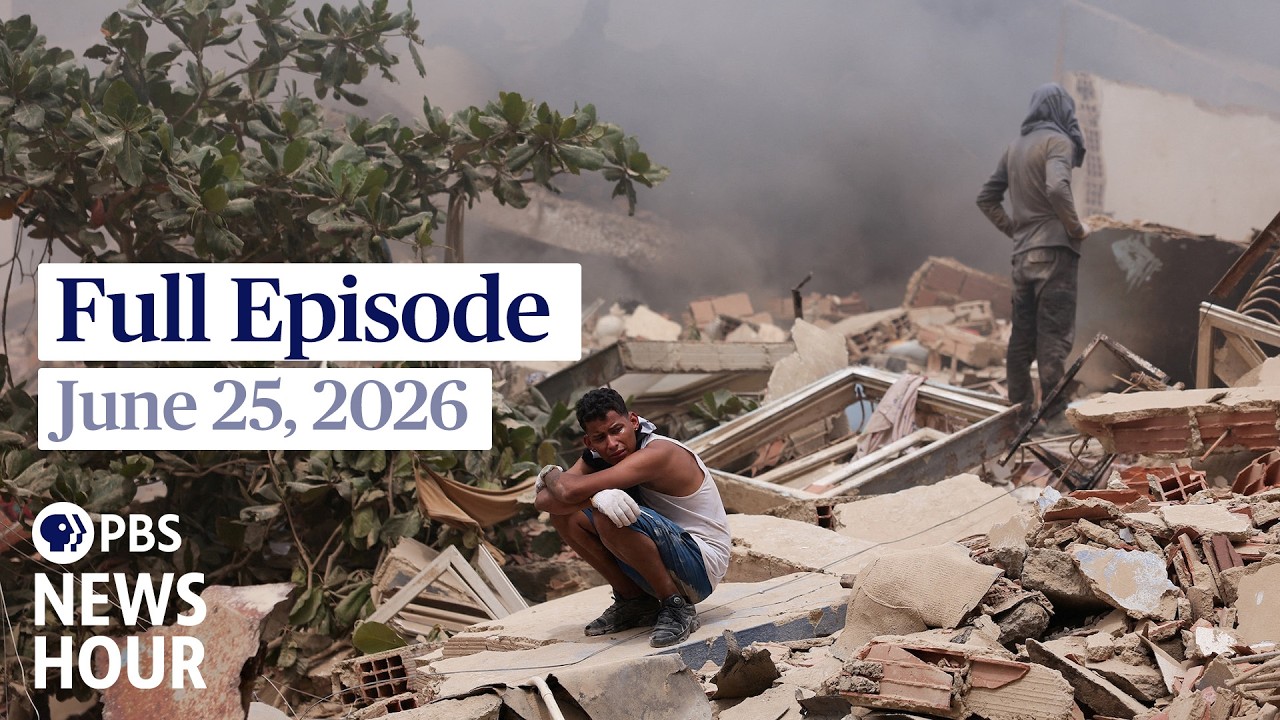
PBS News Hour full episode, June 25, 2026
"This episode covers the catastrophic aftermath of powerful earthquakes in Venezuela, major Supreme Court rulings on immigration and corporate liability, and a new bipartisan initiative to prepare the American workforce for the AI economy, alongside escalating tensions in the Strait of Hormuz."