Iran Caves to China & US as Shocking Details of Peace Deal Surprise Trump Skeptics
YouTube · 96GP7nHdd1Q
Quick Read
Summary
Takeaways
- ❖The Iran ceasefire resulted from Trump's 'Art of the Deal' strategy, using extreme rhetoric to force negotiations, not actual military escalation.
- ❖China's economic dependence on Iranian oil led it to intervene and pressure Iran to accept the ceasefire.
- ❖Mainstream media and some right-wing pundits are criticized for misinterpreting Trump's actions, either as genocidal or as a retreat, failing to recognize his consistent negotiation patterns.
- ❖The host argues that a 'regime change' occurred in Iran, with new leadership potentially more amenable to US demands.
- ❖The de-escalation in the Middle East is presented as a 'global reset,' impacting Russia-Ukraine negotiations and China's stance on Taiwan.
- ❖The concept of 'blackpilling' (giving up hope) is condemned as counterproductive to political engagement and achieving conservative goals.
Insights
1Trump's Negotiation Strategy Led to Iran Ceasefire
The host argues that Donald Trump's aggressive rhetoric, including statements about 'civilizational destruction' and 'f-bombs' on Easter, was a deliberate tactic to pressure Iran into a ceasefire, consistent with his 'Art of the Deal' philosophy. This approach, characterized by appearing 'a little wild,' created uncertainty and forced Iran back to the negotiation table after initially ending talks.
Trump's Truth Social post announcing a two-week ceasefire (), the host's repeated reference to 'The Art of the Deal' quote (, , ), and the timeline of Iran ending talks then returning after Trump's statements ().
2China's Intervention Was Pivotal
China, a major recipient of Iranian oil (80%), intervened at the last minute to pressure Iran to show flexibility and diffuse tensions. This highlights how Trump's actions in the Middle East had broader geopolitical implications, signaling to China that the US is a powerful force and influencing its stance on issues like Taiwan.
New York Times report cited by Breaking 911, stating China's 'last-minute intervention' asked Iran to 'show flexibility' amid economic concerns (), and the host's interpretation of this as Trump showing China American force ().
3Media and Pundits Misunderstood Trump's Playbook
Rubin criticizes both mainstream media (MSNBC, CNN) and some right-wing pundits (Tucker Carlson, Megan Kelly) for misinterpreting Trump's actions. They either panicked, predicting World War III, or, after the ceasefire, dismissed it as a 'retreat' or 'empty threats,' failing to recognize the consistent pattern of Trump's negotiation tactics over decades.
Clips of Lawrence O'Donnell calling the peace deal a 'death of civilization' (), Abby Phillips calling Trump's threats 'empty' (), and the host's criticism of Tucker Carlson and Megan Kelly for their 'panickin' reactions (, ).
4Iran Underwent a 'Productive Regime Change'
Trump's statement on Truth Social claimed that Iran 'has gone through what will be a very productive regime change,' implying new leadership is in charge after the military actions. This new leadership is expected to be more willing to negotiate and cease funding terror, potentially leading to Iran's reconstruction and integration into a 'golden age of the Middle East.'
Trump's Truth Social post: 'The United States will work closely with Iran, which we have determined has gone through what will be a very productive regime change.' (), and the host's commentary on the 'old regime is dead' and new guys needing to 'play ball' ().
Bottom Line
The Iran conflict, as framed by the host, served as a strategic demonstration to China regarding US resolve and power, potentially influencing China's calculations on Taiwan.
This suggests that US foreign policy actions, even in seemingly unrelated regions, can have ripple effects on other geopolitical flashpoints, indicating a multi-layered strategic approach.
Analysts should consider how regional conflicts are leveraged to send broader messages to global powers, looking for indirect strategic objectives beyond immediate conflict resolution.
The host posits that the 'incapacitation' of Iran could lead to a 'golden age of the Middle East' with new peace deals, as Gulf States and Arab countries align more closely with Israel due to shared threats.
This implies a significant realignment of alliances in the Middle East, potentially creating new economic and security partnerships that were previously unthinkable.
Businesses and policymakers should prepare for shifting regional dynamics, including new trade routes, investment opportunities, and security architectures in a post-Iran-conflict Middle East.
Key Concepts
Peace Through Strength
The idea that a strong military posture and assertive diplomacy are the most effective ways to deter adversaries and achieve peaceful resolutions, as opposed to appeasement or purely diplomatic approaches.
The Art of the Deal (Trump's Negotiation Playbook)
A negotiation strategy characterized by escalating rhetoric, creating uncertainty, appearing unpredictable, and pushing situations to the brink to gain maximum leverage before securing a favorable agreement. This involves using threats that are not necessarily intended to be carried out but rather to induce fear and a desire for de-escalation from the other party.
Pattern Recognition
The ability to identify recurring behaviors, strategies, or outcomes over time, allowing for more accurate predictions and interpretations of current events, particularly in political and geopolitical contexts.
Blackpilling
A term used to describe a mindset of extreme pessimism and resignation, where individuals believe that societal or political problems are insurmountable and therefore disengage from efforts to change them. The host critiques this as counterproductive.
Lessons
- Practice 'pattern recognition' in political analysis: Instead of reacting to immediate rhetoric, look for consistent strategies and historical precedents in leaders' actions.
- Avoid 'blackpilling' and 'panickin': Resist the urge to assume the worst or disengage from political discourse when events don't align with expectations, as this can be counterproductive.
- Value loyalty and integrity in leadership: Observe how leaders and their teams navigate disagreements internally versus publicly, recognizing that open dialogue within a team can lead to stronger, unified action.
Trump's 'Art of the Deal' Negotiation Playbook (as interpreted by Rubin)
**Escalate Rhetoric and Create Uncertainty:** Use extreme language and unpredictable actions to put the opposing party on edge and unsure of your next move.
**Push to the Brink:** Bring negotiations to the verge of collapse or conflict to demonstrate seriousness and force the other side to re-evaluate their position.
**Leverage External Pressures:** Exploit the economic or political vulnerabilities of the opposing party and encourage third-party interventions (e.g., China's oil dependence).
**Secure a Pause/Ceasefire:** Achieve an initial de-escalation (e.g., a two-week ceasefire) to allow for further negotiations under more favorable conditions.
**Finalize a Favorable Agreement:** Use the established leverage and the opponent's desire for stability to secure a long-term deal that aligns with your objectives, including regime change or policy shifts.
Notable Moments
Trump's 'Art of the Deal' quote used to explain his negotiation style.
This quote, involving a threat of a murder lawsuit, is presented as the foundational example of Trump's tactic of using extreme, seemingly 'wild' rhetoric to gain leverage, directly paralleling his approach to Iran.
The host's strong criticism of mainstream media (MSNBC, CNN) and some right-wing pundits for their 'panickin' and 'blackpilling' reactions to Trump's Iran strategy.
This highlights a significant divide in political commentary, where the host argues that many analysts fail to understand Trump's consistent strategic patterns, leading to misinterpretations and counterproductive negativity.
JD Vance's display of loyalty and integrity in supporting Trump's Iran policy, despite earlier philosophical differences.
This is presented as an example of honorable political conduct, where internal disagreements are handled privately, and public support is given to the president's ultimate decision, contrasting with those who 'run their mouth to the American media.'
Quotes
"If you don't understand that at this point, you need a different job, like you shouldn't be doing this for a living."
"Donald Trump has a track record of doing the right thing and using language in a way to get everybody to go crazy."
"Trump just got Iran to cry uncle. They've been calling him crazy for making threats, but guess the threats worked."
"Our civilization was not built overnight. It's not going to be saved overnight. And so what I'd encourage you to do is stay involved, be patient, and don't let disappointment turn to checking out of the system entirely."
"I value loyalty above almost everything else. A lot of respectable people talk integrity but have no loyalty. Results over talk, loyalty over posturing."
Q&A
Recent Questions
Related Episodes

Iran Update: Israel’s Newest Bombing Campaign, the Oncoming War With China and How to Avoid It
"Colonel Wilerson reveals how the US and Israel are actively bombing China's strategic infrastructure in Iran, escalating a covert economic war that Beijing intends to win without direct military conflict by dismantling the dollar's global dominance."

🚨 TOTAL F*CKING CHECKMATE 😂😂😂
"The host argues that Trump's 'ceasefire' with Iran was a calculated '5D chess' move to orchestrate a global energy market reshuffle, while simultaneously lambasting 'woke' domestic policies and the 'freefall' of anti-Trump conservative figures."
Robby Soave GOES OFF On ANNOYING Liberal Black Woman Making Emotional Trump Deranged Arguments!
"The host dissects a heated foreign policy debate, arguing that 'left-wing' emotionalism and 'Trump derangement' prevent a rational understanding of US sanction strategies against Cuba and Iran."
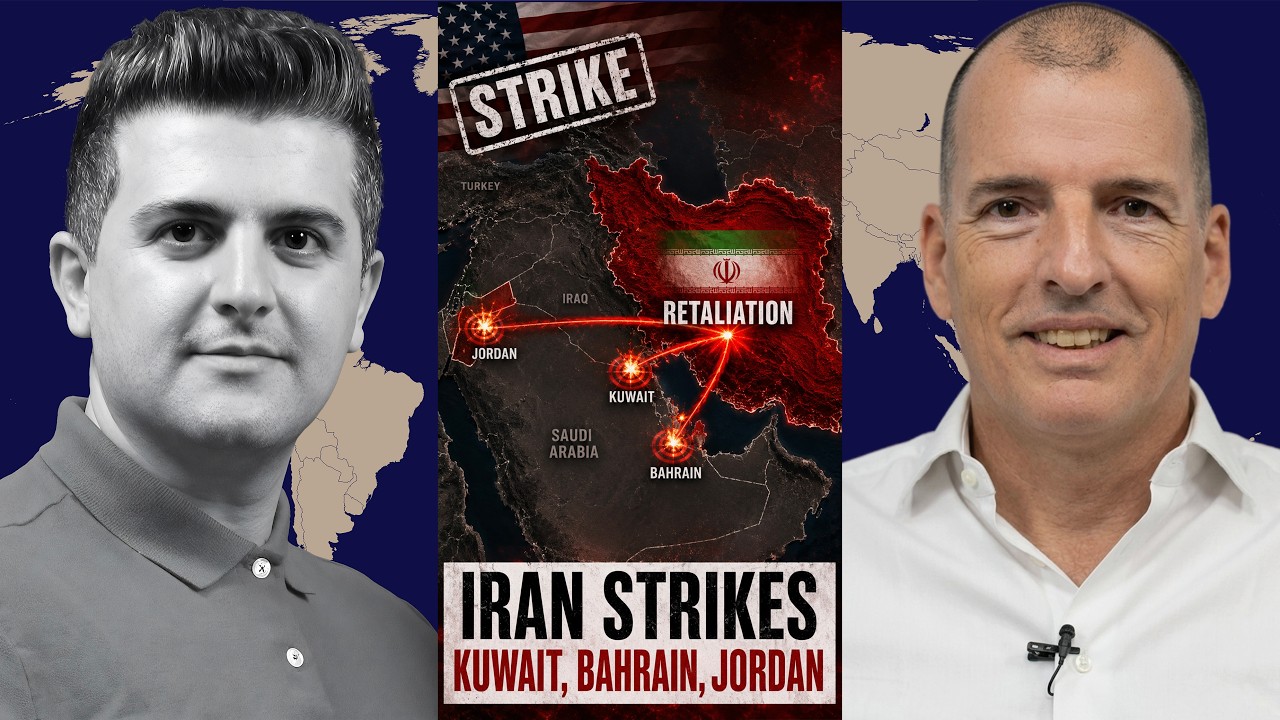
Alex Krainer: US STRIKES Iran – Iran RETALIATES Against Kuwait, Bahrain & Jordan!
"Amidst escalating US-Iran conflict and Iranian retaliation against regional US allies, this episode argues that US foreign policy is deeply controlled by an 'Anglo-Zionist conspiracy' led by the Rothschild banking dynasty, prioritizing Israeli interests over American ones."