
Pierre Poilievre: The Economy Is About to Collapse! America Is Making a Huge Mistake!
YouTube · 9JxaESJIGO0
Quick Read
Summary
Takeaways
- ❖The United States' 'go it alone' foreign policy is a major strategic mistake, alienating allies like Canada.
- ❖Canada holds the fourth-largest oil supply and critical strategic minerals, which it can leverage for tariff-free trade with the US.
- ❖The Iranian government is a leading state sponsor of terrorism, and preventing their acquisition of nuclear weapons is necessary for world peace.
- ❖Canada's economy suffers from overtaxing, punishing initiative, and bureaucratic obstacles that prevent skilled immigrants from working in their fields.
- ❖Government regulations and taxes, not land or labor, are the primary drivers of Canada's housing unaffordability crisis.
- ❖Monetary inflation, where cash creation outpaces goods production, disproportionately harms the working class through the 'Catalon effect'.
- ❖Canada's decline in the global happiness index is linked to food price inflation caused by hidden taxes and regulations.
- ❖Successful economies like Switzerland and Singapore demonstrate that free enterprise, small government, and low taxes lead to prosperity.
- ❖Massive expansion of international student and temporary foreign worker programs has been abused by corporations to drive down wages and inflate housing costs.
- ❖AI's rapid disruption requires a public policy objective to empower human meaning and lower living costs, not just replace jobs.
- ❖Wokeism is an 'illiberal ideology' that divides people by accentuating differences rather than promoting equality and individual merit.
- ❖Canada is increasing its military spending to protect its sovereignty and reduce reliance on the US, especially after perceived threats from the former US President.
- ❖Personal experiences, including growing up adopted and raising an autistic daughter, have reinforced Poilievre's commitment to compassion and supporting those who cannot provide for themselves.
Insights
1US 'Go It Alone' Strategy is a Strategic Mistake
Poilievre asserts that the United States' decision to pursue an isolationist foreign policy, including imposing tariffs on allies like Canada, is a significant strategic error. He highlights Canada's role as a reliable source of critical resources, particularly its vast oil reserves and strategic minerals, which the US should leverage by fostering friendly relations and tariff-free trade, rather than alienating natural allies.
The US 'going it alone' is a 'very big strategic mistake' (, ). Canada has the fourth biggest supply of oil and strategic minerals the US needs (, , ). The US should work with traditional Western alliances (). Canada sells oil to the US at an 'enormous price discount' (). Canada can be a strategic reserve for oil (). Leveraging resources can secure 'tariff-free trade for our steel, aluminum, lumber, and automobiles' ().
2Government Intervention Drives Economic Decline and Inequality
Poilievre argues that current government policies in Canada, characterized by excessive taxation, bureaucratic hurdles, and unchecked monetary expansion, are actively redistributing wealth from the working class to the wealthy elite. This 'socialism for the very rich' manifests in unaffordable housing, stagnant wages, and rising food costs, leading to a significant drop in Canada's happiness index and GDP per capita.
Canada is 'overtaxing our population,' 'punishing initiative,' with 'wages destroyed' (, ). The vast majority of new home costs are 'government taxes, fees, charges, bureaucracy' (). Canada has the 'fewest homes per capita' despite having the most land (). Money supply increased by 100% in 10 years, while homes increased by 13% (). Canada dropped from 5th to 25th in the happiness league table (). GDP per capita has plateaued (). Germany's energy policy is cited as an example of government intervention 'screwing over the working class' ().
3Immigration System Abused, Hindering Economic Potential
Poilievre contends that multinational corporations have exploited Canada's immigration system, particularly through expanded international student and temporary foreign worker programs, to artificially depress wages. This influx, coupled with bureaucratic licensing hurdles, prevents skilled immigrants (like 20,000 doctors and 32,000 nurses) from working in their fields, exacerbating housing costs and displacing Canadian workers.
Multinational corporations 'abused the immigration system in order to drive down wages' (). Government 'massively expanded' international student and temporary foreign worker programs (). This 'drove down wages, displaced people from their jobs and ultimately ballooned housing costs' (). There are '20,000 immigrant doctors and 32,000 immigrant nurses who can't work in medicine' due to bureaucratic licensing ().
4AI Requires a Focus on Human Empowerment and Cost Reduction
Acknowledging the rapid and potentially disruptive nature of AI, Poilievre emphasizes that public policy must ensure AI 'enables and empowers people' to find meaning and freedom, rather than rendering them obsolete. He advocates for policies that ensure cost savings from AI are passed on to the populace, lowering the cost of living, rather than being inflated away by government money printing.
AI agents can act like '50 team members' (). Poilievre's principle for AI is 'how do we make sure that the AI enables and empowers people to make more decisions for themselves and have more freedom and to pursue their own meaning rather than replacing' (). Savings from AI 'should be passed on to people' and 'not be inflated away' ().
Bottom Line
Canada's military buildup is partly a direct reaction to former US President Trump's comments about Canada becoming the 51st state, highlighting a shift towards self-reliance even among historically close allies.
This indicates a growing distrust or at least a recognition of potential instability in traditional alliances, prompting nations like Canada to invest more in their own defense capabilities, which could alter regional power dynamics and defense spending priorities.
Defense contractors and cybersecurity firms could see increased demand from countries looking to bolster independent defense capabilities and protect national sovereignty against potential threats, both conventional and unconventional.
The 'Catalon effect' and 'socialism for the very rich' are framed as direct consequences of government monetary policy, where wealth is redistributed upwards through inflation and regulatory barriers, rather than a natural outcome of capitalism.
This challenges the conventional narrative of economic inequality, suggesting that government actions, not just market forces, are key drivers. It implies that policy changes focused on fiscal discipline and deregulation could directly address wealth disparity and improve conditions for the working class.
Advocacy groups and think tanks focused on monetary policy reform, sound money principles, or deregulation could gain traction. Investment strategies focused on assets that historically perform well during periods of high inflation or government overspending might also be relevant.
Key Concepts
Invisible Hand / Free Market System
Adam Smith's concept where voluntary exchange of work for wages, product for payment, and investment for interest, guided by price signals, leads to efficient resource allocation and economic growth without central control.
Fellow Feeling
Adam Smith's idea from 'The Theory of Moral Sentiments' that humans possess an innate empathy, feeling good when others succeed and bad when they suffer, which drives virtuous behavior alongside self-interest.
Catalon Effect
The phenomenon where those first to receive newly created money (e.g., through government deficits injected into the financial system) benefit most, deploying it before inflation erodes its value, while the working class receives it later, after its purchasing power has diminished.
Thucydides Trap
A historical theory suggesting that war is often inevitable when a rising power challenges an established one, as discussed in the context of US-China relations.
Stoicism
A philosophy emphasizing focusing only on what is within one's control (e.g., one's actions and reactions) to achieve inner peace and effectiveness, rather than dwelling on external circumstances.
Lessons
- Advocate for reduced government bureaucracy and faster permit approvals in local and national contexts to stimulate housing construction and resource development.
- Support policies that cap immigration numbers to ensure population growth does not outpace the expansion of housing, healthcare, and job opportunities.
- Push for reforms in occupational licensing to allow skilled immigrants to practice their professions, addressing labor shortages and boosting economic productivity.
- Educate yourself and others on the impacts of monetary inflation and government spending on the cost of living, supporting policies that prioritize fiscal responsibility and stable currency.
- Engage in discussions about AI's societal impact, advocating for policies that focus on human empowerment, job creation through new technologies, and ensuring cost savings are passed to consumers.
Notable Moments
Poilievre describes his adopted parents, two school teachers, and the emotional story of meeting his half-brother at an 'baby store', highlighting his working-class upbringing and early admiration for ordinary people.
This personal narrative grounds his political philosophy in a deep understanding of working-class struggles and a desire to restore 'the promise of Canada' for all, providing context for his policy proposals aimed at affordability and opportunity.
Poilievre's emotional reflection on his adopted mother's graciousness in allowing him to meet his biological mother, and her lesson about 'scars are the trophies of survival'.
This moment reveals a profound personal value system rooted in gratitude, self-acceptance, and resilience, which likely informs his stoic approach to political challenges and his belief in individual agency.
Poilievre discusses his daughter Valentina, who is non-verbal and autistic, and how this has reinforced his compassion for people who cannot provide for themselves, advocating for government's role in supporting those with disabilities.
This personal revelation adds a layer of empathy and nuance to his generally small-government philosophy, demonstrating a pragmatic recognition of the state's role in a social safety net for the most vulnerable, and a commitment to policies that enable people with disabilities to contribute.
Quotes
"In Canada's case, we have everything the United States needs if they treat us like a friend."
"The American working class has been thoroughly screwed over by relentless money printing that has inflated their cost of living while also inflating the wealth of a small group of elites."
"It is not that these things cost more. It's that the money with which we buy them is worth less because we're creating so much of it."
"The big lie is that when government gets big, it gives people their fair share. What it does in fact is it gives the money and the resources to those who have the most political power."
"My mission in politics is to reverse that entire approach. Have a small government with big people, a meritocracy that rewards work and a free enterprise system that requires businesses compete for workers with higher wages and consumers with lower prices."
"My principle for me is how do we make sure that the AI enables and empowers people to make more decisions for themselves and have more freedom and to pursue their own meaning rather than replacing and rendering them giving them a sense of of lost meaning and purpose."
"Wokeism is exactly the opposite of that. It's it like accentuates all of those differences and disagreements. It groups people based on what should be irrelevant characteristics like race and gender. And then having divided people into groups, it seeks to expand state control over their lives."
"I am the master of my fate. I am the captain of my soul."
"My biggest fear is that we become the the frog in boiling water and it just gets slowly warmer and warmer and warmer and the frog really never notices."
Q&A
Recent Questions
Related Episodes

LIVE: Trump HIDES FROM PUBLIC as US SOLDIER KILLED!!! 6/2/2026
"The host exposes alleged government cover-ups regarding military casualties, Trump's unexplained public absence, and questionable political appointments, arguing these reflect a 'regime of loser babies' and a failing foreign policy."

Iran Update: Israel’s Newest Bombing Campaign, the Oncoming War With China and How to Avoid It
"Colonel Wilerson reveals how the US and Israel are actively bombing China's strategic infrastructure in Iran, escalating a covert economic war that Beijing intends to win without direct military conflict by dismantling the dollar's global dominance."
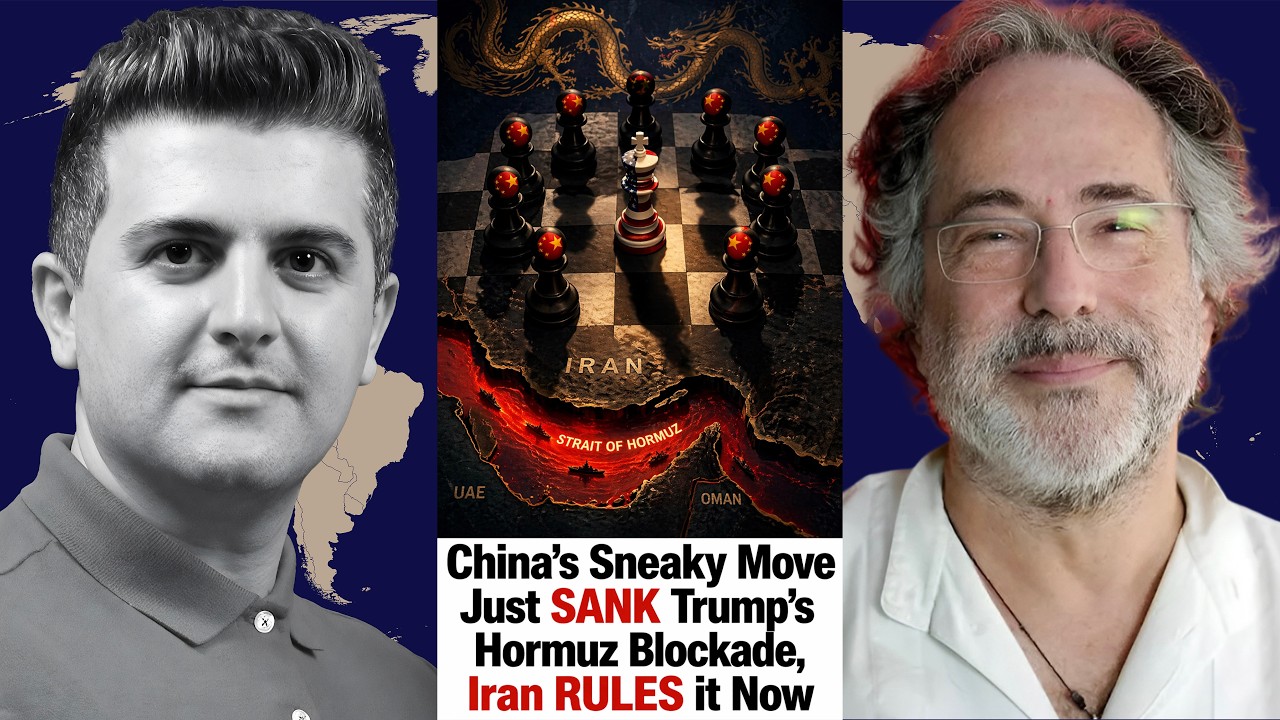
Pepe Escobar: “Total Failure”: Trump’s Blockade Just Backfired Disastrously
"Pepe Escobar argues that the US blockade against Iran, spearheaded by Donald Trump, has utterly failed and backfired, accelerating global economic chaos and challenging US geopolitical dominance."

🚨 TOTAL F*CKING CHECKMATE 😂😂😂
"The host argues that Trump's 'ceasefire' with Iran was a calculated '5D chess' move to orchestrate a global energy market reshuffle, while simultaneously lambasting 'woke' domestic policies and the 'freefall' of anti-Trump conservative figures."