
$5 Gas Is Just the Beginning. It Gets MUCH Worse. | The Next Level
YouTube · 9SEmMmTxQ2w
Quick Read
Summary
Takeaways
- ❖Liberal states' nonpartisan redistricting efforts have created an asymmetry, leaving them vulnerable to aggressive partisan gerrymandering by Republicans.
- ❖The Supreme Court's timing of controversial rulings, particularly on redistricting, is perceived as politically motivated and impactful on elections.
- ❖The 'winner-take-all' mentality is escalating, moving beyond redistricting to federal aid, with the Trump administration reportedly targeting blue states.
- ❖The Iran war is viewed as a significant strategic defeat for America, potentially leading to a global economic crisis and the end of the post-WWII Bretton Woods order.
- ❖There's a call for Democrats to channel public rage into aggressive political action and persuasive messaging, focusing on economic impacts like gas prices and tariffs.
- ❖Voters are increasingly seeking 'outsider' candidates who promise to challenge party leadership and entrenched interests, reflecting widespread dissatisfaction with the political establishment.
Insights
1Asymmetry in Redistricting Due to Good Governance Efforts
Blue and purple states that implemented nonpartisan redistricting commissions to promote good governance now find their hands tied. In contrast, Republican-led states, which avoided such reforms, are free to engage in aggressive partisan gerrymandering, creating a significant electoral disadvantage for Democrats.
Sarah Longwell details how 'democracy community' efforts to make redistricting nonpartisan in blue states now result in more hurdles for them compared to red states that didn't adopt reforms.
2Supreme Court's Politically Timed Rulings
The Supreme Court is accused of making politically motivated decisions, particularly regarding the timing of controversial redistricting rulings. These decisions, like the one impacting Southern states' primaries, are released at opportune moments to influence election outcomes, undermining claims of judicial impartiality.
Tim Miller points out the Supreme Court's historical pattern of releasing controversial decisions at the end of June and highlights the recent redistricting ruling's timing 'right before all the southern states have their primaries,' questioning John Roberts' claims of non-political action.
3Escalation of 'Winner-Take-All' Politics to Federal Aid
The 'winner-take-all' mentality, initially seen in redistricting, is extending to federal resource allocation. The Trump administration has initiated federal reviews and withheld funds from Democratic states, demonstrating a willingness to use federal power to punish political opponents.
JVL notes the Trump administration's unprecedented targeting of blue states with budget cuts and federal aid reviews, including withholding wildfire prevention money from California and Colorado, framing it as a 'winner-take-all' fight.
4Iran War as a Strategic Defeat with Global Economic Catastrophe
The ongoing Iran war is characterized as a profound strategic defeat for America, potentially leading to the collapse of the post-WWII Bretton Woods economic order and an unpredictable global economic crisis. The public is largely unaware of the scale of this impending catastrophe.
Tim Miller, referencing Bob Kagan's Atlantic piece, asserts that the Iran war is 'insane and lost,' a 'total catastrophe' that could end the Bretton Woods order, with consequences far worse than the Iraq war for everyday life, including rising gas prices.
5Voter Demand for Aggressive, Outsider Candidates
Across both parties, voters are increasingly dissatisfied with traditional party leadership and are seeking 'outsider' candidates who are perceived as aggressive, authentic, and willing to challenge the establishment. This reflects a deep-seated rage and desire for fundamental change.
Tim Miller observes a consistent trend since 2012 of 'insane results in the presidential primaries' where voters are 'unhappy with the party leadership' and 'interested in something different, an outsider, somebody to shake it up.' Sarah Longwell adds that voters 'want them to be more aggressive' and 'avatars for their rage.'
Bottom Line
The 'good governance' movement, aimed at nonpartisan redistricting, has inadvertently created an asymmetric vulnerability for blue states, as red states exploit the absence of such reforms to aggressively gerrymander.
This means that efforts to improve democratic processes, while well-intentioned, can be weaponized by less scrupulous actors, leading to a net loss for the side attempting to uphold norms. It highlights a critical strategic dilemma for reformers.
Reform advocates need to develop strategies that account for this asymmetry, possibly by linking 'good governance' to national political consequences or by re-evaluating the timing and scope of unilateral reforms when facing an unconstrained opposition.
The Supreme Court's politically timed rulings, particularly on redistricting, are eroding public trust in judicial impartiality and directly impacting electoral outcomes by disrupting established processes close to elections.
This judicial activism, perceived as partisan, further radicalizes voters and contributes to a sense of helplessness, making it harder to convince people that the system is fair or responsive.
Political leaders and civil society groups must explicitly call out and document these patterns of judicial timing and impact, using it as a rallying cry for electoral mobilization and potentially for future judicial reform efforts, if political power is secured.
The current political climate fosters 'rage without a plan,' where widespread anger and online discourse fail to translate into effective, organized action for democratic change.
This impotence allows anti-democratic forces to operate with less resistance, as they perceive public outrage as performative rather than a genuine threat to their power.
Leaders should focus on converting this diffuse rage into concrete, non-violent political action, such as large-scale protests and targeted persuasion campaigns, by providing clear objectives and pathways for engagement beyond online expression.
The potential use of federal aid as a 'deterrence' against states engaging in anti-democratic practices, mirroring the Trump administration's targeting of blue states, represents a significant escalation of 'winner-take-all' politics.
Such a strategy, while potentially effective in creating leverage, risks further fracturing national unity and harming innocent citizens within targeted states, blurring the lines between political punishment and governance.
If adopted, this strategy would require careful calibration to maximize political pressure on state legislatures without unduly punishing local populations, potentially through conditional aid or targeted infrastructure investments linked to democratic reforms.
Opportunities
Political Brand Ruination Campaigns
Develop and execute aggressive, data-driven advertising campaigns in targeted states to systematically 'ruin the brand' of specific politicians (e.g., governors, senators) by directly linking their policies (e.g., sales tax increases, poor school performance) and their party's national actions (e.g., war-driven gas prices) to negative impacts on constituents' daily lives. The goal is not necessarily to convert voters to the opposing party, but to erode support for the targeted politicians and their party.
Key Concepts
The Ratchet Effect (Illiberalism)
This model describes how illiberal actions, once taken, are difficult to reverse, and how liberal processes can be exploited to achieve illiberal ends. The hosts argue that 'liberalism is a one-way street; the ratchet only turns one way,' meaning that while liberal states adhere to process, illiberal states disregard it, creating an asymmetric advantage for the latter.
Deterrence Theory (Political)
Applied to domestic politics, this theory suggests that aggressive actions by one political side (e.g., partisan gerrymandering, withholding federal aid) must be met with a credible threat of reciprocal action from the other side to prevent further escalation. The hosts debate whether a Democratic administration should use federal spending as a deterrent against red states engaging in anti-democratic practices.
Rage Without a Plan
This concept highlights the ineffectiveness of public anger or online outrage if it is not channeled into organized, strategic action with clear objectives. The hosts lament that much of the current political rage is unproductive because it lacks a concrete plan for achieving political change, contrasting it with historical non-violent resistance movements.
Lessons
- Prioritize winning elections with overwhelming force to gain political power, as this is the foundational step for implementing any meaningful democratic reforms or counter-strategies.
- Channel public anger and frustration into organized, non-violent political action, such as large-scale protests and targeted persuasion campaigns, rather than allowing it to remain as unproductive online rage.
- Develop and deploy aggressive, clear, and persuasive messaging that directly links opponents' policies and actions to tangible negative impacts on voters' daily lives (e.g., higher gas prices, increased taxes).
- Support and promote 'outsider' candidates who authentically channel public dissatisfaction and are willing to challenge established party leadership and entrenched interests, reflecting the current voter mood for change.
- Re-evaluate 'good governance' strategies in light of political asymmetry, considering how unilateral reforms can be exploited by unconstrained opponents, and develop more robust deterrence mechanisms.
Overwhelming Electoral Victory & Aggressive Messaging Playbook
**Identify and Mobilize the 'Rage Vote':** Understand the deep dissatisfaction with the political establishment and channel this energy into active participation, both at the ballot box and in public demonstrations.
**Go on Offense with Messaging:** Craft simple, direct messages that connect political decisions (e.g., wars, tariffs, local taxes) to everyday economic hardships (e.g., gas prices, beer prices) and attribute blame clearly to political opponents.
**Invest in Persuasion, Not Just Structural Reforms:** Allocate significant resources to advertising and direct voter contact aimed at changing minds and eroding opponent's brands, rather than solely focusing on complex, often vulnerable, structural reforms.
**Support 'Punching' Candidates:** Back candidates who are perceived as aggressive, authentic, and willing to fight against established interests and political opponents, aligning with the public's desire for strong avatars of their frustration.
**Prepare for Post-Election Challenges:** Anticipate and strategize for potential challenges to election results, especially in close races, given the current political climate of questioning democratic processes.
Notable Moments
The hosts' satirical take on Marjorie Taylor Green's departure from Congress, framing it as a 'pure' decision to find love and start a new life in Costa Rica, suggesting it as a model for other ineffective or complicit politicians.
This moment highlights the hosts' cynical view of the current political landscape and the perceived lack of integrity among many elected officials, using humor to suggest that disengagement might be a more 'pure' path than complicity.
Sarah Longwell's 'boomer appreciation rant,' praising older generations for actively protesting in the streets while questioning the absence of younger people despite widespread online rage.
This reflects a frustration with the disconnect between online political discourse and real-world action, underscoring a perceived generational gap in civic engagement and the effectiveness of different forms of protest.
The anecdote about an Uber driver in New Orleans expressing feelings of radicalization and helplessness after her vote was effectively canceled due to redistricting.
This personal story humanizes the abstract political issues, illustrating the direct impact of gerrymandering and judicial decisions on individual citizens' trust in democracy and their sense of political efficacy.
Quotes
"Liberalism is a one-way street, right? The ratchet only turns one way."
"You cannot tell me it was a [expletive] accident, right? Okay. You just can't. Like it was not a coincidence, right?"
"The anger comes from feeling impotent and feeling like there's not a lever to pull."
"We are going to lose this war and we're going to end up way worse off. The Iranians are going to control this straight and therefore the global oil supply for the foreseeable future because of a thing that us and Israel went and did."
"I don't think that most people have any idea how bad the situation is. Like it is it's very possible that it's the end of the Bretton Woods postworld war II order."
"Voters are very clear on what they want. They don't care about whether a candidate is more centrist or more progressive. They want them to be more aggressive."
Q&A
Recent Questions
Related Episodes
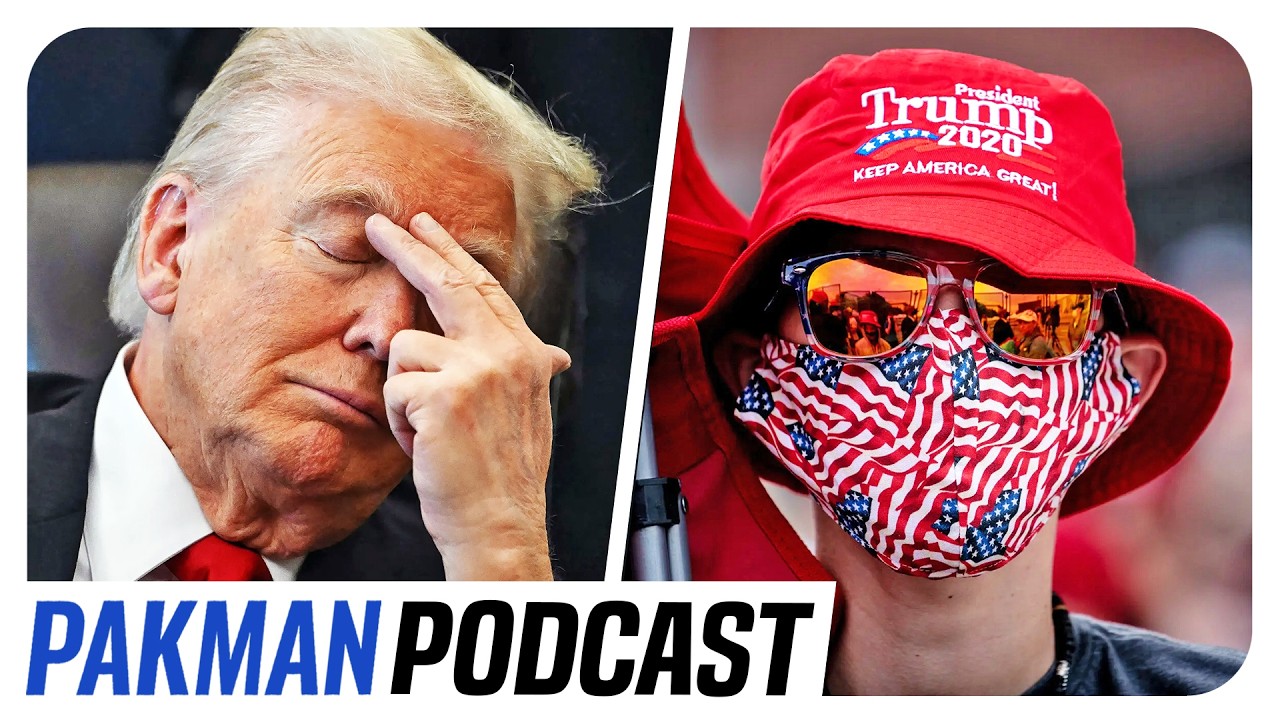
What happens to Trump voters when Trump is gone?
"The David Pakman Show explores the contentious path forward for Trump voters after his political era, exposing alleged corruption, economic misrepresentation, and the necessity of media literacy."

Trump's HEATED Call + AOC's Data Center Deep Dive | PBD #804
"This episode dissects the week's most impactful events, from Trump's contentious call with Netanyahu and Elon Musk's path to trillionaire status, to the societal implications of AI-driven job displacement and AOC's unexpected political alignment on data center concerns."

A major shift is happening right now
"Donald Trump is losing his grip on the Republican party and movement, evidenced by internal dissent and a broader political landscape grappling with a collapse of accountability and truth."

Billionaire Investor Ray Dalio Warns of Deadly Economic Crisis (Here's How to Avoid It)
"Ray Dalio outlines a historical cycle of civilizations, asserting the US is in 'Stage 5' of decline, characterized by monetary, political, and geopolitical breakdowns, and warns of an impending 'great disorder' if systemic issues like the budget deficit are not addressed."