
Pepe Escobar: Iran’s Hidden Strategy: DEATH by a THOUSAND CUTS
YouTube · AYjHa4WDj5w
Quick Read
Summary
Takeaways
- ❖Iran's 'decentralized mosaic strategy' allows autonomous regional commanders to make rapid, on-the-spot decisions, enabling immediate and devastating responses to attacks.
- ❖The ongoing conflict is accelerating the decline of the petrodollar, with Gulf states considering withdrawing US investments and Russia gaining significant leverage over OPEC+.
- ❖The US leadership's lack of pre- and post-planning, coupled with perceived ignorance, has turned them into 'cornered animals,' making the geopolitical situation extremely volatile.
Insights
1Iran's Sophisticated 'Decentralized Mosaic Strategy'
Iran's official strategy, fine-tuned for months, involves a decentralized command structure with four levels of replacement tiers. Regional commanders are autonomous, making immediate decisions without central approval. This allows for rapid, flexible, and incremental targeting of US military bases, energy installations, and even hotels housing US personnel in the Gulf states.
Pepe Escobar describes it as an 'immensely sophisticated' strategy of 'death by a thousand cuts' against the 'Epson syndicate' (US-Israel combo). He notes the decentralization of decisions, allowing commanders to make '5-second decisions on the spot.'
2Immediate and Devastating Iranian Response
Iran demonstrated a significantly improved response capability compared to previous conflicts. Following a decapitation strike, Iran unleashed 1,200 missiles and drones on day one, using older generation missiles initially, with plans to progressively deploy newer batches and state-of-the-art hypersonics for precise targets.
Escobar states, 'half an hour after the decapitation strike... Iran unleashed its response.' He mentions '1,200 missiles and drones on day one' and the progressive use of 'new batches missiles' and 'state-of-the-art hypersonics.'
3Gulf States' Disillusionment and Economic Repercussions
The conflict has exposed the vulnerability of Gulf monarchies, leading to their disillusionment with US protection. They are discussing withdrawing from US contracts and canceling future investment commitments, recognizing that the US prioritizes Israel over their security and economic stability.
Nema reports 'Saudi Arabia, the United Arab Emirates, Kuwait, Qatar are discussing withdrawing from contracts with the United States and cancelling future investment commitments.' Escobar cites an open letter from Emirati billionaire Khalaf Ahmed al-Habur to Trump, stating, 'You placed the GCC countries at the heart of danger they didn't choose.'
4Accelerated Decline of the Petrodollar and Rise of Russia/China
The conflict is fundamentally breaking the petrodollar system. Gulf states are expected to seek alternatives to selling energy in dollars. Russia is already consolidating control over OPEC+, and China is poised to facilitate a transition to the petroyuan, further diminishing US financial influence.
Escobar asserts, 'the business model is how the petro dollar works... they will stop using the petro dollar.' He adds, 'Guess who controls OPEC plus now already? Russia.' and 'the transition is going to be from the petro dollar to the petrol yuan.'
5US Leadership's Ignorance and Miscalculation
The US entered the conflict with pre-planning but 'zero post planning,' assuming a quick regime change in Iran. The leadership, particularly Trump, is characterized by 'arrogance and total ignorance,' reacting to soundbites rather than intelligence, making them 'cornered animals' capable of dangerous, absurd decisions.
Escobar states the US 'got into this without any pre with some pre-planning but with zero post planning' and describes Trump as a 'functional illiterate' with a 'very very peculiar mix of arrogance and total ignorance.'
6India's Betrayal of BRICS and Economic Partners
India is accused of betraying its BRICS partners and economic allies like Iran, particularly by not condemning the assassination of Ayatamele and aligning with the 'abstinent syndicate.' This behavior threatens to sideline India from key regional projects like the International North-South Transportation Corridor, with China ready to step in.
Escobar states, 'India has behaved in the most disgusting diplomatic way possible. The blow up of bricks at the moment the responsibility is totally with India.' He suggests Russia and Iran 'should expel India from this corridor and bring in China.'
7Iran's Preparedness for a Long, Asymmetrical War
Iran has planned for a very long war, maintaining intact underground missile factories and possessing tens of thousands of drones. They are capable of sustaining asymmetrical warfare for months, even while enduring heavy bombardment, demonstrating a resolve rooted in their history as a civilization state.
Escobar notes, 'all those underground missile factories they are there intact' and Iran 'must have what over 20,000 drones if not more, maybe 40,000 drones. So they can take this to forever if they want.' He states, 'Iran planned for a very long war.'
Bottom Line
The US's perceived abandonment of Gulf monarchies could lead to Russia becoming a new 'umbrella' for their protection, fundamentally altering regional security architecture.
This would signify a complete reversal of traditional alliances, granting Russia unprecedented influence over critical energy producers and trade routes, further isolating the US.
For Russia, it's an opportunity to expand its geopolitical and economic reach, securing long-term energy partnerships and challenging Western dominance in the region.
China is strategically positioned to integrate Iran's Chabahar Port into its Maritime Silk Road, especially if India is sidelined from the International North-South Transportation Corridor due to its perceived betrayal.
This would enhance China's access to West Asian markets and energy resources, strengthening its Belt and Road Initiative and providing an alternative to the Strait of Hormuz for its trade.
China gains a critical strategic port, deepening its economic and logistical ties with Iran and potentially creating a more resilient supply chain independent of Western influence.
The rapid destabilization of the global energy market and the petrodollar system could trigger a systemic breakdown of the global economy, far beyond initial predictions.
This indicates that the current conflict is not merely regional but has immediate, profound, and unpredictable global economic consequences, affecting everything from commodity prices to international finance.
Nations and entities prepared for de-dollarization and diversified energy sources may weather the storm better, potentially gaining economic advantage in a new multipolar financial order.
Key Concepts
Death by a Thousand Cuts
This strategy, evoked from Chinese friends, describes Iran's approach of inflicting numerous small, incremental damages and attacks against the US-Israel combo, rather than a single decisive blow. The cumulative effect aims to weaken and eventually defeat the adversary.
Decentralized Mosaic Strategy
This is Iran's official military doctrine, characterized by a highly autonomous, multi-tiered command structure. Regional commanders can make 5-second decisions without central approval, allowing for rapid, flexible, and sophisticated responses. The 'mosaic' aspect refers to the intricate, multi-angled, and adaptable nature of its implementation.
Lessons
- Monitor shifts in Gulf state alliances and investment patterns, as their disillusionment with the US could trigger significant capital reallocation and new regional partnerships.
- Track the evolving dynamics of OPEC+ and the petrodollar, as Russia's increasing influence and the potential rise of the petroyuan will directly impact global energy pricing and currency stability.
- Assess geopolitical risk models to account for the 'functional illiteracy' and unpredictable decision-making of key global leaders, recognizing that traditional diplomatic and strategic frameworks may no longer apply.
Notable Moments
Khalaf Ahmed al-Habur's open letter to Trump, expressing Gulf states' disillusionment.
This public rebuke from a prominent Emirati billionaire signifies a deep fracture in trust between Gulf monarchies and the US, highlighting their feeling of being endangered and used, rather than protected.
Iranian Foreign Minister Arashi's interview with NBC, where he deftly handled questions about Russian and Chinese military support.
Arashi's composed and articulate responses, without revealing specific details, confirmed tacit support from Russia and China, shocking mainstream Western media and potentially influencing US public opinion against the war.
Quotes
"It is a strategy of death by a thousand cuts to evoke our Chinese friends against the Epson syndicate, the US-Israel combo. And it's immensely sophisticated."
"You placed the GCC countries at the heart of danger they didn't choose."
"The Kremling wants to see the smashing of the US presence in West Asia as much as Iran and as much as China."
"The transition is going to be from the petro dollar to the petrol yuan. No question about that."
"He doesn't read intel reports which land on his desk every morning. He only uh reacts to uh Fox News sound bites... Basically, he is a functional illiterate."
Q&A
Recent Questions
Related Episodes

Alex Krainer: US STRIKES Iran – Iran RETALIATES Against Kuwait, Bahrain & Jordan!
"Amidst escalating US-Iran conflict and Iranian retaliation against regional US allies, this episode argues that US foreign policy is deeply controlled by an 'Anglo-Zionist conspiracy' led by the Rothschild banking dynasty, prioritizing Israeli interests over American ones."

Patrick Henningsen: Hezbollah JUST Fired Back at Israel - Iran Vows to “Crush” All Attacks
"Patrick Henningsen argues that the US and Israel initiated an illegal war against Iran, driven by Trump's incompetence and Israeli influence, leading to an inevitable escalation with severe global economic repercussions."
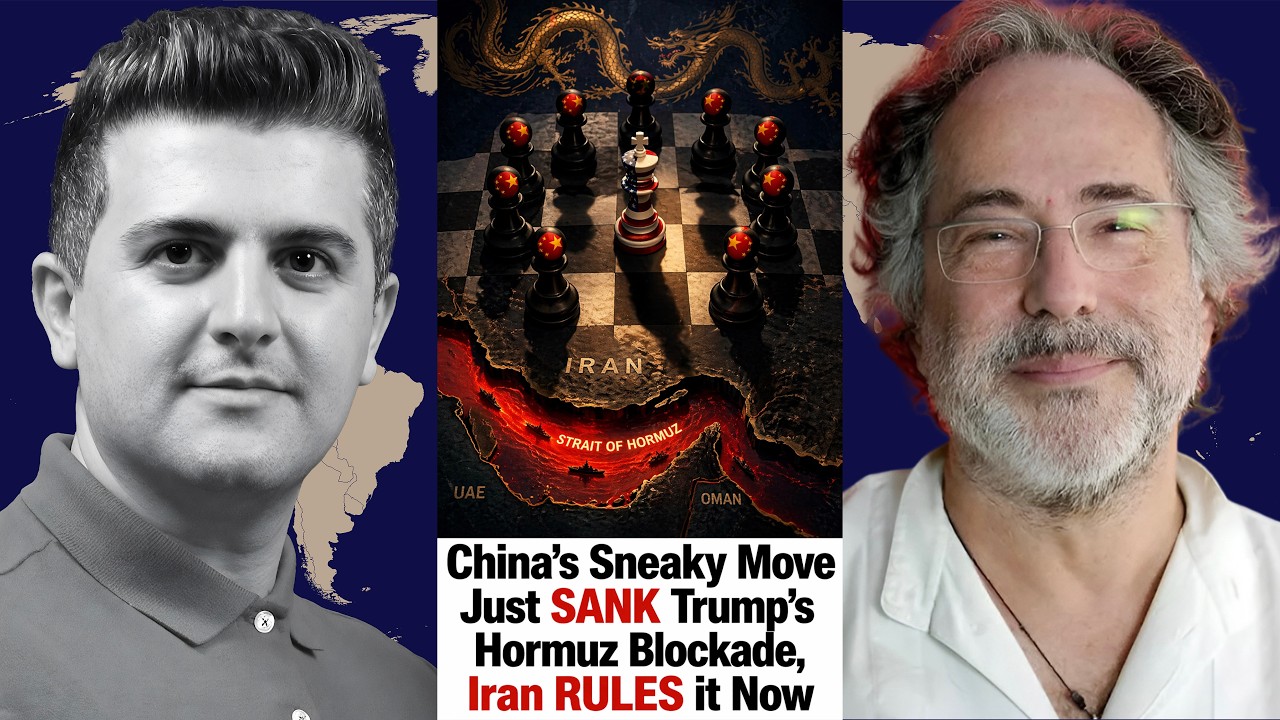
Pepe Escobar: “Total Failure”: Trump’s Blockade Just Backfired Disastrously
"Pepe Escobar argues that the US blockade against Iran, spearheaded by Donald Trump, has utterly failed and backfired, accelerating global economic chaos and challenging US geopolitical dominance."

🚨 TOTAL F*CKING CHECKMATE 😂😂😂
"The host argues that Trump's 'ceasefire' with Iran was a calculated '5D chess' move to orchestrate a global energy market reshuffle, while simultaneously lambasting 'woke' domestic policies and the 'freefall' of anti-Trump conservative figures."