
What Is Quantum Mechanics Really Telling Us? | World Science Festival
YouTube · Af5LICjFIBc
Quick Read
Summary
Takeaways
- ❖The term 'interpretation' in quantum mechanics is a misnomer; these are distinct theories, some incomplete.
- ❖Physics' purpose is understanding the world, not just making predictions to many decimal places.
- ❖The Heisenberg picture, focusing on observable dynamics, offers a clearer understanding of quantum theory than the Schrodinger picture.
- ❖The Everettian (Many Worlds) theory, when taken seriously, reveals a deterministic multiverse where all possible outcomes occur.
- ❖Probability is not fundamental to the universe; it's a concept needed for decision-making within a deterministic quantum reality.
- ❖Quantum computation challenges collapse theories (like GRW) by requiring a flexible boundary for collapse that shifts with technological advancement.
- ❖The de Broglie-Bohm theory, while realist, is seen as the Everett theory with unnecessary complications due to its equivocation on the reality of pilot waves and particles.
- ❖Free will is the ability to create novelty and new knowledge, distinct from both classical determinism and quantum indeterminism.
- ❖Constructive theory aims to express physics in terms of what transformations can and cannot be brought about, potentially making laws of motion and initial conditions emergent properties.
Insights
1Quantum 'Interpretations' are Distinct Theories
Deutsch, echoing Bryce DeWitt, asserts that what are commonly called 'interpretations' of quantum mechanics are actually different theories. Some, like the Copenhagen interpretation, are incomplete, while others, like Everett's, are full theories about reality. This distinction is crucial for scientific progress, as treating them as mere interpretations lowers the standard of argument.
The host and Deutsch discuss how the term 'interpretation' is a misnomer, with Deutsch stating he got this view from Bryce DeWitt who was 'angry about this terminology'.
2Physics' Purpose is Understanding, Not Just Prediction
Deutsch argues against the instrumentalist view that physics is solely about making predictions. He contends that the primary purpose of physics, like all science, is to understand and control the world by explaining the 'seen in terms of the unseen,' generating new ideas about what is actually happening.
Deutsch states, 'I think that is giving up on the purpose of physics. The idea, the purpose of physics is to track down the sixth and seventh decimal place of predictions. It's just absurd.'
3Heisenberg Picture Offers Clearer Quantum Reality
Deutsch favors the Heisenberg picture over the Schrodinger picture for understanding quantum theory. While both are mathematically equivalent, the Heisenberg picture treats observables as fundamental and time-evolving (q-numbers), with the state being constant. This avoids the conceptual difficulties of a 'wave function collapse' and offers a more intuitive description of how outcomes arise, similar to classical physics.
Deutsch states, 'I favor using the Heisenberg picture, which is the other way around. It takes as fundamental, the observables of a physical system, exactly like classical physics does.'
4Quantum Computation Challenges Collapse Theories
Deutsch argues that theories proposing wave function collapse (like GRW) are undermined by quantum computation. These theories require a parameter for the speed or complexity of collapse, but the dividing line for this parameter would constantly change as quantum computers become more powerful, making the theory unstable and impractical.
Deutsch explains that collapse 'has to take place at a certain speed, or at a certain complexity... And the bigger the quantum computer you're contemplating... this dividing line where you've got to set the parameter is going to change every time somebody makes a better quantum computer.'
5Probability is Not Fundamental in a Deterministic Multiverse
In the Everettian multiverse, where all possible outcomes occur, Deutsch posits that probability is not a fundamental feature of reality. Instead, it's a concept that emerges from decision theory. When stripped of its probability axiom, conventional decision theory, combined with quantum mechanics, dictates how rational agents should 'bet' on outcomes, yielding the same probabilities as the Born rule.
Deutsch states, 'There is no such thing as probability at a fundamental level. The world according to Everett and quantum theory is completely deterministic.' He adds, 'We only want it for making decisions. And if we apply it with conventional decision theory... then we get the answer we want.'
6Free Will is the Creation of Novelty, Not Quantum Indeterminism
Deutsch's updated view on free will separates it from the multiverse or quantum indeterminism. He argues that free will is the ability to introduce genuinely new knowledge or ideas into the world (inspiration), which are not reducible to prior physical states. This emergent layer of 'explanatory ideas' operates under its own laws, distinct from the deterministic physics of particles.
Deutsch explains, 'there really is something new that you are bringing into the world when you make a decision. Not any decision... But we do sometimes bring something new into the world, new knowledge, basically.' He contrasts this with 'grunt work' that can be automated.
Bottom Line
The lack of a mathematical object for the 'multiverse' within quantum theory, despite its conceptual utility, highlights a gap in our fundamental understanding of reality's structure.
This suggests that current quantum theory, even in its Everettian form, is incomplete at a foundational level, lacking a 'spacetime' equivalent for the multiverse. Future theories must define this underlying mathematical structure.
Research into 'constructive theory' or other foundational approaches that define reality based on 'what can and can't be brought about' could provide the missing mathematical framework for the multiverse, potentially unifying physics at a deeper level.
The historical preference for the Schrodinger picture over the Heisenberg picture, despite the latter's conceptual clarity for understanding reality, was partly due to its mathematical familiarity (waves) and the complexity of matrix mechanics at the time.
This historical bias may have hindered conceptual progress in quantum mechanics by prioritizing calculational ease over fundamental understanding, leading to persistent 'interpretational' issues.
Re-emphasizing the Heisenberg picture in quantum education and research could foster a more realistic and less mystical approach to quantum phenomena, potentially accelerating the development of next-generation theories.
Key Concepts
Heisenberg Picture vs. Schrodinger Picture
Two equivalent mathematical formulations of quantum mechanics. The Schrodinger picture uses a time-evolving wave function to describe probabilities, while the Heisenberg picture focuses on time-evolving observables (q-numbers) and a constant state. Deutsch argues the Heisenberg picture is superior for understanding the underlying reality, as it directly describes the motion of physical system observables, similar to classical physics.
Everettian (Many Worlds) Interpretation
The theory that all possible outcomes of a quantum measurement actually occur, each in a different 'branch' or 'universe' of the multiverse. Deutsch champions this as the most logical conclusion when taking quantum mechanics seriously, implying a deterministic, branching reality rather than a probabilistic collapse.
Probability as a Decision Theory Construct
Deutsch's view that probability is not a fundamental property of the universe but an emergent concept derived from decision theory. In a deterministic multiverse where all outcomes happen, probability serves as a rational framework for making choices and inferences, rather than describing inherent randomness.
Free Will as Creation of Novelty
A redefinition of free will, separating it from the debate of determinism vs. indeterminism. Deutsch argues that free will is the human capacity to bring genuinely new knowledge and ideas into the world (inspiration), rather than merely executing pre-determined or random processes. This 'novelty' is an emergent layer of physical events obeying its own laws (e.g., epistemology).
Constructive Theory
A proposed framework for physics that expresses laws in terms of what transformations can and cannot be brought about, rather than initial conditions plus laws of motion. This approach suggests that fundamental laws (like computational universality) could imply emergent properties such as laws of motion and initial conditions, offering a different foundational perspective.
Q&A
Recent Questions
Related Episodes

Solo: Looking Quantum Mechanics in the Eyeball | Mindscape 355
"Sean Carroll argues that fundamental reality in quantum mechanics is an abstract vector in Hilbert space, and familiar concepts like space and locality are emergent properties, not fundamental."
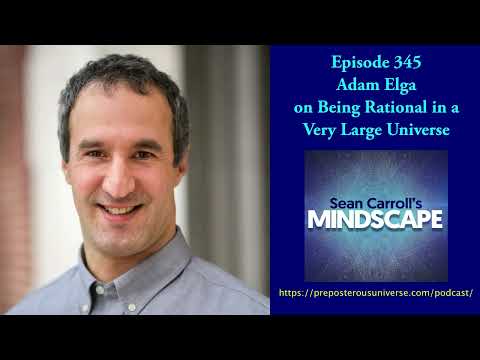
Adam Elga on Being Rational in a Very Large Universe | Mindscape 345
"This episode explores the profound challenges to rationality and Bayesian reasoning when confronted with extreme uncertainties, such as self-locating problems in vast cosmological models or the implications of Boltzmann brains."

Live Q&A with Brian Greene | World Science Festival
"Brian Greene answers diverse questions on cosmology, quantum mechanics, and the future of science, from black holes and multiverse theories to the impact of AI on physics research."
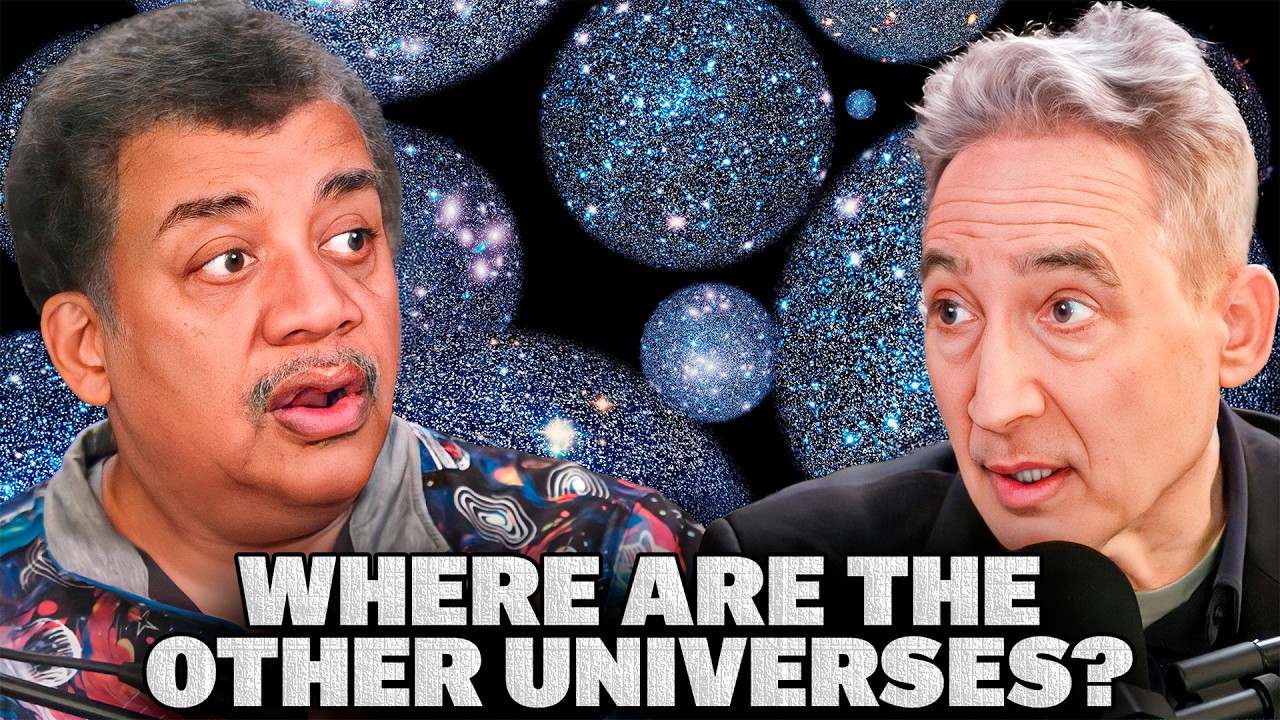
Exploring Hidden Dimensions with Brian Greene
"Theoretical physicist Brian Greene unpacks the universe's most mind-bending concepts, from the many-worlds multiverse to the fabric of spacetime woven by quantum entanglement, with Neil deGrasse Tyson."