
Stanislav Krapivnik: Breaking: US attacks Iran - Russia: No Deal Coming
YouTube · Cg-cFVQ55S8
Quick Read
Summary
Takeaways
- ❖Russian public opinion demands aggressive escalation in Ukraine, driven by anger over drone attacks, not fear.
- ❖Skepticism surrounds the US justification for striking Iran, with claims of fabricated incidents and Trump's alleged market manipulation.
- ❖Iran's '150% response' doctrine and the unification of the 'Axis of Resistance' signal a significant shift in regional power dynamics.
Insights
1Russian Public's Demand for Escalation
Anger, not fear, drives Russian public opinion regarding drone attacks on Russian soil, leading to widespread calls for decisive military action against Ukraine and questioning why Kyiv remains standing.
Stanislav Krapivnik states, 'these attacks on on Russia, they don't make people scared, they make people angry. And the anger is already pretty damn high as it is.' He adds, 'the common question is, you know, why is Kev still standing?'
2Kremlin's Internal Factions
The Russian government contains diverse factions, ranging from those advocating for extreme military escalation (e.g., 'burning Paris and London') to those seeking a diplomatic deal, complicating policy decisions.
Krapivnik explains, 'there are different factions inside the Kremlin... there are hardcore factions that say, "We should have been burning uh Paris and London to the ground by now."' He contrasts this with 'the other side hey let's make a deal and go back to 2012.'
3Critique of Russian Military Strategy
Military analysts question Russia's failure to destroy critical Ukrainian logistics infrastructure, such as Dnieper River bridges, deeming it militarily illogical and suggesting political motivations rather than military necessity.
Krapivnik asks, 'the bridges over the Neper, for example, are still standing. Why are they still standing?' He asserts, 'from a professional military point of view, that was the first thing you need to take out. You cut the logistics.'
4"Manufactured Reality" in Western Media
Western media narratives (e.g., CNN) are accused of presenting a distorted view of the Ukraine conflict, downplaying Russian advances and Ukrainian losses while highlighting minor Ukrainian gains to create a 'manufactured reality.'
Krapivnik dismisses a CNN analyst's claim of Ukrainian success, stating, 'It's manufactured reality.' He points out that Western media ignores significant Russian advances like the fall of Constantinovka and encirclement in Zaparosia.
5Skepticism on US-Iran Helicopter Incident
The official US narrative of an Apache helicopter being hit by an Iranian drone with no casualties is strongly doubted, citing helicopter vulnerabilities and the implausibility of surviving such an event without injury.
Krapivnik, drawing on his Apache unit experience, states, 'Helicopters are a [__] to survive when they go down.' He calls the claim of no injuries 'Bull crap. Total crap. So, I don't believe for a second, oh, the pilots weren't injured. I don't believe the Apache even happened.'
6Trump's Alleged Market Manipulation
Former President Trump is accused of using geopolitical events and potentially fabricated incidents to influence markets for personal financial gain, citing a history of significant stock movements.
The host asks, 'Why would you say that? Just because Trump has had 3,000 stock uh movements that earned him $4 billion over the last year and a half.' Krapivnik describes Trump as a 'pathological liar' who 'fully believe[s] their own crap.'
7Iran's Assertive Stance and "Axis of Resistance"
Iran has shifted from a defensive 'survival mode' to a more assertive posture, with its society demanding strong retaliation, leading to an unprecedented unification of the 'Axis of Resistance' (Yemen, Iraq, Lebanon, Palestine).
Krapivnik notes, 'Iran's a lot more assertive. It's no longer survival mode. It's now where uh let's see what do we want now.' The host adds, 'they have united the axis of resistance the way that we haven't seen it before.'
8Iran's "150% Response" Doctrine
Iran's policy is to escalate beyond a tit-for-tat response, aiming for a 150% retaliation to deter future attacks, contrasting with the US strategy of 'death by a thousand cuts.'
Krapivnik explains, 'they've had a policy basically of uh 150% response... if the if the swan guy is going to cut you in the chest, you chop his hand off. There's your response.'
Bottom Line
The US is projected to exhaust its standoff munitions within two weeks, potentially limiting its capacity for sustained long-range strikes against Iran.
This suggests a critical vulnerability in US military projection, potentially forcing a re-evaluation of engagement strategies or leading to an operational pause if ground forces are not viable.
For adversaries, this highlights a window of opportunity to withstand initial strikes and then leverage US logistical constraints.
The unification of the 'Axis of Resistance' (Yemen, Iraq, Lebanon, Palestine) represents a significant, unprecedented geopolitical shift, making it difficult for external powers to isolate or divide these regional actors.
This creates a more formidable and coordinated regional bloc, increasing the complexity and potential scale of any conflict involving these nations.
For Iran, this solidifies its regional influence and provides a multi-front deterrent against aggression.
Russia's long-term strategy for Western Ukraine involves encouraging neighboring countries (Poland, Hungary, Romania) to reclaim historical territories, rather than direct Russian occupation, to avoid inheriting a 'hotbed of terrorists.'
This indicates a calculated approach to regional restructuring that offloads the burden of pacification and governance onto other nations, while still achieving a demilitarized buffer.
For these neighboring countries, it presents a potential, albeit risky, opportunity to expand territorial claims.
Notable Moments
Host announces breaking news that the United States is attacking Iran during the live podcast.
This live update injects immediate relevance and urgency into the discussion, shifting the focus to a rapidly unfolding geopolitical crisis and allowing for real-time commentary.
Stanislav Krapivnik strongly questions the veracity of the official US report regarding an Apache helicopter being hit by a drone with no casualties, calling it 'bull crap.'
This highlights a deep skepticism towards official narratives, suggesting potential fabrication of pretexts for military action and underscoring a theme of distrust in government statements.
Quotes
"They've taught Russians how to hate. Again, Russians don't hate pe other people normally, but they they the West has done a very good job of it."
"The Russian military is in a fighting mood in in a very angry fighting mood."
"Helicopters are a [__] to survive when they go down... You're not ejecting out of a out of an Apache. Why? Because you're going to go right through the rotors."
"Iran's a lot more assertive. It's no longer survival mode. It's now where uh let's see what do we want now."
"I started calling Israel a war crime masquerading as a country."
Q&A
Recent Questions
Related Episodes
Patrick Henningsen: Hezbollah JUST Fired Back at Israel - Iran Vows to “Crush” All Attacks
"Patrick Henningsen argues that the US and Israel initiated an illegal war against Iran, driven by Trump's incompetence and Israeli influence, leading to an inevitable escalation with severe global economic repercussions."

🚨 THEY F*CKED AROUND FOR THE LAST TIME 😭😭😭
"This episode unleashes a torrent of highly opinionated commentary on the US-Iran deal, Israel's role, and a scathing critique of 'leftist' policies and immigration, particularly highlighting the UK grooming gang report as evidence of Western societal decay."
BREAKING: Protests ERUPT In Iran Over IRGC Surrendering To Trump - Infighting Clashes In Tehran
"Iran is experiencing severe internal infighting and protests as hardline IRGC elements clash with government figures over a perceived 'surrender' to the US, while mainstream Western media misrepresents the situation."
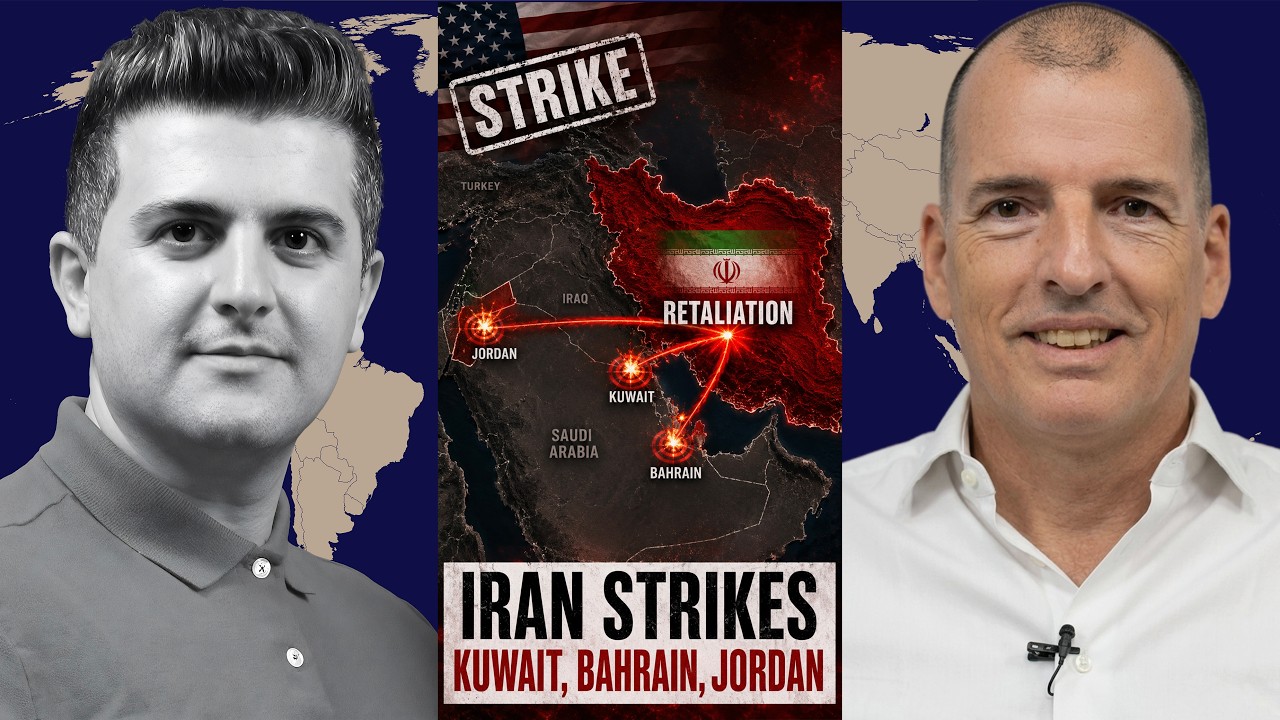
Alex Krainer: US STRIKES Iran – Iran RETALIATES Against Kuwait, Bahrain & Jordan!
"Amidst escalating US-Iran conflict and Iranian retaliation against regional US allies, this episode argues that US foreign policy is deeply controlled by an 'Anglo-Zionist conspiracy' led by the Rothschild banking dynasty, prioritizing Israeli interests over American ones."