
Watch the GOP Media Machine Flip the Switch (w/ Lib & Learn)
YouTube · EoNmR0S5mqc
Quick Read
Summary
Takeaways
- ❖Political violence, while serious, often doesn't significantly alter public opinion or poll numbers.
- ❖The idea that 'words are violence' is a misdirection from underlying issues like gun proliferation.
- ❖The Republican media machine exhibits a high degree of cultishness and coordinated messaging, often incentivized by monetization.
- ❖Democrats need candidates who offer a clear critique of the party establishment and appeal to economic populism.
- ❖A successful Democratic strategy requires a clear anti-stupid-war foreign policy and a slightly tougher stance on public safety/immigration.
- ❖Democratic leadership, particularly in Congress, is perceived as lacking the 'fight' and compelling messaging that resonates with the base.
- ❖The 'Green Lantern theory of politics' (presidents can force Congress to act through will/charisma) is a flawed lens for evaluating political effectiveness.
- ❖Effective political communication now demands a 'more is more' approach, with constant updates and credit-claiming, as exemplified by figures like Zoron.
- ❖Biden's VP choice and continued candidacy are criticized for prioritizing identity politics and personal ambition over strategic effectiveness.
- ❖The long-term trajectory of the Republican Party is seen as a permanent shift towards right-wing populism and authoritarianism.
Insights
1The Cynical Exploitation of Political Violence
Tim Miller and the hosts discuss how political violence, like assassination attempts, is often cynically exploited by political parties for perceived gain, despite rarely leading to significant, lasting shifts in public opinion or poll numbers. They note that such events are quickly absorbed into the news cycle without fundamentally changing voter perspectives on candidates like Trump.
Miller points out that 13 of the last 15 presidents have faced assassination attempts, and even Gerald Ford had two in 17 days, none of which became major historical inflection points. He argues that the focus on 'rhetoric' after such events distracts from the more tangible problem of gun proliferation.
2The GOP Media Machine's Coordinated Messaging
The discussion highlights the highly coordinated and 'cultish' nature of the modern Republican media apparatus. This machine quickly disseminates unified talking points, often leveraging social media monetization to incentivize the spread of partisan narratives, regardless of factual basis.
Ashley Sinclair's observations about unified messaging in chat groups, where everyone is 'on the same page minutes after it happens' to push specific narratives (e.g., the 'ballroom' story), are cited. Miller notes that unlike past campaigns where journalists had 'minimum dignity,' current social media platforms incentivize 'Trump slop' for retweets and monetization.
3A Playbook for Democratic Electoral Success
Tim Miller, a former Republican, outlines a pragmatic strategy for Democrats to achieve electoral wins, even if it diverges from his personal ideological preferences. This involves distancing from the 'Clinton, Biden, Harris triumvirate' and adopting a specific policy and messaging mix.
Miller suggests Democrats need a candidate with 'distance from the Clinton, Biden, Harris triumvirate,' offering 'a little bit more economic populism,' a 'very clearly anti-the stupid war' foreign policy, and a 'slightly' rightward shift on 'either immigration or public safety,' demonstrating a pivot from 'far-left prosecutors' and ensuring violent criminals are 'put behind bars.'
4The Imperative of Oversight and Investigations for Democrats
Miller stresses that when Democrats regain power, their primary focus should be maximizing oversight and investigations into corruption, rather than solely pursuing impeachment. He argues that the previous Democratic House failed to adequately investigate Trump's administration.
Miller expresses obsession with the need for 'absolutely max out on oversight and investigations' when Democrats take back power, citing 'the amount of corruption that he has undergone in this two years is just beyond people's imagination.' He criticizes the decision to 'stop investigating Trump and what had happened before' during the Biden years.
5The 'Green Lantern Theory' and Democratic Messaging Failures
The 'Green Lantern theory of politics' is introduced, which posits that presidents can achieve anything through sheer will or charisma. The hosts argue that many on the left apply this flawed theory to Democrats, leading to frustration when leaders don't deliver immediate, transformative change, and highlighting a disconnect between the base's expectations and the realities of institutional power.
Ezra Klein's 2014 article on the 'Green Lantern theory' is referenced, explaining it as the belief that presidents can 'force the congress to give them anything they want.' The hosts apply this to current Democratic frustrations, noting that many prominent left-wing voices criticize Democrats for not stopping things they 'can't really stop' when out of power.
6Performance and Charisma as Essential Political Tools
Modern politics increasingly demands that leaders be effective communicators and 'performers' who can rally the base and project a fighting spirit, even if their legislative achievements are limited. This 'performance' aspect is now as crucial as policy substance.
Miller observes that voters in focus groups praised figures like Marjorie Taylor Green and Matt Gates for 'doing well' because 'you just see them a lot. They're just trolls and they're loud.' He suggests that 'maybe that is kind of the job of Congress in this day and age,' and that Democrats need 'more fire brands, more people that are good at messaging.'
7Critique of Biden's VP Choice and Identity Politics
Miller criticizes Joe Biden's selection of Kamala Harris as Vice President, framing it as a decision driven by identity politics rather than a pure meritocracy, and suggesting it was a 'selfish' move that has complicated the Democratic Party's future.
Miller states, 'it's possible the original sin of all this was Joe Biden like feeling like he had to name a black woman as his VP.' He questions why Biden didn't 'pick the best person' or someone who wouldn't run, suggesting that Biden's 'selfishness and narcissism' led to him staying in power too long and creating a difficult succession scenario due to 'the identity thing.'
Lessons
- Democrats should actively seek and promote candidates who can articulate an economic populist message, critique corporate coziness, and adopt a clear anti-war foreign policy.
- Democratic leaders must prioritize and aggressively pursue oversight and investigations into corruption when in power, demonstrating a 'fighting moderate' approach similar to past Republican tactics.
- Political candidates and parties need to develop compelling, non-cringe messaging and embrace the 'performance' aspect of modern politics to rally their base and counter opponents, taking credit for achievements even if shared.
Quotes
"I just think it's important to be practical. And I don't like I kind of laugh. I I was like if you graded like how close a candidate to me was from like 0 to 100 like McCain Obama like both of them were like decently close to me you know like like in various ways like they weren't too far apart from each other and both of them were way closer to me than like Trump and Harris."
"I want a Ben I want a Trey Gaudy. I want a Democratic Trey Gaudy going to have 30 Benghazi hearings. I want 30 hearings on the crypto corruption and 30 hearings on the business comp the companies that Don Jr. and Eric are on the board of that are getting government contracts and on everything."
"I just think that sometimes like the libs like get too wrapped around the axle around all this stuff, man. It's just, you know, it's like, hey, this was this was big boy business here. This was big boy business. We need to make sure we had the strongest possible person."
Q&A
Recent Questions
Related Episodes

🚨 LEFTISTS ARE F*CKING SEETHING 😂😂😂
"The host aggressively celebrates perceived 'wins' for the right-wing, from global conflicts and domestic politics to cultural shifts, framing them as a 'humiliation' for the 'leftist world order' and a testament to Donald Trump's influence."
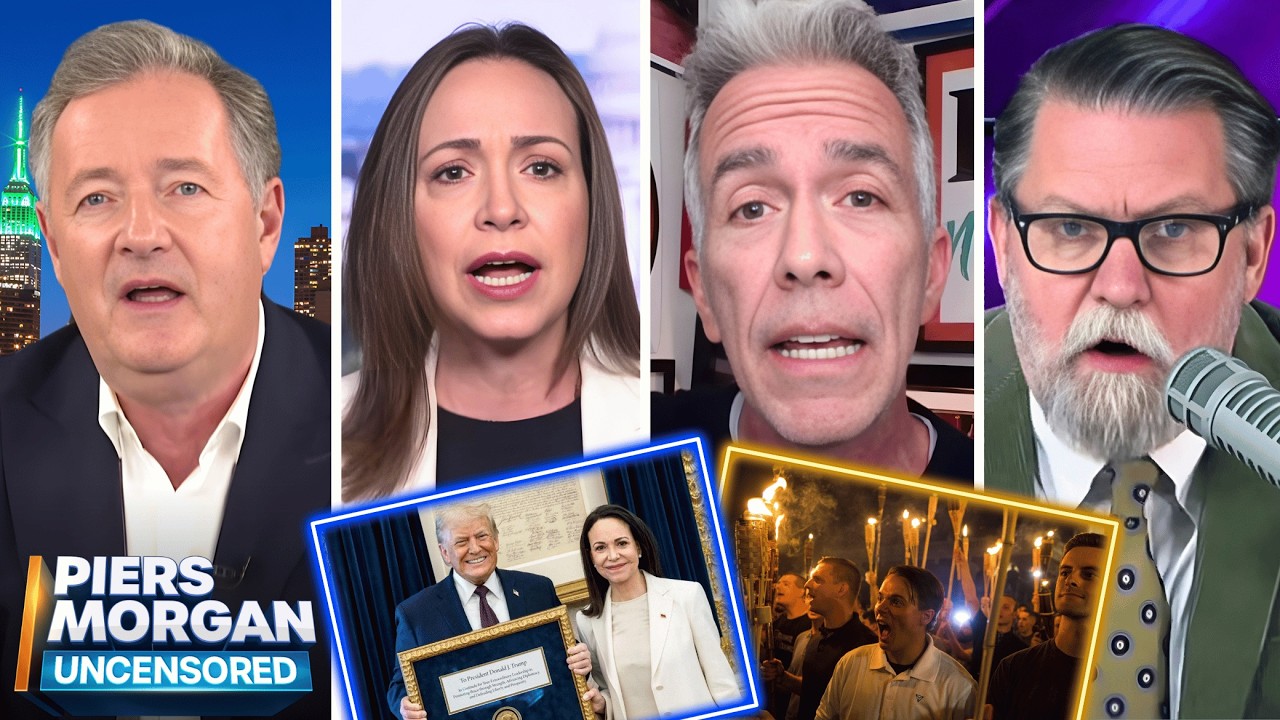
"Fighting Solves EVERYTHING!" Who's To Blame For Political Violence? + Maria Machado On Trump
"This episode dissects the escalating political violence in the US, with panelists fiercely debating the role of partisan rhetoric and media in radicalization, alongside an interview with Venezuelan opposition leader Maria Machado on US intervention and her country's future."

🚨 THEY F*CKED AROUND FOR THE LAST TIME 😭😭😭
"This episode unleashes a torrent of highly opinionated commentary on the US-Iran deal, Israel's role, and a scathing critique of 'leftist' policies and immigration, particularly highlighting the UK grooming gang report as evidence of Western societal decay."

Iran Deal Skepticism. Whoopi Vs Vance. Potomac Park Invasion. Racist Hurls Slurs At Black Boy.
"This episode dissects multiple instances of alleged anti-Black policies and racial injustice, from the Trump administration's legal challenges to reparations and the Iran deal, to police brutality and the erasure of Black history."