
Patrick Henningsen: Iran REJECTS Ceasefire — Missile Bunkers Rebuilt in Record Time
YouTube · Hmx-VXnLTQ0
Quick Read
Summary
Takeaways
- ❖The Trump administration's Iran policy is a 'political war' aimed at gaining domestic and international legitimacy, despite internal military dissent.
- ❖US generals are pushing back against a ground invasion of Iran, leading to dismissals and forced resignations.
- ❖Iran possesses mobile and decentralized air defense systems, making US aerial operations increasingly vulnerable and costly.
- ❖The US and Israel are intentionally degrading global oil and gas export markets to create leverage and benefit US energy companies.
- ❖Financial markets, including cryptocurrency, are being weaponized to inflate oil prices, creating profit for elites while causing inflation for the public.
- ❖Mainstream US media and elements within the CIA are showing unprecedented dissent against the White House's war narrative.
- ❖The US has adopted 'rampage foreign policy' tactics, mirroring Israel's methods of deception, assassination, and propaganda.
- ❖The Israeli lobby is directly dictating US foreign policy and military tasking in the conflict.
- ❖US casualty figures in Iran are being significantly underreported, potentially by orders of magnitude.
- ❖Gulf States are perceived as 'puppet regimes' serving Western and Israeli interests, lacking true sovereignty and failing to protect their own populations from environmental risks like nuclear fallout.
Insights
1Internal US Military Dissent Against Iran Ground Invasion
The Trump administration faced significant pushback from military generals regarding a ground invasion of Iran, leading to the dismissal or forced resignation of over 12 generals, including one who previously commanded the 82nd Airborne Division slated for deployment. This indicates a lack of consensus within the US military on the feasibility and wisdom of escalating the conflict with ground troops.
More than 12 generals were dismissed or forced to resign under Secretary of War Pete Hegseth. One general was previously in command of the 82nd Airborne, a division 'said to be deployed for combat operations on the ground in Iran.'
2Trump's 'Political War' and Economic Consequences
Donald Trump's war in Iran is characterized as a 'political war' to shore up his legitimacy, both domestically and internationally. His reputation, tied to tariff warfare and economic claims, hinges on this military operation. However, the conflict is causing severe inflationary pressure due to oil price spikes and supply throttling from the Persian Gulf, negatively impacting average Americans and global economic activity.
Trump's 'entire reputation for all of his tariff warfare rests on this military operation' and his claim as 'president for the economy.' The economic results for average Americans will be 'really, really difficult' due to 'inflationary pressure from the spike of oil and the throttling of supplies.'
3Iran's Mobile Air Defense Challenges US Air Operations
Iran's air defense systems are not static, but mobile and decentralized, including shorter-range defenses, making them difficult for the US to target effectively. This forces US aircraft to fly closer, increasing their vulnerability to man-portable air-defense systems (MANPADS) and other mobile threats, leading to significant aircraft losses.
Iranian radars are 'mostly mobile,' moving between 'underground cities.' This forces US aircraft to 'move in closer' and use 'glide bombs' making them 'more vulnerable to various targeting from various levels of air defense.'
4US-Israel Strategy to Degrade Global Energy Markets
The US, through proxies like Ukraine, and Israel are actively working to degrade global oil and gas export capacity. Ukrainian drone attacks have damaged Russian refineries, while Israeli actions have impacted Iranian capacity, and Iranian retaliation has affected Gulf capacity. This coordinated degradation benefits US oil and gas interests by increasing their market leverage and control over global supply.
Ukraine damaged Russian export capacity by '30 possibly 40%.' Israel 'knocked out Iranian capacity,' and Iran 'knocked out Gulf capacity.' The 'direct beneficiary is US oil and gas.'
5Weaponization of Financial Markets and 'Hormuz Hype'
The financial markets, particularly oil trading and associated cryptocurrency markets, have been weaponized around the conflict. Trump's tweets and geopolitical events are used to create volatility, allowing Wall Street, big oil, and his inner circle to profit from both market rises and dips. This includes 'Hormuz Hype,' a phenomenon where European oil prices are artificially inflated despite Europe receiving only 7% of its oil from the Persian Gulf.
Trump and his base (Wall Street, big oil, big tech) are 'making money on the dip as well as on the rebound.' A report called 'Hormuz Hype' details how the price of petroleum in Europe is gamed, despite Europe getting only '7% of their oil from the Persian Gulf.'
6European Hypocrisy in Geopolitical Conflicts
European leaders, who previously condemned Russia's actions in Ukraine based on international law and human rights, are now silent or backing off from criticizing US and Israeli actions in Iran. This exposes their hypocrisy, revealing that their 'ethical or moral or international law considerations' are selectively applied, largely dependent on US interests.
Europe 'remodeled' Russia's intervention in Ukraine as 'Russian aggression' but now 'where are all these great platitudes now? They've all disappeared. The Europeans are hiding.' They have to 'deal with all of that hypocrisy.'
7US Adoption of Israeli 'Rampage Foreign Policy'
Under Trump, the US has adopted Israel's 'rampage foreign policy' tactics, which involve killing, assassinating, bombing, lying, deceiving, propagandizing, and executing false flags. This marks a shift from the US pretending to be a rational hegemon while Israel did the 'dirty work,' to the US actively engaging in these 'gutter methods.'
The US 'adopted all of the methods and tactics of the Israelis... rampage foreign policy. Kill, assassinate, bomb, lie, deceive, propagandize, false flags.' Trump has 'taken the United States down in the gutter... with Israel to do gutter methods, sturdy street criminal methods.'
8Israeli Lobby Dictating US Foreign Policy
The Israeli lobby is directly influencing and dictating US foreign policy and military tasking in the conflict with Iran. This influence extends to bypassing congressional oversight, as the lobby instructed senators and congressmen to vote against the War Powers Act.
Israel is 'directing US foreign policy and Israel is providing tasking for the US military.' The Israeli lobby 'helped instruct senators and congressmen to vote against the war powers act.'
9Cover-up of US Casualties in Iran
Reports indicate a significant cover-up of US casualties in the Iran conflict. The number of deaths and wounded is orders of magnitude higher than officially reported, with deaths being 'triaged and managed' off manifests to avoid political fallout for the Trump administration.
Our sources told us... the number of casualties are orders of magnitude higher than what was being reported and that especially deaths were not are not included on the manifests going back to the United States of wounded deaths are being triaged and being managed.
10Gulf States as 'Puppet Regimes' for Western Powers
The Gulf States (UAE, Saudi Arabia, Kuwait) are characterized as 'puppet regimes' that serve at the pleasure of Western powers and Israel. They lack true sovereignty, making decisions that are not in their own long-term interest or the welfare of their people. Their primary function is to prop up the US dollar, buy US weapons, and invest in Western brands, with the threat of military coups if they deviate.
These are 'tribesmen that were selected by the British Empire' to rule. They 'serve at the pleasure of Western powers and of Israel ultimately.' Their purpose is to 'prop up the US dollar' and 'buy US weapons.' The US 'could have a military coup' to oust them.
11Trump's Admission of Nuclear Fallout from Attacks
Donald Trump publicly admitted that US and Israeli attacks on Iranian nuclear facilities, specifically the Bushehr site, resulted in 'nuclear dust' blowing around, rendering them unusable for a long time. This poses a severe environmental risk to nearby Gulf States, whose leaders remain silent due to their subservient relationship with Western powers.
Trump said, 'Yeah, we've hit the nuclear plants and there's there's nuclear dust. There's nuclear dust blowing around.' This means 'radioactive material blowing around Iran's nuclear facilities after US and Israeli attacks.'
Bottom Line
There is a significant split within US intelligence agencies (CIA) and mainstream media regarding the Trump administration's war in Iran, with elements actively working to undermine the official narrative through leaks and critical reporting.
This internal fracturing suggests a potential weakening of the 'deep state' consensus on foreign policy and could lead to greater public awareness and pressure against future military interventions.
For independent media and analysts, this creates an opportunity to leverage these internal leaks and dissenting voices to provide more accurate and critical reporting, challenging established narratives.
The current crisis presents an 'existential crisis' and a unique opportunity for Gulf States to re-evaluate their relationship with the US and normalize relations with Iran, acting in their own long-term national interest rather than as proxies.
Such a shift would fundamentally alter regional power dynamics, potentially leading to a more multipolar Middle East and reducing the influence of external powers.
For regional actors seeking greater autonomy, this crisis provides a pretext to pivot away from traditional alliances and forge new, more beneficial relationships, potentially stabilizing the region and fostering economic cooperation.
Israeli intelligence has deeply infiltrated the UAE's military and government, suggesting a long-term plan for Israel to 'oust the royal family' and take over the country within a decade.
This indicates a severe vulnerability for Gulf States, highlighting that even their 'allies' may harbor intentions of ultimate control, making their current subservience highly risky.
This insight underscores the urgent need for Gulf States to diversify their security alliances and intelligence partnerships, reducing their dependence on any single external power to prevent future internal takeovers.
Key Concepts
Weaponization of Financial Markets
The deliberate manipulation of global commodity markets (e.g., oil and gas) through geopolitical conflict and orchestrated crises to generate profit and leverage for specific financial and corporate entities, often at the expense of public economic stability.
Puppet State Syndrome
A geopolitical dynamic where ostensibly sovereign nations (e.g., Gulf States) operate under the significant influence or direct control of external powers, making decisions that serve foreign interests rather than the long-term welfare of their own populations or dynasties.
Lessons
- Critically evaluate official narratives on geopolitical conflicts, especially those involving energy-rich regions, by seeking out alternative media sources and analyses that expose underlying economic and political motivations.
- Recognize the potential for financial markets to be weaponized during crises; understand how geopolitical events can be exploited to generate profit for specific entities, impacting global inflation and personal finances.
- Demand greater transparency and accountability from elected officials regarding military engagements and foreign policy decisions, particularly concerning congressional oversight and accurate casualty reporting.
Notable Moments
The host mentions Donald Trump's repeated 48-hour ultimatums to Iran, framing them as attempts to intimidate rather than genuine deadlines.
This sets the tone for the discussion, highlighting the perceived performative and politically motivated nature of Trump's actions.
The guest discusses the purge of over 12 US generals, including one from the 82nd Airborne, linking it to their pushback against a ground invasion of Iran.
This reveals significant internal dissent within the US military regarding the Iran conflict, suggesting a lack of strategic consensus and potentially desperate measures by the administration.
The guest details the 'Hormuz Hype' phenomenon, where European oil prices are artificially inflated despite minimal reliance on Persian Gulf oil, exposing market manipulation.
This highlights the deliberate weaponization of financial markets during geopolitical crises, demonstrating how elites profit from manufactured scarcity and public fear.
The guest notes CNN's unprecedented deviation from Pentagon propaganda in this conflict, suggesting a split within mainstream media and intelligence agencies.
This is a significant observation, indicating a potential weakening of the traditional 'embedded' media narrative and internal resistance to the administration's war efforts.
The guest mentions Marco Rubio's accidental admission that the US entered the war because Israel 'was going in first,' revealing the true impetus behind US involvement.
This quote provides direct evidence, from a US official, of Israel's influence in initiating the conflict, reinforcing the claim that the Israeli lobby dictates US foreign policy.
Donald Trump's public admission that US/Israeli attacks on Iranian nuclear plants caused 'nuclear dust' to blow around.
This is a critical admission of environmental and humanitarian recklessness, directly implicating the US in actions that could have severe regional consequences, while Gulf States remain silent.
Quotes
"This is what happens when you put someone who's not qualified, probably Pete Hegseth's not really even qualified to lead a battalion in the US military."
"For Donald Trump, it's a political war in the US and also legitimacy within the US, but also legitimacy internationally."
"The currency for this this presidency is memes. I'll I'll tell you. It's memes. It's sound bites, headlines, it's tweets, and it's lies."
"The US is outsourced. The US is is nothing more than a glorified mercenary force for the state of Israel and the Israeli lobby. As far as this conflict is concerned, 100%."
"The only honest assessment I've heard so far, Nema, is from Marco Rubio, who accidentally said that Israel, the reason we we got into the war is because Israel was going in first."
"Donald Trump has admitted there's radioactive material blowing around Iran's nuclear facilities after US and Israeli attacks on those facilities."
"There's nothing there's no loyalty between the West and Israel and these Gulf states. They perform a function. They prop up the US dollar. That's the that is a to and they're there to buy US weapons and make US defense contractors rich."
Q&A
Recent Questions
Related Episodes

Iran Update: Israel’s Newest Bombing Campaign, the Oncoming War With China and How to Avoid It
"Colonel Wilerson reveals how the US and Israel are actively bombing China's strategic infrastructure in Iran, escalating a covert economic war that Beijing intends to win without direct military conflict by dismantling the dollar's global dominance."

Patrick Henningsen: Hezbollah JUST Fired Back at Israel - Iran Vows to “Crush” All Attacks
"Patrick Henningsen argues that the US and Israel initiated an illegal war against Iran, driven by Trump's incompetence and Israeli influence, leading to an inevitable escalation with severe global economic repercussions."
BREAKING: Protests ERUPT In Iran Over IRGC Surrendering To Trump - Infighting Clashes In Tehran
"Iran is experiencing severe internal infighting and protests as hardline IRGC elements clash with government figures over a perceived 'surrender' to the US, while mainstream Western media misrepresents the situation."
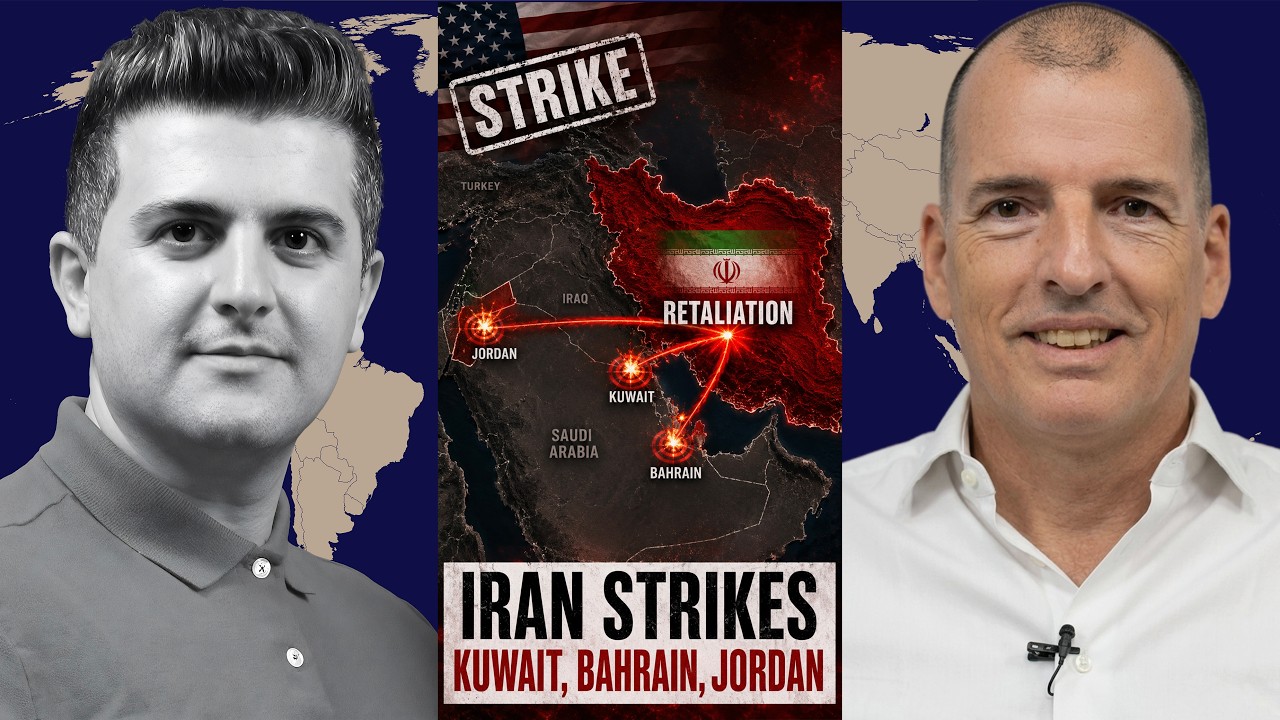
Alex Krainer: US STRIKES Iran – Iran RETALIATES Against Kuwait, Bahrain & Jordan!
"Amidst escalating US-Iran conflict and Iranian retaliation against regional US allies, this episode argues that US foreign policy is deeply controlled by an 'Anglo-Zionist conspiracy' led by the Rothschild banking dynasty, prioritizing Israeli interests over American ones."