
Operation Joy
YouTube · IrhMhwqv9t8
Quick Read
Summary
Takeaways
- ❖The US war in Iran is a quagmire, with intractable demands from both sides and Israel's true objective being a 'failed Iranian state' and territorial expansion.
- ❖Israeli ministers openly state plans to annex Southern Lebanon up to the Latani River and retain Western Syria, contradicting 'self-defense' narratives.
- ❖Netanyahu allegedly convinced Trump to initiate the Iran war by exploiting his ego with fabricated assassination plots and promises of easy regime change.
- ❖Mainstream media is accused of actively 'running cover' for Israeli expansionism and US political corruption.
- ❖Gavin Newsom's retraction of 'apartheid state' comments on Israel exemplifies donor influence over US politicians.
- ❖Trump's approval ratings are significantly declining, especially among men under 45, driven by the war and cost of living concerns.
- ❖The deployment of ICE agents to airports is framed as a 'test run' for voter intimidation tactics in future elections.
- ❖China is strategically benefiting from the prolonged US entanglement in Middle East conflicts, positioning itself as a stable alternative for global trade and capital.
Insights
1Israel's Expansionist War Aims in Lebanon and Syria
Israeli Finance Minister Basel Smotrich openly declared that Israel's new border must be the Latani River in Southern Lebanon, and that Israel intends to retain occupied Western Syria. This objective, confirmed by Defense Minister Israel Katz, indicates a strategy of territorial acquisition rather than self-defense, aiming to create a 'different reality entirely' in the region. The Israeli government is actively destroying infrastructure south of the Latani River, displacing hundreds of thousands of Lebanese children, mirroring actions in Gaza.
Smotrich stated, 'The new Israeli border must be Latani,' and referenced 'the yellow line in Gaza and like the buffer and the crown of Mount Hermon in Syria.' Defense Minister Israel Katz warned Lebanon could face 'loss of territory.' Israel has struck bridges linking South Lebanon and ordered destruction of all crossings over the Latani River. (, , , , , )
2Netanyahu's Manipulation of Trump into the Iran War
Benjamin Netanyahu allegedly persuaded Donald Trump to initiate the war with Iran by leveraging false intelligence and appealing to Trump's ego. Netanyahu presented fabricated Iranian plots to assassinate Trump and promised an easy regime change in Iran, where the populace would 'take to the streets' and 'chant Trump, Trump, Trump.' This narrative contradicted US intelligence assessments, which predicted a hardliner replacement if Iranian leaders were killed. Trump's own Defense Secretary, Pete Hexith, later confirmed revenge was a motive, stating, 'Iran tried to kill President Trump and President Trump got the last laugh.'
Reuters reported Netanyahu's 'closing argument' to Trump included claims of Iranian assassination plots and a 'historic opportunity to remake the Middle East' through regime change. Trump believed Israelis over the CIA. Trump himself stated, 'I got him before he got me.' (, , , , , )
3Intractable Demands Prolong Middle East Conflict
Peace negotiations for the Middle East war are stalled due to fundamentally irreconcilable demands from both the US/Israel and Iran. Iran demands reparations for war damages and a pledge from the US and Israel not to launch future attacks. Conversely, the US insists on the dismantlement of Iran's nuclear program, suspension of its ballistic missile program, and an 'end to support for proxy militias.' These maximalist positions, coupled with Iran's increased leverage from controlling the Strait of Hormuz, make a resolution 'near impossible' and indicate the war is 'nowhere near over.'
Iran demands US/Israel pledge not to launch future attacks and compensation for damages. The US demands dismantlement of Iran's nuclear work, suspension of its ballistic missile program, and a stop to proxy militia support. General Jim Mattis stated, 'Neither side has the ability right now to move the other side off of where they're at.' (, , , )
4China Benefits from US Middle East Entanglement
A protracted Middle East war creates a 'strategic opportunity' for China, draining US resources and pushing global capital, industry, and trade routes towards China as a stable alternative. Turmoil at sea, particularly the closure of the Strait of Hormuz, makes US allies dependent on seaborn energy vulnerable, increasing demand for alternative land routes and accelerating China's 'revival of continental power.' Capital, initially flowing to the US dollar, will eventually seek new safe havens like Hong Kong, strengthening China's position as a global industrial hub with pricing and rule-setting authority.
A Chinese think tank report, republished by Drop Site News, explicitly outlines these strategic benefits, noting the draining of US resources and the shift of global capital and trade towards China. ()
5Trump's Declining Approval Amidst War and Economic Woes
Donald Trump's approval ratings are plummeting, particularly among men and young men (under 45), a demographic crucial to his 2024 election victory. His net approval rating among all men is down 20 points, now at -7, and for men under 45, it's -19. On the critical issue of the cost of living, Trump's net approval among men is underwater by 30 percentage points, a 40-point swing. This significant decline is attributed to the ongoing war and its economic impact, signaling potential major losses for Republicans in upcoming elections.
Poll data shows Trump's net approval among men dropped 20 points from 2024 to present, now -7. For men under 45, it's -19. On the cost of living, his net approval among men is -30, a 40-point swing from 2024. (, , )
6ICE Deployment as a 'Test Run' for Voter Intimidation
The deployment of ICE agents to 14 major US airports, ostensibly to assist TSA during a DHS shutdown, is viewed by conservative commentators like Steve Bannon as a 'brilliant 5D chess move' and a 'test run' for future voter intimidation tactics. These commentators explicitly advocated for deploying ICE agents to polling sites during the 2026 midterms to 'check IDs' and prevent 'illegal aliens' from voting, despite the lack of evidence for widespread voter fraud and ICE agents' limited training for airport security tasks.
Trump announced ICE deployment to airports. Steve Bannon and Mike Davis discussed using this as a 'test run' to perfect ICE's involvement in the 2026 midterm election at polling places to 'check IDs' and 'pick them out of line.' CNN reported ICE agents were largely observed 'talking amongst themselves' and 'roaming around' rather than assisting with critical tasks. (, , , )
7Establishment Democrats Prioritize Donors Over Voters
California Governor Gavin Newsom's public retraction of his statement calling Israel an 'apartheid state' after speaking with Politico illustrates how establishment Democrats prioritize donor interests over their constituents' views. Similarly, in the Maine Senate primary, the Democratic Senatorial Campaign Committee (DSCC) is actively supporting incumbent Janet Mills, who is trailing her progressive challenger Graham Platner in polls. This 'dirty tricks' approach, including attack ads and funneling 'big money,' is seen as an attempt to undermine a progressive candidate who does not align with corporate or pro-Israel donors, even if it means potentially losing a winnable general election.
Newsom 'walked back' his 'apartheid state' comment, stating, 'I rever the state of Israel' and 'I deeply regret it.' The DSCC formed a joint fundraising committee with Mills, despite Platner leading in polls by up to 38 points. (, , , )
Bottom Line
The US is inadvertently accelerating its own decline as a global economic power by engaging in prolonged, externally-driven conflicts, while simultaneously creating a vacuum that China is strategically filling.
This suggests a fundamental miscalculation in US foreign policy that not only fails to achieve stated objectives but actively undermines long-term national interests, including economic stability and geopolitical leadership.
Policymakers could shift focus from military intervention to economic statecraft, prioritizing domestic investment and stable trade relations to counter China's rising influence, rather than engaging in costly wars that yield no benefit.
The explicit public statements by Israeli ministers regarding territorial expansion in Lebanon and Syria, despite being downplayed by mainstream media, indicate a clear, long-term geopolitical strategy that the US is unwittingly enabling.
This challenges the narrative of 'self-defense' often presented to the American public, revealing a more aggressive, expansionist agenda that US military and financial aid directly supports, potentially leading to further regional instability.
A critical re-evaluation of US aid and military cooperation with Israel is warranted, with conditions tied to adherence to international law and non-aggression, to prevent complicity in territorial annexations and ethnic cleansing.
Lessons
- Voters should critically evaluate political candidates' stances on foreign policy and donor influence, especially regarding Middle East conflicts, as these directly impact national resources and global standing.
- Support and engage with independent media outlets that provide alternative perspectives and expose potential corruption or manipulation in mainstream narratives.
- Participate in local primaries to elect progressive candidates who prioritize economic populism and anti-war policies, as these align more closely with broad public sentiment and offer a path to counter establishment influence.
Quotes
"Neither side has the ability right now to move the other side off of where they're at. Never in history has air power alone changed a regime."
"A protracted Middle East war would be a period of strategic opportunity for China. One that drains US resources while pushing global capital, industry, and trade routes towards China as the next best option."
"Does anyone really think that someone can tell President Trump what to do? Come on."
"I don't even notice when the power goes out anymore."
Q&A
Recent Questions
Related Episodes

Trump Just ENDED JD Vance’s White House Dreams
"A New York Times article and internal White House dynamics reveal Donald Trump's deep dissatisfaction with J.D. Vance, potentially ending Vance's 2028 presidential ambitions and highlighting a broader struggle for control within the Republican Party."
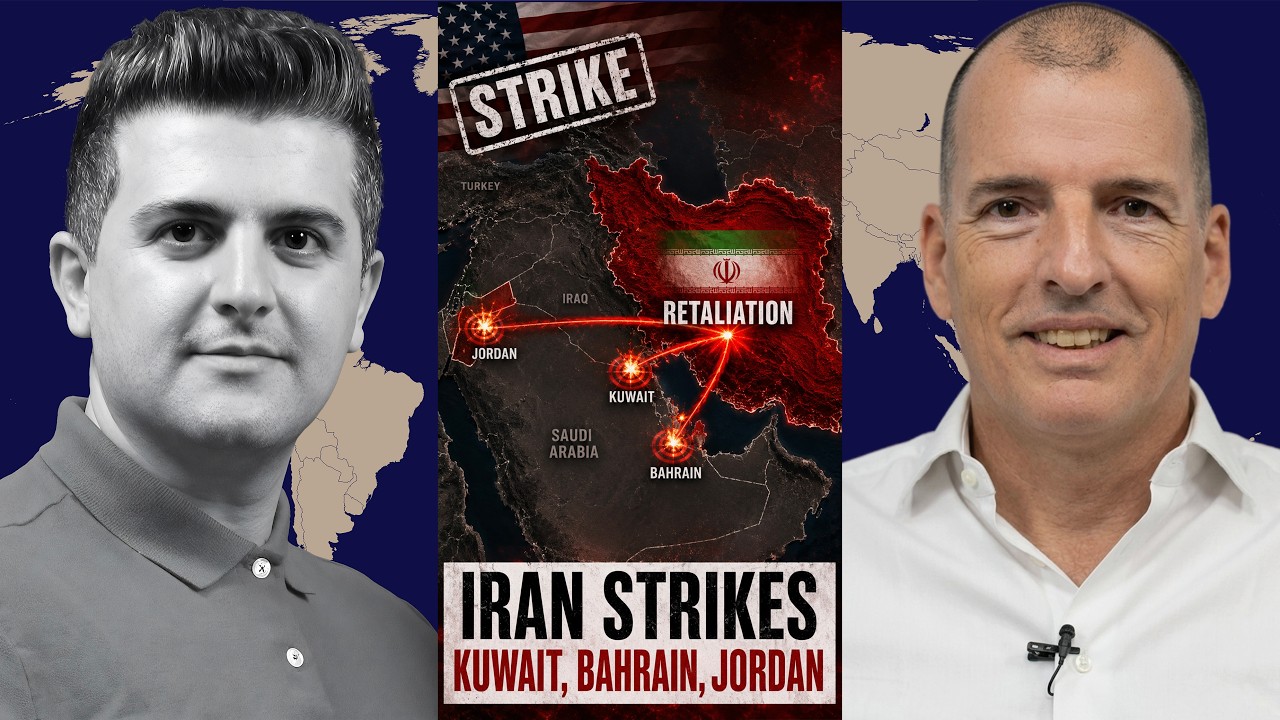
Alex Krainer: US STRIKES Iran – Iran RETALIATES Against Kuwait, Bahrain & Jordan!
"Amidst escalating US-Iran conflict and Iranian retaliation against regional US allies, this episode argues that US foreign policy is deeply controlled by an 'Anglo-Zionist conspiracy' led by the Rothschild banking dynasty, prioritizing Israeli interests over American ones."

LIVE: Trump HIDES FROM PUBLIC as US SOLDIER KILLED!!! 6/2/2026
"The host exposes alleged government cover-ups regarding military casualties, Trump's unexplained public absence, and questionable political appointments, arguing these reflect a 'regime of loser babies' and a failing foreign policy."

Trump Panics As Own Lawyers Turn Against Him Over War
"Donald Trump faces scrutiny from his own Justice Department over alleged insider trading in oil markets tied to Iran war announcements, highlighting broader issues of political corruption and economic destabilization for profit."