
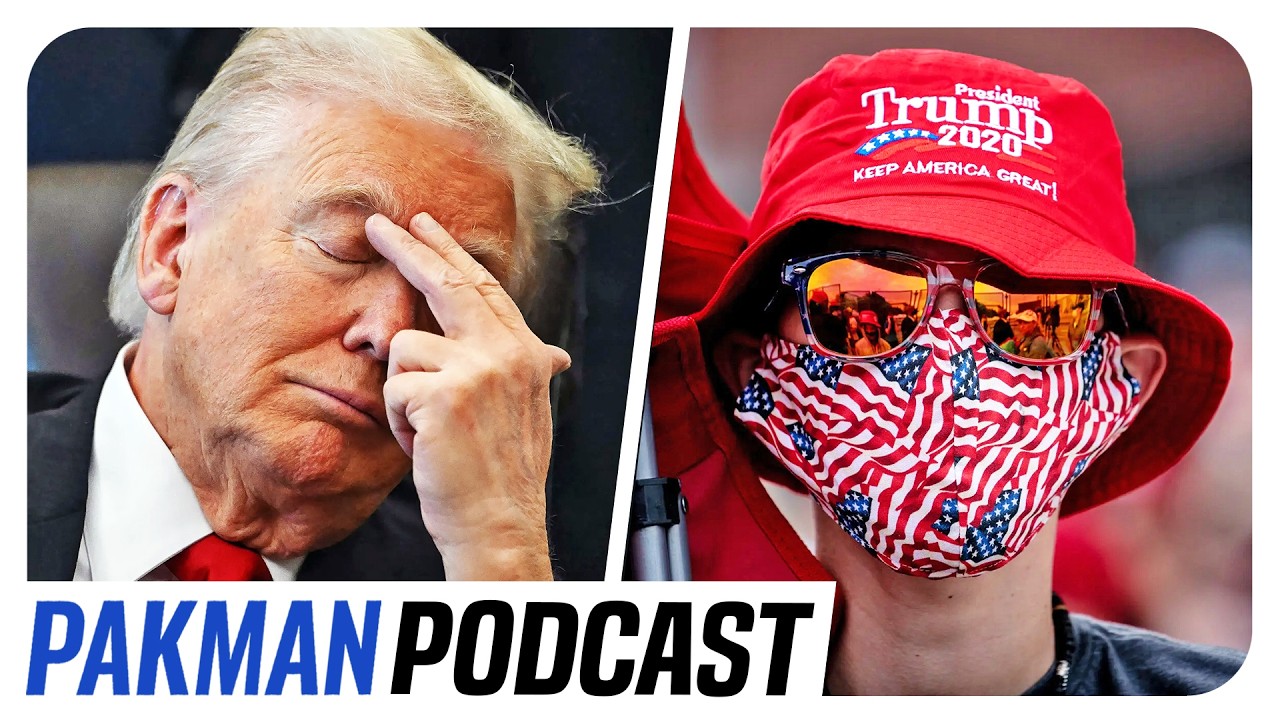
I don’t think they know how to get out of this
YouTube · KUxHJJoIAkA
Quick Read
Summary
Takeaways
- ❖Donald Trump's public appearances frequently include cognitive glitches, such as confusing past presidents and making incoherent statements.
- ❖Trump's approval rating has plummeted by 54 points in 18 months among politically disengaged voters, primarily due to economic concerns.
- ❖The appointment of Dr. Stephanie Haridopolos as acting Surgeon General raises concerns about vetting and the prioritization of loyalty over competence.
- ❖Trump's $1.7 billion IRS settlement, framed as a 'slush fund,' is drawing claims from loyalists like Mike Lindell, fueling perceptions of corruption.
- ❖Lanny Davis advocates for a 'Third Way' Democratic strategy that focuses on policy, fiscal responsibility, and empathy to attract swing voters, rather than solely 'bashing Trump'.
- ❖Economic decline is often a slow, quiet erosion of financial stability, with people increasingly relying on debt for basic necessities, rather than a sudden collapse.
- ❖Authoritarian patterns, such as enriching loyalists and weaponizing institutions, are evident in Trump's administration, mirroring criticisms often leveled at regimes like Cuba.
Insights
1Trump's Cognitive Decline and Incoherent Public Appearances
Donald Trump continues to exhibit signs of cognitive decline, evidenced by confusing Barack Obama with Joe Biden regarding the Afghanistan withdrawal, delivering rambling and disjointed speeches (e.g., at the Coast Guard commencement), and providing nonsensical answers to basic questions about AI. His responses often lack substance, coherence, and factual accuracy, even prompting visible alarm from interviewers.
Trump confusing Obama with Biden on Afghanistan withdrawal; rambling at Coast Guard commencement; making strange comments about freeing Cuba; providing a non-substantive answer on AI, instead discussing job numbers and the stock market.
2Massive Drop in Trump's Approval Among Disengaged Voters
New polling data reveals a catastrophic 54-point decline in Donald Trump's net approval rating over 18 months among politically disengaged voters (those who didn't vote in 2024). This demographic, less ideological and more reactive to real-world conditions, is turning against Trump due to economic anxieties, including rising credit card debt, auto loan delinquencies, food prices, and housing costs, indicating a deep underlying problem for Republicans.
CNN's Harry Enten highlighted Trump's shift from +4 to -50 among non-2024 voters, totaling a 54-point drop. The host links this to surging credit card debt, auto loan delinquencies, high food/gas prices, and unaffordable housing.
3Appointment of Unqualified Loyalists to Key Positions
Following the withdrawal of a previous nominee, Donald Trump appointed Dr. Stephanie Haridopolos as acting Surgeon General. Her public appearance on Fox News was characterized by slurred speech and bizarre, non-responsive answers, raising serious questions about the vetting process and the prioritization of personal loyalty over professional competence for critical government roles.
Dr. Stephanie Haridopolos's slurred speech and incoherent responses on Fox News, visibly alarming host Brian Kilmeade, after Trump's initial nominee crashed and burned.
4Trump's Controversial IRS Settlement and 'Slush Fund' Claims
Donald Trump settled a lawsuit with the IRS, agreeing to drop his $10 billion suit in exchange for a $1.7 billion 'slush fund' and an agreement that the IRS would not investigate his finances or taxes. This settlement is controversial, with figures like Mike Lindell (MyPillow) already claiming entitlement to compensation from this fund, arguing they were 'persecuted,' highlighting concerns about corruption and the monetization of grievances.
Trump's $1.7 billion IRS settlement; Mike Lindell stating he believes he is entitled to $400 million from the fund due to 'persecution' of MyPillow.
5The 'Third Way' for Democrats: Policy Over Labels
Lanny Davis advocates for Democrats to adopt a 'Third Way' strategy, similar to Bill Clinton's approach, which involves balancing progressive social policies with fiscal responsibility (e.g., balancing the budget, paying for spending). He argues that focusing on concrete policies and demonstrating empathy for diverse viewpoints, rather than adhering strictly to ideological labels or solely 'bashing Trump,' is crucial for attracting swing voters and winning elections.
Lanny Davis's book 'Finding the Third Way'; his argument for balancing budgets and taxing the wealthy, while being tolerant on cultural issues like transgender rights, to appeal to swing voters.
Bottom Line
The perception of economic decline is often a 'slow, quiet erosion' rather than a dramatic collapse, making it harder for political leaders to acknowledge or address effectively until widespread dissatisfaction is evident.
Policymakers and political strategists often misinterpret economic stability if they only look at top-line indicators, missing the underlying financial stress experienced by ordinary citizens. This disconnect can lead to unexpected political shifts.
Political messaging that genuinely addresses the 'slow erosion' of financial stability, rather than dismissing it as individual irresponsibility or touting abstract economic growth, could resonate deeply with a broad segment of the electorate.
Authoritarian patterns, such as prioritizing loyalty, attacking media, punishing dissent, and enriching state power, transcend traditional left-right ideological divides and manifest similarly across different regimes.
This suggests that the core mechanisms of authoritarianism are structural and behavioral, not purely ideological. Voters and analysts should look for these patterns regardless of the stated political leanings of leaders.
Educating the public on these universal authoritarian 'threads' can equip them to identify and resist such tendencies within their own political systems, rather than being distracted by ideological labels.
Key Concepts
Slow Erosion of Economic Stability
Economic decline often manifests not as a sudden collapse, but as a gradual, quiet erosion of financial well-being. Individuals slowly accumulate debt for essential expenses, fall behind on payments, and lose financial breathing room, even if macroeconomic indicators seem stable. This 'slow burn' can lead to widespread voter dissatisfaction without a dramatic 'breaking point'.
The Third Way (Political Strategy)
A political strategy, popularized by Bill Clinton, that seeks to balance progressive social policies with fiscally conservative principles (e.g., balancing budgets, reducing national debt). It aims to appeal to a broader base of swing voters by focusing on tangible policies and civility, rather than ideological labels or constant opposition rhetoric.
Tell It Early, Tell It All, Tell It Yourself
A crisis communications strategy where an individual or organization proactively releases all relevant information, including negative facts, to the media. This approach aims to control the narrative, reduce the impact of 'drip-drip' leaks, and build trust by demonstrating transparency, as advised by Lanny Davis.
Monetizing Grievances
A political and social phenomenon where individuals or groups leverage perceived victimhood and grievances for financial or political gain. This often involves seeking compensation, donations, or public support by framing personal or collective setbacks as persecution, as seen with figures associated with the MAGA movement.
Lessons
- Voters should critically evaluate political candidates based on their competence and policy proposals, rather than solely on loyalty or rhetoric, especially for critical government roles.
- Individuals should pay close attention to personal economic indicators like debt levels, food, and housing costs, as these 'slow erosion' factors often drive broader political shifts.
- Democrats should consider adopting a 'Third Way' communication strategy, focusing on concrete policy solutions that balance progressive values with fiscal responsibility to appeal to a wider range of voters.
Lanny Davis's Crisis Communications & Political Strategy
**Tell It Early, Tell It All, Tell It Yourself (Crisis Comms):** Proactively release all facts, good and bad, to the media to control the narrative and prevent 'drip-drip' leaks. Be transparent and complete.
**Focus on Policy, Not Labels (Political Strategy):** For Democrats, articulate clear policy positions (e.g., government as a 'friend' for social programs, but fiscally responsible with balanced budgets) rather than getting bogged down in 'liberal' vs. 'progressive' or 'centrist' labels.
**Engage with Disagreement (Civility):** Instead of demonizing political opponents or those who vote differently, engage in dialogue to understand their motivations and find common ground, particularly with swing voters who might have supported opposing candidates.
Notable Moments
Donald Trump struggling to deliver an inspirational commencement speech at the Coast Guard Academy, making incoherent statements and suggesting he might stay president beyond constitutional limits.
This moment highlights concerns about Trump's cognitive fitness and his disregard for constitutional norms, raising questions about his suitability for leadership.
Dr. Stephanie Haridopolos, acting Surgeon General, giving a visibly slurred and non-responsive interview on Fox News.
This incident underscores concerns about the quality of appointments in the administration, suggesting loyalty is prioritized over competence and public trust.
Senator John Kennedy's description of Cuba's government (incompetent, oppressive, enriching military/police at public expense) inadvertently sounding like a critique of Trump's administration.
This illustrates how authoritarian patterns can manifest similarly across different ideological systems, prompting reflection on domestic political trends.
Quotes
"If people feel, 'I'm broke. I'm exhausted from this stuff. I'm anxious from how erratic governance is. I'm stuck.' the performance of 'we're winning everything' is not going to matter."
"If I can't tell a reporter the truth, I will say off the record, 'I can't answer your question 'cause it creates legal jeopardy for my client, but you can't publish that sentence 'cause I'm a lawyer.'"
"If you want Donald Trump as president, worry about vocabulary, that difference between liberal and progressive, or the word centrist, or whatever the labels are."
"It's immoral to turn over those debts to our children."
Q&A
Recent Questions
Related Episodes
What happens to Trump voters when Trump is gone?
"The David Pakman Show explores the contentious path forward for Trump voters after his political era, exposing alleged corruption, economic misrepresentation, and the necessity of media literacy."

HOT TOPICS | Is Donald Trump Destroying MAGA?!
"Don Lemon declares the MAGA movement is collapsing, citing Donald Trump's escalating political missteps, economic failures, and alienation of his core base and former allies."

SOTU: Trump In FREEFALL With Independents Ahead Of Big Speech
"Donald Trump faces unprecedented declines in independent voter approval, with his populist promises from a year prior largely unfulfilled, signaling a significant shift in his political standing."

🚨 LEFTISTS ARE F*CKING SEETHING 😂😂😂
"The host aggressively celebrates perceived 'wins' for the right-wing, from global conflicts and domestic politics to cultural shifts, framing them as a 'humiliation' for the 'leftist world order' and a testament to Donald Trump's influence."