
Richard Wolff & Michael Hudson: Iran Did the Unthinkable – Trump Left With Nothing
YouTube · L931HhowKE0
Quick Read
Summary
Takeaways
- ❖Iran's effective control over the Strait of Hormuz marks a significant shift in regional power dynamics, granting it leverage over global energy supplies.
- ❖Neoconservative figures like Robert Kagan acknowledge the US has 'lost this war' in the Middle East, attributing it to a 'mistake' rather than a systemic decline of empire.
- ❖Richard Wolff argues that the US's loss of control is not a 'mistake' but an inevitable consequence of a declining empire unable to maintain global dominance.
- ❖Michael Hudson defines US foreign policy as 'geopathology' and 'ectopathology,' a pathological attempt to control global trade (especially oil) and economic systems through abusive means.
- ❖The US strategy relies on weaponizing oil and food trade to enforce its foreign policy, a method now being challenged by a rising multipolar world.
- ❖China's economic success, achieved outside the US-led 'economic development' framework, demonstrates the ineffectiveness and counterproductivity of US imperialistic aid.
- ❖The current geopolitical struggles, particularly around oil trade, are pushing for a new international economic order based on mutual aid and sovereign self-sufficiency.
- ❖The US political establishment, across both parties, remains in denial about the empire's decline, continuing to pursue outdated strategies of global control.
- ❖Attempting new conflicts in places like Cuba or Venezuela to compensate for losses in Ukraine and Iran would further expose the US's diminishing capacity and global standing.
Insights
1Iran's Control of the Strait of Hormuz and US Imperial Decline
Robert Kagan, a prominent neocon, acknowledges that Iran is now in control of the Strait of Hormuz, giving it enormous leverage over global energy supplies and regional influence. He frames this as a 'lasting mistake' by the US. Richard Wolff counters that this is not a mere mistake but a clear symptom of a declining American empire losing its grip on critical global passageways. The US, which previously controlled the strait, is now confronted with 'new management,' a reality it struggles to accept.
Kagan: 'Iran is in control of the strait... it'll be under Iranian management... This gives Iran enormous leverage in the region... and in the world.' [] Wolff: 'What he is bemoning... is the loss of control... It's not under US control. It has moved to... Iranian control. That is an outstanding impossible horror for Mr. Kagan.' []
2US Foreign Policy as 'Geopathology' and Economic Control
Michael Hudson characterizes US international strategy as 'geopathology,' an abusive attempt to control the world through economic means, primarily by weaponizing the oil and food trade. The US aims to cut off access to these essentials for countries that do not align with its foreign policy. This strategy, rooted in post-WWII restructuring of the global economy, is now being challenged as nations seek alternatives to US dominance.
Hudson: 'The US international strategy... has been based on control of the world's oil trade... the ability to cut other countries off from access to oil... The whole strategy of the United States is controlled by being able to cut off world's oil trade, the food trade... All of this is being threatened.' [] 'Geopathology is an attempt to structure a world in an abusive way. That's what the doctrine of control is.' []
3The Failure of US-Led Economic Development and China's Alternative Path
Richard Wolff highlights the historical failure of US-led 'economic development' efforts in Asia, Africa, and Latin America after World War II. Despite significant investment and expertise, these countries remained poor and subordinate. In stark contrast, China, which was ostracized and received no US 'help,' achieved remarkable economic development by pursuing its own path. This demonstrates that US intervention often cemented dependency rather than fostering true growth.
Wolff: 'We didn't help them. We ended up without understanding it cementing them in a subordinate position... With one big exception, China... All the people we helped didn't do as well as the Chinese who went and did it on their own.' [] Hudson adds that the World Bank actively 'fought against development' that didn't favor US interests, publishing 'Partners in Backwardness' to ensure countries wouldn't compete with American agriculture. []
4The Inevitability of a New International Economic Order
Both economists argue that the current geopolitical and economic shifts are leading to a new international economic order. The US's inability to maintain its 'rules-based international order' and its continued use of economic warfare are forcing countries to seek self-sufficiency and alternative alliances (like BRICS). This new order will challenge the dollar's dominance, alleviate debt burdens for Global South countries, and fundamentally restructure global trade and financial systems.
Hudson: 'All of this requires what's truly a new international economic order... The United States still had a strangle hold on the economy... This is the first time that countries are saying well if we maintain the United Nations with American veto power then it will never have any means of enforcement.' []
Bottom Line
The US's 'security' doctrine, which demands control over the entire world to prevent distant threats, is a form of 'craziness' that leads to endless, costly, and ultimately self-defeating interventions.
This perspective suggests that the US is trapped in a self-perpetuating cycle of intervention that undermines its own long-term stability and prosperity by diverting resources and alienating potential partners.
For other nations, this creates an opportunity to forge independent paths and alliances, free from the perceived need for US 'protection' or economic 'development' aid, as demonstrated by China.
The US political establishment, across both Democratic and Republican parties, exhibits a profound denial of the empire's decline, clinging to 'cheerleading' slogans instead of developing realistic strategies.
This denial prevents necessary internal reforms and external adaptations, leading to a continuous series of 'mistakes' and an accelerating loss of global influence.
Countries and non-state actors that accurately assess the US's declining power can strategically position themselves to benefit from the emerging multipolar world, forming new alliances and economic structures.
Key Concepts
Geopathology
Coined by Michael Hudson, this concept describes a pathological attempt to structure the world in an abusive way, characterized by a lack of empathy for other countries and a drive for absolute control, particularly over essential resources like oil and food.
Ectopathology
Also coined by Michael Hudson, this refers to a pathological economic idea of how an economy develops, specifically critiquing the US neoliberal strategy that underpins its foreign policy of control, which prioritizes exploitation over mutual aid and fairness.
Opportunity Cost
Richard Wolff uses this economic concept to highlight the hidden costs of maintaining a vast military and engaging in endless wars. The resources spent on global control represent lost opportunities for domestic investment and development.
Lessons
- Re-evaluate geopolitical risk models to account for a multipolar world where US control over critical chokepoints and resources is diminishing.
- Diversify supply chains and strategic alliances, recognizing that traditional US-centric economic and security frameworks are becoming less reliable.
- Invest in understanding the economic and political strategies of emerging powers like China, Russia, and Iran, as their models for development and international relations differ significantly from Western paradigms.
Notable Moments
Richard Wolff highlights the bipartisan nature of US imperial denial, noting that both Trump's 'Make America Great Again' and Clinton's 'We are already great' reflect an inability to acknowledge decline.
This observation underscores that the problem is deeply ingrained in the US political psyche, transcending party lines and making a realistic policy shift difficult.
Quotes
"The control is now not what it was... It's not under US control. It has moved to quote new management, Iranian control. That is an outstanding impossible horror for Mr. Kagan."
"You're an empire losing control. That's what you're that's what's going on now. It's been going on slowly for years. Now it's speeding up."
"The whole strategy of the United States is controlled by being able to cut off world's oil trade, the food trade for countries that need food... All of this is being threatened."
"The world is never under the control of any empire. That's why the world is still here and all the empires are gone. That should have been a clue as to which is more profound."
"We didn't help them. We ended up without understanding it cementing them in a subordinate position. How do we know that? Because that's where they are now. They haven't developed."
"The government that was a pariah, that was kept out of the system, that was hampered in every conceivable way... outperformed us and does so year in and year out as if to mock the very system."
"Geopathology is an attempt to structure a world in an abusive way. That's what the doctrine of control is."
Q&A
Recent Questions
Related Episodes

Patrick Henningsen: Hezbollah JUST Fired Back at Israel - Iran Vows to “Crush” All Attacks
"Patrick Henningsen argues that the US and Israel initiated an illegal war against Iran, driven by Trump's incompetence and Israeli influence, leading to an inevitable escalation with severe global economic repercussions."

Iran Update: Israel’s Newest Bombing Campaign, the Oncoming War With China and How to Avoid It
"Colonel Wilerson reveals how the US and Israel are actively bombing China's strategic infrastructure in Iran, escalating a covert economic war that Beijing intends to win without direct military conflict by dismantling the dollar's global dominance."
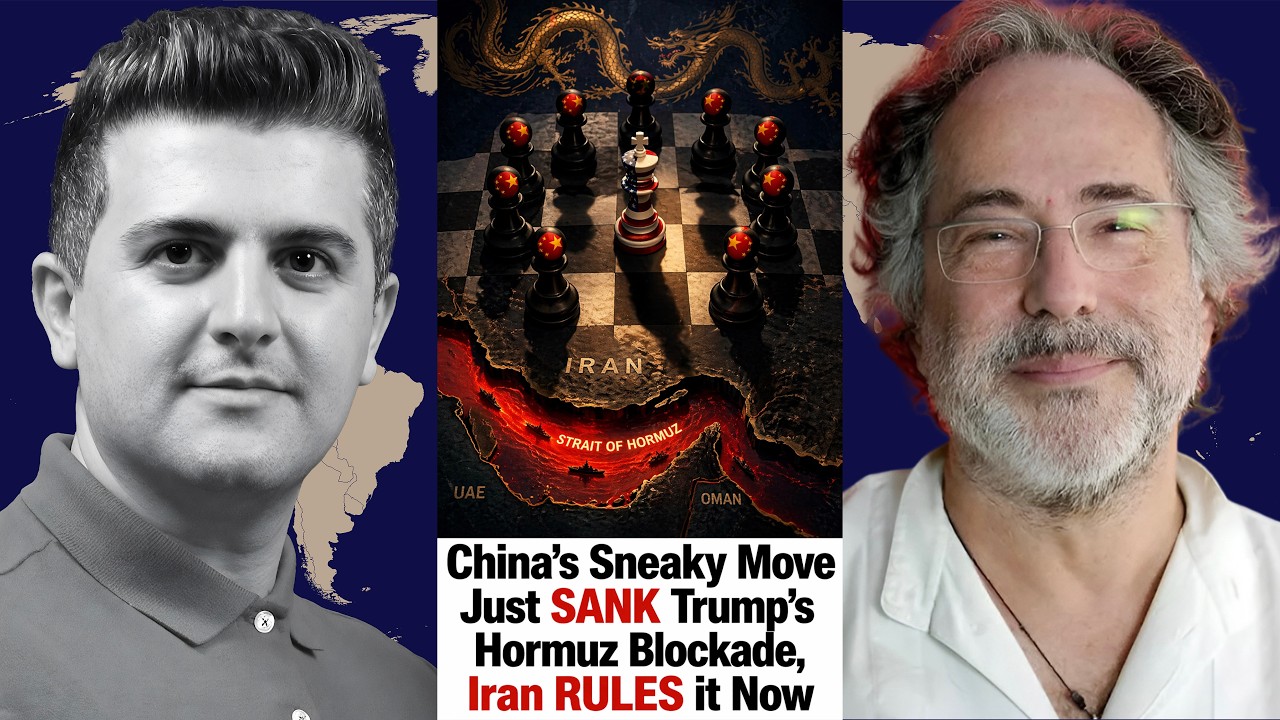
Pepe Escobar: “Total Failure”: Trump’s Blockade Just Backfired Disastrously
"Pepe Escobar argues that the US blockade against Iran, spearheaded by Donald Trump, has utterly failed and backfired, accelerating global economic chaos and challenging US geopolitical dominance."

🚨 TOTAL F*CKING CHECKMATE 😂😂😂
"The host argues that Trump's 'ceasefire' with Iran was a calculated '5D chess' move to orchestrate a global energy market reshuffle, while simultaneously lambasting 'woke' domestic policies and the 'freefall' of anti-Trump conservative figures."