
Joe Rogan Experience #2479 - Bob Lazar & Luigi Vendittelli
YouTube · Lb_1d68vx-g
Quick Read
Summary
Takeaways
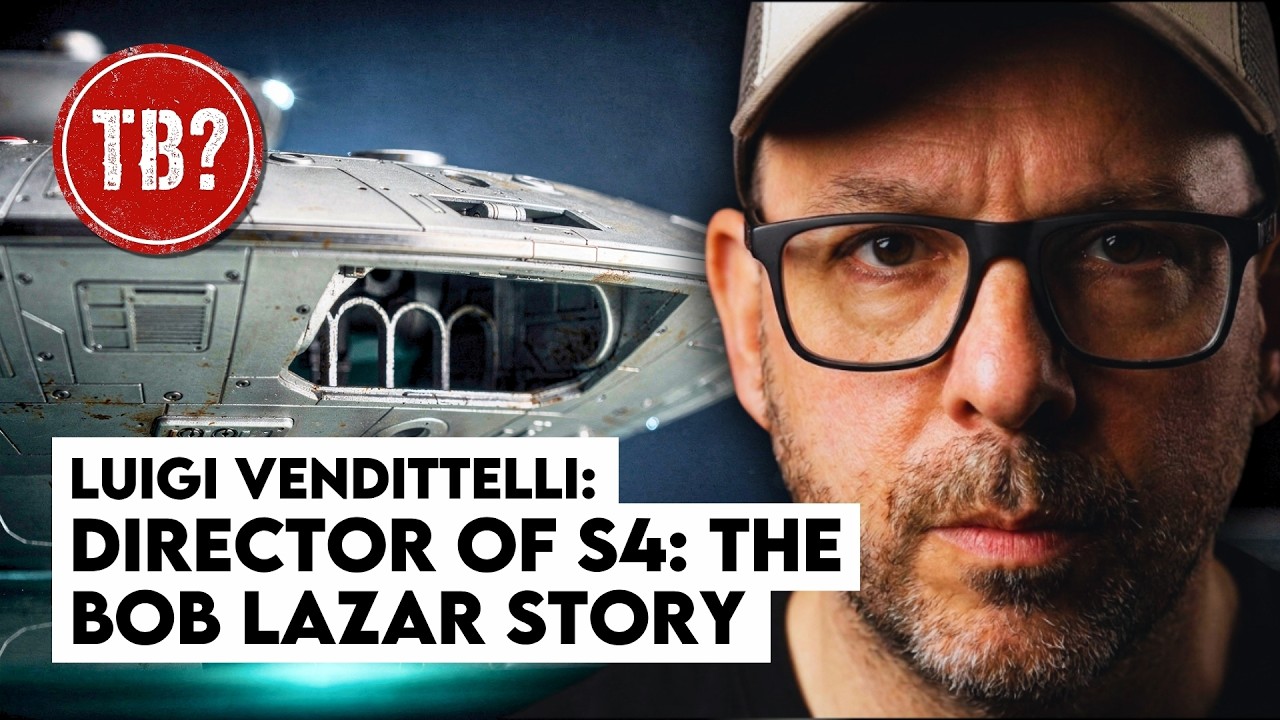
- ❖Luigi Vendittelli's film recreates S4 and Bob Lazar's experiences using 90% handmade CGI (Blender) and 10% AI, de-aging Lazar and building environments based on his descriptions.
- ❖Lazar found the film's recreation 'mindblowing,' feeling 'teleported back' to S4, and remembered forgotten details due to the visual prompts.
- ❖Lazar's story, first told in 1989, aligns with later government-released videos of UAPs exhibiting similar 'belly roll' movement.
- ❖The compartmentalized nature of S4 research, where scientists couldn't freely exchange information, severely hampered progress on understanding alien technology.
- ❖Lazar suspected the craft's material was an 'electret' (permanent static electric field) crucial to its propulsion, but couldn't collaborate with material scientists.
- ❖The alien craft's material could 'push into a smaller volume' without changing thickness, a property unknown to Earth science, suggesting 3D printing or 'growing' the material.
- ❖Element 115, a stable isotope, was central to the craft's reactor, producing an anti-gravitational field that repelled the craft from the ground without transferring weight.
- ❖Lazar described touching an 'elastic field' around the reactor, which pushed back and prevented physical contact, unlike any known force.
- ❖Lazar believes the craft was an 'archaeological recovery' and speculates it had been at S4 for 'a decade or decades' before his arrival.
- ❖Rogan and Lazar discuss the potential dangers of advanced technology, suggesting that the long-term secrecy around alien tech might be due to its world-dominating potential and humanity's unreadiness.
- ❖Vendittelli's team discovered a 1941 map showing a road directly into the mountain where S4 was located, suggesting it was an old silver mine, later removed from maps after the CIA took over.
- ❖Digital reconstruction of the craft revealed that its interior, despite industrial lighting, remained 'super dark,' consuming light in a way that surprised the filmmakers, validating Lazar's specific detail.
- ❖The film's recreation confirmed the visibility of a reversed American flag on the craft's hull, a detail previously dismissed by detractors, adhering to military flag display regulations for vehicles.
Insights
1Digital Recreation Validates Lazar's Specific Details
Luigi Vendittelli's meticulous digital recreation of S4 and the alien craft, based on Bob Lazar's descriptions, unexpectedly validated specific, obscure details of Lazar's account. The craft's interior, despite powerful industrial lighting, remained 'super dark' due to the material's light-absorbing properties, a phenomenon the filmmakers struggled to replicate without prior knowledge. Additionally, the precise placement and angle of a reversed American flag on the craft's hull, a detail previously contested by skeptics, was confirmed to be clearly visible from Lazar's described vantage point in the digital model.
Luigi Vendittelli describes the unexpected darkness inside the digitally recreated craft, requiring 20-fold light intensity to be visible in the film (). He also recounts his team's surprise at confirming the clear visibility of the reversed American flag on the craft's hull, a detail previously doubted by detractors ().
2Compartmentalization Hinders Scientific Progress in Secret Projects
Bob Lazar describes extreme compartmentalization at S4, where different scientific groups (e.g., metallurgists, propulsion specialists) were forbidden from direct communication. Information exchange was limited to written requests approved by supervisors, resulting in brief, unhelpful responses. This structure, imposed by security personnel who did not understand collaborative science, led to stagnation and prevented a holistic understanding of the alien technology, which operated as a cohesive unit where material properties were intrinsically linked to propulsion.
Lazar states, 'There was no exchange of information between any groups' () and 'that's not how science works' (). He explains his inability to connect the craft's 'electret' material properties to the propulsion system due to these restrictions ().
3Alien Craft's Material Exhibits Unprecedented Properties
The alien craft's material, possibly an 'electret,' possesses properties unknown to Earth science. It can 'push into a smaller volume' without increasing in thickness, unlike any known material. This suggests a fabrication method beyond current human capabilities, possibly a form of advanced 3D printing or 'growing' the material. The material's interaction with light, causing the craft's interior to be unusually dark, further points to its unique physics.
Lazar describes the pipe-like structure that 'just becomes smaller' without getting thicker () and the craft's material 'consumes light' ().
4Element 115 Reactor Generates Repulsive Gravitational Field
The alien craft's power source is a reactor utilizing a stable isotope of Element 115, machined into a specific triangular shape. This reactor, when energized, produces a repulsive gravitational field that lifts the craft. Lazar described this field as 'elastic,' pushing back when touched and preventing close contact, fundamentally different from gravity's known attractive force. The craft's ability to cancel its own weight without pushing off the ground signifies a complete manipulation of gravity.
Lazar states Element 115 'produces an anti-gravitational field' () and describes touching an 'elastic field' that repelled his hand (). He clarifies it 'just canceling out its weight' ().
5Historical Maps and Aerial Photos Corroborate S4 Location
Research by Luigi Vendittelli's team uncovered a publicly available 1941 US Department of the Interior map clearly showing a road leading directly into the mountain where Bob Lazar claimed S4 was located. Subsequent maps from the 1950s show this road removed, suggesting its deliberate concealment after the CIA took control of the area. Additionally, analysis of 2020 aerial photos of Papoose Lake, initially used by skeptics to 'disprove' Lazar, revealed camouflaged geometric shapes consistent with hangar doors when image contrast was adjusted.
Luigi Vendittelli details finding a 1941 map with a road to S4's location, which was later removed (). He also explains how adjusting contrast on 2020 aerial photos revealed camouflaged hangar doors ().
Bottom Line
Humanity's rapid technological advancement and environmental impact are inadvertently driving an 'engineered' evolution towards a 'gray-like' species: genderless, less muscular, with larger heads, and reduced fertility.
This suggests that the 'gray alien' archetype might not be an external species, but a future version of humanity, shaped by our own technological and industrial choices, which disrupt endocrine systems and alter biology.
Understanding this potential trajectory could prompt a re-evaluation of technological development and environmental policies, shifting focus from pure innovation to conscious biological and societal evolution, or even intentional 'self-domestication' to transcend 'territorial primate' instincts.
Ancient megalithic structures and artifacts, like those in Egypt and Peru, display engineering precision and material properties (e.g., perfectly symmetrical granite vases, interlocked earthquake-resistant stones) that defy current archaeological explanations and surpass modern capabilities, suggesting a lost, highly advanced 'different pathway' civilization.
This challenges conventional historical narratives, implying that humanity is not the first advanced civilization and that a 'species with amnesia' has forgotten prior technological epochs, possibly reset by apocalyptic events.
Aggressively pursuing archaeological digs in newly identified subterranean structures (like the Egyptian labyrinth with a 40-meter metallic object) could uncover foundational 'ancient technology' that offers alternative physics or engineering principles, potentially accelerating current scientific understanding or revealing past 'divine-like' technologies.
The ultimate form of technology, particularly sentient AI with exponential self-improvement, could converge with the concept of 'divine power,' effectively 'manufacturing our own God' capable of manipulating fundamental physics like space and time.
This implies that humanity's relentless pursuit of innovation is a 'process' leading to a self-created deity, raising profound ethical questions about control, purpose, and the potential obsolescence or integration of biological humans into this new 'divine' entity.
Proactive philosophical and ethical frameworks are needed to guide AI development, focusing on alignment with long-term human (or post-human) flourishing rather than unchecked exponential growth, to prevent unintended 'traps' or a 'death of us' scenario.
Lessons
- Challenge existing narratives: Be skeptical of 'gatekeepers' in any field (science, history, government) who maintain dogmatic views and resist new information that contradicts their established identity or understanding.
- Prioritize interdisciplinary collaboration: Recognize that complex problems, especially those involving advanced technology, require open communication and exchange of information across diverse fields, rather than compartmentalization.
- Re-evaluate technological progress: Consider the long-term biological and societal impacts of technological innovation (e.g., plastics, AI) beyond immediate economic benefits, and question if unchecked progress is leading to a desirable future for humanity.
Notable Moments
Bob Lazar's emotional reaction to seeing the S4 recreation in VR, feeling 'teleported back' and shedding tears.
This highlights the profound psychological impact of his alleged experiences and the accuracy of the film's recreation, lending emotional weight to his claims.
Discussion of the 'soul catcher' theory from John Leer and the 'humans are containers' document Lazar saw at S4.
These speculative, unsettling ideas touch on existential questions about human purpose and the nature of consciousness, hinting at potentially 'bad' information being withheld from the public.
The hosts' and guests' agreement that humanity is not ready for world-dominating alien technology, possibly justifying its continued secrecy.
This reflects a deep concern about human nature and the potential for misuse of such power, suggesting a 'greater good' argument for non-disclosure.
Quotes
"It looks like you guys downloaded that out of my brain."
"It's not like what I saw. It's it's exactly what I saw."
"That's not how science works. Science works on the free exchange of information and it they they were just killing themselves with security."
"Look, for 40 years all the people in control of this information have all agreed to keep it quiet... There has to be a reason why."
"I don't think we came about as a normal evolutionary process like all the other animals."
"A liar would not say it was really dark in there. You don't know that. You have to build it."
Q&A
Recent Questions
Related Episodes

Georges St-Pierre Reveals Truth on UFO Encounter, Bob Lazar & the Pyramids
"MMA legend Georges St-Pierre shares his UFO sighting, dives into Bob Lazar's claims, reveals his personal health journey with fasting, and outlines his four-layer mental preparation strategy for elite performance."
The Basement: Luigi Vendittelli | Why Bob Lazar Skipped Congress to Film in Montreal
"Filmmaker Luigi Vendittelli details his meticulous 3D recreation of Bob Lazar's S4 facility, revealing previously unknown structural details, and shares profound insights from his UFO investigations and Ariel School witness Emily Trim."

Joe Rogan Experience #2458 - Matt McCusker
"Joe Rogan and Matt McCusker dive into a wide-ranging discussion covering health hacks, conspiracy theories around Epstein and UFOs, the absurdities of modern academia, and the gritty realities of the comedy world."

Crazy WW1 & WW2 Stories, White Racism & Japan Loves BBQ | Unsubscribe Podcast 258
"This episode dives into the surprising origins of Arlington National Cemetery, the dark side of Pokemon card collecting, the evolution of YouTube plaques, and the unexpected cultural exchange between Japan and American BBQ enthusiasts."