
Recording Cold Case Investigator Stories!!!
YouTube · LmhklPVJkRQ
Quick Read
Summary
Takeaways
- ❖A cold case detective investigated a retired oil rig supervisor and former army engineer who went missing in 2014, with his car found in Idaho.
- ❖The missing man's wife reported a strained marriage and his frequent, secretive calls with an old army friend before his disappearance.
- ❖A friend of the wife theorized the missing man and his army buddy were covertly working for the CIA, investigating extraterrestrial materials at black sites.
- ❖Military records revealed the missing man served an unusual three-year 'intelligence capacity' role in the army, despite being an engineer.
- ❖His discharge on October 5, 2001, shortly after 9/11, was highly suspicious, as he forfeited his pension during a period of high military enlistment.
- ❖The missing man's old army buddy eventually confirmed they both served as CIA 'interrogators' after 9/11, a role euphemistically termed for torture.
- ❖The Fallujah interrogation unit in 2005 operated almost completely unsupervised, becoming 'bloodthirsty' and openly enjoying inflicting punishment, often torturing individuals to death, regardless of their actual knowledge of 9/11.
Insights
1Suspicious Post-9/11 Military Discharge
A decorated army engineer, the subject of a cold case, was suspiciously discharged from the military on October 5, 2001, less than a month after the 9/11 attacks. This was unusual because it was a period of high military enlistment and retention, and he forfeited his army pension by leaving 18 months early. This suggested he was transferred to a secret, deniable asset role rather than genuinely leaving service.
The army couldn't provide a reason for his discharge, only the date. He had served honorably in war zones and earned a Bronze Star in Panama. Over 30,000 extra troops signed up in the 6 months after 9/11, and retention rates soared.
2CIA Recruitment and 'Advanced Interrogation Techniques'
The missing person and his old army buddy were recruited into the Central Intelligence Agency (CIA) after 9/11, serving as 'interrogators.' This role, euphemistically termed 'advanced interrogation techniques,' was a direct replacement for the word 'torture,' reflecting the US government's willingness to 'rip up the rule book' in pursuit of revenge and intelligence post-9/11.
The army buddy confirmed their CIA service. The narrator explicitly states 'advanced interrogation techniques' conveniently replaced 'torture' in the context of post-9/11 desperation.
3Unsupervised Brutality in Fallujah Interrogation Unit
The Fallujah interrogation unit in 2005, where the missing person and his buddy served, operated almost entirely unsupervised due to attention being focused on Baghdad. This lack of oversight led to extreme brutality, with interrogators becoming 'bloodthirsty' and openly enjoying inflicting punishment, often torturing individuals to death, regardless of their actual knowledge of 9/11. The headquarters was described as a 'living nightmare' with constant screams and the smell of blood.
The old army buddy described the headquarters as a 'living nightmare' with constant screams and the smell of blood attracting flies. Bodies of those who died during interrogation were buried in the desert, and innocent individuals were dumped by the roadside.
4Speculation on Fake Alien Invasions and Psychological Operations
The host discusses the theory of a 'fake alien invasion' (Operation Blue Beam) as a potential psychological operation by governments to unite the world under a 'one world order' against an external threat. He connects this to the Miami Mall incident in 2024, where witnesses reported seeing 'tall alien creatures' that looked like holograms, and the unexplained drone sightings in New Jersey.
The host references the Miami Mall incident where figures looked 'see-through' and 'hologrammy,' aligning with Operation Blue Beam theories. He suggests these events could be 'dry runs' to gather data on public reaction and media control.
5Content Virality Challenges and Failed Marketing Attempts
The host recounts paying a company to create short-form content from his long-form videos with a goal of 5 million views. The initiative failed so completely that the company refunded his money, highlighting the difficulty of achieving organic virality even with professional help.
The host paid a company to divvy up his content to make shorts, aiming for 5 million total views, but they refunded him because 'it just wasn't moving at all'.
6Psychological Toll of War on a CIA Operative
A missing CIA operative, initially a 'true believer' in the Iraq War, became deeply disillusioned and guilt-ridden after realizing the war's justifications were false and the suffering inflicted was 'for nothing'. This led to severe alcoholism and an inability to cope with the classified nature of his trauma.
The 'missing man' went from 'true believer to openly questioning what the hell the US military was even doing in Iraq' after WMD claims were debunked. He 'took to drinking' heavily, realizing 'how many innocent people they'd hurt and killed'.
7Fallujah's Fall as a Catalyst for Despair
The final breaking point for the CIA operative was the news that Fallujah had fallen to ISIS terrorists on January 4th, 2014. This event, nine years after the US Marines' siege, solidified his belief that his actions and sacrifices were futile, driving him to a presumed suicide.
The missing person's wife confirmed he disappeared on January 4th, the 'exact same day the news broke that Fallujah had fallen to ISIS terrorists'. This was 'the straw which broke the proverbial camel's back'.
8The 'Problem, Reaction, Solution' Political Model
The host posits that political systems often operate on a 'problem, reaction, solution' model, where opposing ideologies (generalized as 'feminine and masculine' psychological profiles) are pitted against each other to maintain control and distract the populace from underlying issues like military funding, money laundering, and cover-ups.
The host states, 'Problem, reaction, solution, politics in a nutshell... you pit them against each other with two like ideologies... and just have them smash heads over and over again. But you yourself are pulling the strings from behind.'
9Rwandan Genocide: Colonial Roots and Brutality
The Rwandan genocide was directly linked to Belgium's colonial legacy, which imposed ethnic identity categories (Hutu/Tutsi) and favored the Tutsi minority, fostering deep resentment. This division, exacerbated by the assassination of the Hutu president, led to a 'slaughter of biblical proportions' where Interahamwe militias used everyday items and Belgian-made weapons to kill 800,000 to 1 million people.
Belgium 'colonized Rwanda and rolled through a system of ethnic identity which divided people into one of two categories, Hutu or Toottsie.' Militias 'set up roadblocks' and 'slaughtered neighbors in the streets' using 'gardening tools' and 'Belgian FAL's'.
10Personal Impact of Genocide Investigation
A Belgian prosecutor, tasked with investigating the Rwandan genocide, was overwhelmed by the scale of the atrocities. The discovery of children's remains, personal effects like a child's blood-stained sweater, and the realization that Belgian weapons and colonial policies contributed to the violence, caused immense emotional distress and shame.
The prosecutor found 'thousands of clothes piled on top of each other' and a 'child's sweater... stiff with dry blood', leading him to cry. He felt 'sick to my stomach' seeing Belgian-made weapons used and 'ashamed of my country' for issuing ethnic identity cards.
11YouTube's Ambiguous Monetization Policies for AI Content
The host criticizes YouTube's monetization guidelines, particularly regarding 'reused or inauthentic content', as 'open-ended, ambiguous, and subjective'. While synthetic content is allowed, the lack of clear 'quality and originality requirements' creates uncertainty and potential for arbitrary enforcement, raising concerns about future AI-driven content manipulation.
YouTube's email stated 'reused or inauthentic content' is non-compliant, but also that 'the use of synthetic content is fully allowed... provided the overall video meets our quality and originality requirements,' which the host finds unclear.
12Carmelo Anthony Murder Conviction and Rejected Self-Defense
Carmelo Anthony was found guilty of murder and sentenced to 35 years for the fatal stabbing of Austin Metaf. Jurors rejected his self-defense claim because prosecutors framed Anthony as the aggressor, noting he was asked to leave, warned Metaf with a knife, and initiated a 'sneak surprise attack' after Metaf pushed him. The defense's 'sudden passion' argument was also dismissed, indicating the jury viewed his actions as beyond reasonable self-defense.
The host reads a summary of the trial: 'Carmemella Anthony was found guilty of murder in the fatal stabbing of Austin Metaf at a Frisco, Texas track meet. He was sentenced to 35 years in prison. Jurors rejected his self-defense claim...' and details the prosecution's arguments.
13YouTube's Arbitrary Censorship and Demonetization
The host criticizes YouTube for its inconsistent and often retroactive demonetization policies, which force creators to 'walk on eggshells.' He highlights how videos covering dark topics are age-restricted or blocked for minor keyword mentions like 'stabbing,' severely impacting creators' income and discoverability, despite similar content being permissible on podcast platforms.
The host states, 'for some reason with YouTube, you're always just like walking on eggshells for some dumbass reason because supposedly they don't want to upset advertisers.' He recounts being 'autodeed for saying the [expletive] word stabbing.'
14The Unsolved 'Orchard Apartment Murders' of 1979 Houston
A series of brutal, unsolved murders occurred in Houston in 1979, starting with Alice Ranken, a 33-year-old secretary found tied, decapitated, and her head missing. Two weeks later, Mary Kolkata was found two floors up, also naked, having fought hard, with her throat slit and stabbed, but her head not fully removed. On the same day, Doris Threadgill was found across town, neck cut, suggesting the killer gained entry under false pretenses. Later, a teenage couple was found, with the boy's head missing. Despite extensive investigation, no forensic evidence or suspects led to arrests, leaving the cases cold.
The host narrates, 'The night on the first murder was July 27th of 1979... a lady named Alice Ranken... found her bed with no clothes on. Her feet are tied and there's a pillow covering her from the neck up... Just a stump where her head used to be.' He continues to detail Mary Kolkata, Doris Threadgill, and the teenage couple's murders.
15Corporatization of Social Movements and Holidays
The host argues that movements like Pride Month have become overly commercialized, with corporations prioritizing profit over genuine support for minority groups. He suggests that the original struggles are overshadowed by marketing, and that many gay individuals simply desire peaceful lives without their identity being a public spectacle. He also humorously suggests that many holidays, like Christmas and birthdays, are primarily driven by women, while men would prefer 'get drunk and hit each other with hammers day.'
The host remarks, 'it's just like so corporatized, privatized, [expletive] monetized like to the extent and it's not like hard.' He later states, 'If women didn't exist, I don't think there would be Christmas. If women didn't exist, I don't think there would be birthdays.'
Bottom Line
The host's failed attempt to make his content viral through a paid service highlights a significant gap in the market for effective, results-driven content amplification strategies, especially for long-form content creators.
Many creators struggle with discoverability and virality. A service that genuinely understands niche audiences and platform algorithms, and can guarantee measurable results (beyond just views), would be highly valuable.
Develop a specialized content marketing agency that focuses on deep audience analysis and tailored short-form content creation/distribution, offering performance-based contracts or clear success metrics to build trust with creators who have been burned by ineffective services.
The host's observation about regional differences in public demeanor (Pennsylvania's 'neutrality' vs. South Carolina's 'stoked' positivity) suggests a correlation between environment, culture, and general well-being, potentially linked to factors like sunlight exposure or economic conditions.
Understanding these regional psychological differences could inform public policy, community development, or even targeted marketing strategies. It also highlights the subjective nature of 'happiness' and 'satisfaction'.
Conduct sociological research into the factors contributing to perceived regional happiness/discontent, or develop community initiatives that focus on fostering positive social interactions and local pride, drawing lessons from 'stoked' regions.
The host's concern that AI is 'killing critical thinking' by providing instant, unchecked answers, and YouTube's ambiguous policies regarding 'inauthentic content', points to a looming crisis in information literacy and platform integrity.
As AI becomes more sophisticated, the ability to discern truth from fabrication will be paramount. Platforms' vague rules could be exploited, leading to a flood of AI-generated content that undermines human creators and critical thought.
Develop educational tools or platforms that specifically train users in critical evaluation of AI-generated information. Advocate for clearer, more transparent content policies from major platforms, or create alternative platforms that prioritize human-verified content and ethical AI use.
The host's observation that YouTube's content moderation is more restrictive than podcasting platforms for similar 'dark topics' suggests an opportunity for creators to strategically diversify their content distribution, leveraging podcasts for more sensitive narratives while maintaining a presence on YouTube for less controversial material.
Creators are losing significant income and reach on YouTube due to ambiguous and retroactively applied guidelines, creating a need for alternative monetization and distribution channels where content freedom is greater.
Develop platforms or services that help creators seamlessly cross-post and monetize content across multiple platforms, optimizing for each platform's specific content policies, or specialize in podcast-first content production for sensitive niches.
Opportunities
Performance-Based Content Virality Service
A marketing agency specializing in short-form content creation and distribution for long-form creators, with a business model tied directly to achieving specific, measurable virality metrics (e.g., guaranteed reach, engagement rates, or subscriber growth) rather than just view counts. This addresses the host's negative experience with a company that failed to deliver.
Ethical AI Content Verification & Curation Platform
A platform that uses advanced AI to detect AI-generated content, but also provides human-verified fact-checking and context, helping users discern authentic information from potentially misleading or 'inauthentic' content. This counters the host's concern about AI killing critical thinking and YouTube's ambiguous policies.
Lessons
- Cultivate personal financial freedom and self-reliance, as the host suggests it empowers individuals to effect positive change in their communities more effectively than relying on governing bodies.
- Critically examine political narratives and societal divisions, questioning whether they are genuinely organic or orchestrated to maintain control and distract from deeper systemic issues.
- Recognize the historical context and long-term consequences of colonial policies and international inaction, as exemplified by the Rwandan genocide, to better understand contemporary global conflicts.
- Content creators should diversify their distribution channels beyond YouTube to mitigate risks from arbitrary demonetization and censorship, leveraging platforms like podcasts for greater content freedom.
- When discussing sensitive or controversial topics online, creators should be aware of platform-specific keyword restrictions and potential retroactive policy enforcement, adapting language or content strategy accordingly.
- Individuals should critically evaluate corporate involvement in social movements, recognizing that commercialization may dilute original intent and prioritize profit over genuine advocacy.
Notable Moments
Host discusses the dangers of helicopters and bungee jumping, citing recent deaths.
Highlights a common human fascination with extreme sports and risky activities, contrasting it with the host's personal aversion due to perceived high fatality rates.
Host expresses frustration with YouTube's live stream algorithm, noting a permanent decrease in reach after a temporary schedule change.
Provides insight into the challenges content creators face with platform algorithms and their impact on audience engagement and channel growth.
Host critiques dating apps as a 'non-stop humiliation ritual' and ineffective for finding partners.
Reflects a common sentiment about the frustrations and perceived ineffectiveness of modern dating platforms, contrasting with traditional in-person meetings.
Host discusses the dangers of equating political identity with personal identity, likening political commentators to 'mega pastors'.
Offers a critical perspective on modern political discourse, suggesting it can foster tribalism and hinder independent thought, much like religious dogma.
The host's content marketing company refunded him entirely because his short-form content 'wasn't moving at all' towards a 5 million view goal.
This highlights the significant challenges content creators face in achieving virality and the potential for marketing services to fail, even with financial investment.
The discovery that 'Dead Man's Bridge' was a known site for suicides, where the river's rapids and undertow offered a 'dignified' way to disappear into the Pacific Ocean.
This grim detail provides a plausible and tragic explanation for the missing CIA operative's disappearance, underscoring the depth of his despair and the specific means he might have chosen.
The Belgian prosecutor's emotional breakdown upon finding a child's blood-stained sweater with a knitted duck at a Rwandan genocide murder site.
This moment humanizes the immense scale of the genocide, illustrating the profound psychological impact of such atrocities on those who investigate them, particularly when confronted with evidence of child victims.
The host's observation comparing the 'neutral' and 'abstractly disconnected' demeanor of people in Pennsylvania to the 'stoked' and positive attitude of those in South Carolina.
This anecdotal comparison offers a unique perspective on regional cultural differences and their potential impact on general well-being, prompting reflection on factors influencing societal happiness.
The host recounts meeting Michael Ironside from Starship Troopers, noting Ironside's brash personality, political commentary, and current project to play Alistair Crowley.
This provides a personal anecdote about celebrity interaction, offering a glimpse into the unfiltered nature of some public figures and the host's own observations on their public persona versus their craft.
The host expresses a profound fear of opiate addiction, acknowledging his own vulnerability and the severe impact such an addiction could have.
This moment reveals a personal, vulnerable side of the host, highlighting the pervasive and destructive nature of addiction and the host's self-awareness regarding his own potential struggles.
Quotes
"The absolute least safe thing you could possibly ever do in your life is get in a helicopter."
"If ever you want to just be in a non-stop humiliation ritual where nothing you do is ever going to get anyone's attention."
"If you look for something, you never find. It kind of seems how reality sort of works, right? You just sort of go along and then suddenly it kind of makes sense."
"Your heart's stupid as [__]. Anybody who makes decisions based on emotions is a [__] and I don't think should ever be in any position of power ever."
"You kind of have to find your niche that creates a very strong pop in your channel during like a particular um like a very popular thing at that time, right? And that's where you get most of your audience and most of your momentum."
"All that pain and suffering they'd inflicted had been for nothing."
"The only place you can start is yourself, right? And if there's a degree of just like rage boiling in you, you're just it's understandable. But displacing it onto your like fellow citizen, it's not going to accomplish anything."
"It was Belgium who issued the ethnic identity cards in the first place. Cards which might as well have been death warrants if they had Tootszie written on them. And just like when we found those bullets, I've never been more ashamed of my country."
"The use of synthetic content is fully allowed on the platform and has the ability to monetize provided the overall video meets our quality and originality requirements."
"At the end of the day, murder is murder, and you should be tried as such. I don't really see uh really any any defense."
"I don't feel as nervous existing over in the podcast realm. I feel like within podcasting, you can just say what you want and still monetize it and it's like not a big deal. Whereas, for some reason with YouTube, you're always just like walking on eggshells for some dumbass reason."
"Anytime some authority says 'for the Children's' of Power Play, right?"
"Justice is not a natural force, but a fragile human invention that is easily starved of resources and will."
"The world, as I've found, moves on far, far too easily."
"If women didn't exist, I don't think there would be Christmas. If women didn't exist, I don't think there would be birthdays. If women didn't exist, I don't think we would have literally to celebrate."
"Most gay people don't give a [expletive]. Like I have so many gay friends who are like, 'Who gives a [expletive] dude?' Like it's not like no one cares. No one gives a [expletive]. Like and they don't want to rub it in anybody's face. You know what I mean? They just want to live peaceful lives."
"He said the way orchard apartments got hit twice in quick secession and how the killer liked taking heads. It suggested a kind of evil that was almost like unholy."
Q&A
Recent Questions
Related Episodes
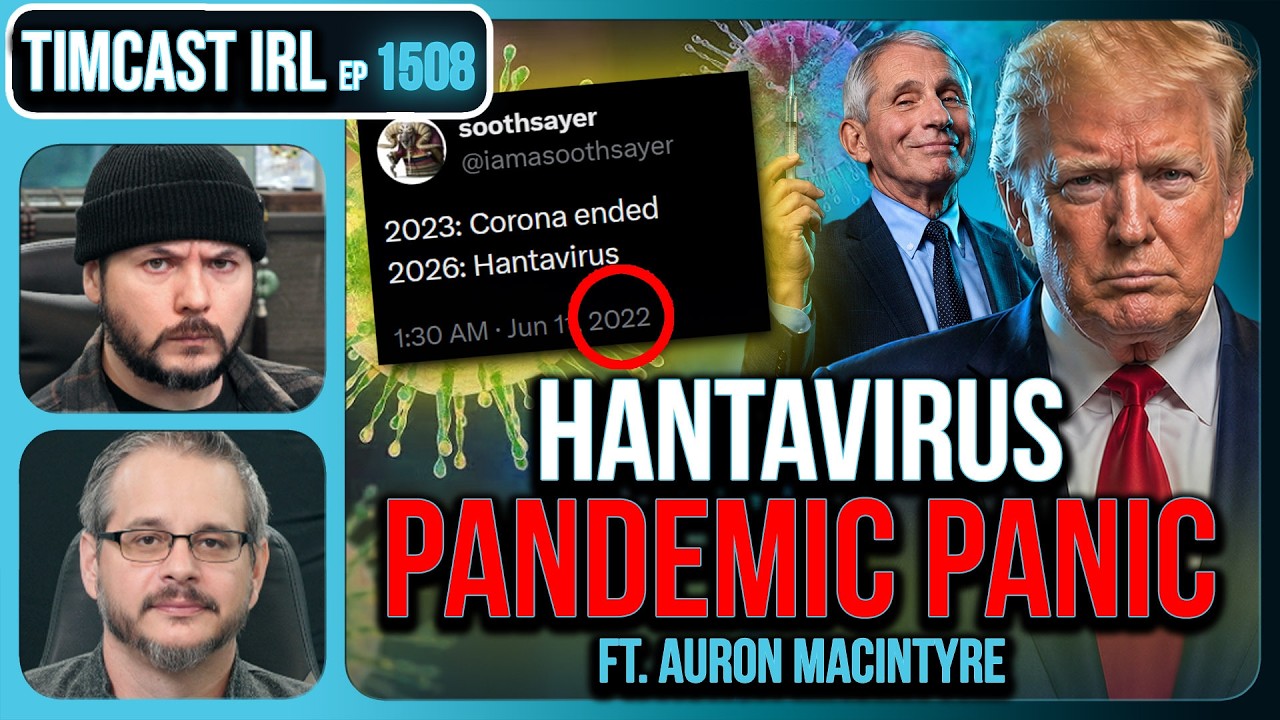
HANTAVIRUS PANDEMIC PANIC, Human To Human Spread Feared | Timcast IRL
"Tim Pool and his guests dismiss the Hantavirus panic as media desperation, pivot to discussing escalating political polarization, the rise of technocracy, and the weaponization of social issues."

"Fighting Solves EVERYTHING!" Who's To Blame For Political Violence? + Maria Machado On Trump
"This episode dissects the escalating political violence in the US, with panelists fiercely debating the role of partisan rhetoric and media in radicalization, alongside an interview with Venezuelan opposition leader Maria Machado on US intervention and her country's future."

True-crime cases with recent developments | 48 Hours Full Episodes
"This episode reconstructs four complex true-crime cases, detailing the harrowing searches for missing persons, the challenges of prosecuting murders without bodies, and the enduring quest for justice in cold cases spanning decades."

Alex Jones: Epstein Files, Bondi Hearing + El Paso Shutdown | PBD #737
"Alex Jones details his conspiratorial view of the Epstein files, alleging deep state involvement and a political cover-up, while also recounting his personal legal battles, including the Sandy Hook lawsuit, which he frames as a weaponized attack on free speech."