
Stanislav Krapivnik: Russia & Iran Just Crossed a Line
YouTube · MmCEp0m3lAQ
Quick Read
Summary
Takeaways
- ❖Ukrainian military offensives are dramatically shrinking in scale, indicating severe manpower and equipment shortages.
- ❖The 2023 Ukrainian counter-offensive resulted in 85,000 Ukrainian dead for minimal territorial gains, akin to World War I casualties.
- ❖US and NATO military personnel are directly operating HIMARS and Patriot missile systems in Ukraine, not just training Ukrainians.
- ❖Russia's military has gained extensive combat experience from Chechnya, Syria, and Ukraine, rotating commanders and units to build expertise.
- ❖Russia's economy is far more self-sufficient and larger than Western estimates, capable of sustaining a prolonged conflict without Western imports.
- ❖A US/Israel attack on Iran would be an existential threat to Russia and China, likely leading to their direct support for Iran.
- ❖Iran possesses the capability to overwhelm US aircraft carrier defenses and close the Strait of Hormuz, causing a global oil supply shock.
- ❖The closure of the Strait of Hormuz would lead to a total economic collapse for the European Union due to oil shortages.
Insights
1Ukraine's Military Collapse and PR Warfare
Ukrainian forces are experiencing critical manpower and equipment shortages, leading to significantly smaller and less effective offensives. The speaker claims their strategy has shifted from tactical victories to 'PR victories,' involving suicide squads sent to capture photos for propaganda, even if it means immediate death.
Offensives shrinking from Khikov (2022) to the 'vaunted counter-offensive of 2023' (85,000 dead for 120 sq km) to smaller 2024 operations. Use of 'suicide squads' for border photos.
2Direct NATO/US Military Involvement and Casualties
The speaker asserts that US and NATO military personnel are directly operating advanced weapon systems like HIMARS and Patriot batteries in Ukraine, not just providing training. He claims these foreign personnel are incurring significant casualties, which are not publicly acknowledged by Western governments.
Claims HIMARS are 'strictly Americans firing it,' Patriot batteries (94 people) are crewed by Germans/Americans/Brits/Poles, not Ukrainians, due to extensive training requirements. Cites a December 2024 New York Times article confirming US generals demanded missile attacks, not Ukrainians.
3Russia's Military Transformation and Mobilization Capacity
Russia's military has undergone a significant transformation, gaining extensive combat experience from Chechnya, Syria, and Ukraine. It possesses a vast mobilization capacity (30 million reservists) and a continuous flow of volunteers, allowing for unit rotation and sustained operations. The speaker notes a shift from 'glory hounds' to a sober, methodical approach.
Senior commanders' experience from Chechnya (1999) and Syria (rotating personnel). Partial mobilization called up only 2% of 30 million reservists, with 30-40k volunteers monthly. Criminals (for specific offenses) are also recruited and given full training.
4Russia's Undervalued and Self-Sufficient Economy
The speaker argues that Russia's GDP was intentionally undervalued by Western experts after the Soviet collapse (from 6-7% to 2% of world GDP) to facilitate cheap acquisitions. Russia possesses a massive manufacturing sector and is largely self-sufficient, producing everything from airliners to fertilizers with 100% domestic parts, unlike many Western nations.
Claims Russia was 'never 2% of world GDP,' but closer to 6-7%. Mentions Russia launched two 100% Russian-part airliners and a new civilian helicopter in 2025. Highlights Russia as the biggest producer of fertilizers after China and a major supplier of raw materials and semi-assembled goods to Europe.
5Iran as an Existential Crisis for Russia/China and Global Economic Threat
An attack on Iran by the US and Israel is framed as an existential crisis for Russia and China, as it would open their internal borders to Western penetration. Iran, with Russian and Chinese military support (S-300/S-400, SU-35s, jamming equipment), can defend itself, potentially sinking US aircraft carriers and closing the Strait of Hormuz, leading to a global oil supply shock and economic collapse, particularly in Europe.
Iran is 'deep front' for Russia/China. Russia has supplied S-300s, S-400s, and SU-35s to Iran. Iran can launch 300-400 missiles/drones to overwhelm carrier groups. Closing Strait of Hormuz (35-36% of world oil) would cause a 'supply side shock,' leading to European economic collapse and countries running out of oil.
Bottom Line
The US military's standard operating procedure in conflict zones (e.g., Afghanistan/Iraq) involves calling in artillery/aviation to wipe out buildings suspected of housing snipers, disregarding civilian presence, which contrasts with Russia's more cautious approach in Ukraine to preserve civilians.
This highlights a fundamental difference in military doctrine and rules of engagement between the US and Russia, suggesting different approaches to urban warfare and civilian casualties. It implies that Russia's current restraint in Ukraine is a deliberate choice, not a lack of capability.
Understanding these doctrinal differences can inform more accurate predictions of military outcomes and humanitarian impacts in future conflicts involving these powers. It also suggests that Western narratives about Russian 'indiscriminate' attacks might be missing context on their actual capabilities and self-imposed restraints.
The Russian military is actively preparing for a 'big war with Europe,' seeing 'the writing on the wall.' This is evidenced by their refusal to take back older, experienced officers, telling them 'your time hasn't come,' implying they are being saved for a larger conflict.
This suggests a long-term strategic outlook within the Russian military, anticipating a direct confrontation with European NATO members beyond the current Ukraine conflict. It indicates that Russia views the current conflict as a training ground and a precursor to a larger geopolitical struggle.
This perspective challenges the idea that Russia's military focus is solely on Ukraine. It implies that European nations should re-evaluate their defense strategies and industrial capacities in light of Russia's long-term planning for a potential large-scale conflict.
Key Concepts
War of Economies
Any conflict lasting more than a month or two transforms into a war of economies, where replenishment capabilities for men and equipment become paramount. Russia's self-sufficient manufacturing and resource base gives it a significant advantage over Europe, which relies heavily on external supply chains and has de-industrialized.
Proxy War Escalation
What begins as a proxy conflict, like Ukraine, can escalate through direct involvement of major powers (e.g., US/NATO operating systems) and intelligence sharing, blurring lines and increasing the risk of direct confrontation. This model suggests that 'plausible deniability' becomes increasingly fragile as stakes rise.
Lessons
- Re-evaluate geopolitical risk models by incorporating non-Western perspectives on military capabilities and economic resilience, particularly for Russia and China.
- Assess the potential for global supply chain disruptions, especially in energy, by modeling the impact of a Strait of Hormuz closure and considering the self-sufficiency of major powers.
- Scrutinize official narratives on military conflicts for evidence of direct foreign military involvement and its implications for escalation and accountability.
Notable Moments
The speaker details Russia's initial combat operations in Ukraine, stating that for the first three months, Russian forces were not allowed to fire on Ukrainians until they were fired upon, due to ongoing negotiations.
This reveals a significant self-imposed restraint by Russia at the outset of the conflict, which likely contributed to higher Russian casualties and a slower advance. It contradicts the narrative of an unprovoked, aggressive full-scale invasion without initial attempts at de-escalation or negotiation.
The speaker highlights that the New York Times confirmed in December 2024 that missile attacks were a 'demand from US generals,' not a request from Ukrainians, and that Americans were operating the systems.
This is presented as a critical confirmation of direct US military command and control over Ukrainian operations, undermining claims of Ukrainian autonomy and escalating the conflict's character to a direct proxy war between the US/NATO and Russia.
Quotes
"This is I think this is the first war in history where one side is fighting not so much uh for strategical uh and tactical victories as in uh PR victories."
"Those highars going boom those are Americans behind uh the the wheel. The patriots going boom... those aren't Ukrainians."
"Russia could turn Kiev into Gaza. Russia could turn any Ukrainian city into Gaza or into Masul... Russia isn't fighting like that."
"If there's a missile heading toward Moscow and it's a Tomahawk missile, you have to consider that this is a nuclear tipped missile trying to do a decapitation strike. And what's the logical response? Full solo nuclear strike back on the US and Europe."
"Russia is literally a self-sustained economy on most things. It feeds itself quite well, but it feeds about a third of the world, too."
"If Iran falls it opens up all their internal borders to penetration by the US and NATO. That's an that's an basically existential crisis for both Russia and China."
Q&A
Recent Questions
Related Episodes

Iran Update: Israel’s Newest Bombing Campaign, the Oncoming War With China and How to Avoid It
"Colonel Wilerson reveals how the US and Israel are actively bombing China's strategic infrastructure in Iran, escalating a covert economic war that Beijing intends to win without direct military conflict by dismantling the dollar's global dominance."

Patrick Henningsen: Hezbollah JUST Fired Back at Israel - Iran Vows to “Crush” All Attacks
"Patrick Henningsen argues that the US and Israel initiated an illegal war against Iran, driven by Trump's incompetence and Israeli influence, leading to an inevitable escalation with severe global economic repercussions."
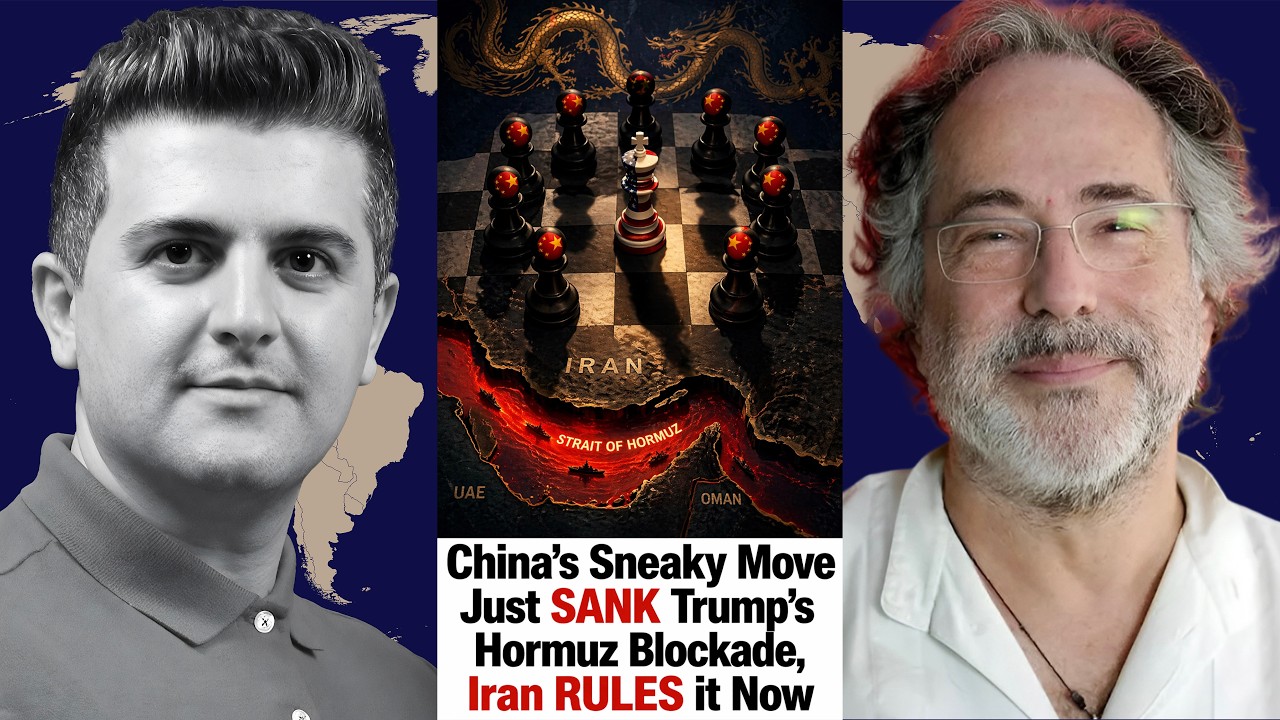
Pepe Escobar: “Total Failure”: Trump’s Blockade Just Backfired Disastrously
"Pepe Escobar argues that the US blockade against Iran, spearheaded by Donald Trump, has utterly failed and backfired, accelerating global economic chaos and challenging US geopolitical dominance."

Bibi DEMANDS Ground Troops As Marines Rushed to Iran
"Benjamin Netanyahu is pushing for US ground troops in Iran, framing air strikes as insufficient, while the US rushes Marines to the region and struggles to secure the Strait of Hormuz against surprisingly capable Iranian defenses."