
Scott Galloway: AI Wasn’t Built For You. The Rich Don’t Need You Anymore!
YouTube · NdU6UdUKaYc
Quick Read
Summary
Takeaways
- ❖AI's brand has suffered immense erosion, viewed positively only by the wealthy who benefit from it.
- ❖Predictions of mass job destruction from AI are often a 'thinly veiled attempt' to justify high valuations and massive investments.
- ❖Historical data suggests technology creates more jobs than it destroys, with current unemployment rates not reflecting an 'AI apocalypse'.
- ❖Tech CEOs often 'catastrophize' about AI's dangers while simultaneously cashing out, demonstrating a disconnect.
- ❖The ability to endure rejection is a critical, underrated skill being lost by young people in an increasingly frictionless online world.
- ❖Many tech billionaires exhibit a 'nihilist vein,' preparing 'go bags' for societal collapse rather than investing in collective well-being.
- ❖AI, like jet transportation or PCs, may be a 'shitty business' for investors, failing to concentrate shareholder value despite its seminal impact.
- ❖China could 'dump' cheap AI models into the US market, potentially causing a significant correction in the overvalued US tech sector.
- ❖GLP-1 drugs (like Ozempic) are a more impactful technology for human lives and shareholder value than AI.
- ❖Recessions, while painful, can be healthy resets for younger generations, allowing for asset acquisition at lower prices.
Insights
1AI's Brand Erosion and Wealth Correlation
The brand of AI has significantly eroded over the last 18 months, with public perception becoming increasingly negative. This perception is directly correlated with wealth: only people making over $200,000 annually tend to view AI positively, seeing it as a portfolio booster and innovation. For the average middle-class person, AI is perceived as scary and a wealth creator exclusively for the already rich, exacerbating concerns about energy costs and job security.
Galloway states, 'Your view of AI is directly correlated to your wealth. The only cohort that has a positive rating of AI is people making over $200,000.'
2Catastrophizing by Tech CEOs as a Fundraising Tactic
Many public statements by AI CEOs, such as Elon Musk's prediction of 'AI and robots will replace all jobs' or Sam Altman's 'dystopian future' scenarios, are primarily a 'thinly veiled attempt' to inflate valuations and secure massive investments. The actual data on employment does not support an impending 'job apocalypse,' with current unemployment rates remaining low and new business permits doubling in the last decade.
Galloway asserts, 'I think it's mostly the catastrophizing is nothing more than thinly veiled attempt to say my technology is so devastating that it's going to shift society and you should invest at this crazy valuation.' He cites US unemployment at 4.5% and new business permits doubling.
3AI Will Create More Jobs Than It Destroys, Requiring Upskilling
While AI will cause disruption and job displacement in certain sectors (e.g., customer service, legal entry-level roles, long-haul trucking), it is expected to create more jobs overall in the medium to long term. The key is for individuals to adapt and upskill, becoming 'AI fluent' to leverage these technologies rather than be replaced by them. Examples include increased demand for radiologists and coders who can utilize AI as a supplement.
Galloway states, 'I believe over the medium and the long term it's actually going to create more jobs than it destroys.' He mentions radiologist job listings are up because AI supplements diagnosis, and coder listings are up 11%.
4Nihilism and Disassociation Among Tech Billionaires
A 'nihilist vein' runs through big tech, where many billionaires have 'go bags' and elaborate plans to escape societal collapse (e.g., bunkers in New Zealand). This reflects a profound disassociation from the health and well-being of society, as their immense wealth allows them to bypass public services (private jets, concierge medicine, elite schools) and avoid the consequences of societal decline. Their focus remains on maximizing shareholder value, often at the expense of the 'tragedy of the commons'.
Galloway describes billionaires with 'go plans' and bunkers in New Zealand. He states, 'The 0.1% are not invested in the health of America' because they are 'sequestered from it.'
5The US-Iran Conflict: Strategic Incompetence and Brand Damage
The US military action in the Middle East is characterized by 'operational excellence and strategic incompetence.' It was initiated with a miscalculation by the Trump administration, believing it could 'liberate the Middle East' after a successful Venezuela operation. However, a lack of coordination with allies, congressional briefing, and understanding of game theory has led to a 'quagmire,' diminishing the US brand globally and empowering adversaries like the IRGC. Iran is winning the 'AI meme war' through effective propaganda.
Galloway states, 'I would describe the war as being operational excellence and strategic incompetence.' He notes Iran is 'winning what you would call the slopp' through 'highly produced, highly effective' AI-driven memes.
Bottom Line
AI's inherent tendency to average data and provide 'nice' responses could lead to a moderating effect on political discourse, pushing people towards the middle rather than the extremes amplified by social media algorithms.
This suggests a potential positive social outcome for AI, counteracting the polarization seen with previous digital platforms. It implies AI could foster more balanced perspectives.
Develop AI applications specifically designed to facilitate moderate discourse, synthesize diverse viewpoints, and present information neutrally, potentially for educational or news platforms.
Despite its transformative power, AI might be a 'shitty business' for investors, similar to the airline, PC, or vaccine industries, which, over time, have failed to yield concentrated shareholder value for a few dominant companies.
This challenges the current high valuations of AI companies, suggesting a significant market correction is likely. It implies that the benefits of AI may accrue more to society (stakeholders) than to a select few companies (shareholders).
Investors should diversify away from highly speculative AI stocks and consider the broader societal benefits of AI rather than expecting concentrated financial returns from a few 'winners.' Entrepreneurs should focus on applications that leverage AI for widespread utility, rather than solely on proprietary AI models.
China could strategically 'dump' cheap, open-weight AI models into the US market, similar to historical steel dumping, to kneecap the US economy by undermining the valuations of highly capitalized American AI companies.
This represents a significant geopolitical and economic threat to the US, as a large portion of its recent GDP growth and stock market valuation is tied to AI capex. Such a move could trigger a US market crash and recession.
US policymakers should consider this as a potential economic warfare tactic and develop strategies to protect its AI industry, potentially through subsidies for domestic models or regulations against predatory pricing. Corporations should evaluate the long-term risks of relying solely on cheap foreign AI models.
Key Concepts
Catastrophizing as Fundraising
The idea that tech leaders often exaggerate the destructive potential of their technologies (e.g., mass job loss from AI) not out of genuine concern, but as a strategic marketing and fundraising tactic to justify exorbitant valuations and attract investment.
Idolatry of Innovators
The societal tendency to elevate tech CEOs to a god-like status, expecting them to 'save' us, despite their primary incentive being shareholder value, often at the expense of societal well-being or ethical considerations.
Selling Yourself Long
A mindset where individuals project their future, compounded intelligence, wisdom, and connections, rather than valuing themselves based on their current fixed state, enabling them to pursue larger opportunities and negotiate for more.
Recession as a Reset
The perspective that economic recessions, while painful, are a natural and even healthy process that clears 'fatty deposits' in the economy, lowers asset prices, and creates new opportunities for resilient entrepreneurs and younger generations to invest and build wealth.
Lessons
- Cultivate 'AI fluency': Dedicate a 'second screen' to AI tools (LLMs) and actively experiment with integrating them into your daily work to enhance productivity and protect your job.
- Develop resilience to rejection: Actively seek out situations where you might face a 'no' (e.g., applying for ambitious jobs, expressing interest to strangers) to build mental fortitude and overcome the fear of failure.
- Prioritize and invest in relationships: Recognize that strong personal connections are the most important and rewarding aspect of life, compounding over time into powerful assets for happiness and support.
- Implement disciplined financial habits: Start saving early into low-cost index funds, ensuring a portion of your income is automatically invested before it ever reaches your hands, and diversify investments as you accumulate wealth.
Building Resilience to Rejection
Actively seek out social groups (church, sports, classes) and make overtures of friendship to strangers, aiming for a 'no' to practice endurance.
Approach individuals you are romantically interested in and ask them out for coffee, with the explicit goal of getting a 'no' to desensitize yourself to rejection.
Apply for jobs and graduate programs for which you are not fully qualified, viewing rejections as opportunities to build resilience rather than personal failures.
Notable Moments
Galloway's emotional reflection on fatherhood and purpose.
This deeply personal moment reveals a profound shift in Galloway's life philosophy, moving from a transactional, capitalist view to finding purpose in unconditional investment in his children, highlighting the human need for connection and meaning beyond material success.
The host's observation about AI-enabled individuals taking multiple jobs.
This expands on Galloway's 'AI won't take your job, someone who understands AI will' by illustrating that one AI-fluent person can replace several traditional roles (e.g., one analyst replacing five), emphasizing the magnitude of efficiency gains and the need for individual adaptation.
Quotes
"These techs, they do not have our best interests at heart."
"The only cohort that has a positive rating of AI is people making over $200,000."
"I think some of the catastrophizing is nothing more than thinly veiled attempt to say my technology is so devastating that it's going to shift society and you should invest at this crazy valuation."
"AI is not going to take your job. Someone who understands AI is going to take your job."
"The biggest threat that people are young people are losing especially young men and this is a skill and it's hugely underrated is the ability to endure rejection."
"The key attribute of an innovator right now is storytelling. And that is to make sure the promise is way ahead of the performance such you can access cheap capital and pull the future forward."
"They will kill a lot of our people. We will kill some of theirs. They will tire. They will go home."
"The biggest downside of AI in my view is loneliness."
"Nothing's ever as good or as bad as it seems."
"The recedes for love is grief. I hope my boys feel the same way about me."
Q&A
Recent Questions
Related Episodes

Iran Update: Israel’s Newest Bombing Campaign, the Oncoming War With China and How to Avoid It
"Colonel Wilerson reveals how the US and Israel are actively bombing China's strategic infrastructure in Iran, escalating a covert economic war that Beijing intends to win without direct military conflict by dismantling the dollar's global dominance."

Trump's HEATED Call + AOC's Data Center Deep Dive | PBD #804
"This episode dissects the week's most impactful events, from Trump's contentious call with Netanyahu and Elon Musk's path to trillionaire status, to the societal implications of AI-driven job displacement and AOC's unexpected political alignment on data center concerns."

Patrick Henningsen: Hezbollah JUST Fired Back at Israel - Iran Vows to “Crush” All Attacks
"Patrick Henningsen argues that the US and Israel initiated an illegal war against Iran, driven by Trump's incompetence and Israeli influence, leading to an inevitable escalation with severe global economic repercussions."
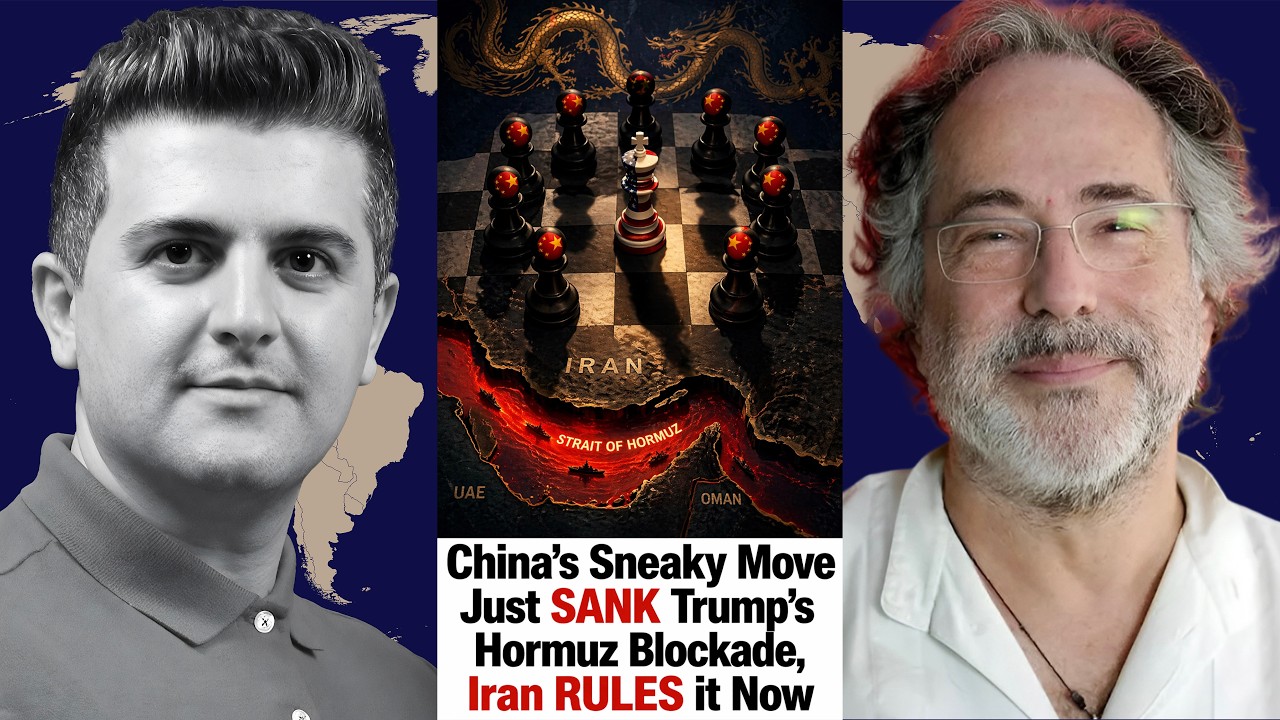
Pepe Escobar: “Total Failure”: Trump’s Blockade Just Backfired Disastrously
"Pepe Escobar argues that the US blockade against Iran, spearheaded by Donald Trump, has utterly failed and backfired, accelerating global economic chaos and challenging US geopolitical dominance."