LaTosha Brown: “Our Pockets, They Are Cleaning Us Dry”. MAGA Targeting Black Communities
YouTube · NlJIuYAm6hk
Quick Read
Summary
Takeaways
- ❖MAGA forces are actively working 'double, triple, quadruple overtime' to suppress Black votes through various mechanisms, including restrictive mail-in ballot rules and potential ICE presence at polling places.
- ❖Political decisions directly impact economic well-being, as seen in the Florida Attorney General's challenge to the NFL's Rooney Rule, which limits economic opportunities for Black coaches and, by extension, their communities.
- ❖Donald Trump's stated policy prioritizes military spending (approaching $1 trillion) over social programs like daycare and healthcare, shifting financial burdens to states and disproportionately affecting vulnerable communities.
- ❖Black grassroots organizations are experiencing significant funding cuts from federal grants and foundations, making community self-funding and redirection of consumer dollars essential for their survival and impact.
- ❖The 'We Got Us' campaign emphasizes that Black communities must rely on themselves, strategically using all available tools—economic, mutual aid, and voting—to build power and protect their interests.
- ❖Early voting is a critical strategy to cure ballots, accommodate diverse work schedules, build community momentum, and mitigate potential election day disruptions or suppression tactics.
Insights
1Systemic Voter Suppression Efforts by MAGA
MAGA-aligned politicians are implementing a range of tactics to make voting more difficult for Black communities. These include passing laws like Florida's 'Save Act,' challenging mail-in balloting, and imposing strict ballot receipt deadlines, often without considering postal service delays. The host and guest highlight these efforts as a concerted strategy to 'steal this election.'
Roland Martin mentions the 'Save Act' in Florida and lawsuits against Trump's mail-in balloting executive order. Cliff Albright adds concerns about potential ICE agents at polling places and states requiring ballots to be *received* by the deadline, not just mailed, despite postal service unreliability.
2Economic Warfare Through Policy and Legal Challenges
The attack on the NFL's Rooney Rule by the Florida Attorney General is presented as a clear example of how political actions directly undermine Black economic opportunities. By challenging a rule that only mandates interviews for diverse candidates, these actions limit access to high-paying coaching jobs and the subsequent economic impact on Black communities, illustrating that political fights are also economic fights.
Roland Martin plays a clip of Florida AG James Umeyer stating the Rooney Rule violates Florida law by requiring race-based considerations. Martin then explains that a Black coach getting a job has an economic impact, leading to hiring interns and other staff, connecting politics to economic outcomes. LaTosha Brown notes 70% of NFL players are Black, but only 9% are coaches, emphasizing the disparity.
3Trump's Fiscal Priorities and Their Impact on Black Communities
Donald Trump's stance on federal spending prioritizes military protection, advocating for states to bear the cost of social programs like daycare and Medicaid/Medicare. This approach, which shifts financial burdens to states and potentially leads to higher state taxes, is seen as a direct threat to programs that benefit Black communities, while the federal military budget approaches or exceeds $1 trillion.
Roland Martin recounts Trump's statement that the US 'can't take care of daycare' or 'Medicaid, Medicare' federally, asserting these are state responsibilities, while the military budget is 'approaching $1 trillion.' Cliff Albright adds that the military budget likely 'exceeds a trillion dollars' when intelligence spending is included.
4The Imperative of Self-Funding Black Grassroots Organizations
Black grassroots organizations, which are critical for community empowerment and advocacy, are facing severe financial challenges due to cuts in federal grants and foundation support, partly influenced by anti-DEI sentiment. The speakers stress that Black communities must redirect their own resources from consumer goods to support these frontline groups, recognizing that 'we cannot depend on white benevolence.'
Reesei asks about funding for Black organizations, noting that money wasn't reaching 'boots on the ground.' LaTosha Brown confirms that 'not a single black organization has not suffered some kind of loss,' and Black Voters Matter has redistributed over $55 million to 800+ groups. She urges listeners to redirect money from luxury brands like Louis Vuitton or Amazon to Black grassroots groups, stating, 'we are all we got right now.' Cliff Albright attributes funding decline to anti-DI sentiment and changing political calculations.
5Strategic Importance of Early Voting
Early voting is presented as a crucial strategy to counter voter suppression and maximize Black community participation. It allows voters to 'cure' any ballot issues, provides flexibility for those with non-traditional work schedules, and builds momentum for the election cycle, acting as a 'winning team' effect.
Greg asks about early voting. Cliff Albright emphasizes its importance, especially given election day disruptions like bomb threats at Black precincts in 2024. LaTosha Brown adds that early voting provides 'opportunity to cure the ballot,' accommodates 'black folks' work schedule,' and 'creates momentum' like a 'concert' or 'winning team' that attracts more participants.
Bottom Line
The 'anti-DI' (Diversity, Equity, and Inclusion) movement is directly impacting the funding landscape for Black grassroots organizations, causing philanthropy to shy away from anything 'appeared black in any way.'
This creates a systemic financial vulnerability for organizations working on racial justice, forcing them to seek alternative funding models and rely more heavily on community-based donations.
Develop new, community-centric funding mechanisms or platforms that are resilient to shifts in mainstream philanthropic and political sentiment, potentially leveraging collective giving and direct community investment.
The host points out that many Black political candidates for governor in Georgia (five on the Democratic side) have not reached out to appear on his show, despite its reach.
This suggests a potential disconnect between some Black political campaigns and established Black media platforms, possibly missing opportunities to engage with a critical voter base and leverage existing community infrastructure.
Black media platforms could proactively offer structured engagement opportunities for candidates, and campaigns should prioritize outreach to diverse media outlets, recognizing their role in community mobilization and information dissemination.
Key Concepts
Power Building Group vs. Voting Group
LaTosha Brown distinguishes Black Voters Matter as a 'power building group' rather than merely a 'voting group.' This model emphasizes using multiple tools—economic, mutual aid, protest support, and voting—to achieve systemic power shifts, rather than solely focusing on electoral outcomes. It views voting as one critical tool among many in a broader struggle for community liberation and protection.
Chaos is the Point
LaTosha Brown posits that the constant barrage of attacks and controversies ('individual hits') serves to create 'so much chaos that it normalizes this process.' This model suggests that the objective is not just to win specific policy battles but to overwhelm and desensitize the public, making attacks on inclusivity seem normal and discouraging organized resistance. Understanding this helps communities push back against the intended psychological and political effects of chaos.
Lessons
- Donate financially to Black grassroots organizations like Black Voters Matter (blackvotersmatterfund.org) to support their work and counter funding cuts.
- Volunteer your time and skills, even from home, through activities like texting and phone banking offered by organizations like Black Voters Matter, which provides weekly trainings.
- Make a plan to vote early where possible, understanding it allows for ballot curing, accommodates diverse schedules, and builds crucial community momentum for the election.
- Redirect personal consumer spending from brands that do not support Black communities to organizations actively fighting for Black liberation and economic justice.
Strategic Early Voting for Community Power
Identify early voting options and dates in your state and local area, understanding that not all states offer it.
Vote early to allow time for 'ballot curing' if any issues arise, ensuring your vote is counted before Election Day.
Utilize the flexibility of early voting to accommodate work schedules and caregiving responsibilities, removing barriers to participation.
After voting early, mobilize your network: 'evangelize' and bring 10 more people to the polls, leveraging the momentum created by early turnout.
Notable Moments
In the 2025 cycle, a Public Service Commission (PSC) race in Georgia, which connects to utility bills and affordability, saw a blowout victory for Democrats (63% for winning candidates), giving them control for the first time in two decades. One of the winning candidates was a Black woman who won statewide.
This demonstrates that when voters connect local issues (like utility bills) to political offices, they can achieve significant, underreported victories, even against voter suppression efforts. It highlights the power of targeted education and organizing around tangible economic concerns and the potential for Black women to win statewide elections in challenging environments.
Quotes
"For something that allegedly doesn't matter, meeting these elections and our vote, they are working overtime, double and triple, quadruple overtime to find ways to make sure that we're not able to to vote."
"As we're talking and debating whether you vote or not or whether it's important or not, the truth of the matter is our pockets, they are cleaning us dry."
"I know not who this Jesus is that they go around talking about this Jesus who's who's anti-gay anti-woman anti- you know racist and doesn't care about the poor and evidently really cares a lot about the defense budget."
"There is a long history of this distorted evil antichrist white supremacist nationalist Christianity. What is disappointing is when that we as a people cannot discern between that and when people in our communities because what black folks were able to do particularly even in the context of Christianity we actually gravitated towards liberation theology."
"It ain't about what you like. This ain't this ain't no um uh social media platform that whether what you like and you don't dislike. This is about how can we use our discernment and strategically use every single tool that is available to us."
Q&A
Recent Questions
Related Episodes
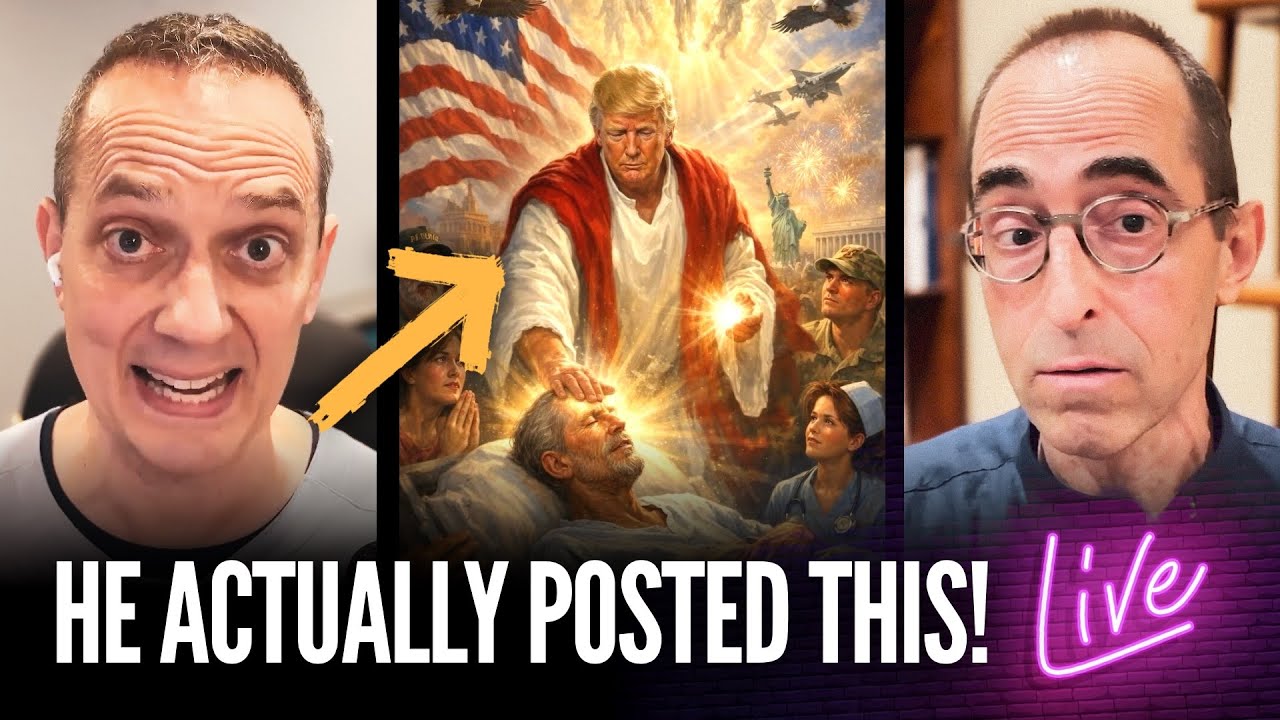
Trump Posts (Then Deletes) Image of Himself as Jesus, Picks Fight with The Pope
"Donald Trump attacked Pope Leo, then posted (and deleted) an AI-generated image depicting himself as Jesus, revealing a transactional view of religious authority and a deep misunderstanding of Christian doctrine."

NC Targets DEI. Trump Blocks Housing Bill. Minority Banks Face New Rules. Kohen Wiley Protests
"This episode exposes how current political actions, from changes in minority bank definitions to attempts to regulate college athlete earnings and block foreign aid, are systematically undermining Black economic power, voting rights, and social justice."

Iran Deal Skepticism. Whoopi Vs Vance. Potomac Park Invasion. Racist Hurls Slurs At Black Boy.
"This episode dissects multiple instances of alleged anti-Black policies and racial injustice, from the Trump administration's legal challenges to reparations and the Iran deal, to police brutality and the erasure of Black history."

Thomas Massie, Kevin O'Leary, & The American Psyop | The Tim Dillon Show #497
"Tim Dillon skewers American politics, corporate greed, and the unchecked rise of AI, arguing that society is being manipulated by 'psyops' and driven towards a dehumanized, hyper-efficient future."