
TRUMP HAS WON
YouTube · PmYbVQiowR8
Quick Read
Summary
Takeaways
- ❖The Iran deal was a strategic victory for the US, not a blunder, designed to achieve long-term geopolitical goals.
- ❖A 'deep state' plan, predating Trump, aimed to establish the US as the world's dominant oil exporter by disrupting Middle Eastern supplies and isolating China.
- ❖Trump's actions, including securing Venezuelan oil and closing the Strait of Hormuz, were deliberate steps in this grand strategy.
- ❖Mainstream media offers 'surface-level' critiques, failing to understand the complex, multi-layered '5D chess' of international relations.
- ❖The US strategy involves decimating enemy leadership and then offering economic incentives (e.g., IMF funds) to bring nations under Western influence.
Insights
1Iran Deal as a Strategic US Victory for Energy Dominance
The host asserts that the Iran deal, despite media portrayal as a Trump failure, was a strategic success. The US aimed to eliminate Iran's aging leadership, disrupt its energy infrastructure (like Qatari gas fields), and close the Strait of Hormuz to cut off China's oil supply. This created an opportunity for the 'Gulf of America' (formerly Gulf of Mexico) to become the world's primary oil exporter, a long-term goal of US foreign policy.
US forces leaving the area, gas prices falling, Iran's leadership 'wiped out,' economic recovery in line with IMF plans, Strait of Hormuz shuttered, US exporting oil at World War II levels from the Gulf of America.
2The 'Deep State' and Persistent Geopolitical Plans
The host argues that a 'deep state' of unelected officials and military leadership maintains consistent geopolitical objectives across administrations, regardless of who is president. These individuals provide the same intelligence and advice, leading to similar outcomes despite surface-level political conflicts between leaders like Trump and Biden. The Iran conflict and US energy strategy are presented as examples of such a long-standing plan.
FBI having 38,000 personnel with holdovers, military leadership persisting through Trump and Biden, intelligence guys pushing for blocking China's energy access from the Strait of Hormuz.
3US Global Strategy: Economic Coercion After Military Decimation
The US strategy, according to the host, involves militarily weakening a target nation's leadership and capabilities, then offering massive economic incentives (e.g., $300 billion in reconstruction funds from IMF/World Bank) to bring them under Western influence. This 'carrot and stick' approach is designed to ensure compliance and prevent future conflicts, even if it means making concessions like curtailing Israel's ability to fight Hezbollah.
Iran's leadership 'flattened and gone,' $300 billion offered for rebuilding, the host's analogy of buying a family home at an inflated price after initial refusal, and the US military's belief that economic reconstruction will stop Iran from funding rebels.
4Energy as the Core Driver of Geopolitics
The host emphasizes that energy control is the fundamental driver of global conflicts and US foreign policy. He connects the Ukraine war to Russia's natural gas pipelines to Europe and the US desire to undermine Russian energy dominance. Similarly, the Iran conflict is framed primarily as a move to secure US oil export supremacy and cut off China's energy access.
Russia controlling 20% of European natural gas, Nord Stream 2 being blown up, US cutting off Russia from Crimea and the Black Sea to prevent oil exports, and China's reliance on Strait of Hormuz oil.
Bottom Line
The renaming of the 'Gulf of Mexico' to the 'Gulf of America' by Trump was a symbolic but significant step in a larger strategy to establish the region as the world's dominant oil export zone.
This suggests that seemingly minor political actions can be indicators of long-term, strategic geopolitical shifts aimed at economic and resource control.
Analysts should pay closer attention to symbolic renamings or seemingly minor policy changes, as they may signal foundational shifts in national strategy, particularly concerning resource control and trade routes.
The US strategy involves isolating adversaries like Cuba and Venezuela, clearing trade lanes of 'narco boats,' and seizing oil interests to ensure unimpeded flow from the 'Gulf of America' to global markets.
This implies that seemingly disparate actions against drug traffickers or specific regimes are integrated into a broader strategy for securing and dominating global energy supply chains.
Businesses involved in global shipping, energy logistics, or maritime security could anticipate shifts in trade routes and security priorities based on these long-term geopolitical objectives, potentially identifying new markets or risks.
Key Concepts
Midwits
Individuals who are slightly above average in intelligence and can see some aspects of what's happening but lack the depth to understand the full, complex picture, often falling for surface-level narratives or grifter motivations.
Poker Analogy for Geopolitics
In complex situations like war or negotiations, the best play might involve losing money or folding a strong hand to achieve a greater, long-term strategic advantage, even if it looks like a loss on the surface. Winning isn't always about having the best hand, but about making the best strategic move to minimize losses or set up future gains.
Lessons
- Critically evaluate mainstream media narratives, especially regarding foreign policy and economic outcomes, by looking for deeper, long-term strategic motivations beyond surface-level explanations.
- Consider how seemingly unrelated geopolitical events (e.g., conflicts in the Middle East, actions in Latin America, energy policies) might be interconnected as part of a larger, multi-decade strategic plan.
- Recognize that 'winning' in complex geopolitical scenarios might not always look like an immediate, obvious victory, but rather a strategic positioning that minimizes long-term losses or sets up future advantages, much like a calculated move in poker.
Notable Moments
The host describes how his journalism gets him 'in trouble' because he has 'insider information' and doesn't adhere to the 'appropriate message' dictated by media and political establishments.
This highlights the host's self-perception as a contrarian journalist willing to expose uncomfortable truths, framing his analysis as an alternative to controlled narratives.
The host uses a detailed poker story to illustrate how the best strategic play can sometimes involve losing money or folding a strong hand, which he then applies to Trump's Iran deal.
This analogy serves as a core mental model for understanding his argument: that complex geopolitical moves might appear as losses on the surface but are actually calculated, long-term strategic victories.
Quotes
"The media is all fake. It's all lies and we are just chickens in a chicken coop being lied to."
"If I want to get access to big events, if I want to sit down with the world's elites, if I want to secure powerful contracts which will expand the show, then it's not about truth, it's about the appropriate message."
"The long-standing plan of the United States stretching back before Donald Trump... this was the plan the whole time."
"The US with this conflict has positioned itself as the dominant oil exporter and producer in the world."
"You destroy their leadership, then you offer them money and they're under your boot."
Q&A
Recent Questions
Related Episodes

🚨 TOTAL F*CKING CHECKMATE 😂😂😂
"The host argues that Trump's 'ceasefire' with Iran was a calculated '5D chess' move to orchestrate a global energy market reshuffle, while simultaneously lambasting 'woke' domestic policies and the 'freefall' of anti-Trump conservative figures."

🚨 THEY F*CKED AROUND FOR THE LAST TIME 😭😭😭
"This episode unleashes a torrent of highly opinionated commentary on the US-Iran deal, Israel's role, and a scathing critique of 'leftist' policies and immigration, particularly highlighting the UK grooming gang report as evidence of Western societal decay."
BREAKING: Protests ERUPT In Iran Over IRGC Surrendering To Trump - Infighting Clashes In Tehran
"Iran is experiencing severe internal infighting and protests as hardline IRGC elements clash with government figures over a perceived 'surrender' to the US, while mainstream Western media misrepresents the situation."
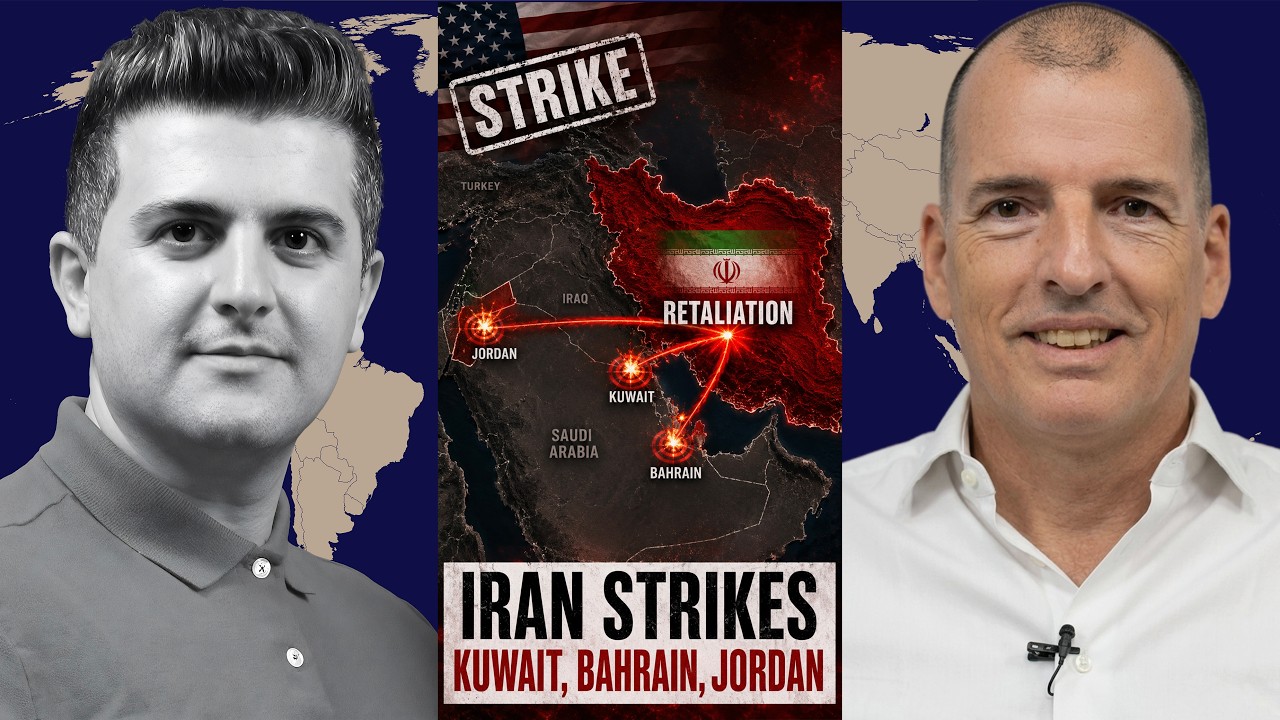
Alex Krainer: US STRIKES Iran – Iran RETALIATES Against Kuwait, Bahrain & Jordan!
"Amidst escalating US-Iran conflict and Iranian retaliation against regional US allies, this episode argues that US foreign policy is deeply controlled by an 'Anglo-Zionist conspiracy' led by the Rothschild banking dynasty, prioritizing Israeli interests over American ones."