
“I Found the Proof That Ends the Moon Landing Debate” | Tim Dodd
YouTube · R7gFk_By5wU
Quick Read
Summary
Takeaways
- ❖Tim Dodd, 'Everyday Astronaut,' started his YouTube channel to answer common spaceflight questions and debunk misinformation.
- ❖The Apollo program's Saturn V was designed to be disposable, making subsequent missions prohibitively expensive, unlike today's reusable rockets.
- ❖Early Von Braun concepts for lunar missions (1950s) involved in-orbit refueling for direct descent, a different approach than Apollo's lunar orbital rendezvous.
- ❖Only a quarter of a percent of the Saturn V's launch mass actually landed on the moon, highlighting Apollo's extreme mass-efficiency for a disposable system.
- ❖SpaceX's Starship aims to land 300 tons on the moon, 20-200 times more than Apollo, by reusing hardware and refueling in Earth orbit 12-15 times.
- ❖The Artemis program's SLS rocket is criticized for its high cost and reliance on old Space Shuttle hardware due to congressional mandates for job preservation.
- ❖The 'lost moon landing tapes' refer only to backup data tapes that were recorded over due to storage shortages, while original film and telemetry data are preserved.
- ❖The Van Allen radiation belts were mapped and understood by the 1960s; Apollo missions passed through them quickly, minimizing radiation exposure.
- ❖SpaceX has achieved over 550 Falcon 9 booster landings with a 97% success rate, demonstrating mastery of rocket reusability.
- ❖Future Mars missions face challenges like sustained life support, resource extraction on Mars, and managing long-term radiation and zero-G exposure for crews.
- ❖A fungus found in Chernobyl that 'eats' radiation (Cladosporium sphaerospermum) is being researched by NASA for potential radiation shielding in spacecraft.
- ❖The commercialization of space, driven by lower launch costs and off-the-shelf components, is making space exploration more accessible and innovative.
- ❖The proliferation of AI-generated content and misinformation on social media poses a significant threat to discerning truth, even in scientific fields.
Insights
1Apollo's 'Disposable' Design vs. Modern Reusability
The Saturn V rocket, used for Apollo missions, was designed to be entirely disposable, with only 0.25% of its initial launch mass actually landing on the moon. This 'throw it all away' approach, while effective for the space race, made repeated missions economically unsustainable. In contrast, modern vehicles like SpaceX's Starship aim for full reusability and in-orbit refueling (requiring 12-15 refueling missions for lunar travel) to drastically reduce costs and increase payload capacity, landing hundreds of tons on the moon.
Saturn V mass fraction (0.25% to moon), Starship's 300-ton lunar landing target, 12-15 refueling missions for Starship, Apollo program cost ~$300 billion (today's money) vs. Starship's $3 billion contract for lunar landings.
2Debunking the 'Lost Moon Landing Tapes' Conspiracy
The claim that NASA 'lost' the moon landing tapes is a misrepresentation. Only specific backup data tapes of the Apollo 11 transmission were recorded over due to a data storage shortage in the 1970s/80s. All primary data, including 16mm film shot by astronauts, telemetry, and broadcast recordings, was preserved and is publicly accessible. The initial broadcast quality was poor due to slow-scan to NTSC conversion, but this was a common practice at the time, not evidence of a cover-up.
Explanation of backup tapes being overwritten, existence of 16mm film, 11,000 hours of audio, NASA's public archives (nasa.gov/history), kinescope recording for broadcast conversion.
3Van Allen Belts: Understood and Traversable
The Van Allen radiation belts, often cited as an insurmountable barrier, were extensively mapped and understood by the 1960s through missions like Explorer 1. They are toroidal (donut-shaped), and Apollo missions traversed them quickly, minimizing radiation exposure. Astronauts' radiation levels were monitored (e.g., Armstrong's 0.11 rad), and the spacecraft provided significant shielding. The current Artemis 2 mission will again pass through these belts, further demonstrating their traversability.
Van Allen belts mapped by 1960s, toroidal shape, quick transit time for Apollo, Apollo 11 radiation levels (0.11 rad), Artemis 2 mission passing through belts.
4NASA's Bureaucracy and the SLS Rocket
The Space Launch System (SLS) rocket, used for the Artemis program, is a product of congressional mandates to reuse as much Space Shuttle hardware as possible. This approach, driven by job preservation and political interests, has resulted in an 'insanely expensive' rocket (costing ~$3 billion/year for over a decade) that is largely based on older technology. This contrasts with the fixed-price commercial contracts given to companies like SpaceX for lunar landers, which are significantly cheaper and more innovative.
SLS cost ~$3 billion/year for 10+ years, reuse of Space Shuttle engines and solid rocket boosters, 'jobs program' criticism, comparison to SpaceX's $3 billion lunar lander contract.
5The Commercial Space Revolution: Lower Costs and Innovation
The space industry is undergoing a revolution driven by lower launch costs and the commercialization of hardware. Companies like SpaceX (with its Falcon 9 and Starship) have mastered reusability, drastically reducing the cost of access to space. This has enabled new ventures like asteroid mining (Astroforge), commercial space stations, and even 'selfie-sats' (Mark Rober's Satgus), which were unimaginable 20 years ago. NASA is increasingly shifting towards fixed-price contracts and relying on commercial partners for services, allowing the agency to focus on riskier, developmental science missions.
SpaceX's 550+ Falcon 9 landings, Starlink's 10,000+ satellites, Astroforge (asteroid mining), Mark Rober's 'selfie-sat' ($2 million cost), NASA's shift to fixed-price contracts.
Bottom Line
A black fungus (Cladosporium sphaerospermum) discovered in Chernobyl, which 'eats' radiation, is being researched by NASA for potential use as a radiation shield for astronauts in deep space missions.
This biological shield could offer a novel, potentially self-sustaining method to protect humans from cosmic radiation during long-duration space travel to Mars or beyond, addressing a critical challenge for human exploration.
Further research into extremophile organisms and their unique properties could unlock new biotechnological solutions for space travel, including radiation protection, life support systems, and in-situ resource utilization.
The Japanese billionaire Yusaku Maezawa, who purchased a private orbital flight around the moon on SpaceX's Starship (Dear Moon project), ultimately canceled his contract because Starship had not flown its mission by the agreed-upon deadline of late 2023.
This highlights the significant financial and scheduling risks associated with cutting-edge space development, even for well-funded private ventures. It also underscores the iterative and often delayed nature of ambitious space programs, impacting participants who had 'uprooted their lives' for the mission.
As commercial spaceflight matures, clearer contractual agreements and more realistic timelines will be essential. This also creates opportunities for other private space tourism providers to learn from such experiences and offer more reliable, albeit potentially less ambitious, services.
Opportunities
Commercial Space Station Operations
Develop and operate private space stations that NASA and other entities can use as customers for science, research, and potentially tourism. This shifts the burden of maintaining expensive infrastructure from government agencies to commercial enterprises, fostering competition and innovation.
Asteroid Mining for Rare Earth Materials
Establish a company focused on identifying and mining asteroids for valuable rare earth materials (e.g., platinum) that are abundant in space but scarce on Earth. The decreasing cost of launch makes retrieving these materials potentially profitable, creating a new space-based resource economy.
Space-Based Experiential Marketing/Art Platforms
Create platforms that allow individuals or brands to send personalized content (e.g., photos, messages) into orbit on 'selfie-sats' or other small satellites. This taps into the public's fascination with space, offering unique, shareable experiences and inspiring a new generation in STEM, as demonstrated by Mark Rober's Satgus.
Key Concepts
First Principles Thinking
SpaceX and Elon Musk operate on the principle of 'first principles,' breaking down problems to their fundamental truths rather than reasoning by analogy. This approach allows them to challenge conventional wisdom, such as the necessity of disposable rockets, and innovate solutions like full reusability and in-space refueling for Starship.
Occam's Razor
The principle that among competing hypotheses, the one with the fewest assumptions should be selected. Tim Dodd applies this to debunking UFO sightings, suggesting that simpler explanations like weather balloons, ice chunks, or optical illusions are often more plausible than extraterrestrial spacecraft, especially when considering human perceptual limitations and instrument behavior.
Lessons
- Seek out primary sources and expert analysis when evaluating complex scientific or historical claims, especially those related to spaceflight, to avoid misinformation.
- Recognize that technological evolution means past methods (e.g., Apollo's disposable rockets) may not be replicated today, as new, more sustainable approaches (e.g., SpaceX's reusability) emerge.
- Understand the economic and political factors (like congressional mandates and cost-plus contracts) that influence large-scale government projects like NASA's, which can impact efficiency and innovation.
Quotes
"I'm not convinced we didn't go, and I'm not fully convinced we went. I'm a little bit on the fence here. That's a great place to be."
"A voyage around the moon must be made in two phases... if we can refuel the ship in this orbit with fuel brought up by cargo rocket ships, it can set out on the second phase, the trip around the moon and back."
"The smartest minds in the world have always wanted that [reusability]. Veron Braun wanted that. It's extremely hard and even with 21st techn 21st century technology, computing, uh, you know, material science, all of these things, it's still a huge, that's still the ultimate, you know, the holy grail of space flight is reuse and actually being able to reuse your rockets, just put fuel back in them and take back off."
"It's not that we physically lost the ability to do so. We just don't have the economic driving factor to do so."
"It's like if they were faking this, they would just broadcast a a pre faked video that was perfect. They wouldn't have to have a blackout cut. But the blackout cut is actually because the plasma coming out of the rocket interfered with the uplink that was sending the video out back to the studio. So like literally because it dropped out was actually oddly proof that it's happening in real life, you know?"
Q&A
Recent Questions
Related Episodes

Minneapolis; The Far Side of the Moon; Boom Chicago | 60 Minutes Full Episodes
"This 60 Minutes episode dissects a contentious federal law enforcement operation in Minneapolis, details NASA's ambitious Artemis 2 moon mission amidst a new space race, and explores how an unlikely improv club in Amsterdam became a launchpad for American comedy stars."

Astrobiologist: What NASA Isn’t Telling Us About Mars
"An astrobiologist details the complex realities of human space travel to Mars, from propulsion systems and radiation challenges to the potential for extraterrestrial microbial life and the surprising history of space exploration."
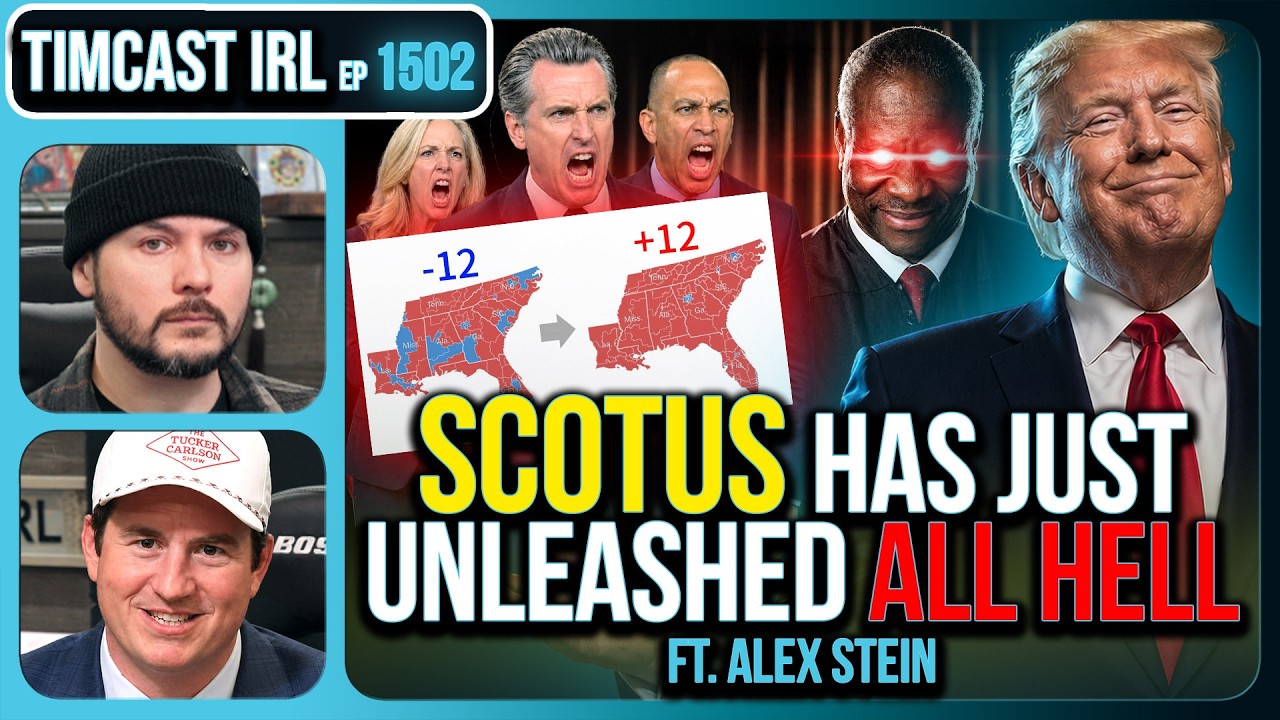
SCOTUS Ruling Just Gave GOP THIRTY SEATS, This Is NUCLEAR IN Politics | Timcast IRL
"The Supreme Court's ruling against racially gerrymandered districts could shift 30-40 congressional seats to Republicans, fundamentally altering the political landscape and empowering individual lawsuits."

'You're Full Of S***!' Piers Morgan Takes Down Moon Landing Denier | Artemis II Debate
"Piers Morgan hosts a fiery debate between a moon landing conspiracy theorist and a physicist, an Apollo astronaut, and William Shatner, dissecting claims of fakery with scientific evidence and firsthand accounts."