Lost technologies and the secrets they hold, in 53 minutes | Sam Kean: Full Interview
YouTube · S3-SFRJR2mM
Quick Read
Summary
Takeaways
- ❖Experimental archaeology allows for sensory and practical understanding of ancient life, beyond visual artifacts.
- ❖Ancient beds made of ash and aromatic leaves provided comfort and acted as natural insect repellents.
- ❖Ostrich egg canteens were self-cooling due to their porous nature, keeping water colder than ambient temperature.
- ❖Roman concrete was self-healing, utilizing undigested quicklime to fill cracks when exposed to water, making it more durable than modern concrete.
- ❖A Baltimore hairdresser, Janet Stevens, revolutionized Roman hair styling understanding by realizing they used needle and thread to sew hair into place.
- ❖Viking-era 'leech book' recipes, specifically a mixture of onion, garlic, wine, and ox gall, proved effective against modern drug-resistant bacteria like MRSA and gonorrhea, even breaking through biofilms.
- ❖The Alsos Mission was a covert Allied operation to spy on, sabotage, and potentially assassinate members of the Nazi atomic bomb project.
- ❖Werner Heisenberg's chemical explosion during an atomic experiment was misinterpreted as a low-grade atomic chain reaction, terrifying Allied scientists and spurring the Manhattan Project.
- ❖Nazi ideology, including the expulsion of Jewish scientists and a belief in their own superiority, significantly hindered their atomic bomb development.
Insights
1Self-Healing Roman Concrete Outperformed Modern Mixes
Archaeologists initially believed undigested lumps of quicklime in Roman concrete were a mistake. However, MIT researchers discovered these lumps were a key feature: when water entered cracks, it reacted with the quicklime to create a substance that filled the void, making the concrete self-healing and significantly more durable than modern concrete.
Archaeologists at MIT recreated Roman concrete and found that when water got in, it would find these undigested chunks of quick lime and react with them and actually create a substance that filled the space. So it was essentially self-healing concrete.
2Ancient Viking Antibiotic Recipe Effective Against Drug-Resistant Bacteria
A recipe from a 900 AD 'leech book' (doctor's manual) containing onions, garlic, wine, and ox gall, when mixed and left for a week, was tested by modern microbiologists. It effectively killed drug-resistant bacteria like MRSA and gonorrhea, even penetrating protective biofilms, demonstrating a lost medical knowledge with modern applications.
This mixture of onions, garlic, wine, and ox gall did a really nice job killing these drug resistant bacteria. She was surprised at how good they were. And in fact, she tried them in another even tougher test and they passed this test as well... when they try this ancient mixture on biofilms, it busted right through and killed the bacteria anyway.
3Misinterpreted Explosion Accelerated the Manhattan Project
Werner Heisenberg's experiment to create a chain reaction resulted in a chemical explosion when uranium reacted with leaking heavy water. This event was misreported and exaggerated through a 'game of telephone' among scientists, eventually reaching Allied ears as a 'small-scale atomic explosion.' This misinformation terrified Allied scientists, leading to urgent calculations that Germany would have a bomb within six months, which significantly accelerated the Manhattan Project.
As the story kept getting passed along from person to person, it changed a little bit. It wasn't just a chemical explosion anymore, it was a low-grade atomic chain reaction... they panicked. They ran right back to their countries, told everyone about it. And before long, in their minds, this was a small-scale atomic explosion with several people dead... this is really where the Manhattan Project got going in earnest.
4Nazi Ideology Hampered Their Atomic Bomb Project
Two key aspects of Nazi ideology directly interfered with their atomic research: their anti-Semitism led to the expulsion of many brilliant Jewish scientists who then contributed to the Allied Manhattan Project, and their inherent snobbery and belief in German superiority prevented them from considering that 'Yahoo' countries like the United States could surpass them in scientific endeavors.
They didn't like Jewish people and they kicked a lot of very smart scientists out of Europe who ended up coming to the United States and playing key roles on our Manhattan Project... a lot of Nazis were just sort of snobs. They figured they were the most advanced civilization in the world and that no other nation could possibly reach the same levels that they did, especially not a Yahoo country like the United States.
Bottom Line
The 'Alsos Mission' involved extreme measures, including a plan for baseball player-turned-spy Mo Berg to assassinate Werner Heisenberg if he indicated Germany was close to an atomic bomb.
This highlights the unprecedented level of fear and desperation among the Allies regarding a Nazi atomic weapon, leading to highly unconventional and dangerous covert operations.
Understanding the psychological impact of perceived threats on strategic decision-making and the lengths nations will go to neutralize them in high-stakes conflicts.
The destruction of the heavy water plant in Norway by Allied commandos was a crucial early success of the Alsos Mission, severely delaying the Nazi atomic bomb project.
This specific act of sabotage demonstrates the effectiveness of targeted, high-risk operations against critical infrastructure in disrupting enemy scientific and military development.
Analyzing the strategic value of 'chokepoint' resources (like heavy water) in advanced technological warfare and the efficacy of special operations to neutralize them.
Opportunities
Commercialize Ancient Antibiotic Formulations
Develop and commercialize pharmaceutical products based on rediscovered ancient remedies, like the Viking-era onion, garlic, wine, and ox gall mixture, specifically targeting drug-resistant bacteria. This could involve modernizing the delivery method while preserving the active compounds.
Self-Healing Construction Materials
Research and develop modern construction materials (e.g., concrete, asphalt) that incorporate self-healing properties inspired by Roman concrete. This could significantly extend infrastructure lifespan and reduce maintenance costs.
Key Concepts
Experiential Learning in Archaeology
This model posits that hands-on recreation and direct experience of ancient practices (e.g., building, cooking, crafting) yield deeper, more accurate insights into historical technologies and daily life than purely academic or observational study. It emphasizes that 'doing' reveals implicit knowledge and practical challenges often missed in written records.
Non-Linear Knowledge Progression
This model challenges the assumption that knowledge is always cumulative and linear. It highlights instances where valuable knowledge or technologies from the past (e.g., ancient antibiotics, Roman concrete) can be lost or forgotten, only to be rediscovered later, suggesting that modern advancements do not automatically render all older knowledge obsolete.
Lessons
- Challenge assumptions about historical capabilities: Actively seek out and re-evaluate 'lost' or 'primitive' technologies, as they may hold practical solutions for modern problems.
- Embrace interdisciplinary approaches: Combine diverse fields like hairdressing and archaeology, or microbiology and history, to unlock novel insights and solve long-standing mysteries.
- Verify information rigorously, especially in high-stakes situations: Recognize how misinterpretations and 'games of telephone' can lead to significant strategic errors or unnecessary escalation, as seen with Heisenberg's explosion.
- Consider the 'experiential' dimension of learning: Engage with subjects hands-on to gain a deeper, more intuitive understanding that purely theoretical study cannot provide.
Experimental Archaeology: Recreating the Past
Identify a historical practice or technology that lacks complete understanding from traditional archaeological records (e.g., how pyramids were built, ancient recipes).
Gather available historical evidence: texts, artifacts, depictions, and consult experts from relevant fields (e.g., chefs for recipes, engineers for structures).
Source authentic materials and tools where possible, or create accurate replicas based on historical data.
Recreate the practice or technology step-by-step, meticulously documenting the process, challenges, and outcomes.
Analyze the results, comparing them to existing theories and noting any unexpected discoveries or practical insights gained from the hands-on experience.
Disseminate findings to both academic and public audiences, emphasizing the 'experiential' value and practical implications of the research.
Notable Moments
Sam Kean's personal experience attempting a trepination on a deer skull, describing the difficulty, dulling tools, and discomfort from flies and bodily fluids.
This vividly illustrates the harsh realities and frustrations faced by ancient practitioners, emphasizing the value of experiential archaeology in understanding historical challenges beyond theoretical knowledge.
The story of Janet Stevens, a hairdresser with no formal archaeological training, who deciphered Roman hairstyles by realizing they were sewn with needle and thread, then published her findings.
This highlights how expertise from unexpected fields can revolutionize established academic disciplines and solve mysteries that specialists overlook.
Quotes
"If you have deep knowledge about how to do something or how to make something, you're going to ask different, better questions about it and have a better eye about what to look for, the range of things people might have used, stuff like that."
"This was the best loaf of bread I have ever eaten in my life. It was so delicious. It was very simple recipe, however. It was just emmer the grain that they used for flour. Emmer, coriander, salt, yeast, and that's it."
"We knew the world would not be the same. Few people laughed. Few people cried. Now I am to come death, the destroyer of worlds. I suppose we all fought that one way or another."
"Knowledge isn't always a linear. I think we have sort of an idea that we're constantly accumulating knowledge that we knew more than people did 10 years ago, more than 20 years ago, more than a few centuries ago, and certainly more than people knew thousands of years ago. But that's not always the case."
Q&A
Recent Questions
Related Episodes

His Top Secret job turned him into a LEGEND
"Discover the real-life, strange, dark, and mysterious events that inspired 'The Phantom of the Opera,' the creation of James Bond, and an early documented encounter with a Bigfoot-like creature."
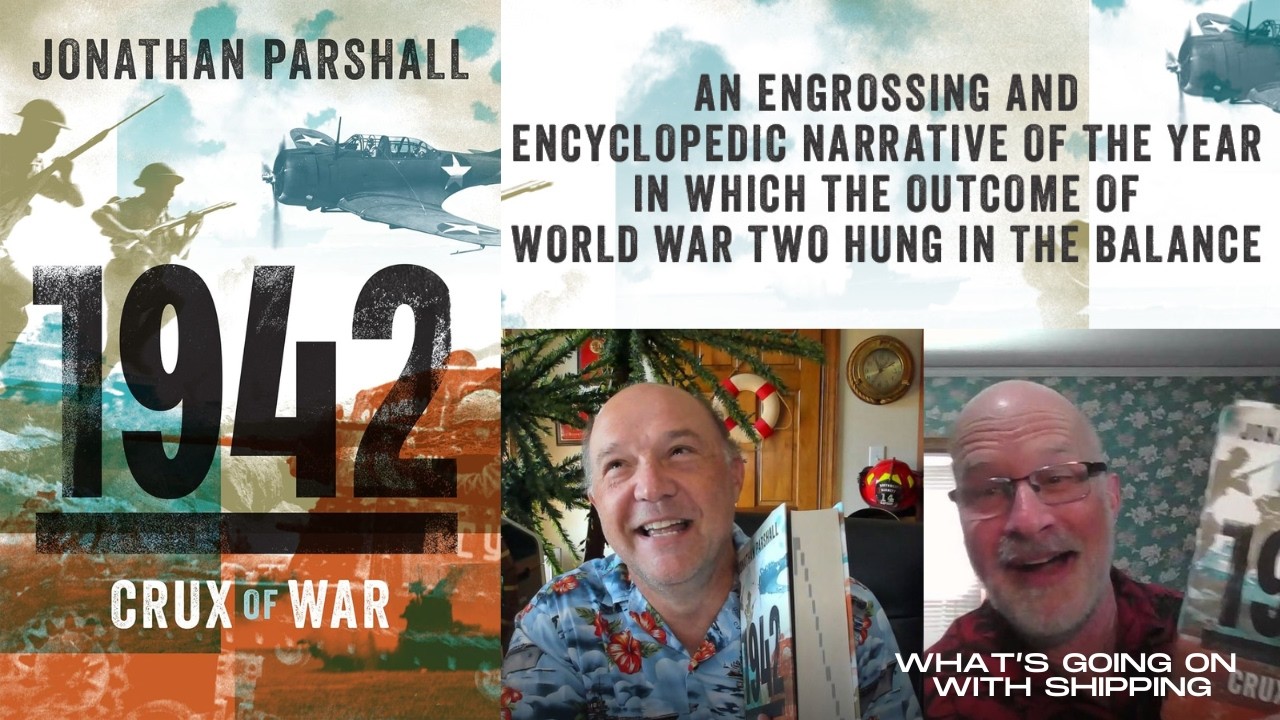
1942: Crux of War | A Conversation with Jon Parshall
"Historian Jon Parshall discusses his monumental book, '1942: Crux of War,' arguing that 1942 was a year of numerous inflection points, not singular turning points, that collectively shifted the tide of World War II."

SCANDAL 2x19, 2x20, 2x21 & 2x22 Reaction! | SEASON FINALE | Kerry Washington | Shonda Rhimes
"The hosts react to the 'Scandal' Season 2 finale, dissecting major character revelations, political power plays, and shocking plot twists, including Huck's traumatic past and Olivia's unexpected family connection."

Israel CAUGHT Spying On Trump & HERE’S WHY! w/ Max Blumenthal
"Max Blumenthal and Jimmy Dore assert that Israel has consistently spied on the US, specifically targeting the Trump administration to sabotage peace negotiations with Iran, leveraging deep political and financial influence over American politicians and media."