
🚨 THIS WAS ALWAYS THE F*CKING PLAN 😭😭😭
YouTube · SVh5EQeSMhI
Quick Read
Summary
Takeaways
- ❖US military operations targeted Kharg Island, responsible for 90% of Iran's oil, as part of a strategy to destabilize the Iranian regime.
- ❖Saudi Arabia's Crown Prince supports the US stance against Iran, echoing concerns about Iranian expansionism.
- ❖Exiled Iranian Crown Prince Reza Pahlavi issued a direct call for an internal ground rebellion against the Islamic Republic, promising to lead the charge in the first liberated city.
- ❖The host criticizes past US administrations (Obama, Biden) for allegedly funding Iran through frozen asset releases, linking this funding to the rise of terrorist organizations.
- ❖Domestic terror incidents, such as an attempted synagogue bombing in Michigan and a school breach in Texas, are highlighted as evidence of growing Islamic extremist threats within the US.
- ❖The host argues that mainstream media and leftist politicians downplay the religious motivations behind terror attacks, instead blaming 'online rhetoric' to suppress free speech.
- ❖Strong advocacy for denaturalizing and deporting immigrants who support US-designated terrorist organizations or fail to assimilate into American society.
- ❖Examples from Canada and Europe are used to illustrate the perceived dangers of unchecked immigration and 'leftist empathy' leading to increased terror and cultural erosion.
Insights
1US Strikes on Kharg Island as a Decades-Old Strategy
The host frames the US bombing of Kharg Island, which accounts for 90% of Iran's oil production, as a strategic move to cripple the Iranian regime. He cites a 1988 interview where Donald Trump discussed taking Kharg Island, suggesting a long-term, consistent plan now being executed. The host emphasizes that Iran has no effective defense against these attacks.
Host's interpretation of Trump's actions and a 1988 interview clip. Trump's statement on bombing military targets on Kharg Island. (, )
2Iranian Crown Prince Calls for Ground Rebellion
Reza Pahlavi, the exiled Crown Prince of Iran, released a statement calling for an internal rebellion, urging Iranians to form 'small but effective cells' to weaken the Islamic Republic's 'oppressive apparatus.' He promised to join and lead the rebellion on the ground in the first liberated city, aiming for a 'final collapse' of the regime.
Direct translation and interpretation of Reza Pahlavi's statement. ()
3US Funding of Iran Under Previous Administrations
The host alleges that the Obama and Biden administrations provided significant financial relief to Iran, including $56 billion in unfrozen assets and subsequent cash transfers totaling $1.3 billion, and later $6 billion for 'humanitarian purposes.' He argues this funding directly enabled Iran to finance terrorist organizations like Hamas and Hezbollah, leading to regional instability and attacks against Americans.
Fox News report clips detailing financial transfers to Iran under Obama and Biden, and the host's commentary linking these funds to terrorist activities. (, , , )
4Domestic Islamic Terror Attacks and Media Response
The episode details recent domestic terror incidents, including an armed Muslim man entering a Texas elementary school and a Lebanese immigrant attempting to bomb a Jewish preschool in Michigan. The host criticizes media and politicians (e.g., Michigan Governor Gretchen Whitmer, CNN's Jake Tapper) for attributing these acts to 'online rhetoric' or unknown motives, rather than explicitly naming Islamic terrorism as the cause, which he views as a deliberate obfuscation.
News clips describing the incidents and political/media reactions, followed by the host's strong critique. (, , )
5Critique of Immigration and Assimilation Policies
The host argues that current immigration policies allow individuals who are 'culturally unable to become American' into the country, citing the example of the Michigan synagogue attacker whose brothers were Hezbollah terrorists. He advocates for strict vetting, denaturalization, and mass deportation of immigrants who do not assimilate or who support US adversaries, emphasizing that 'legal immigration' also needs reform.
Discussion of the Michigan attacker's background, Congressman Andy Ogles' 'Assimilation Act,' and the host's commentary on the need for selective immigration. (, )
Bottom Line
The host suggests that the alignment between leftists and Islamists is 'logical' because both groups 'hate Western civilization' and are 'enemies of God and biblical values,' aiming to destroy the US.
This perspective reframes political opposition as an existential, almost spiritual, conflict rather than ideological disagreement, implying a deeper, more sinister motive behind 'leftist' policies.
For those who share this view, it reinforces the need for a unified, aggressive stance against both domestic political opponents and foreign adversaries, seeing them as interconnected threats.
The host claims that the reason the US does not bomb 'literal civilian ships' in the Strait of Hormuz, unlike Iran-backed Houthis, is because 'we're not f*cking terrorists.' He uses this to highlight a perceived moral superiority.
This contrasts US military conduct with that of its adversaries, emphasizing a distinction in ethical standards, even while advocating for aggressive military action against state targets.
It provides a rhetorical tool to justify US military force while simultaneously condemning the methods of its enemies, appealing to a sense of national righteousness.
The host highlights a story of a Sikh restaurant owner in London who was arrested for refusing to sell halal meat after receiving death and rape threats from Muslims. The host frames this as an 'occupation' and a failure of Western governments to protect their citizens from unassimilated migrant cultures.
This incident is used as a stark warning about the consequences of immigration policies that, according to the host, prioritize 'empathy' over cultural compatibility and national security, leading to the erosion of native culture and law.
It serves as a rallying cry for stricter immigration controls and a defense of Western cultural norms against perceived Islamic encroachment, particularly in European countries.
Lessons
- Advocate for stricter immigration policies, including denaturalization and deportation for immigrants who do not assimilate or support US adversaries.
- Challenge media narratives that attribute Islamic terror attacks to 'online rhetoric' or unknown motives, demanding explicit identification of religious ideology as a root cause.
- Support political leaders and policies that prioritize aggressive military action against state sponsors of terrorism like Iran, and actively work to dismantle their regimes.
- Educate oneself on the alleged historical and religious texts of Islam to understand its tenets, particularly concerning women and non-believers, to counter perceived 'Islamophobia' accusations.
- Pressure elected officials to pass legislation like the 'Save America Act' to prevent illegal immigrants from voting and to combat fraud in government programs.
Notable Moments
Discussion of Trump's 1988 interview where he mentioned taking Kharg Island, linking it to current US military actions against Iran.
This moment is used to establish Trump's long-standing consistency on Iran policy, countering narratives that his actions are impulsive or recent.
The host's detailed breakdown and strong condemnation of the attempted synagogue bombing in Michigan by a Lebanese immigrant.
This incident serves as a central example for the host's arguments about domestic Islamic terrorism, the dangers of unchecked immigration, and the alleged failures of media and politicians to address these issues directly.
Critique of leftist influencers like Hasan Piker and Sneo for allegedly supporting US enemies and promoting anti-American sentiment.
This highlights the host's view of an 'enemy within' and the perceived ideological alignment between certain domestic figures and foreign adversaries, framing it as treasonous.
The story of the Sikh restaurant owner in London arrested for not selling halal meat after being threatened by Muslims.
This is presented as a vivid illustration of cultural conflict arising from immigration, where Western laws and values are perceived to be undermined by imported religious demands.
Quotes
"Iran had plans of taking over the entire Middle East and completely obliterating Israel, just like Iran itself. Those plans are now dead."
"If Iran developed a nuclear bomb, we will follow suit as soon as possible."
"I would do a number on Car Island. I'd go in and take it. Iran can't even beat Iraq yet they push the United States around. It'd be good for the world to take them on."
"We support gays, but they throw gays off the buildings."
"If you're going to punch the Iranians, you punch them hard."
"From now, the bravest and most devoted sons of Iran, I ask that as the vanguard force of the nation in every possible way you further exhaust and weaken the Islamic Republic's oppressive apparatus which is now under heavy blows from the sky so that the ground is prepared for its final collapse."
"We don't need common sense, you know, gun reform or, you know, gun control. We need common sense Islamist control."
"If you're gonna execute a woman, make sure you rape her before executing her. Uh because you don't want her to go to heaven as a virgin."
"Why is it that despite Pakistani Muslims only being 6.5% of the population of England, are they 97% of the gang rapes?"
Q&A
Recent Questions
Related Episodes

🚨 THEY F*CKED AROUND FOR THE LAST TIME 😭😭😭
"This episode unleashes a torrent of highly opinionated commentary on the US-Iran deal, Israel's role, and a scathing critique of 'leftist' policies and immigration, particularly highlighting the UK grooming gang report as evidence of Western societal decay."

Patrick Henningsen: Hezbollah JUST Fired Back at Israel - Iran Vows to “Crush” All Attacks
"Patrick Henningsen argues that the US and Israel initiated an illegal war against Iran, driven by Trump's incompetence and Israeli influence, leading to an inevitable escalation with severe global economic repercussions."
BREAKING: Protests ERUPT In Iran Over IRGC Surrendering To Trump - Infighting Clashes In Tehran
"Iran is experiencing severe internal infighting and protests as hardline IRGC elements clash with government figures over a perceived 'surrender' to the US, while mainstream Western media misrepresents the situation."
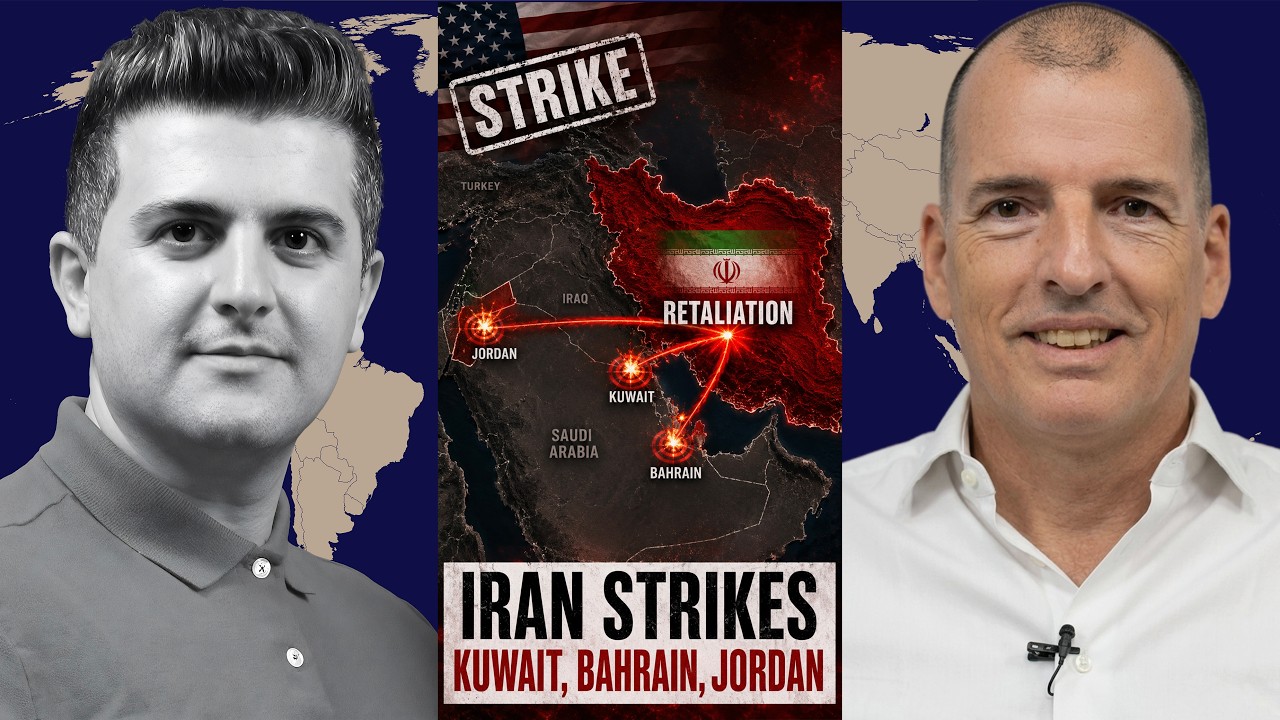
Alex Krainer: US STRIKES Iran – Iran RETALIATES Against Kuwait, Bahrain & Jordan!
"Amidst escalating US-Iran conflict and Iranian retaliation against regional US allies, this episode argues that US foreign policy is deeply controlled by an 'Anglo-Zionist conspiracy' led by the Rothschild banking dynasty, prioritizing Israeli interests over American ones."