
Anthony Aguilar: Why Everything You Knew About the Middle East Just Collapsed
YouTube · SoMzkVMD3Tw
Quick Read
Summary
Takeaways
- ❖The US administration's handling of the Iran conflict is 'catastrophic and disastrous,' leading to strategic defeat despite tactical wins.
- ❖The war was initiated based on 'feelings' and 'blatant lies' about Iran's nuclear threat and internal instability.
- ❖US missile inventories (JASM, Tomahawk, THAAD, Patriot, SM3/6) are severely depleted from the conflict.
- ❖Iran's strategy successfully targeted US/Israeli radar systems and missile defenses using cheap, overwhelming drone attacks.
- ❖The alleged 'pilot rescue' in Isfahan was a cover for a failed strategic raid to seize nuclear material.
- ❖NATO allies are increasingly unwilling to support US military actions due to bullying tactics and unclear objectives.
Insights
1US Strategic Defeat in Iran Conflict
Lieutenant Colonel Aguilar asserts the US had 'already lost this conflict at a strategic level' from the onset, citing a lack of operational lines of effort tied to national policy, mirroring past failures in Iraq, Afghanistan, Syria, and Vietnam.
Aguilar states that the administration handled the conflict 'disastrously' and 'catastrophically,' leading to a strategic defeat, a pattern seen in previous US engagements.
2War Initiated on False Pretenses
The US entered the conflict based on 'feelings' from President Trump and Jared Kushner, and 'blatant lies' about Iran's existential threat, weaponized nuclear capability, or ripe conditions for a coup.
Aguilar explicitly states that Trump and Kushner's 'feelings' led the US into war, and that 'every aspect of the justification' for the conflict was 'either tacitly untrue or blatant lies.'
3Intentional Targeting of a School in Minab
Aguilar states the US intentionally struck a school in Minab, killing 868 schoolgirls, despite knowing it was a civilian target via Tomahawk missile cameras and intelligence, aiming for a moral blow or to provoke a visceral Iranian reaction.
Aguilar claims the targeting of the Manob school was 'intentional' and that the US was 'well aware' it was a school, not a military base, and that Tomahawk missiles provide 'full motion color camera' feedback, allowing for call-off if unintended.
4Iran's Effective Asymmetric Strategy
Iran successfully used cheap Shahed drones to overwhelm and deplete US and Israeli missile defense systems (THAAD, Patriot, Iron Dome) and targeted critical radar systems in GCC countries and Israel, demonstrating a smart 'center of gravity' approach.
Aguilar details Iran's strategy to 'overwhelm with our Shahed one-way drones' to 'devastate the stock of US and Israel missile systems' and 'strike at the things that make all the other things work like the radar systems.'
5Depletion of US Missile Inventory
The US is 'nearly out' of critical missiles, including JASM extended range, Tomahawk, THAAD batteries, Patriot systems, SM3s, and SM6s, limiting options to ground war or tactical nukes.
Aguilar states, 'We are nearly out of JASM extended range missiles. We are nearly out of Tomahawk missiles. We are out of THAAD batteries and nearly out of Patriot missile systems. We are nearly out of SM3s and SM6s.'
6'Pilot Rescue' in Isfahan was a Failed Raid
The alleged rescue of a 'colonel pilot' in Isfahan was a 'facade' for a failed strategic raid to seize nuclear material, involving Delta Force and a nuclear biological chemical reduction team, which took fire and had to destroy aircraft in place.
Aguilar asserts, 'There was no pilot. There was no downed pilot... It was all a lie. It was a facade.' He details the deployment of special operations aircraft, helicopters, Delta Force, and a 'nuclear biological chemical reduction team,' concluding the mission was to 'potentially seize nuclear material' and failed.
7Israel's Vulnerability and US Support
Israel's 'Operation Roaring Lion' is an 'albatross of American victory,' with US deployments (four carrier strike groups, 60,000+ personnel) aimed at replenishing Israel's Iron Dome stocks and allowing Israel to reposition military assets from underground networks.
Aguilar describes Israel's participation as the 'albatross of American victory' and explains US deployments are 'buying time' to 'replenish some of Israel's stocks in its Iron Dome' and allow Israel to 'shore up a position' and move military capability from 'robust underground network[s].'
8Ineffective US Distant Blockade
The US's 'distant blockade' of Iran, with ships 300km away, is ineffective as Iran utilizes historical 'back doors' through Central Asian states, Russia, and China for supplies, weakening the US's global position.
Aguilar explains the US is conducting a 'distant blockade' with its closest ship 'about 300 kilometers away,' which has 'successfully blocked the front door, but left the garage wide open' due to Iran's 'back doors to China, to Russia, to the Central Asian states.'
9NATO's Disunity and US Credibility
NATO allies are increasingly unwilling to support US military actions due to Donald Trump's 'bullying and insulting' rhetoric, leading to logistical challenges (e.g., Spain denying C5 base access) and NATO nations re-evaluating their military independence from the US.
Aguilar states, 'It's very hard to build a coalition... when you start off by bullying and insulting all of those NATO nations.' He cites Spain denying C5 base access and Turkey's actions as examples of NATO nations drawing lines and re-evaluating the US as a 'credible partner.'
Bottom Line
The US Navy is now afraid to go through the Red Sea due to the effectiveness of Houthi forces, forcing US carriers to take the longer route around the tip of Africa.
This significantly increases deployment times and logistical costs, revealing a new vulnerability for US naval power in critical global chokepoints.
Other nations or non-state actors could leverage similar asymmetric tactics to disrupt global shipping and challenge naval dominance in strategic waterways.
Turkey, a NATO ally, denied Israeli President Herzog airspace and is developing its own advanced homegrown interceptor aircraft, signaling a growing military independence and re-evaluation of alliances within NATO.
This indicates a potential shift in regional power dynamics and a weakening of US influence within NATO, as allies seek self-reliance and alternative partnerships.
Companies developing advanced defense technologies outside traditional US platforms could find new markets among NATO members seeking diversified military procurement.
Key Concepts
Sunk Cost Theory
The US continues the war due to past investments, despite ongoing losses and lack of clear objectives.
Center of Gravity Analysis
Iran effectively targeted critical US/Israeli military infrastructure (radars, missile defenses) to achieve strategic impact with limited resources.
Asymmetric Warfare
Iran's use of unconventional tactics (drones, mosaic command structure) exploited US conventional military vulnerabilities.
Lessons
- Prioritize diplomatic solutions over military force, recognizing that war should always be the last resort and that military action cannot defeat a 'desire' or an idea.
- Conduct thorough strategic planning and intelligence assessment, avoiding decisions based on 'feelings' or unconfirmed threats, to prevent costly and unwinnable conflicts.
- Invest in understanding and countering asymmetric warfare capabilities, as conventional military dominance does not guarantee victory against agile, unconventional adversaries.
- Cultivate strong, respectful international alliances rather than relying on bullying tactics, as allies are crucial for logistical support and shared strategic objectives.
Quotes
"from the onset, the United States had already lost this conflict at a strategic level."
"the United States embarked on a disastrous catastrophic war that will forever reshape Western Asia, will forever reshape the United States position in the world."
"we were led into a war by the feelings of a commander-in-chief who has never served in the military... advised by his son-in-law who also has no experience."
"every aspect of the justification or the thoughts of success in going into this conflict were either tacitly untrue or blatant lies."
"This was a school. A school that the walls were painted with flowers and butterflies and rainbows where children played on the playground. We observed this... We knew exactly what we were hitting, not once but twice... It was intentional."
"Weapon systems officers are not colonels... You would not put an '06 Colonel into an F-15 and send them over Iran as the weapon systems officer... It's a lie."
"This is not the assembly of a of a of a mission of peace. This is war."
"How do you defeat a desire? I I don't know. I I've studied military history. I have been a practitioner of war... I don't know how you militarily defeat a desire or an idea."
Q&A
Recent Questions
Related Episodes
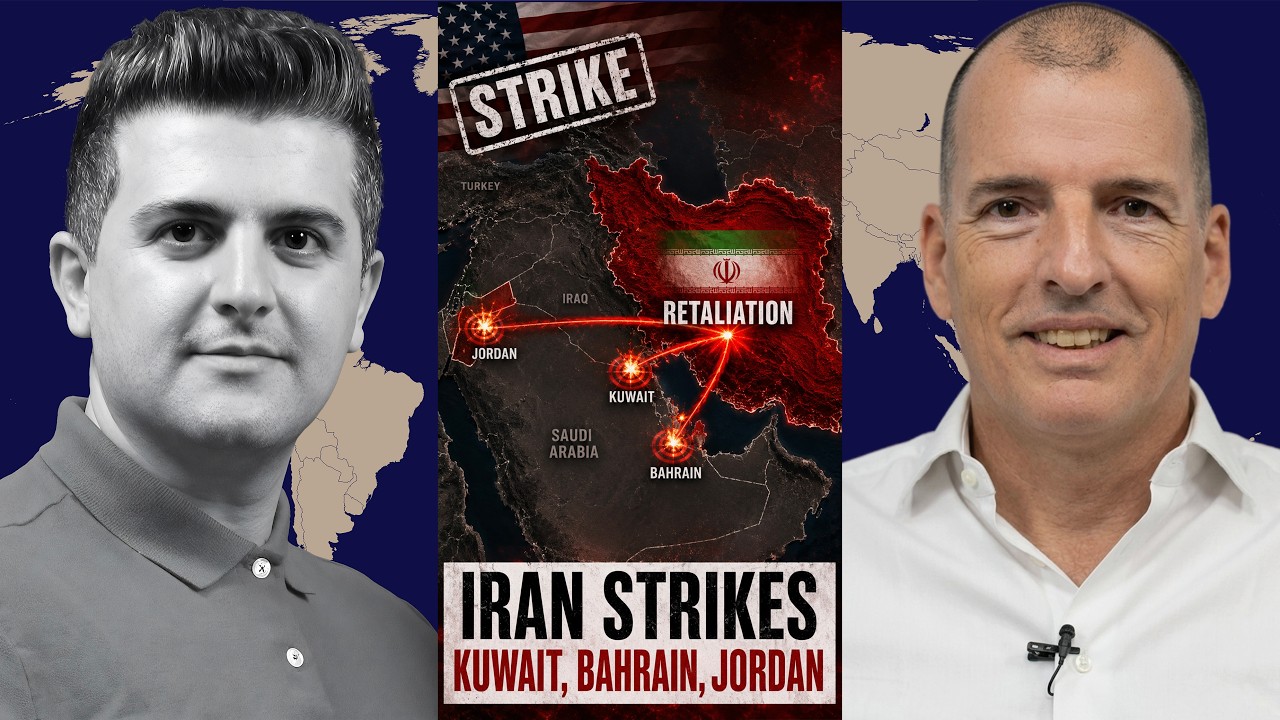
Alex Krainer: US STRIKES Iran – Iran RETALIATES Against Kuwait, Bahrain & Jordan!
"Amidst escalating US-Iran conflict and Iranian retaliation against regional US allies, this episode argues that US foreign policy is deeply controlled by an 'Anglo-Zionist conspiracy' led by the Rothschild banking dynasty, prioritizing Israeli interests over American ones."

Patrick Henningsen: Hezbollah JUST Fired Back at Israel - Iran Vows to “Crush” All Attacks
"Patrick Henningsen argues that the US and Israel initiated an illegal war against Iran, driven by Trump's incompetence and Israeli influence, leading to an inevitable escalation with severe global economic repercussions."

The Fat Electrician Vs Tactically Acquired | Unsubscribe Podcast 267
"This episode features military content creators discussing current geopolitical hotspots, advanced weaponry, and the surprising psychological warfare tactics of modern conflict, alongside their personal journeys building online communities."

LIVE: Trump HIDES FROM PUBLIC as US SOLDIER KILLED!!! 6/2/2026
"The host exposes alleged government cover-ups regarding military casualties, Trump's unexplained public absence, and questionable political appointments, arguing these reflect a 'regime of loser babies' and a failing foreign policy."