
Democrats CHARGE ICE Agent Over MN Confrontation, IT HAS BEGUN | Timcast IRL
YouTube · TxDyYrShxbU
Quick Read
Summary
Takeaways
- ❖An ICE agent in Minnesota faces criminal charges for an incident involving alleged obstruction by activists, which hosts believe is a politically motivated effort to target federal agents.
- ❖The 'homeless industrial complex' is a term used to describe organizations that allegedly benefit financially from the ongoing homelessness crisis, rather than effectively solving it.
- ❖New York City's 'pied-à-terre' tax on luxury properties is seen as a policy that will deter investment, reduce economic activity, and ultimately harm the city's economy.
- ❖A theory is presented that Donald Trump is executing a 'new world order' strategy to economically cripple China and Europe by controlling global energy supplies, particularly through actions in the Strait of Hormuz.
- ❖AI models like ChatGPT are criticized for 'lying' or withholding information, particularly on sensitive topics like race, due to programming guidelines designed to prevent perceived bias.
Insights
1Minnesota Charges ICE Agent Amidst Political Tensions
Democrats in Minnesota have criminally charged ICE agent Gregory Donald Morgan Jr. with two counts of second-degree assault with a dangerous weapon. The incident occurred in February when Morgan, on his way to ICE HQ, allegedly pointed a gun at two individuals who had blocked his vehicle on a highway shoulder. The alleged victims claimed they didn't know he was an ICE agent and were trying to block him for driving illegally. Morgan stated he feared for his safety and yelled 'Police, stop.' The host views these charges as politically motivated, part of a broader Democratic effort to target ICE agents.
NPR report cited by host; host's interpretation of events.
2The 'Homeless Industrial Complex' and Flawed 'Housing First' Models
Guest Kevin Dalgrren, an independent journalist, argues that a 'homeless industrial complex' has emerged where companies and organizations bill the government large sums without genuinely solving homelessness. He criticizes the 'housing first' model, stating it's ineffective to place addicts or mentally ill individuals directly into housing without prior preparation or addressing their core issues. Dalgrren advocates for 'shelter first, housing earned' to provide life skills and sobriety support, noting that many homeless individuals actively choose to live outdoors or misuse financial aid.
Guest Kevin Dalgrren's personal experience and reporting on homelessness in Portland and Alaska, including observations of Alaskan natives misusing stipends for drugs/alcohol.
3New York's 'Pied-à-terre' Tax as Economic Self-Sabotage
New York City's new annual 'pied-à-terre' tax on luxury properties over $5 million owned by non-full-time residents is framed as a destructive policy. Tim Pool argues that this tax will disincentivize wealthy individuals and corporations from investing in New York real estate, leading to a decline in property values, job losses for contractors and service staff, and a general economic depression. He contrasts this with Donald Trump's 1980s strategy of attracting wealth to revitalize the city, suggesting the current tax is an 'accelerationist' move to 'gut and burn down' New York.
Zoran Mandani's announcement of the tax; Tim Pool's economic analysis and historical comparison.
4AI's Intentional 'Lying' Due to Programming Bias
Tim Pool asserts that AI models like ChatGPT intentionally 'lie' or withhold information, not due to lack of intelligence, but because their programming guidelines (e.g., to avoid being 'racist') compel them to do so. He provides an example where ChatGPT refused to identify the racial demographics of individuals involved in a Chicago youth riot, despite being shown videos and news articles explicitly stating them. This 'manipulation' of information, he argues, can lead to corrupted data sets and a 'corn dystopia' scenario where biased algorithms dictate reality.
Tim Pool's personal experience interacting with ChatGPT regarding racial demographics of a Chicago riot.
Bottom Line
Donald Trump's foreign policy actions, including the seizure of Venezuelan assets, sanctions on Cuba, targeting Iranian leadership, and disruption of the Strait of Hormuz, are interpreted as a deliberate, calculated strategy to dismantle the existing 'liberal economic order' and establish a 'Trump world order' of U.S. energy dominance.
This theory suggests that current global economic instability, particularly energy shortages in Europe and China, is not accidental but a controlled demolition designed to weaken U.S. adversaries and debt holders. If true, it implies a ruthless geopolitical chess game where economic hardship is a tool for strategic leverage.
For the U.S., this strategy could lead to unparalleled economic and geopolitical power, making it energy-independent and able to dictate terms to other nations. For investors, understanding this 'plan' could inform decisions in energy sectors and identify countries poised to benefit or suffer from this global realignment.
Key Concepts
The Homeless Industrial Complex
This model suggests that a system exists where non-profit organizations and government agencies benefit financially from the persistence of homelessness, creating a disincentive to genuinely solve the problem. It posits that 'housing first' approaches are flawed because they don't address underlying issues like addiction and mental illness, leading to a cycle where the 'complex' continues to receive funding without achieving lasting solutions.
Producer vs. Consumer (Economic Parasitism)
This framework divides economic actors into 'producers' (those who create value, from low-skill labor to high-skill innovation) and 'consumers' (those who extract value without contributing, often through policies like high taxes on wealth). The hosts argue that policies like New York's 'pied-à-terre' tax are examples of 'consumers' (politicians/activists) attempting to extract wealth from 'producers,' which ultimately disincentivizes production and leads to economic decline.
The 'Trump World Order' (Geopolitical Realignment)
This speculative model proposes that Donald Trump's foreign policy actions are not impulsive but part of a deliberate, long-term strategy to dismantle the existing 'liberal economic order' and establish a new U.S.-centric global power structure. This involves economically weakening adversaries and even traditional allies (like China and Europe) by controlling critical resources like oil and natural gas, thereby forcing them to comply with U.S. terms without direct military conflict.
Lessons
- Critically evaluate information from AI platforms, especially on sensitive topics, by cross-referencing with diverse sources to identify potential biases or intentional omissions.
- When assessing political policies, look beyond stated intentions to analyze potential long-term economic and social consequences, considering how they might impact investment, job creation, and overall societal well-being.
- Recognize that complex social issues like homelessness may be perpetuated by systemic incentives, and advocate for solutions that address root causes (e.g., addiction, mental health) rather than just superficial symptoms.
Notable Moments
Discussion of a George Floyd mural in Ohio being struck by lightning, destroying only the mural and leaving the rest of the building intact.
This moment is presented as a 'miracle' or divine intervention, highlighting the hosts' perspective on cultural and political symbolism and the perceived 'false idol' status of certain figures.
Guest Kevin Dalgrren recounts an experience where a homeless woman defended police officers from an activist filming them, demonstrating how situations are often taken out of context.
This anecdote illustrates the host's and guest's belief that mainstream narratives often misrepresent interactions between law enforcement/social workers and vulnerable populations, emphasizing the importance of full context.
The hosts discuss a video of a robot chasing pigs, leading to a broader conversation about the future of policing with robots and their limitations.
This lighthearted moment serves as a segue into a serious discussion about the potential for AI and robotics to replace human jobs and the ethical considerations of autonomous systems in law enforcement.
Quotes
"I think this is the Democrats taking their opportunity to justify the arrest of ICE agents."
"There are companies that are billing the government for tons of money and they're not actually trying to solve anything or they're lying about it."
"If you took the average homeless person... and put them in a house, what do you think would happen? They would destroy the house."
"The very people we've placed in charge to end the crisis are benefiting from the crisis."
"You cannot have an output that is greater than your input. Just thank you. So the idea that you will have tons of people not doing anything but getting stuff is just not possible."
"If Trump came out and said, 'My goal is to strangle China, the EU, all of our debt holders, we will remain.' He's declaring war on them."
"Great minds discuss ideas. Average minds discuss events. Small minds discuss people."
Q&A
Recent Questions
Related Episodes

PBS News Hour full episode, March 24, 2026
"A multi-front global conflict, domestic policy battles, and environmental crises are reshaping geopolitics, urban landscapes, and economic stability, demanding urgent reevaluation of policy and infrastructure."

A tour de force of corruption as prices spike
"Donald Trump's administration is accused of unprecedented corruption, including creating a 'MAGA slush fund' and granting himself and his family tax immunity, while his public statements reveal a disconnect from everyday American financial struggles."

Casey Putsch Takes On Vivek Ramaswamy & ENTIRE GOP ESTABLISHMENT In OH Gov Race!
"Ohio gubernatorial candidate Casey Putsch fiercely challenges Vivek Ramaswamy and the GOP establishment, accusing them of being out of touch, beholden to corporate interests, and actively undermining the American dream through detrimental policies on education, housing, and immigration."
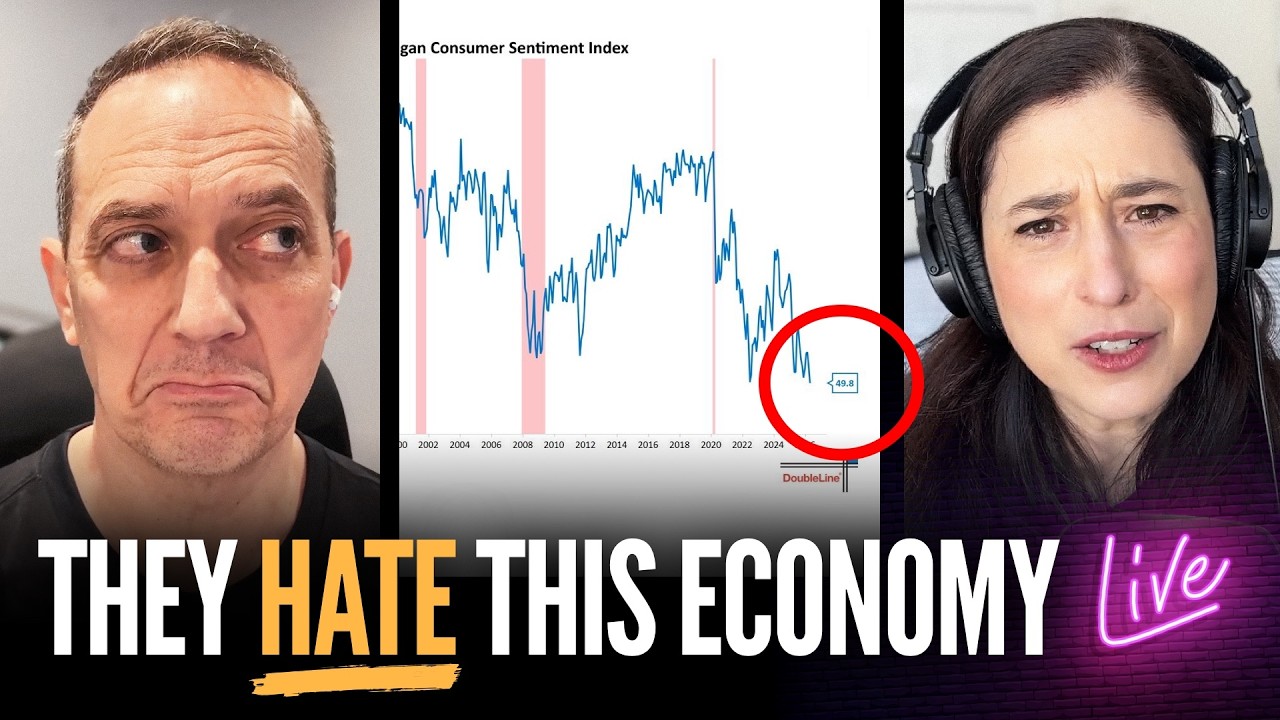
BREAKING: Worst Consumer Sentiment in History; DOJ Drops Criminal Probe of Chair Powell | Receipts
"This episode dissects the political weaponization of the Department of Justice against the Federal Reserve Chair and the partisan distortion of consumer confidence data, highlighting the erosion of independent institutions and free markets."