Prof. Steve Hanke: Explosions Rock Strait Of Hormuz - Lebanon Ceasefire On The BRINK
YouTube · VEQ-9wftJA0
Quick Read
Summary
Takeaways
- ❖US political rhetoric regarding Iran, especially from figures like Trump, is primarily 'spin' for domestic consumption and often contradicts the reality of closing markets.
- ❖Iran has demonstrated a credible threat to control the Strait of Hormuz, leading to a significant reduction in shipping traffic.
- ❖The 'Afghan Effect' illustrates how US sanctions on one country (e.g., Soviet Union, China) can inadvertently create economic booms for others (e.g., Argentina, Brazil).
- ❖US politicians are often 'clueless' about the complexities of Middle Eastern conflicts, relying on text messages rather than deep expertise.
- ❖Israel's 'Greater Israel' concept, supported by substantial US financial and military aid, ensures its continued military presence in Lebanon despite any agreements.
- ❖Iran's inflation rate is 100% annually, not hyperinflation, and the country is undertaking significant infrastructure projects despite sanctions.
- ❖Professor Hanke recommends a gold-backed currency board system for Iran, Russia, and Turkey to stabilize their economies and de-dollarize.
Insights
1US-Iran Negotiations are Dominated by Domestic Political Spin
Professor Hanke asserts that statements from US officials like Donald Trump and JD Vance regarding Iran, particularly concerning frozen assets and agricultural exports, are primarily 'spin' designed to appeal to domestic voters, especially farmers. Trump's claims of 'opening markets' contradict his actual policy of imposing tariffs and closing markets, as seen with Chinese electric vehicles. The Iranian parliament explicitly refutes US claims about using frozen assets to buy American products, highlighting the disconnect between US rhetoric and Iranian reality.
Trump's statements about Iran buying US soybeans, corn, and wheat () are contrasted with the Iranian parliament's denial () and Hanke's observation of Trump's 'tariff man' policies () and recent ban on Chinese EVs ().
2Iran's Credible Control Over the Strait of Hormuz
Geography dictates control of the Strait of Hormuz, and Iran has demonstrated its capability to be a credible threat, effectively controlling passage. This reality has shifted since the war, with traffic significantly reduced. While US officials may 'spin' the situation as open, the practical reality is reduced transit and increased Iranian influence, including the imposition of transit fees by Iran and Oman.
Bloomberg reported Oman's stance that there is 'no return to pre-war status quo' in the Strait, implying fees (). Hanke states that even on 'good days,' traffic was only 53% of pre-war levels (), and Iran 'can shut it down anytime they want to' ().
3US Support for Israel Undermines Lebanon Ceasefire and Regional Stability
Despite a clear memorandum of understanding (MOU) requiring Israel to cease bombing and withdraw from Lebanon, Professor Hanke predicts this will not happen. He attributes this to Israel's unwavering commitment to the 'Greater Israel' concept, which is financially and militarily unsustainable without massive US aid. The US Congress, influenced by the Israeli lobby, turns a 'blind eye' to Israeli actions, including what Hanke describes as 'blatant genocide in Gaza' and daily violations in Lebanon, making US rhetoric against Israeli actions largely irrelevant.
Hanke states that 'Israel is breaking the memorandum of understanding every day in Lebanon' () and that 'Israel controls the thing and the Israeli lobby controls the thing' (). He predicts Israel will not withdraw from Lebanon () because the 'Greater Israel' idea 'cannot proceed without the US money and the US military and intelligence' ().
4Iran's Economic Resilience and the Case for a Gold-Backed Currency
Despite Western narratives of a 'crushed' economy and high inflation (currently 100% annually, not hyperinflation), Iran continues significant infrastructure projects, like the North-South corridor and oil facility upgrades. To combat endemic inflation and de-dollarize, Professor Hanke recommends Iran implement a gold-backed currency board system, similar to what he proposed for Bulgaria. This would provide monetary stability without relying on any sovereign currency, making it politically palatable for Iran, Russia, and Turkey to form a 'gold block.'
Hanke notes Iran's recent completion of a gas platform upgrade () and measures Iran's inflation at 100% annually, clarifying it is not hyperinflation (). He details his recommendation for a gold-backed currency board system, translated into Farsi for the Iranian parliament (), and suggests a 'gold block' for Iran, Russia, and Turkey ().
Bottom Line
The US strategy to promote dollar usage globally, as advised by Hanke, involves either direct dollarization (like Ecuador) or establishing currency board systems where local currencies are 100% backed by and fixed to the US dollar (like Hong Kong).
This reveals a nuanced approach to maintaining dollar hegemony beyond direct sanctions, suggesting that even 'local' currencies can effectively extend the dollar's influence if structured correctly.
For countries seeking monetary stability, understanding these models offers pathways to either full dollarization or a credible currency board, potentially attracting foreign investment by reducing exchange rate risk, though at the cost of independent monetary policy.
The 'Afghan Effect' demonstrates that trade interventions and sanctions, while intended to punish, often create new economic opportunities and strengthen geopolitical rivals by forcing trade re-alignments.
This implies that sanctions can be a double-edged sword, failing to achieve their primary objective while inadvertently fostering resilience and alternative trade networks among targeted nations and their partners.
Nations facing sanctions can proactively seek new trade partners and develop alternative economic corridors (e.g., Iran's North-South corridor) to mitigate impact and potentially gain strategic advantage.
Key Concepts
The Afghan Effect
This model describes how seemingly isolated geopolitical events or sanctions (like the Soviet invasion of Afghanistan leading to a US agricultural export ban) can trigger widespread, often unintended, economic and political ripple effects globally. For example, the US ban on grain exports to the Soviet Union benefited Argentina, and US tariffs on China led China to pivot to Brazilian agricultural imports.
Lessons
- When evaluating US foreign policy statements, especially during election cycles, critically assess them as potential 'spin' aimed at domestic audiences rather than genuine shifts in international strategy.
- Monitor the Strait of Hormuz for ongoing Iranian control and potential disruptions, as Iran has demonstrated a credible capability to impact global energy flows.
- For investors or policymakers in regions like the Middle East, recognize that US financial and military aid to allies like Israel can override diplomatic agreements and prolong conflicts, making a 'Greater Israel' ambition a persistent factor.
Notable Moments
Hanke reveals that the Iranian parliament's research department translated one of his books into Farsi, specifically recommending a gold-backed currency board system for Iran.
This highlights a direct, albeit unofficial, engagement between a prominent Western economist and Iranian policymakers on critical economic reforms, suggesting potential pathways for monetary stabilization outside the dollar system.
Hanke's assertion that Israel created Hezbollah 44 years ago, providing the rationale for a resistance movement.
This is a highly contrarian and provocative claim that reframes the origins of a major regional actor, suggesting that some conflicts are self-perpetuating or even inadvertently created by the actions of their supposed adversaries.
Quotes
"Trump is a spinner, he's a spin doctor. So if if if some if something's black and he wants to make it white, he'll say it's white."
"The Iranians now have indicated and proven that they're a credible threat to control. So they they will control because they they are a credible threat. They can shut it down anytime they want to."
"Rubio's clueless. He has no idea what's going on. By the way, he's goes from meeting to meeting to meeting. He looks at his email, looks at his text messages. That's how he knows and studies what's going on."
"The lobby's money. You you you buy politi politicians in the United States like unfortunately and in in most democracies now, they buy they're they're commodities, they're bought and sold."
"The only way it would happen is if the US would make a decision that Lebanon is a red line. It's in the MOU and if the Israel does not retreat and and get out of Lebanon, the money will be cut off."
"Israel created Hezbollah. They they they they gave the the rationale and so forth for the formation of a resistance movement."
Q&A
Recent Questions
Related Episodes
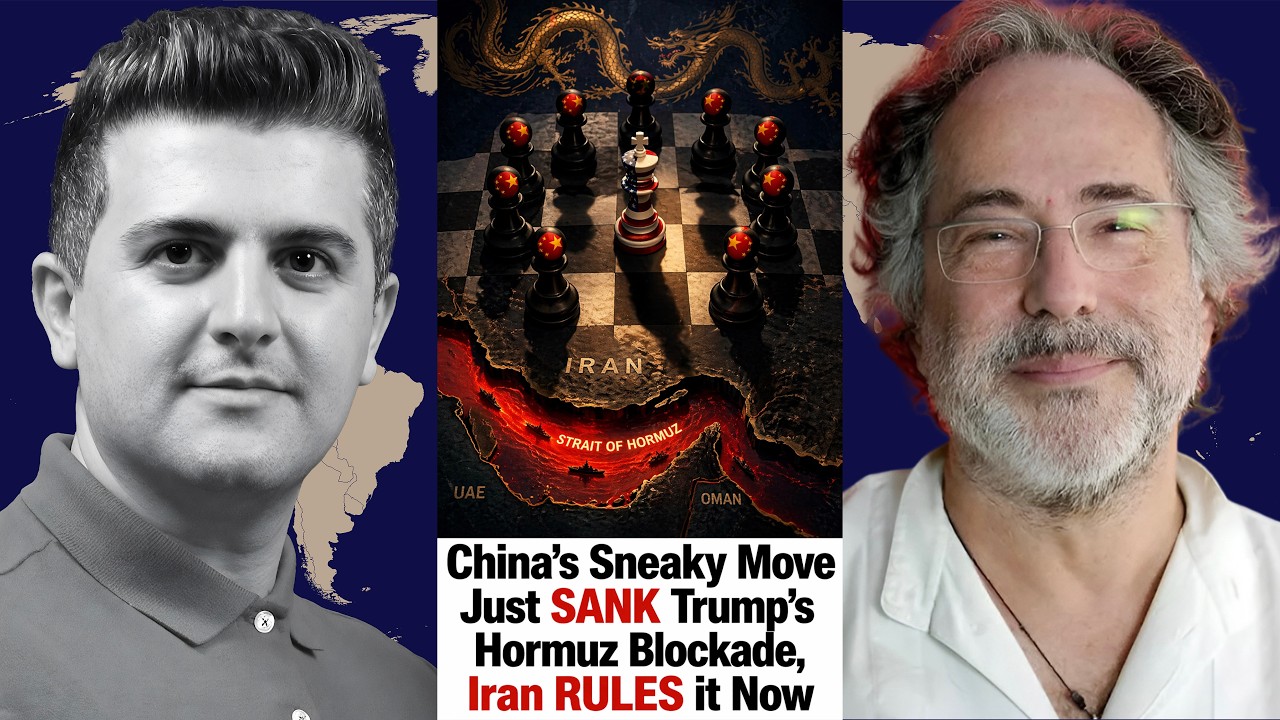
Pepe Escobar: “Total Failure”: Trump’s Blockade Just Backfired Disastrously
"Pepe Escobar argues that the US blockade against Iran, spearheaded by Donald Trump, has utterly failed and backfired, accelerating global economic chaos and challenging US geopolitical dominance."

Iran Update: Israel’s Newest Bombing Campaign, the Oncoming War With China and How to Avoid It
"Colonel Wilerson reveals how the US and Israel are actively bombing China's strategic infrastructure in Iran, escalating a covert economic war that Beijing intends to win without direct military conflict by dismantling the dollar's global dominance."

Patrick Henningsen: Hezbollah JUST Fired Back at Israel - Iran Vows to “Crush” All Attacks
"Patrick Henningsen argues that the US and Israel initiated an illegal war against Iran, driven by Trump's incompetence and Israeli influence, leading to an inevitable escalation with severe global economic repercussions."

🚨 TOTAL F*CKING CHECKMATE 😂😂😂
"The host argues that Trump's 'ceasefire' with Iran was a calculated '5D chess' move to orchestrate a global energy market reshuffle, while simultaneously lambasting 'woke' domestic policies and the 'freefall' of anti-Trump conservative figures."