
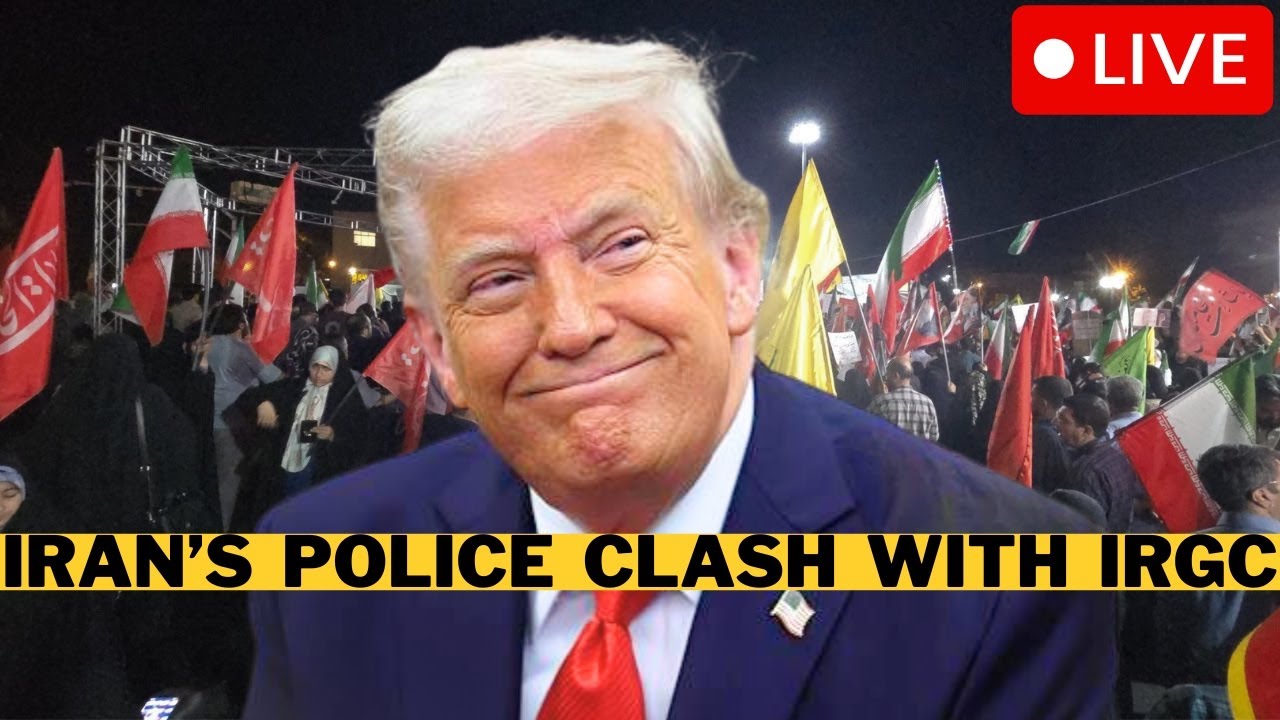
LIVE: Trump Ends 'Iran Deal' Hopes - Explosion In Tehran - IRGC Attack In London
YouTube · VFUowkphLgA
Quick Read
Summary
Takeaways
- ❖President Trump rejected all Iranian demands for a nuclear deal, including sanctions relief, frozen asset release, and control over the Strait of Hormuz.
- ❖The host claims the Iranian regime's economy is collapsing, forcing a partial restoration of internet access after a three-month blackout.
- ❖US military conducted retaliatory airstrikes in Bandar Abbas, targeting and likely eliminating Brigadier General Ali Azmayi, the IRGC Navy commander.
- ❖The 'immortal guard' in Iran announced a shift from civil resistance to armed resistance following a massacre of unarmed Iranian people.
- ❖Trump is pushing for Saudi Arabia, Qatar, and other Arab nations to immediately join the Abraham Accords, potentially making it a condition for any future Iran deal.
Insights
1Trump Rejects All Iranian Deal Demands
President Trump has rejected every single demand from the Islamic Republic regarding a new nuclear deal, including the release of frozen IRGC assets, sanctions relief, delayed uranium discussions, and Iranian control of the Strait of Hormuz. He stated, 'The deal has to be perfect or nothing,' and would not accept enriched uranium being sent to third countries like Russia or China.
Host's summary of Trump's stance and direct quotes from Trump's cabinet meeting.
2US Launches Retaliatory Strikes, Targets IRGC Navy Commander
Following an IRGC attack on US forces, the US military launched defensive airstrikes in Bandar Abbas, southern Iran. These strikes targeted an IRGC military vehicle and an IRGC military site near the Strait of Hormuz. Brigadier General Ali Azmayi, the newly appointed leader and commander of the IRGC Navy, responsible for piracy operations and attacks on US forces, was confirmed as the target of elimination.
Breaking news updates during the podcast, including details of strikes in Bandar Abbas and the identification of Ali Azmayi as the target.
3Iranian Regime Facing Internal Collapse and Shift to Armed Resistance
The host asserts that the Iranian regime is experiencing a 'slow death and collapse,' with a flatlined economy, fallen currency, and widening internal cracks. The partial restoration of internet after a three-month blackout was attributed to systemic collapse. The 'immortal guard,' a key opposition group, announced a shift from civil resistance and protests to armed resistance following a massacre of unarmed Iranian people in January.
Host's analysis of the Iranian economy, internet situation, and translation of the 'immortal guard's' message.
4Trump Demands Abraham Accords Expansion as Leverage
President Trump is pushing for Saudi Arabia, Qatar, and other Arab nations to immediately join the Abraham Accords and normalize relations with Israel. The host speculates this 'radical' move, unrelated to the Iran deal, is intended to pressure Iran or prepare for upcoming military action against the Islamic Republic, with Trump suggesting a deal might be contingent on their participation.
Trump's statements during a cabinet meeting regarding the Abraham Accords and the host's interpretation.
Bottom Line
The 'foreplay stage of conflict' is characterized by escalating, targeted actions like explosions and assassinations before an 'all-out war' breaks out, as seen in the current US-Iran dynamic.
This suggests that the ongoing, seemingly isolated incidents (Tehran explosions, IRGC attacks, US retaliatory strikes, targeted assassinations) are not random but part of a calculated escalation, indicating a higher probability of a larger conflict.
Analysts and policymakers should monitor these 'foreplay' indicators closely to anticipate and potentially de-escalate or prepare for broader military engagements, rather than dismissing them as isolated events.
Trump's strategy of demanding Arab nations join the Abraham Accords, seemingly unrelated to the Iran deal, is a 'radical' move to create leverage or prepare for military action against Iran.
This indicates a complex, multi-faceted pressure campaign by the US, not just on Iran but also on its regional neighbors, potentially forcing a realignment of alliances and further isolating the Iranian regime. It suggests a long-term strategic goal beyond just the nuclear deal.
Regional powers should assess their geopolitical alignment and prepare for potential shifts in alliances and security architectures, as the US is actively reshaping the Middle Eastern landscape. Businesses operating in the region should consider the increased geopolitical risk and potential for new economic partnerships or disruptions.
The 'immortal guard' in Iran has shifted from civil resistance to armed resistance, signaling a new, more violent phase of internal opposition.
This transformation implies that the internal struggle against the Iranian regime is intensifying and becoming more militarized, potentially leading to increased instability, civil unrest, and a higher death toll within Iran. It also indicates a potential for external support to armed opposition groups.
International human rights organizations and governments should prepare for a worsening humanitarian situation. External actors interested in regime change may find new avenues for engagement, while those concerned with regional stability face increased challenges from internal armed conflict.
Lessons
- Monitor the Strait of Hormuz for increased military activity and potential disruptions, as both the US and Iran are asserting control and engaging in retaliatory actions.
- Track internal developments within Iran, particularly the 'immortal guard's' shift to armed resistance, as this signals a significant escalation in domestic opposition and potential for widespread instability.
- Observe the progress of the Abraham Accords, as President Trump's push for Saudi Arabia and Qatar to join could indicate a broader US strategy to isolate Iran and reshape regional alliances, impacting geopolitical stability and economic partnerships.
Notable Moments
President Trump rejects all Iranian demands for a nuclear deal, stating 'perfect or nothing.'
This signals a hardline, uncompromising stance from the US, effectively ending hopes for a quick diplomatic resolution and intensifying pressure on the Iranian regime.
Reports of multiple explosions in Tehran, including at a military administrative building.
These incidents suggest internal instability or covert operations targeting Iranian military infrastructure, contributing to the regime's perceived 'collapse.'
IRGC members launch a car attack on Iranian patriots at a memorial in North London, running over Amir Hussein Turkan.
This demonstrates the IRGC's reach and willingness to conduct aggressive actions against dissidents even on foreign soil, highlighting the transnational nature of the conflict.
US military launches defensive airstrikes in Bandar Abbas, southern Iran, targeting an IRGC military vehicle and site.
This marks a direct military retaliation by the US against IRGC actions, escalating the conflict and demonstrating US commitment to safeguarding its regional interests.
Brigadier General Ali Azmayi, IRGC Navy commander, is targeted for elimination in Bandar Abbas.
The targeting of a senior IRGC leader indicates a precise and high-stakes US military operation aimed at disrupting Iranian naval operations and leadership, potentially decapitating key figures responsible for attacks.
The 'immortal guard' announces a shift from civil resistance to armed resistance in Iran.
This signifies a critical turning point in the internal struggle against the Iranian regime, moving towards a more violent and potentially prolonged conflict within the country.
Quotes
"I didn't do all this to get a bad deal. The deal has to be perfect or nothing."
"The strait's going to be open to everybody. It's international waters. Nobody's going to control it. We're going to watch over it. We'll watch over it, but nobody's going to control it."
"I'm not sure we should make the deal if they don't sign. You want to know the truth? if they don't sign to join the Abraham Accords, I don't know that we, you know, we have countries in there already."
"If they won't, then the man on my left is going to finish him off."
Q&A
Recent Questions
Related Episodes

Patrick Henningsen: Hezbollah JUST Fired Back at Israel - Iran Vows to “Crush” All Attacks
"Patrick Henningsen argues that the US and Israel initiated an illegal war against Iran, driven by Trump's incompetence and Israeli influence, leading to an inevitable escalation with severe global economic repercussions."
BREAKING: Protests ERUPT In Iran Over IRGC Surrendering To Trump - Infighting Clashes In Tehran
"Iran is experiencing severe internal infighting and protests as hardline IRGC elements clash with government figures over a perceived 'surrender' to the US, while mainstream Western media misrepresents the situation."

Alex Krainer: US STRIKES Iran – Iran RETALIATES Against Kuwait, Bahrain & Jordan!
"Amidst escalating US-Iran conflict and Iranian retaliation against regional US allies, this episode argues that US foreign policy is deeply controlled by an 'Anglo-Zionist conspiracy' led by the Rothschild banking dynasty, prioritizing Israeli interests over American ones."

🚨 TOTAL F*CKING CHECKMATE 😂😂😂
"The host argues that Trump's 'ceasefire' with Iran was a calculated '5D chess' move to orchestrate a global energy market reshuffle, while simultaneously lambasting 'woke' domestic policies and the 'freefall' of anti-Trump conservative figures."