
BREAKING: Supreme Court BLOCKS Trump's Tariffs
YouTube · VN5vXH1qrzk
Quick Read
Summary
Takeaways
- ❖The Supreme Court struck down former President Trump's 'liberation day tariffs,' which were imposed under emergency authority.
- ❖The decision was 6-3, with Chief Justice Roberts' majority opinion emphasizing the 'major questions doctrine' and Congress's exclusive power of the purse.
- ❖The invalidated tariffs represent approximately $175 billion collected from U.S. businesses, with the Supreme Court punting the refund process to the Court of International Trade.
- ❖Businesses, many of whom absorbed tariff costs and delayed price increases, are now awaiting clarity on refunds and future tariff policies.
- ❖The Trump administration has stated it will attempt to reconstitute similar tariffs using other, more procedurally intensive legal authorities (e.g., Sections 122, 301, 201, 232).
- ❖The ruling reduces the effective tariff rate on consumers from an estimated 16.9% to 9.1%, still the highest since 1946 (excluding 2025).
- ❖The decision is seen as a 'brushback pitch' against executive overreach, particularly regarding legislative authorities, despite the court's prior deference on other executive power issues.
Insights
1Supreme Court Blocks Trump's Emergency Tariffs
The Supreme Court, in a 6-3 decision, struck down the 'liberation day tariffs' that former President Trump imposed using claimed emergency authority. The ruling found that the executive branch overstepped its constitutional bounds by asserting an extraordinary power to set tariff levels without explicit congressional authorization, violating the 'power of the purse' and the 'major questions doctrine.'
Host Andrew Edgar and economics editor Katherine Mangu-Ward discuss the Supreme Court's decision, noting it was 'expected to be clear' () and that the justices ruled on the 'major questions doctrine' and the specific law used to justify the tariffs (). Chief Justice Roberts' opinion is quoted: 'The president's assertion here of broad statutory power over the national economy is extravagant by any measure' ().
2Uncertainty for $175 Billion in Collected Tariffs
The Supreme Court punted on the issue of what happens to the estimated $175 billion in tariffs already collected from businesses. This leaves companies in limbo, many of whom absorbed these costs and delayed price increases in anticipation of a refund. The matter has been sent back to the Court of International Trade, prolonging the uncertainty for small and medium-sized businesses.
Katherine Mangu-Ward states, 'They punted however on what happens to all of the tariffs that have already been collected. And there is a lot of money on the line. That's about $175 billion' (). She also mentions businesses 'have been trying to temporarily absorb the cost of those tariffs in the hopes that the Supreme Court was going to give the money back to them' ().
3Administration's Plan to Reconstitute Tariffs
Despite the Supreme Court's ruling, the Trump administration has signaled its intent to reconstitute similar tariffs using other existing legal authorities. These alternative authorities (e.g., Sections 122, 301, 201, 232) are more constrained by procedural requirements like public hearings and specific criteria (e.g., unfair practices, sudden import increases, national security), making it harder for the president to impose them unilaterally and quickly.
Andrew Edgar asks, 'Do these stay up because the White House has promised that even if these particular authorities were overturned, they might try to get basically the same tariff regime in place in another way' (). Katherine Mangu-Ward details various other powers: 'Section 122 allows the president to impose 15% tariffs on imports for 150 days... Section 301 is something about unfair practices... safeguard tariffs under section 201... section 232 about national security' ().
4Economic Chaos and Supply Chain Disruptions
The constant imposition and removal of tariffs, along with the lingering uncertainty, have created significant economic inefficiencies and chaos for businesses. Companies have spent considerable resources scrambling and unscrambling supply chains, delaying investments, and holding off on price adjustments, impacting both their profitability and consumer prices.
Andrew Edgar highlights 'the inefficiencies that are created by the chaos of having tariffs being slapped on and pulled off and slapped on and pulled off' (). Katherine Mangu-Ward notes companies 'have been scrambling and unscrambling and cancelling and uncancelling supply chains and orders and everything else' ().
Bottom Line
The Supreme Court's decision, while a legal defeat for Trump, could inadvertently 'gift' his economy a boost by removing inflationary tariffs, yet his administration may reject this 'gift' by re-imposing them.
This creates a paradoxical political dynamic where Trump might actively work against an economic improvement that could benefit his public image, driven by his protectionist ideology and desire for unilateral power.
Democrats could frame the removal of tariffs as a 'Trump tax cut' (even if unintended by Trump) to highlight affordability improvements, but their historical and current protectionist leanings make this messaging difficult.
The ruling significantly curtails the president's ability to use tariffs as a 'cudgel' in geopolitical negotiations, as the process for imposing new tariffs is now much more cumbersome and less immediate.
This reduces the executive's leverage in international trade disputes and demands, potentially shifting power back towards more traditional diplomatic and legislative approaches.
Other countries may find the U.S. a more predictable trading partner, potentially leading to more stable international trade relations, but also reducing the speed and flexibility of U.S. trade policy responses.
Key Concepts
Major Questions Doctrine
This legal principle holds that if an executive agency asserts broad authority to make major policy changes with huge economic or political implications, it must be explicitly authorized by Congress. Congress cannot delegate such significant power implicitly or through vague statutes.
Power of the Purse
The constitutional power to set and lay taxes, which the Supreme Court affirmed belongs to the legislative branch (Congress), not the executive. The ruling reinforced that the executive cannot unilaterally usurp this power, even under claims of national emergency.
Lessons
- Businesses that paid the invalidated tariffs should immediately assess their eligibility for refunds and prepare for potential litigation or administrative processes to recover funds.
- Companies should re-evaluate their supply chains and pricing strategies, considering the removal of the 'liberation day tariffs' but also anticipating the administration's efforts to re-impose them under different authorities.
- Policymakers in Congress now have a clearer mandate to explicitly legislate on trade and tariff policy if they wish to grant such powers to the executive, rather than relying on broad interpretations of existing statutes.
Quotes
"The president's assertion here of broad statutory power over the national economy is extravagant by any measure."
"Small businesses cannot afford to wait months or years while bureaucratic delays play out. Nor can they afford expensive litigation just to recover money that was unlawfully collected from them in the first place. These businesses need their money back now."
"This is a gift that the Supreme Court has given him. It's a gift that the Supreme Court has given Congress. And if Trump is smart, he will gladly accept it. Instead, I suspect he is going to snatch defeat from the jaws of victory."
Q&A
Recent Questions
Related Episodes
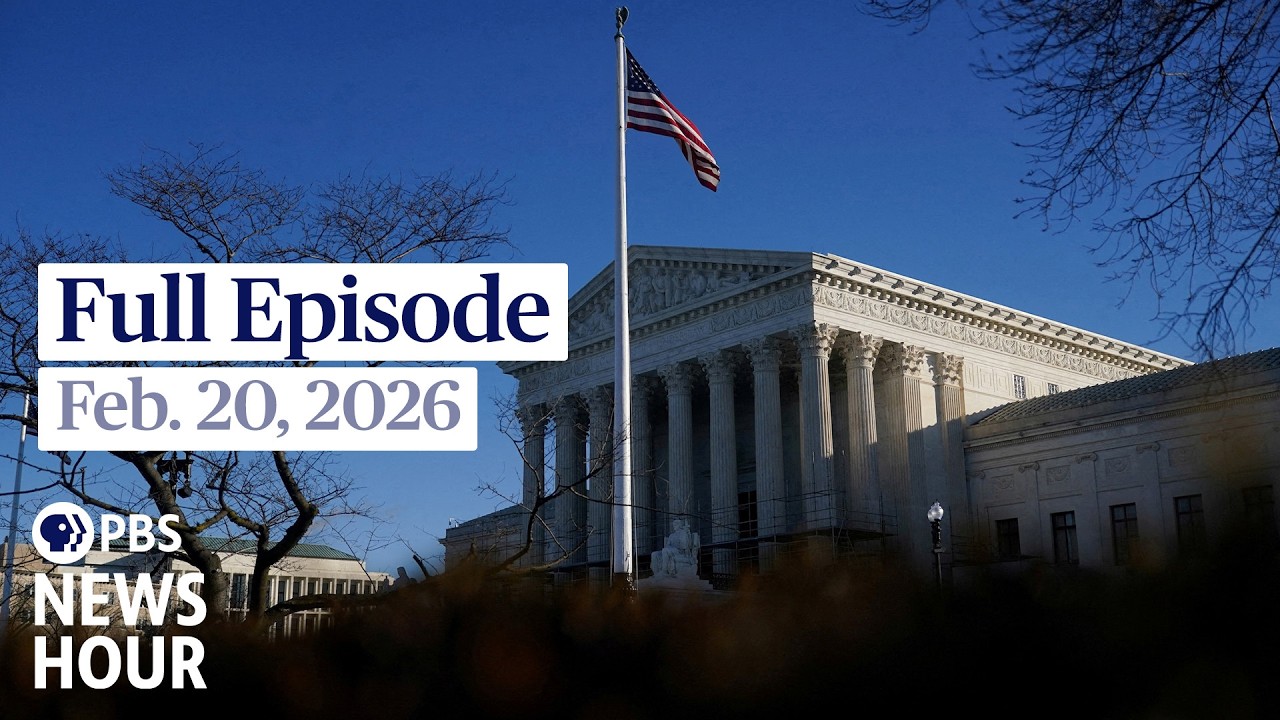
PBS News Hour full episode, Feb. 20, 2026
"The Supreme Court struck down President Trump's sweeping global tariffs, prompting an immediate presidential counter-move with new tariffs and escalating tensions with Iran, while the EPA rolled back critical environmental protections."
SHOCK BREAKING: SHOCKED TRUMP STORMS OUT OF SUPREME COURT IN RAGE!
"This episode dissects Donald Trump's contentious Supreme Court appearance regarding birthright citizenship, the growing disillusionment of right-wing figures like Alex Jones with Trump, and the political fallout from Kristi Noem's husband's alleged cross-dressing scandal."

Trump's Trade War Derailed By SCOTUS w/ Mark Joseph Stern | MR Live
"The Supreme Court significantly curtailed former President Trump's sweeping tariff authority, ruling his use of an emergency statute for broad taxation was unlawful, yet the financial benefits of these illegal tariffs are unlikely to reach the public."

SHOCK Ruling on Trump Deportation PLOT + DEBUNKED Election WARRANT?!? | It's Complicated
"The Fifth Circuit Court's controversial ruling redefines 'seeking admission' for non-citizens, potentially allowing indefinite detention for millions, while a federal search warrant for 2020 election ballots is criticized as a 'test run' for future election interference."