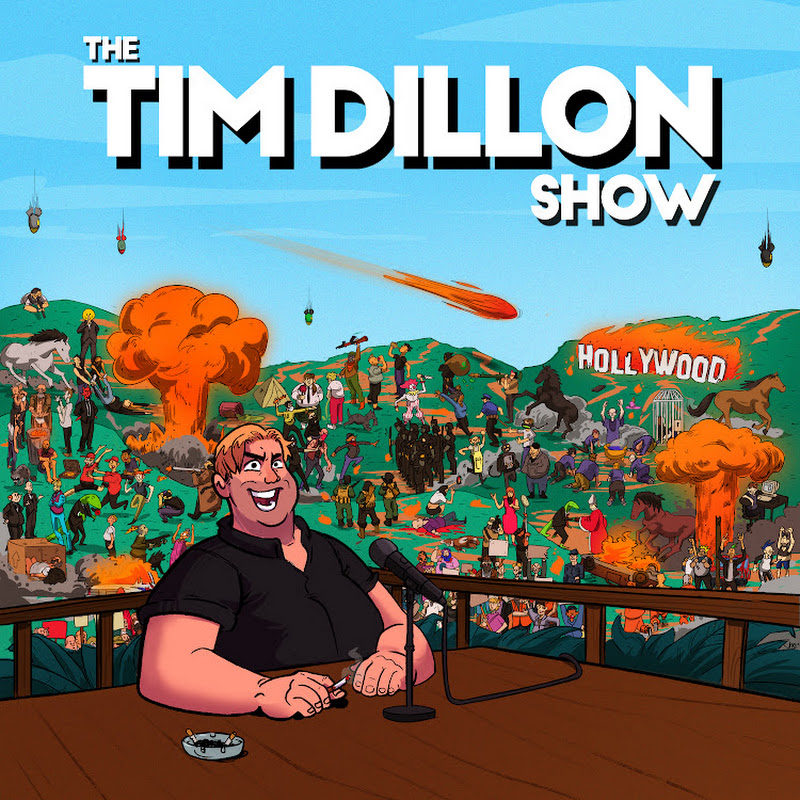
The Palantir Manifesto & My Manifesto | The Tim Dillon Show #493
YouTube · VVyMKE-p0S4
Quick Read
Summary
Takeaways
- ❖A satirical segment features a veteran claiming a fictional drug, Ibegane, cured his PTSD and opioid addiction by eliminating all guilt and shame, even for murder, which the host enthusiastically endorses.
- ❖Tim Dillon critiques Palantir's 22-point manifesto, interpreting it as a blueprint for a tech-oligarch-led, militarized society with a universal draft and extensive surveillance.
- ❖Dillon argues that Palantir's vision promotes 'hard power' through software, replacing cultural influence, and sees tech companies as the true governing force.
- ❖The host expresses concern that modern technological advancements are leading to increased isolation, rage, and a less fulfilling, more sociopathic society, despite promises of a 'better' life.
Insights
1The Satirical 'Cure' of Ibegane
A fictional veteran, 'Mike,' describes taking Ibegane, an 'FDA-approved African root,' which he claims provided 'total liberation from any sort of judgment' for his past actions, including choking a woman to death. He now views death as 'liberation' and feels 'no shame, no guilt, no mercy, no hesitation' for killing. The host, Tim Dillon, satirically praises these effects as 'amazing' and 'beautiful,' suggesting the drug should be integrated into the prison, military, and school systems.
Mike: 'I experienced a total liberation from any sort of judgment I had on the situations I was put in...' 'I see death as a liberation. So, I have no qualms over the death I delivered to these people.' Tim Dillon: 'That sounds amazing.' 'This is beautiful because what you've realized is you don't have to sacrifice using opioids to heal yourself.'
2Palantir's Manifesto: A Blueprint for a Militarized Tech Oligarchy
Tim Dillon analyzes Palantir's 22-point manifesto, interpreting it as a vision for a future dominated by tech oligarchs. He highlights points calling for a universal draft, predicting 'big wars,' and emphasizing 'hard power' built on software. Dillon suggests Palantir sees itself as the 'actual government,' making decisions about the future, and that traditional democratic processes will become ineffectual.
Tim Dillon: 'Palanteer, to their credit, has came out and said, "We think there's going to be wars and big ones."' 'Hard power in this century will be built on software.' 'We are the actual government. You don't realize it now, but we are the actual government.'
3The Surveillance State and Predictive Crime Models
Dillon critiques Palantir's call for Silicon Valley to address violent crime, interpreting it as a move towards a 'cradle-to-grave surveillance state.' He believes this involves building predictive models of criminal behavior based on AI analysis of all personal data, rather than addressing root causes of crime like economic opportunity or effective policing.
Tim Dillon: 'They're talking about predictive models of criminal behavior based on AI analysis of all of the things that you've ever said or done.'
4The Erosion of Liberty and Public Accountability
Dillon argues that Palantir's manifesto subtly advocates for reducing public scrutiny of politicians and tech leaders. He interprets points about showing 'grace towards those who have subjected themselves to public life' and the 'ruthless exposure of the private lives of public figures' as a desire for the press to 'stand down' and allow powerful individuals to operate without accountability, driving away 'billionaire psychopaths' who might otherwise enter politics.
Tim Dillon: 'The press should kind of stand down. Let us do what we want.' 'People are far too critical of people that go into public life. So it drives away a lot of the billionaire psychopaths who would want to do it.'
5Technological Advancement vs. Societal Happiness
Dillon posits that despite unprecedented technological advancement, society is not happier. He contrasts the current era with 2010, arguing that people were more hopeful, connected, and less addicted to rage and social media then. He suggests that modern tech fosters isolation and a 'sociopathic' mindset, where true enjoyment requires ignoring widespread suffering and a focus on superficial gains.
Tim Dillon: 'Nobody believes life is better now than it was in 2010.' 'Right now is one of the bleakest periods that I've ever lived through. And it's the most technologically advanced time that we have.' 'In order to enjoy our time, you have to be a sociopath.'
Bottom Line
The satirical endorsement of Ibegane, a drug that removes guilt and promotes remorselessness, highlights a dark societal fantasy of escaping moral burdens, even at the cost of humanity.
This satire suggests a deep-seated desire to bypass the psychological toll of trauma and moral conflict, potentially reflecting a broader cultural exhaustion with accountability and ethical complexity.
This could be a prompt for creators to explore narratives around moral absolution in a post-truth or post-empathy society, or for ethicists to examine the societal implications of 'curing' guilt without addressing its underlying causes.
Palantir's manifesto, as interpreted, aims to merge AI, nationalism, and religious belief into a cohesive ideology to gain public acceptance for a tech-driven, militarized future.
This strategy seeks to legitimize a corporate-controlled state by appealing to traditional values and national security fears, potentially neutralizing dissent by framing technological control as a divine or patriotic imperative.
Analysts and journalists could investigate how tech companies are actively shaping public discourse and political narratives, particularly through the strategic use of cultural and religious frameworks, to advance their agendas.
Dillon's critique suggests that the modern 'casino economy,' driven by tech and focused solely on wealth accumulation, is inherently unfulfilling and destructive to genuine community and culture.
This perspective challenges the prevailing narrative that more ways to get rich equates to a better society, implying that such a system leads to widespread alienation and a superficial existence, even for those who 'succeed.'
Entrepreneurs and community leaders could focus on building businesses and initiatives that prioritize community, genuine connection, and cultural enrichment over pure financial gain, offering alternatives to the 'casino' model.
Lessons
- Critically examine the underlying motives and potential societal impacts of powerful tech companies and their proposed 'solutions' for global challenges.
- Reflect on personal values and priorities, questioning whether technological advancements genuinely contribute to happiness and fulfillment or merely create more isolation and superficiality.
- Engage in local communities and foster genuine human connections as a counter-narrative to a globally interconnected, yet increasingly isolating, digital existence.
Quotes
"I experienced a total liberation from any sort of judgment I had on the situations I was put in, the situations I was there for."
"I see death as a liberation. So, I have no qualms over the death I delivered to these people. And in some form or another, I'd like to deliver that again."
"This is beautiful because what you've realized is you don't have to sacrifice using opioids to heal yourself."
"Hard power in this century will be built on software."
"We are the actual government. You don't realize it now, but we are the actual government."
"Nobody looks at life now and says it's better. Look at 2010... Nobody thinks this life is better."
"In order to enjoy our time, you have to be a sociopath."
Q&A
Recent Questions
Related Episodes
The Epstein Files Rabbit Hole Is Deeper Than You Think | Unsubscribe Podcast 254
"This episode unravels a dense web of alleged financial manipulation, political corruption, and historical conspiracies, connecting figures from the Federal Reserve and the Rothschilds to the Epstein scandal and 9/11."

Epstein, Wexner, & The Great Silverware Heist | The Tim Dillon Show #484
"Tim Dillon satirically dissects Les Wexner's claims of being 'conned' by Jeffrey Epstein, questions the official 9/11 narrative, and critiques the vague language of political figures, all while observing the absurdities of modern society."

Behind the scenes of Saturday Night Live, the Daily Show and more | 60 Minutes Full Episodes
"Explore the rigorous, chaotic, and often counter-intuitive processes behind iconic American comedy institutions like Saturday Night Live, The Daily Show, Harvard Lampoon, and Amsterdam's Boom Chicago, revealing their roles in shaping comedic talent and cultural commentary."

Tom Nichols: Trump’s Speech Was Pure TRASH | Bulwark Podcast
"Tom Nichols and Tim Miller dissect Trump's 'trashy' speech, the politicization of the military, and the casual corruption eroding American institutions, contrasting it with the founding fathers' vision of patriotism."