
Rev. Jesse Jackson lies in repose at Rainbow PUSH Coalition headquarters in Chicago | Day 2
YouTube · VlNMlzl6eWc
Quick Read
Summary
Takeaways
- ❖The true greatness of a leader is measured by what they inspire others to do and achieve, not just their own accomplishments.
- ❖"I am somebody" is a fundamental declaration of self-worth that empowers individuals to challenge systemic oppression.
- ❖Political engagement, especially voting, is a critical "rock" in the "David and Goliath" struggle against societal giants.
- ❖Leadership must prioritize conscience, redemption, expansion, healing, and unity to achieve a just and peaceful society.
- ❖Challenging stereotypes about learning and capability is essential; physical prowess despite hardship implies intellectual potential.
- ❖"Keep hope alive" is a mantra for perseverance through suffering, recognizing that character breeds faith, and faith breeds hope.
- ❖The power of the U.S. President is immense, influencing war, peace, attitudes, and the direction of the largest business (the American government).
- ❖Tax reform and redirecting funds from loopholes can create new job markets and address social crises more effectively than welfare.
- ❖A new value system is needed where professionals prioritize public good over personal gain (e.g., doctors for public health, lawyers for justice, teachers for life).
Insights
1The Essence of True Leadership
A speaker at the memorial defined true leadership not by a person's individual accomplishments or acquisitions, but by their capacity to inspire others to act, achieve, and strive for self-improvement. Reverend Jackson exemplified this by motivating individuals, including former drug addicts and marginalized youth, to embrace their inherent worth and contribute to a better world.
The greatest of man is not in the great things that he has done... But the true witness of a man is in what he inspires others to do... to achieve. And in how he is trying his others to do better than its dear brothers and sisters.
2Challenging Perceptions of Capability and "Foreign Policy"
Reverend Jackson directly confronted the notion that marginalized communities, particularly Black children, are inherently incapable of learning due to social conditions. He argued that if individuals can excel physically (run faster, jump higher) despite inadequate diets, they possess the innate capacity to learn academically. He also reframed "foreign policy" as deeply personal to Black Americans, citing their historical experiences from slavery to military service and consumer choices (e.g., buying foreign cars).
If we can run faster and jump higher and shoot a basketball straight off of inadequate diets, then we can read and write and count and think of those same diets. All that can happen. You want somebody who marched for you to get the right to vote? You got a choice. You want somebody who challenged corporate America to hire you and give you contracts? You got a choice. It's choice time. All this talk about qualification. What the blacks know about foreign policy? It's an insult. I was 3 years old. I came into my consciousness. My daddy was coming home from the wall foreign policy... When you buy Honda and Toyota, that's foreign policy.
3Political Power and the "Rocks" of Unregistered Voters
Jackson used the "David and Goliath" metaphor to emphasize the latent political power within unregistered and disengaged communities. He highlighted how presidential elections were won by narrow margins, while millions of eligible Black, Hispanic, and student voters remained unregistered. He urged these groups to "pick up your slingshot, pick up your rock" (register and vote) to shift political outcomes and fight for their interests.
Reagan won Massachusetts by 2500 votes... there were over 100,000 students unregistered, over 50,000 blacks, over 50,000 Hispanics. He won by 2500. Tenned state rocks just laying around. He won Illinois by 300,000 votes, 800,000 unregistered blacks. 500,000 Hispanics rocks just laying around... Pick up your slingshot. Pick up your rock. Declare, 'Our time has come. A new day has begun.'
4Personal Narrative as a Tool for Universal Empowerment
Jackson shared his deeply personal story of being born to a teenage mother, adopted, and growing up in poverty without a stable father figure. He used his own experiences of abandonment, being called "nothing," and living in a three-room house with an outdoor bathroom to connect with and validate the struggles of those labeled "outcasts" or "underclass." His message was that if he could overcome these origins to achieve prominence, anyone could.
I was born a teenage mother. Who was born that teenage mother? I understand. I know abandonment and people being mean to you and saying you're nothing and nobody and can never be anything. I understand. Jesse Jackson is my third name. I'm adopted... I wasn't born in the hospital. Mama didn't have insurance. I was born in the bed at house. I really do understand. Born in a three-room house. Bathroom in the backyard... When you see Jesse Jackson, when my name goes in nomination, your name goes in nomination. I was born in the slum, but the slum was not born in me. And it wasn't born in you, and you can make it.
5Redefining Welfare and Advocating for Tax Reform
Jackson argued that the welfare crisis was often mischaracterized as a predominantly Black issue, despite numerically more white people being on welfare. He called this misrepresentation "institutional as well as overt racism." He proposed that tax reform, specifically closing over $40 billion in tax loopholes, could eliminate the need for welfare and generate a new job market, shifting focus from welfare dependency to job creation.
You can't deal politically with welfare unless we raise it above the level of a black issue. Numerically more white folks on welfare than black folk. There have always been more white folks on welfare than black folk. Welfare came in existence for white folk. Always been run by white folk. And if it's messed up, it's because all white folk. And therefore, when Time magazine and Newsweek talks about the welfare crisis and puts a black family on the cover and project into your mind that welfare is black and synonymous, that is the evidence of institutional as well as overt racism... more than $40 billion in tax loopholes enough to wipe out the welfare system and create a complete new job market.
Key Concepts
The "David and Goliath" Strategy for Political Change
Reverend Jackson frequently used the biblical story of David and Goliath to illustrate how seemingly powerless individuals can overcome formidable adversaries through collective action and strategic use of available resources (like votes, referred to as "rocks"). This model emphasizes that even small margins of unregistered voters or disengaged communities can determine significant political outcomes, urging mobilization to challenge established powers.
Attitude Determines Altitude
This model, popularized by Reverend Jackson, posits that an individual's attitude and mindset are more critical determinants of their success and potential ("altitude") than their inherent abilities or circumstances ("aptitude"). It champions willpower and internal fortitude over external factors, encouraging a belief in one's capacity to learn, achieve, and overcome despite challenging environments.
Lessons
- Actively engage in political processes, including voter registration and participation, to influence policy and leadership.
- Challenge negative self-perceptions and societal labels by affirming your inherent worth and potential ("I am somebody").
- Prioritize education and personal development, understanding that attitude and willpower are key to overcoming challenging circumstances.
- Advocate for systemic changes like tax reform to address root causes of poverty and create equitable opportunities.
- Support leaders who champion public health, justice, and education for all, rather than personal gain or political expediency.
The "Keep Hope Alive" Playbook for Social Change
Affirm Self-Worth: Begin by internalizing and declaring "I am somebody," rejecting societal labels and recognizing inherent dignity.
Mobilize for Political Action: Identify and activate unregistered voters, treating each vote as a "rock" in the "David and Goliath" struggle against systemic injustices.
Challenge Systemic Narratives: Actively question and expose biased media portrayals and policies (e.g., welfare as a "black issue") that perpetuate racism and inequality.
Demand Accountable Leadership: Elect and support leaders who prioritize public good over personal gain, focusing on justice, equitable opportunities, and peace.
Persevere Through Adversity: Embrace the philosophy that "suffering breeds character, character breeds faith, and faith breeds hope," maintaining an unwavering commitment to the mission despite setbacks.
Notable Moments
The repeated "I am somebody" chant led by Reverend Jackson, often with audience participation, serving as a powerful affirmation of self-worth and collective identity.
This chant became a cornerstone of the Civil Rights Movement, empowering marginalized individuals to recognize their inherent dignity and reject dehumanizing labels, fostering a sense of unity and purpose.
Reverend Jackson's candid sharing of his personal story, including being born to a teenage mother, adopted, and growing up in poverty, to connect with and inspire those facing similar struggles.
This personal vulnerability allowed Jackson to build deep empathy and credibility with his audience, demonstrating that he understood their challenges firsthand and that their circumstances did not define their potential.
The eulogies and prayers consistently highlighting Jackson's role as a "preacher of justice," "intellectual titan," and "champion of civil rights" who provided a "blueprint of how to serve."
These tributes underscore the multifaceted impact of his leadership, not just in political activism but also in spiritual guidance and intellectual discourse, cementing his legacy as a transformative figure.
Quotes
"We may be in the slum, but the slum is not in us."
"When we are together, we got power and we can make solutions."
"The true witness of a man is in what he inspires others to do."
"Suffering breeds character, and character breeds faith, and faith breeds hope, and hope will not disappoint."
"If my mind can conceive it, and my heart can believe it, I know I can achieve it, because I am somebody."
"I was born in the slum, but the slum was not born in me. And it wasn't born in you, and you can make it."
"Time is neutral and does not change things. With courage and initiative, leaders change things."
"To not vote, to not get involved, is to throw dirt in their faces and to tell them that dying in Samuel was worthless and did not make any sense."
"We must move rapidly toward tax reform... more than $40 billion in tax loopholes enough to wipe out the welfare system and create a complete new job market."
Q&A
Recent Questions
Related Episodes

LIVE! Love Forward Together Mass People’s Assembly & Moral March Mobilization In Raleigh, NC
"Thousands marched across North Carolina in the 'This Is Our Selma' movement, led by Reverend William Barber, to combat gerrymandering, voter suppression, and advocate for a proactive, love-driven vision of social and economic justice."
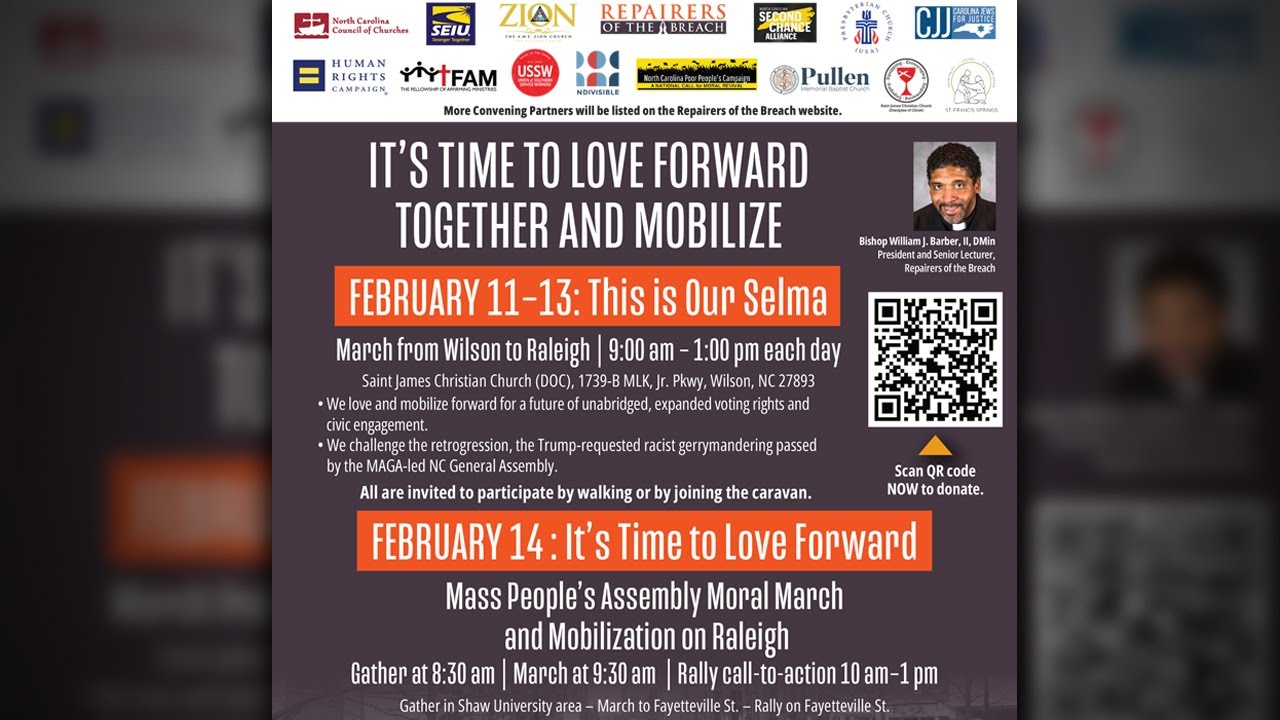
Love Forward Together Mass People’s Assembly & Moral March Mobilization | Day 2
"This episode documents Day 2 of the 'Love Forward Together' march in rural North Carolina, a mobilization against voter disenfranchisement and redistricting, emphasizing community unity and persistent activism."

George Floyd 6 Years Later. Redistricting War in The South. Talarico Senate Campaign
"This episode exposes the ongoing legislative battles and strategic resistance against efforts to diminish Black political power, from federal policing reform to state-level gerrymandering and calls for economic boycotts by Black athletes."
Moral Monday at BLM Plaza. Cleo Fields Sounds Alarm on Louisiana & Gary Chambers Pushes Turnout
"Activists and faith leaders gathered at Moral Monday to denounce 'policy violence' in various forms, from war and budget cuts to voter suppression and healthcare denial, urging sustained mobilization against a 'hijacked' democracy."