
"You're a DISGRACE!" Don Lemon Arrested + Epstein Files | Brett Ratner Speaks!
YouTube · W0qYM7DvtjI
Quick Read
Summary
Takeaways
- ❖The latest release of Epstein files (3 million pages, 180,000 images, 2,000 videos) has publicly humbled high-profile men but yielded few US prosecutions, unlike the UK.
- ❖Legal experts debate whether Don Lemon's presence at a church protest constituted criminal interference or protected journalistic activity, with concerns about setting a dangerous precedent.
- ❖The 'Melania' documentary achieved record box office success and high audience approval despite overwhelmingly negative reviews from mainstream critics, illustrating a significant disconnect.
- ❖Panelists suggest Epstein's vast wealth and connections point to a larger blackmail operation, possibly involving foreign intelligence agencies, which remains uninvestigated.
- ❖Elon Musk's public denials about Epstein Island visits conflict with emails showing his keen interest years after Epstein's conviction.
- ❖The host advocates for intellectual consistency in applying standards across political divides, criticizing tribalism in reactions to events like Don Lemon's arrest.
Insights
1Epstein Files: US Prosecutions Lag UK Consequences Amidst Redactions
Despite the release of millions of documents, images, and videos from the Epstein files, US authorities have not pursued high-profile prosecutions, citing a lack of 'proof beyond a reasonable doubt.' This contrasts sharply with the UK, where figures like Lord Mandelson and Prince Andrew face severe consequences and calls for criminal investigation. Panelists highlight extensive redactions and a perceived lack of follow-up investigation by the FBI, raising questions about transparency and accountability.
Mark Iglash (criminal defense attorney) states, 'association with Epstein, not enough. Photos with him and around him, not enough. There's got to be proof beyond a reasonable doubt.' Tara Palary and Anna Kasparian point out that 3 million of 6 million files are still withheld and heavily redacted, with instances like 'torture videos' senders' names being redacted while victims' names were not. Piers Morgan notes UK figures like Lord Mandelson and Prince Andrew are 'finished' and facing potential criminal prosecution.
2Don Lemon Arrest: Journalistic Freedom vs. Legal Boundaries
The arrest of Don Lemon for allegedly breaking into a church service during a protest sparked a debate on whether his actions were protected journalistic activity or a criminal act. Legal analysis suggests that for a criminal charge, 'intentional interference' must be proven, not just 'incidental interference.' Critics argue the arrest sets a dangerous precedent for journalists, while others contend that no journalist should be immune from laws against trespassing or disrupting worship.
Mark Iglash states, 'The First Amendment gives wide latitude for journalists to do exactly what he did, cover an event... One needs intentional interference to be found guilty of a criminal act. He wasn't there... to interfere with people's ability to worship.' Eric Boly argues Lemon 'broke into an ongoing church service' and was 'looking to create a scene.' Piers Morgan emphasizes the 'slippery slope' of criminalizing journalists and the need for 'intellectual consistency' in applying legal standards.
3Melania Documentary: Audience Success vs. Critical Bias
The 'Melania' documentary achieved significant box office success and overwhelmingly positive audience scores (A CinemaScore, 98-99% audience favor on Rotten Tomatoes) despite being panned by mainstream critics. Director Brett Ratner and producer Mark Beckham attribute this disparity to media bias against the Trumps and argue that traditional film criticism, particularly platforms like Rotten Tomatoes, no longer accurately reflects audience interest, leading to a 'destruction of the film business.'
Brett Ratner states, 'we have an A CinemaScore... I don't think any of my movies that I've made in the past have ever had an A CinemaScore.' He notes Rotten Tomatoes scores of 6-10% from critics versus 98-99% from audiences. Mark Beckham adds, 'This guy right here, Brett Ratner, was able to, I think, break ground and revolutionize the concept of documentary.' Piers Morgan observes, 'people who love the Trumps all saying it's the greatest movie of all time.'
Bottom Line
Epstein's operations may have been a sophisticated blackmail scheme for foreign governments, specifically mentioning Mossad and the Rothschilds, to compromise American politicians and influence foreign policy.
This suggests the Epstein scandal is not merely about sex trafficking but a geopolitical tool, implying a deeper, unaddressed national security threat and foreign interference in US politics.
A dedicated, unredacted investigation into Epstein's financial origins and alleged intelligence connections could uncover significant geopolitical vulnerabilities and bring accountability to state actors involved in 'kompromat' operations.
Notable Moments
The panel discusses the lack of US prosecutions in the Epstein case, despite extensive documentation, contrasting it with swift actions taken against high-profile individuals in the UK.
This highlights a perceived double standard in justice systems and raises questions about the effectiveness and transparency of US investigations into powerful figures.
Brett Ratner, director of the 'Melania' documentary, clarifies a photo of himself with Jeffrey Epstein, stating it was a single encounter 20 years ago with his then-fiancee, and he had no prior or subsequent contact with Epstein.
This provides a direct, specific response to a public accusation, offering a personal account that contrasts with broader media narratives surrounding the Epstein files.
The discussion around Don Lemon's arrest emphasizes the importance of 'intellectual consistency' in how media and the public react to similar actions by individuals from different political affiliations.
This principle challenges partisan bias and calls for a fair, uniform application of legal and ethical standards, regardless of political alignment, which is critical for maintaining credibility and trust in public discourse.
Quotes
"The First Amendment gives wide latitude for journalists to do exactly what he did, cover an event."
"It's a str it's an interesting case study if anything to say the least about how far away the the critics are."
"I mean, you're a smart man. You're not naive. I mean, even if they weren't implicated in the Epstein files, anyone who takes what the rich and powerful have to say at face value are being, I mean, unbearably naive."
Q&A
Recent Questions
Related Episodes

Dan Bongino’s EPIC CRASHOUT Over Jimmy Dore!
"Jimmy Dore dissects Dan Bongino's alleged hypocrisy regarding the Epstein files and his public meltdown during a past interview, framing it as a case of psychological projection and political opportunism."
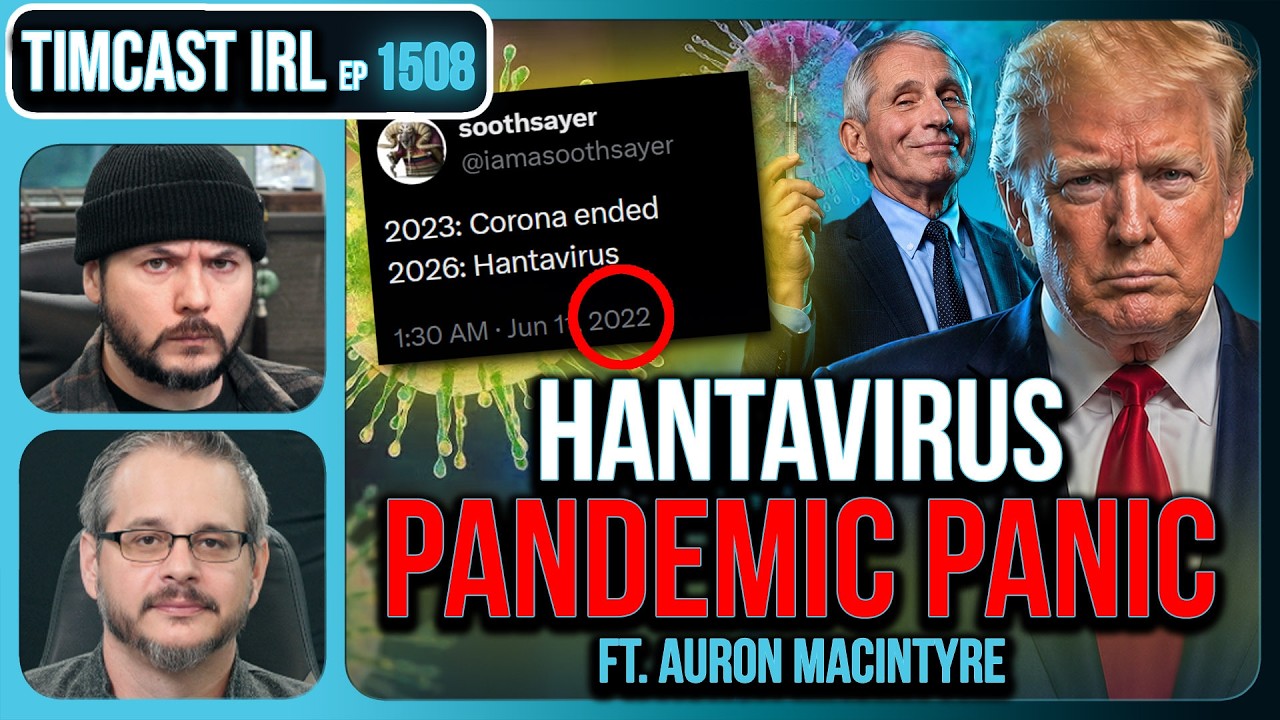
HANTAVIRUS PANDEMIC PANIC, Human To Human Spread Feared | Timcast IRL
"Tim Pool and his guests dismiss the Hantavirus panic as media desperation, pivot to discussing escalating political polarization, the rise of technocracy, and the weaponization of social issues."

"CATASTROPHIC Failure!" Trump Dinner Assassination Attempt & Royal Visit | With Kari Lake
"Piers Morgan and Kari Lake dissect the catastrophic security failure during an assassination attempt on Donald Trump at the White House Correspondents Dinner, blaming media rhetoric while also discussing King Charles III's high-stakes US visit."
Press Corp Humiliated as Press Sec Makes Them Regret Ignoring Swalwell’s Open Secret
"This episode exposes the alleged hypocrisy and corruption within Washington D.C., focusing on the Eric Swalwell scandal, Democratic Party tactics, and the media's role in shaping narratives."