Michael Lester - Is the United States Going to War with Iran For Israel? | SRS #289
YouTube · YTUfls6Yk4c
Quick Read
Summary
Takeaways
- ❖The U.S. war with Iran is attributed to Israeli influence and lobbying, as evidenced by statements from resigning officials and Senator Lindsey Graham's actions.
- ❖Past U.S. interventions in the Middle East (e.g., Iraq) were allegedly driven by Israeli intelligence and a desire to dismantle regional military rivals.
- ❖Official justifications for war with Iran, such as nuclear weapons, are contradicted by U.S. intelligence and international bodies.
- ❖The economic impact of the Iran conflict includes skyrocketing oil prices, potential global depression, and a weakened U.S. dollar, affecting global stability.
- ❖The U.S. military is being stretched thin by multiple global engagements, raising concerns about resource depletion and readiness for other threats (e.g., China/Taiwan).
- ❖Christian Zionists, comprising about 25% of the U.S. population, are a significant voting bloc influencing politicians to support Israel based on religious beliefs.
- ❖The U.S. Congress has allegedly abdicated its constitutional power to declare war and has voted against investigating potential Israeli human rights violations under the Leahy Act.
- ❖There is a concern about potential false flag events in the U.S. to rally public support for the war, drawing parallels to past Israeli operations.
- ❖The current geopolitical situation mirrors the 'tinderbox' of 1913, with interlocking obligations and automated military responses risking an uncontrollable escalation.
Insights
1Israeli Influence on U.S. Foreign Policy
The U.S. war with Iran is not driven by American national interests but by pressure from Israel and its powerful American lobby. Joe Kent, Director of the National Counterterrorism Center, resigned, stating Iran posed no imminent threat and the war was due to Israeli pressure. Senator Lindsey Graham reportedly traveled to Israel, met with intelligence agencies, and coached Benjamin Netanyahu on how to lobby the U.S. president for action against Iran.
Joe Kent's resignation letter explicitly states, 'Iran posed no imminent threat to our nation, and it is clear that we started this war due to pressure from Israel in its powerful American lobby.' () A Wall Street Journal article is cited, detailing Lindsey Graham's trips to Israel, meeting with intelligence, and coaching Netanyahu on lobbying the president. ()
2Manufacturing Pretexts for War
U.S. military interventions in the Middle East, including the Iraq War and the current conflict with Iran, have been initiated based on manufactured or selectively interpreted intelligence, such as the presence of Weapons of Mass Destruction (WMDs). U.S. intelligence and international bodies contradicted claims of Iranian nuclear weapons before the recent bombing.
The guest recounts how Israel allegedly pushed the WMD narrative for the Iraq War despite U.S. intelligence disagreeing. () For Iran, Trump's Director of National Intelligence, Tulsi Gabbard, testified there was no evidence of Iran building nuclear weapons, a view echoed by the IAEA director. ()
3Economic Consequences of the Iran War
The ongoing conflict in Iran is causing significant economic instability, including skyrocketing oil prices and threats to global trade routes. This destabilization could lead to a global depression, impacting wealthy Middle Eastern countries that invest in the U.S. stock market and threatening the U.S. dollar's global reserve status.
Oil prices are over $100 a barrel. () The UAE, Jordan, Kuwait, and Qatar have been hit by missiles, making the region unsafe for business and potentially leading to a withdrawal of investments from the U.S. stock market. () China, Japan, and India rely heavily on oil passing through the Strait of Hormuz, which Iran can disrupt. ()
4Historical U.S. Intervention in Iran
The U.S. has a history of orchestrating coups and interfering in Iran's internal affairs, contributing to the current animosity. In 1953, the U.S. and MI6 conducted Operation Ajax (Operation Boot for MI6) to overthrow democratically elected Prime Minister Mohammad Mosaddegh, who had nationalized Iran's oil, replacing him with the brutal Shah Mohammad Reza Pahlavi.
The guest details the 1953 coup where the U.S. and MI6 removed Mosaddegh and installed the Shah, who then gave 40% of Iran's oil fields to the U.S. and Great Britain. () This led to the 1979 Iranian Revolution, where the U.S. was expelled. ()
5Christian Zionism's Political Power
Christian Zionists, who believe Jewish control of Israel is necessary for the 'second coming,' represent a significant voting bloc (approximately 25% of the U.S. population) that heavily influences politicians to support Israel. This religious motivation is a key driver of pro-Israel policies in the U.S. Congress.
Christian Zionists represent about 25% of the U.S. population and 40-50% of the voting population, making them a powerful force. () Politicians like Ted Cruz and Joe Biden identify as Zionists, appealing to this base. () The Scofield Bible's interpretation of Genesis 12:3 is cited as a foundational text for this belief. ()
6Abdication of Congressional War Powers
The U.S. Congress has failed to uphold its constitutional responsibility to declare war and hold the executive branch accountable for military actions. Despite the War Powers Act, both the Senate and the House voted against even investigating the president's decision to attack Iran.
The War Powers Act requires the president to report to Congress within 48 hours of committing troops, and Congress must approve or troops must be removed within 60-90 days. () After the February 28th attack on Iran, the Senate voted 53-47 and the House voted 219-21 against invoking the War Powers Act. ()
7Potential for False Flag Operations
As public opinion turns against the war in Iran, there is a risk that Israel or its allies could orchestrate a false flag event in the U.S. to create a 'Pearl Harbor moment' and galvanize public support for further military action against Iran. This tactic has historical precedents.
The guest states, 'I am waiting for a false flag event in the US. I am waiting for a terrorist attack like 9/11 in the US blamed on Iran.' () The Lavon Affair, where Israel used disguised agents to bomb American and British targets in Egypt to blame Arabs, is cited as a historical example of this playbook. ()
81913 Parallels: Sleepwalking into War
The current geopolitical climate, particularly regarding the Iran conflict, mirrors the 'tinderbox' situation of 1913 before World War I. This involves a system of interconnected obligations (alliances), a lack of clear and achievable war goals, and military mobilizations that become unstoppable once set in motion, leading to unintended escalation.
The guest describes 1913 as a 'tinder box' with interconnected obligations (e.g., Serbia-Russia-Germany-France alliances) that triggered a domino effect. () He cites historians Christian Clark ('The Sleepwalkers') and Barbara W. Tuchman ('The Guns of August') to explain how European powers 'sleepwalked' into WWI due to pre-set military plans and lack of human intervention once mobilization began. () The U.S. bombing of Iran on February 28th, despite an agreement for peace the day before, is presented as an example of an unstoppable military machine. ()
Bottom Line
Israel views the U.S. as a 'host' and itself as a 'parasite,' leveraging American resources and military power until the U.S. is 'dead,' then moving on to another host like China.
This perspective suggests Israel's long-term strategy is purely opportunistic, devoid of genuine alliance, and implies the U.S. is being exploited to its detriment, potentially leading to its decline as a global power.
For U.S. policymakers, this highlights the need for a radical reassessment of the U.S.-Israel relationship, prioritizing American national interests and disengaging from conflicts that solely benefit external actors, to preserve U.S. strength and resources.
China is actively exploiting the U.S. distraction in the Middle East by increasing military pressure on Taiwan and expanding its diplomatic influence through humanitarian aid to Middle Eastern countries, while the U.S. depletes its military resources.
This suggests a coordinated geopolitical strategy by China to advance its territorial ambitions and global standing while the U.S. is militarily and economically overextended, potentially leading to a major conflict in the Pacific.
The U.S. must recognize this strategic vulnerability and prioritize disengagement from non-essential conflicts to conserve resources and refocus on deterring major adversaries in critical regions like the Indo-Pacific, preventing a two-front global crisis.
The U.S. military faces significant internal resource and readiness issues, with historical examples of ammunition shortages and equipment failures during combat, due to political decisions prioritizing new weapon systems over basic supplies.
This internal weakness means that despite its perceived power, the U.S. military could be severely hampered in prolonged conflicts, making it vulnerable to adversaries who understand these limitations.
Advocates for military reform should push for transparent audits of military spending, prioritizing readiness and essential supplies over costly, unproven weapon systems, and ensuring political decisions do not compromise combat effectiveness.
Opportunities
Secure Digital Information Vault for Estate Planning and Emergency Access
A personal security company offering ultra-secure, zero-knowledge end-to-end encrypted digital vaults for storing sensitive information (wills, powers of attorney, crypto keys, personal documents, videos) that can be securely transmitted to designated recipients upon a triggering event (e.g., death, incapacitation). This addresses the problem of lost access to critical information, especially for digital assets.
Consumer-Friendly Cybersecurity for Mobile Devices
A cybersecurity company focused on consumer-friendly solutions for mobile phones, including VPNs (specifically American-based to avoid foreign influence) and burner phone number services. The goal is to protect personal data from extraction and provide privacy for communications, addressing concerns about phone tapping and data leakage.
Key Concepts
Follow the Money/Influence
Understanding political and military actions requires tracing financial contributions, lobbying efforts, and the motivations of influential groups rather than solely relying on stated public reasons.
History Repeats Itself
Examining historical patterns of intervention, propaganda, and geopolitical escalation (e.g., 1913, 1953 Iran coup) provides critical context for understanding current events and predicting potential outcomes.
Confirmation Bias
Decision-makers often seek information that confirms their existing beliefs or political agendas, leading to the manufacturing or selective interpretation of intelligence to justify predetermined actions.
Single Point of Failure
Over-reliance on a single economic factor (like oil exports for Middle Eastern countries) or a single military strategy creates extreme vulnerability when that factor is disrupted or challenged.
Lessons
- Contact your state representatives and state senators to advocate for your state joining the 'Popular Vote Compact' to effectively bypass the Electoral College and ensure presidential elections are decided by popular vote.
- Research political candidates' funding sources, particularly from foreign lobbying groups like APAC, APAC PAC, or the United Democracy Project, using tools like 'APAC Tracker' to make informed voting decisions.
- Write physical letters to your federal congressmen and senators to express your opposition to the Iran war and demand accountability for foreign policy decisions, as physical letters require individual processing and are harder to ignore than emails.
- Stay informed about geopolitical events and domestic political actions by seeking diverse information sources and questioning official narratives, rather than relying on curated news, to hold representatives accountable.
Citizen's Guide to Reclaiming Democratic Accountability
Educate yourself on the history and motivations behind U.S. foreign policy, especially in the Middle East, by questioning official narratives and seeking out diverse perspectives.
Actively engage in the political process by contacting your state and federal representatives on specific issues, making your voice heard on matters like war, peace, and foreign influence.
Support initiatives like the 'Popular Vote Compact' to reform electoral systems and ensure that elected officials truly represent the will of the majority, reducing the influence of special interests in swing states.
Demand transparency and accountability from government officials regarding military actions and foreign aid, ensuring adherence to constitutional principles like the War Powers Act and the Leahy Act.
Notable Moments
Joe Kent's resignation from the National Counterterrorism Center, citing Israeli pressure for the Iran war.
This is a rare public resignation by a high-ranking official explicitly blaming foreign influence for a major U.S. military engagement, providing concrete evidence for the episode's central thesis.
The U.S. bombing of Iran on February 28th, the day after Oman announced a peace agreement with Iran regarding nuclear material.
This event highlights the 'Guns of August' phenomenon, where military mobilization, once set in motion, becomes unstoppable, overriding diplomatic solutions and leading to inevitable conflict.
The discussion of the Scofield Bible and its role in shaping Christian Zionist beliefs that influence U.S. foreign policy.
This reveals a deep-seated religious motivation behind a significant portion of pro-Israel sentiment in the U.S., linking theological interpretations to geopolitical actions and political funding.
The revelation that a person's vote in Wyoming counts 15 times more than a vote in California due to the Electoral College.
This exposes a fundamental flaw in the U.S. democratic process, demonstrating how the Electoral College disproportionately empowers certain states and reduces the value of individual votes in others, leading to a focus on 'swing states' in presidential campaigns.
Quotes
"Iran posed no imminent threat to our nation, and it is clear that we started this war due to pressure from Israel in its powerful American lobby."
"A United States senator traveled and talked to a foreign leader and mentored them and coached them on how to get a better deal from our president... That should be treasonous."
"We are spending 200 to 1 to their cost. They can keep that up a long time before we can."
"Right now we're the host and Israel's the parasite living off of us. And eventually it'll eat you up until you're dead and then it'll move on to another host."
"Text out of context is nonsense. You've got to know what's around it."
"The amount of effort it takes to refute something ridiculous is twice what it was for somebody to just post it."
Q&A
Recent Questions
Related Episodes
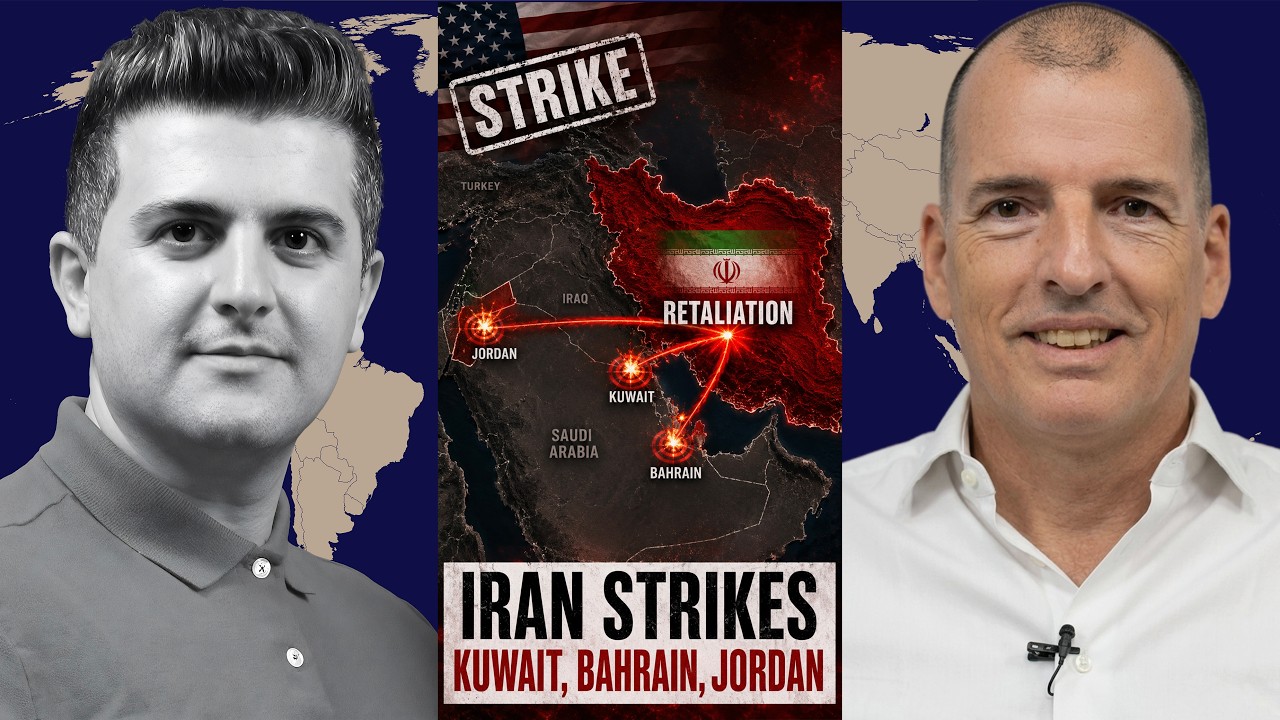
Alex Krainer: US STRIKES Iran – Iran RETALIATES Against Kuwait, Bahrain & Jordan!
"Amidst escalating US-Iran conflict and Iranian retaliation against regional US allies, this episode argues that US foreign policy is deeply controlled by an 'Anglo-Zionist conspiracy' led by the Rothschild banking dynasty, prioritizing Israeli interests over American ones."

Iran Update: Israel’s Newest Bombing Campaign, the Oncoming War With China and How to Avoid It
"Colonel Wilerson reveals how the US and Israel are actively bombing China's strategic infrastructure in Iran, escalating a covert economic war that Beijing intends to win without direct military conflict by dismantling the dollar's global dominance."

Patrick Henningsen: Hezbollah JUST Fired Back at Israel - Iran Vows to “Crush” All Attacks
"Patrick Henningsen argues that the US and Israel initiated an illegal war against Iran, driven by Trump's incompetence and Israeli influence, leading to an inevitable escalation with severe global economic repercussions."

🚨 THEY F*CKED AROUND FOR THE LAST TIME 😭😭😭
"This episode unleashes a torrent of highly opinionated commentary on the US-Iran deal, Israel's role, and a scathing critique of 'leftist' policies and immigration, particularly highlighting the UK grooming gang report as evidence of Western societal decay."