
Everything is great other than all of this stuff
YouTube · YqVMgfsL6cY
Quick Read
Summary
Takeaways
- ❖Gas prices are at a 3.5-year high, reaching $4.34 per gallon, driven by Middle East conflicts and the effective closure of the Strait of Hormuz.
- ❖Despite promises of lower energy costs, oil prices hit a 'wartime high' of $126 a barrel, leading to a nearly 60% increase in gas prices.
- ❖A $400 million White House ballroom, initially touted as privately funded, is now being proposed for taxpayer funding by Republicans like Lindsey Graham, citing security concerns after a shooting.
- ❖Canada's Prime Minister, Mark Carney, stated that close ties to the US have become 'weaknesses,' prompting Canada to diversify economic and security partnerships away from the US.
- ❖The host argues that media and political attention is being deliberately shifted to 'spectacle' (UFOs, ballroom) to obscure negative economic realities and policy failures.
Insights
1Gas Prices Soar Amid Middle East Instability
Gasoline prices have reached their highest point in years, hitting $4.34 per gallon, a nearly 60% increase. This surge is attributed to Middle East conflicts and the effective closure of the Strait of Hormuz, a critical shipping route for 20% of global oil volume. This contradicts political promises of lower energy costs.
Gas prices are at $4.34 a gallon, an 18-month high, and a 3.5-year high compared to previous peaks. Oil prices reached a 'wartime high' of $126 a barrel. The Strait of Hormuz is effectively closed, impacting global oil volume.
2Taxpayers Eyed for $400 Million White House Ballroom
A proposal by Republican senators, led by Lindsey Graham, seeks taxpayer funding for a $400 million White House ballroom. This project was initially promised by Trump to be fully financed by private donors. The justification for public funding emerged after a shooting at the White House Correspondents Dinner, despite the proposed ballroom's inability to accommodate the event's size and the event not being held at the White House.
Senators led by Lindsey Graham introduced a bill to fund a $400 million White House ballroom with taxpayer money. Trump previously stated the ballroom would be 'fully financed by private donors' and would have 'money left over.' The proposed ballroom would only accommodate 1,000 people, while the White House Correspondents Dinner hosts 2,500.
3Canada Shifts Away from Unpredictable US Alliance
Canada is actively recalibrating its foreign policy, diversifying economic and security partnerships away from the United States. Prime Minister Mark Carney stated that close ties to the US, once a strength, have become a 'weakness' due to the unpredictability and inconsistency of the current US administration. Canada is now building strength at home and expanding partnerships with the EU, Nordic countries, Australia, India, China, and Brazil, aiming to double non-US exports within a decade.
Mark Carney stated, 'many of our former strengths built on our close ties to the United States have become our weaknesses.' Canada is 'diversify[ing] our partnerships abroad,' securing over 20 economic and security partnerships across four continents, and re-engaging with 'global giants like India, China, and Brazil.' The goal is to 'double our non US exports within a decade.'
Bottom Line
The lack of disclosure requirements for private equity ownership of YouTube channels creates opacity regarding potential editorial or content influence.
Viewers cannot easily discern if the content they consume is influenced by corporate interests or financial backers, potentially compromising the perceived independence and objectivity of information sources.
Advocate for greater transparency regulations requiring disclosure of private equity ownership for significant media platforms and content creators, empowering consumers to make more informed judgments about content credibility.
Key Concepts
Spectacle vs. Substance
This model describes how political figures and media often prioritize sensational or distracting events ('spectacle') to divert public attention from more impactful, but less favorable, policy outcomes or economic realities ('substance'). It's a tactic to manage public perception and avoid accountability for tangible issues.
Hypernormalization
The concept of 'hypernormalization' refers to a state where people become so accustomed to insane or abnormal events that they cease to react to them as unusual. This can lead to a desensitization to political absurdities or economic hardships, making it harder to mobilize public opposition or demand accountability.
Lessons
- Scrutinize political promises regarding economic stability and energy prices against real-world data and personal financial impacts.
- Demand transparency and accountability from elected officials regarding the use of taxpayer money for projects like the White House ballroom, especially when initial funding promises change.
- Resist 'hypernormalization' by actively questioning and reacting to political actions or media narratives that seem absurd or designed to distract from substantive issues.
Quotes
"The Strait of Hormuz is effectively closed. One of the most critical shipping routes in the world. 20% of oil volume globally goes through that. And that's going to drive prices higher across the economy."
"My constituents can't afford grocery bills or utility bills, and he now wants to spend taxpayer money on a ballroom, on reckless wars, on a masked immigration regime. I mean, it's his priorities are clearly in the wrong spot."
"Many of our former strengths built on our close ties to the United States have become our weaknesses. The US has changed. That's their right. And we are responding. That is our imperative."
"We need a spectacle to compete with substance. Right now the substance sucks for Trump. It's gas prices up. It's economic growth expected to decline... And so you add a little spectacle. UFO files."
Q&A
Recent Questions
Related Episodes

"CATASTROPHIC Failure!" Trump Dinner Assassination Attempt & Royal Visit | With Kari Lake
"Piers Morgan and Kari Lake dissect the catastrophic security failure during an assassination attempt on Donald Trump at the White House Correspondents Dinner, blaming media rhetoric while also discussing King Charles III's high-stakes US visit."

"Fighting Solves EVERYTHING!" Who's To Blame For Political Violence? + Maria Machado On Trump
"This episode dissects the escalating political violence in the US, with panelists fiercely debating the role of partisan rhetoric and media in radicalization, alongside an interview with Venezuelan opposition leader Maria Machado on US intervention and her country's future."
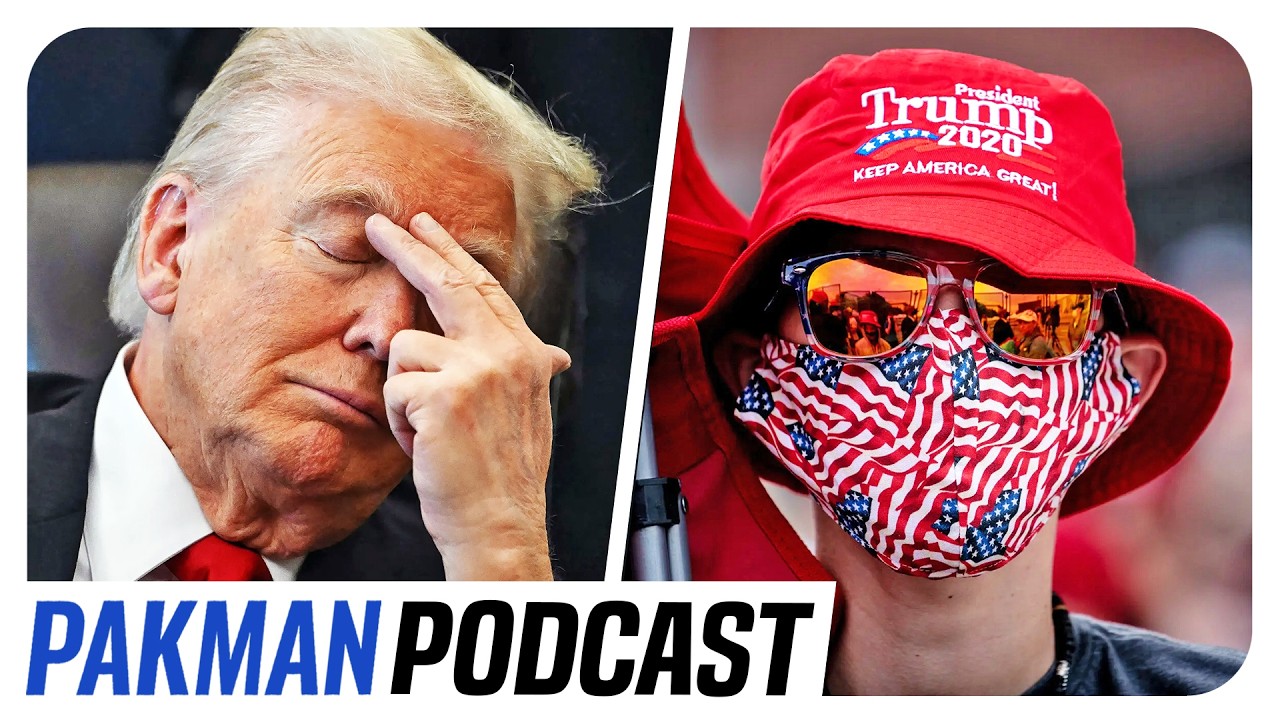
What happens to Trump voters when Trump is gone?
"The David Pakman Show explores the contentious path forward for Trump voters after his political era, exposing alleged corruption, economic misrepresentation, and the necessity of media literacy."

MAGA Stooge Freezes After My Question on CNN
"Adam Mockler dissects the Trump administration's claims of 'total victory' in foreign conflicts and its alleged attempts to politicize the Department of Justice, arguing these actions undermine democratic institutions and moral leadership."