
A truly brutal week if you care about sanity
YouTube · YrCTuvvRqRI
Quick Read
Summary
Takeaways
- ❖Four Republicans joined Democrats in the House to rebuke Donald Trump's war with Iran, indicating internal party dissent.
- ❖Oil reserves are at their lowest level since 2004 due to Trump's drawdowns, contradicting his promise of cheaper energy.
- ❖Most Americans do not feel financially better off than when Trump took office, despite administration claims of a booming economy.
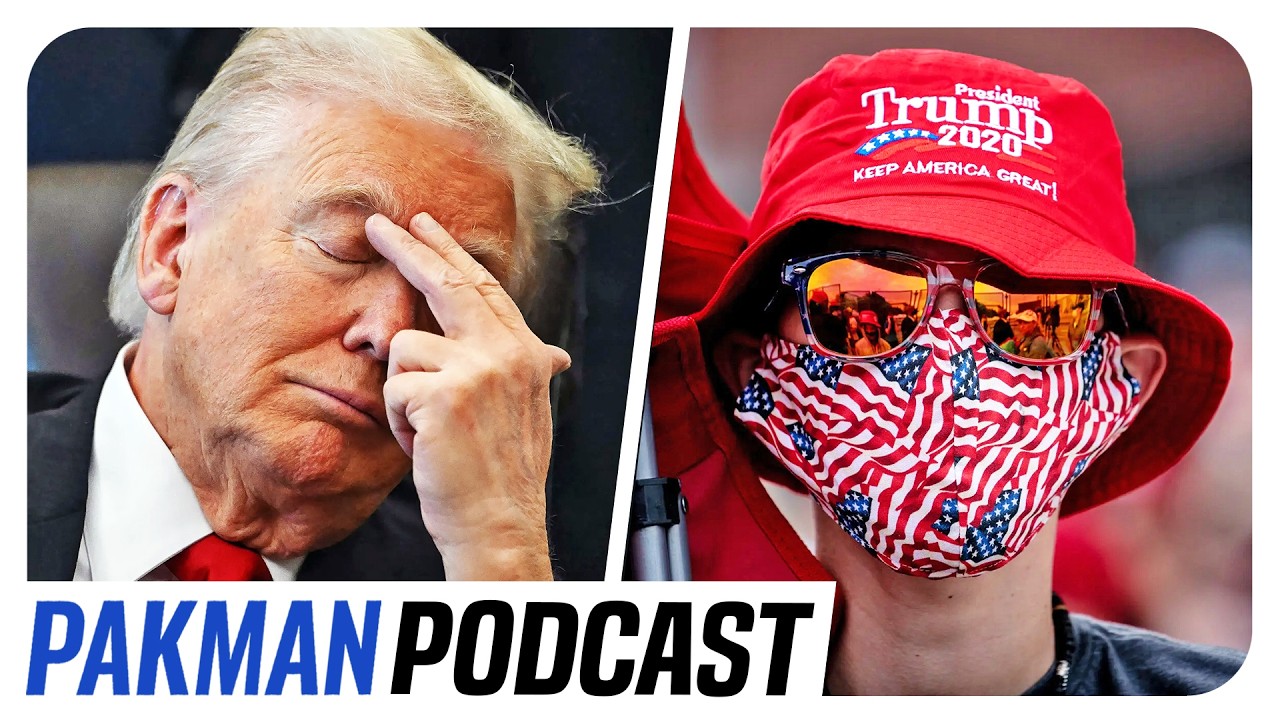
- ❖Trump disappeared from public view for seven days following a physical, reappearing visibly tired and making incoherent statements.
- ❖Marco Rubio denied video evidence of Donald Trump sleeping during cabinet meetings, illustrating a culture of mandatory denial within Trump's political orbit.
- ❖Transparency on the Epstein files remains elusive, with ongoing delays and redactions protecting alleged perpetrators, not just victims.
Insights
1House Rebuke of Iran War Powers Signals Deepening Republican Frustration
The House of Representatives voted to rebuke Donald Trump's war with Iran, with four Republicans joining Democrats. This is framed as a significant political defeat for Trump, highlighting growing frustration within his own party. Republicans attempted to block the vote, knowing some members would side against Trump's war powers, and have also rejected some of his spending requests and supported aid for Ukraine against his stance.
House of Representatives voted to rebuke Donald Trump's war with Iran; four Republicans joined Democrats. Trump posted to Truth Social, raging about the 'meaningless vote' and calling the Republicans 'grandstanders.'
2Trump's Economic Promises Contradicted by Reality and Strategic Reserve Depletion
Despite Trump's campaign promises of lower gas, grocery, and energy prices, and more affordable housing, the opposite has occurred. Oil reserves are at their lowest in over 20 years due to Trump drawing down the strategic petroleum reserve to prevent price spikes. This action mirrors a practice he previously attacked Joe Biden for, exposing hypocrisy.
Oil reserves are at their lowest level since 2004. Trump attacked Joe Biden for strategic petroleum reserve releases, then did the same. Prices for gas, groceries, and utilities are up since Trump took office.
3Concerns Mount Over Trump's Health and Erratic Behavior After Seven-Day Disappearance
Donald Trump was missing from public view for seven days following a physical exam, with his medical report released late on a Friday night. Upon reappearing, he looked and sounded 'brutally tired and haggard,' with a swollen eye, and made incoherent statements, such as comparing a pool's length to building heights. His late-night social media posts are described as agitated and panicking, pushing 'bonkers conspiracy theories' and lies about the economy.
Trump missing for 7 days, 11 p.m. Friday release of medical report. Reappeared 'brutally tired and haggard' with a swollen eye. Posted agitated screeds to Truth Social at a.m. and later, containing lies about tax cuts and falling prices.
4Mandatory Denial of Reality Characterizes Trump Administration's Public Stance
Marco Rubio, when confronted with video evidence of Donald Trump sleeping during cabinet meetings, repeatedly denied it, claiming, 'I've never seen him fall asleep.' This is presented as an example of a 'mandatory lying' culture within Trump's administration, where allies are expected to deny observable facts to protect Trump's image, regardless of clear evidence.
Congressman Ted Lieu played videos of Trump sleeping during cabinet meetings to Marco Rubio, who denied seeing it, stating, 'I've never seen him fall asleep.'
5Epstein Files Transparency Remains Stalled, Protecting Perpetrators Over Victims
Despite promises of transparency and a legal act requiring disclosure, the Epstein files continue to be delayed and heavily redacted. The host argues that redactions are protecting alleged perpetrators, not just victims, and that the ongoing secrecy itself has become a significant story. This lack of transparency fuels speculation and prevents accountability for alleged wrongdoers.
Coverage and web searches for Epstein files have dramatically decreased. Redactions in released files protect alleged perpetrators, not just victims, contrary to the Epstein File Transparency Act.
Bottom Line
The political strategy of denying clear visual evidence, as seen with Marco Rubio denying Trump sleeping, is not aimed at convincing those who value facts, but at reinforcing loyalty within a hardcore base for whom evidence is irrelevant.
This indicates a deepening polarization where political discourse operates on separate realities, making fact-based debate increasingly difficult and potentially solidifying support for leaders who demand unquestioning allegiance.
For opposition or independent media, the opportunity lies in consistently documenting and juxtaposing these denials with clear evidence, not necessarily to persuade the deniers, but to inform and mobilize the segment of the population that still values truth and transparency, thereby highlighting the integrity gap.
Trump's late-night, agitated social media posts, filled with lies and conspiracy theories, are not just random acts but a sign of panic driven by poor approval ratings on the economy.
This suggests that despite outward bravado, Trump is acutely aware of his economic vulnerabilities and is resorting to desperate, unhinged communication tactics, which may further alienate moderate voters.
Political opponents can leverage these erratic communications to underscore concerns about stability and fitness for office, directly linking them to the economic anxieties of average Americans rather than engaging with the content of the lies.
Key Concepts
Cult Dynamics in Politics
The host frames the behavior of Trump's allies, like Marco Rubio, as indicative of 'cult dynamics,' where individuals are expected to deny observable reality and adhere to a mandatory narrative, regardless of evidence, to maintain loyalty and standing within the group. This includes denying Trump's mistakes, confusion, fatigue, or health issues.
The Two Economies
This model distinguishes between the 'TV economy' — the positive narrative presented by administration propagandists — and the 'lived economy' — the daily financial reality experienced by average citizens through their credit card statements, grocery bills, and housing costs. The host argues that the lived economy is the true measure voters will use.
Lessons
- Critically evaluate economic claims from political figures by comparing them against personal financial experiences and independent data, rather than relying on official narratives.
- Demand transparency from public officials, especially regarding health, financial dealings, and sensitive investigations like the Epstein files, pushing back against delays and protective redactions.
- Recognize and challenge instances of 'mandatory lying' or denial of observable reality by political figures and their allies, understanding that such behavior often serves to maintain power within a specific base rather than inform the public.
Notable Moments
Trump's incoherent comparison of a pool's length to building heights during a public appearance.
This moment highlighted concerns about Trump's cognitive state and ability to communicate clearly, especially after a period of public absence.
Trump's attack on reporter Caitlyn Collins for not smiling and for asking 'real questions,' accusing her of 'hatred.'
This demonstrates Trump's misogynistic tendencies and his expectation that female reporters should be deferential, rather than holding him accountable, reinforcing a hostile environment for critical journalism.
Trump begging a reporter to compliment his Truth Social post on communism, then forcing them to read it aloud.
This illustrates Trump's extreme ego-mania and insecurity, seeking validation for his posts even from critical media, and his attempt to control the narrative by dictating what is read and discussed.
Trump claiming he had 'more people' at his speeches than Martin Luther King Jr., despite official numbers, by arguing his crowd was 'tighter.'
This exemplifies Trump's consistent exaggeration and distortion of facts, even on historically significant events, to inflate his own importance and deny objective reality.
Quotes
"In a meaningless vote, the House voted four bad Republicans and all of the Democrats to limit my war powers right in the middle of my final negotiations to end the war with the Islamic Republic of Iran, who would do such an unpatriotic thing."
"Is your life easier financially right now than when Donald Trump took office? And think about who can answer yes to that question. The average worker cannot say that they are better off or easier in an easier financial situation today than when Donald Trump took office."
"If Biden was missing seven days and he reappeared with his right under eye swollen like it's filled with some kind of putty, speaking like this and comparing the length of a pool to the height of a building. There would be a lot Hannity would be going constitutional crisis."
"Ceasefire is when you're shooting in a more moderate manner. Moderate fighting and shooting is a ceasefire."
"I've never seen him fall asleep. On the contrary, the guy doesn't sleep, which is a big problem because he calls me at 2:00 in the morning. He calls me at 5:00 in the morning."
"I have no greater interest in covering up crimes by a Democrat than I have in covering up crimes by a Republican. It doesn't make a difference to me."
Q&A
Recent Questions
Related Episodes
What happens to Trump voters when Trump is gone?
"The David Pakman Show explores the contentious path forward for Trump voters after his political era, exposing alleged corruption, economic misrepresentation, and the necessity of media literacy."

HOT TOPICS | Is Donald Trump Destroying MAGA?!
"Don Lemon declares the MAGA movement is collapsing, citing Donald Trump's escalating political missteps, economic failures, and alienation of his core base and former allies."

Trump Just ENDED JD Vance’s White House Dreams
"A New York Times article and internal White House dynamics reveal Donald Trump's deep dissatisfaction with J.D. Vance, potentially ending Vance's 2028 presidential ambitions and highlighting a broader struggle for control within the Republican Party."

🚨 LEFTISTS ARE F*CKING SEETHING 😂😂😂
"The host aggressively celebrates perceived 'wins' for the right-wing, from global conflicts and domestic politics to cultural shifts, framing them as a 'humiliation' for the 'leftist world order' and a testament to Donald Trump's influence."