
Trump Let RFK Jr. Run Wild at HHS—Now They’re Trying to Contain It | Mona Charen Show
YouTube · Z4KO0GVPLkY
Quick Read
Summary
Takeaways
- ❖RFK Jr.'s appointment to HHS under the Trump administration was immediately seen as a 'five-alarm fire' for public health.
- ❖HHS under Kennedy promoted unsubstantiated claims, such as a link between Tylenol and autism, despite scientific consensus to the contrary.
- ❖The administration removed several critical vaccines, including the meningococcal vaccine, from the recommended childhood schedule, citing a flawed comparison to Denmark's schedule.
- ❖Measles, once eliminated in the U.S., is experiencing a continuous rolling set of outbreaks, with cases on pace to exceed 30-year highs and resulting in child deaths.
- ❖The 'natural is better' ideology, promoted by Kennedy and his allies, dismisses proven medical interventions like pasteurization and vaccination in favor of 'natural' exposure to disease.
- ❖Internal White House polling indicated that the anti-vaccine stance was a 'political loser,' prompting a strategic shift to 'soft pedal' the agenda.
- ❖Key anti-vaccine advisors within HHS have been sidelined or told to reduce their public messaging, and controversial policy decisions, like blocking Moderna's flu vaccine application, have been reversed.
Insights
1RFK Jr.'s Radical Restructuring of HHS
Upon taking over HHS, RFK Jr. initiated a drastic overhaul, laying off a quarter of the staff, purging senior leaders, and firing all scientists on the Advisory Committee on Immunization Practices (ASIP). He replaced them with individuals sympathetic to his anti-vaccine views, effectively dismantling institutional political controls and scientific integrity within the agency.
Jonathan Conn details the mass layoffs and purges, specifically mentioning the firing of ASIP scientists and the CDC director for not signing off on new vaccine recommendations. (, -)
2Promotion of Unsubstantiated Tylenol-Autism Link
HHS, under Kennedy, announced 'strong evidence' linking Tylenol to autism, with Trump amplifying the message to 'don't ever take Tylenol.' This claim was made despite a lack of scientific consensus and was later refuted by a new meta-study. The misinformation caused a documented drop in Tylenol use among pregnant women, potentially pushing them towards more dangerous alternatives like ibuprofen, and led to a shortage of an anti-cancer drug (Leucovorin) after Trump also recommended it.
The hosts discuss the Tylenol announcement, Trump's extreme statements, the subsequent meta-study refuting the link, and the public's reaction (decreased Tylenol use, Leucovorin shortage). (-)
3Removal of Key Vaccines from Childhood Schedule
HHS/CDC under Kennedy reduced the recommended childhood vaccine schedule from 17-18 vaccines to 11, removing critical protections like the meningococcal vaccine, rotavirus, and RSV. The justification, that the U.S. was 'out of step with international consensus,' was specious, as it selectively cited Denmark (a small, homogenous country) as a model while ignoring larger, more diverse nations with similar or higher vaccine schedules.
Conn explains the removal of meningococcal and other vaccines, the 'international consensus' argument, and the specific, flawed comparison to Denmark. (-)
4Resurgence of Measles and Preventable Deaths
Due to declining vaccination rates, which have fallen below herd immunity thresholds in many communities, the U.S. is experiencing a continuous series of measles outbreaks. Last year saw the most measles cases in 30 years, a record on pace to be broken this year, including two confirmed child deaths in Texas. This threatens the U.S.'s measles elimination status.
Charen and Conn discuss the measles outbreaks, the loss of herd immunity, the record number of cases, and the two child deaths in Texas. (-)
5Political Pushback Forces Strategic Retreat on Anti-Vaccine Agenda
Internal White House polling revealed that the aggressive anti-vaccine stance was politically unpopular, even among Republicans (68% support mandatory school vaccinations). This led to a directive to 'soft pedal' the vaccine agenda, sideline key anti-vaccine advisors, and reverse controversial decisions, such as the FDA's initial refusal to review Moderna's flu vaccine application. This suggests a tactical shift rather than a change in core belief.
The hosts discuss Tony Fabrizio's polling report, the 'soft pedal' directive, the sidelining of advisors like Cali Means, and the reversal of the Moderna flu vaccine decision. (-)
Bottom Line
The Trump administration's strategic retreat on its anti-vaccine agenda is driven purely by political expediency, not a change in scientific understanding or belief.
This indicates that public health policy remains vulnerable to political calculation, and the extreme rhetoric could resurface if the political calculus shifts, especially after elections.
Advocates for public health should leverage this demonstrated political sensitivity by consistently highlighting public support for vaccines and the negative political consequences of anti-science policies.
The 'natural is better' philosophy, once associated with the political left, has migrated and been weaponized by the 'Maha' movement to justify anti-vaccine and anti-science positions.
This ideological shift complicates traditional political alignments and requires a nuanced approach to counter misinformation, as it taps into deeply held, albeit misguided, beliefs about health and purity.
Public health messaging needs to address the underlying philosophical appeal of 'natural' remedies, emphasizing that scientific interventions are often 'unnatural' precisely because they are more effective and safer than natural alternatives (e.g., pasteurization, vaccines).
Key Concepts
Natural vs. Artificial Fallacy
The belief that anything 'natural' is inherently good or superior, while anything 'artificial' (like vaccines or pasteurized milk) is inherently bad or dangerous. This fallacy drives much of the anti-vaccine and 'wellness' movements, ignoring the proven benefits and safety of scientific interventions.
Tradeoffs in Policy
The understanding that every policy decision involves weighing competing benefits and risks. For example, the decision to take Tylenol during pregnancy involves a tradeoff between managing fever (which can harm the fetus) and potential, unproven risks of the medication, where current science indicates Tylenol is the safest option.
Herd Immunity
The concept that a sufficient percentage of a population being immune to an infectious disease (typically through vaccination) provides indirect protection to those who are not immune, preventing widespread outbreaks. The erosion of herd immunity due to declining vaccination rates directly leads to disease resurgence.
Lessons
- Verify health information from official scientific and medical sources, especially when claims contradict long-standing consensus, as political figures can promote unsubstantiated theories.
- Engage with local and national political processes to support leaders who prioritize evidence-based public health policies and resist the politicization of science.
- Understand the 'natural vs. artificial' fallacy and its role in health misinformation; recognize that many life-saving advancements are 'unnatural' precisely because they improve upon natural risks.
Notable Moments
The widespread, tearful, and joyful national reaction to the announcement of the Salk polio vaccine's safety and effectiveness in 1955, including church bells ringing and factories observing moments of silence.
This historical account starkly contrasts with the current climate of vaccine skepticism, highlighting a past era of profound public trust and gratitude for scientific breakthroughs that eradicated terrifying diseases.
The anecdote of a doctor injecting calcium into a 7-year-old boy's heart for 36 hours to keep it beating against meningococcal disease, only for the child to die anyway.
This visceral story underscores the catastrophic and rapid lethality of diseases like meningococcal, emphasizing the critical importance of available vaccines and the tragedy of preventable deaths when vaccination is foregone.
Quotes
"That which does not kill me makes me stronger, said Nietzsche. But of course, a lot of the time it did kill you."
"I remember thinking that of all the horrors and depradations that this administration was going to visit upon us, maybe one of the most galling and one of the hardest to tolerate was the complete degradation of public health and the choice of RFK Jr. a crank to lead our most important health agency."
"We have these these quacks who are convincing people that it's the vaccines that are going to make you sick, not the diseases that the vaccines protect you from."
"It is a mark of an enlightened society that says when we can prevent a child death that is that is the utmost of the utmost importance and we have the tools."
"I think people want shortcuts, right? It's like, ah, exercise and diet, it's so much work and it's so it's not fun. And you know if they if you tell me that I can take this supplement and it will increase my muscle mass sort of magically. That sounds good."
Q&A
Recent Questions
Related Episodes

Trump Dirt REVEALED: Iran, Zohran, Pardons, Deportations
"Journalists Maggie Haberman and Jonathan Swan reveal how Donald Trump operates in his second term, detailing his inner circle, policy priorities, and the surprising checks on his executive power."

BREAKING: Protests ERUPT In Iran Over IRGC Surrendering To Trump - Infighting Clashes In Tehran
"Iran is experiencing severe internal infighting and protests as hardline IRGC elements clash with government figures over a perceived 'surrender' to the US, while mainstream Western media misrepresents the situation."

Abortion Pill Fight. Child Trauma. RFK’s Tanning Bed Push #SecondOpinion
"This episode unpacks critical health and policy debates, from the legal fight over the abortion pill and the intergenerational impact of paternal health to the long-term effects of child trauma and the dangers of teen tanning bed use."
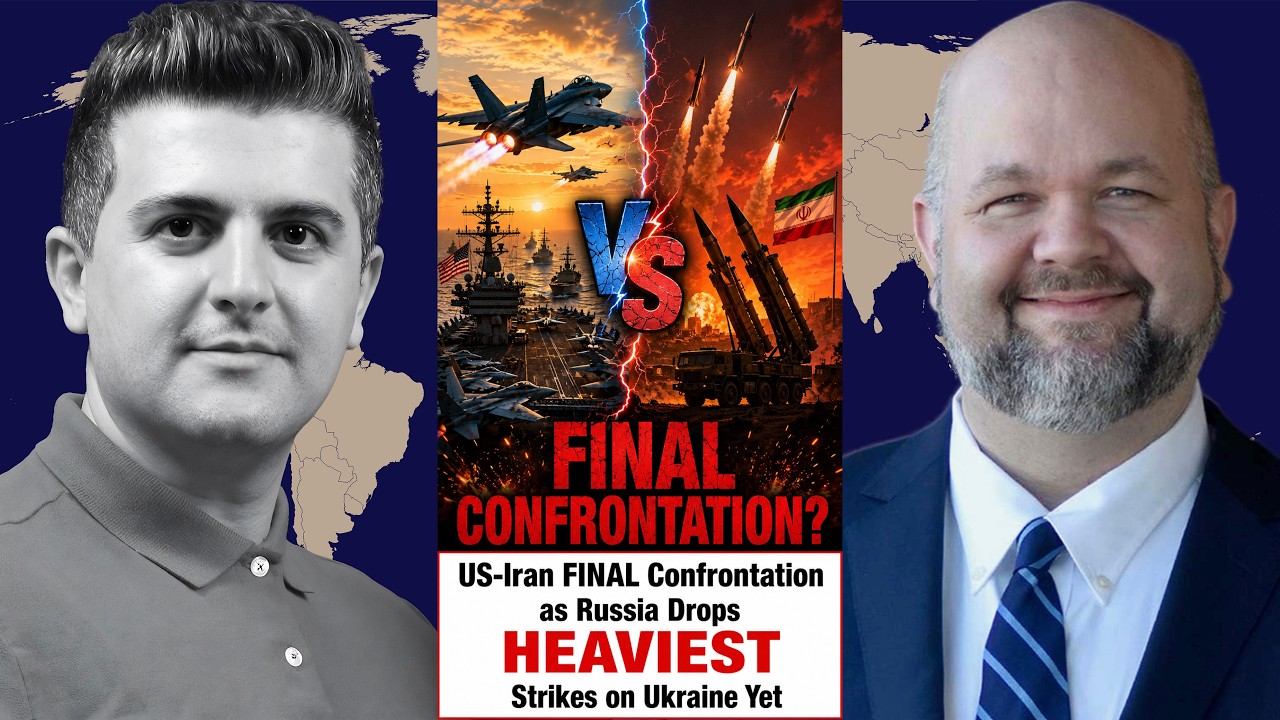
Robert Barnes: US-Iran FINAL Confrontation as Russia Drops HEAVIEST Strikes on Ukraine Yet
"Robert Barnes critically analyzes the current US foreign policy under a 'second-term Trump administration,' arguing that the Israel lobby's influence and the President's declining mental state have led to disastrous escalations in the Middle East and Ukraine, alienating global powers and imperiling domestic stability."