
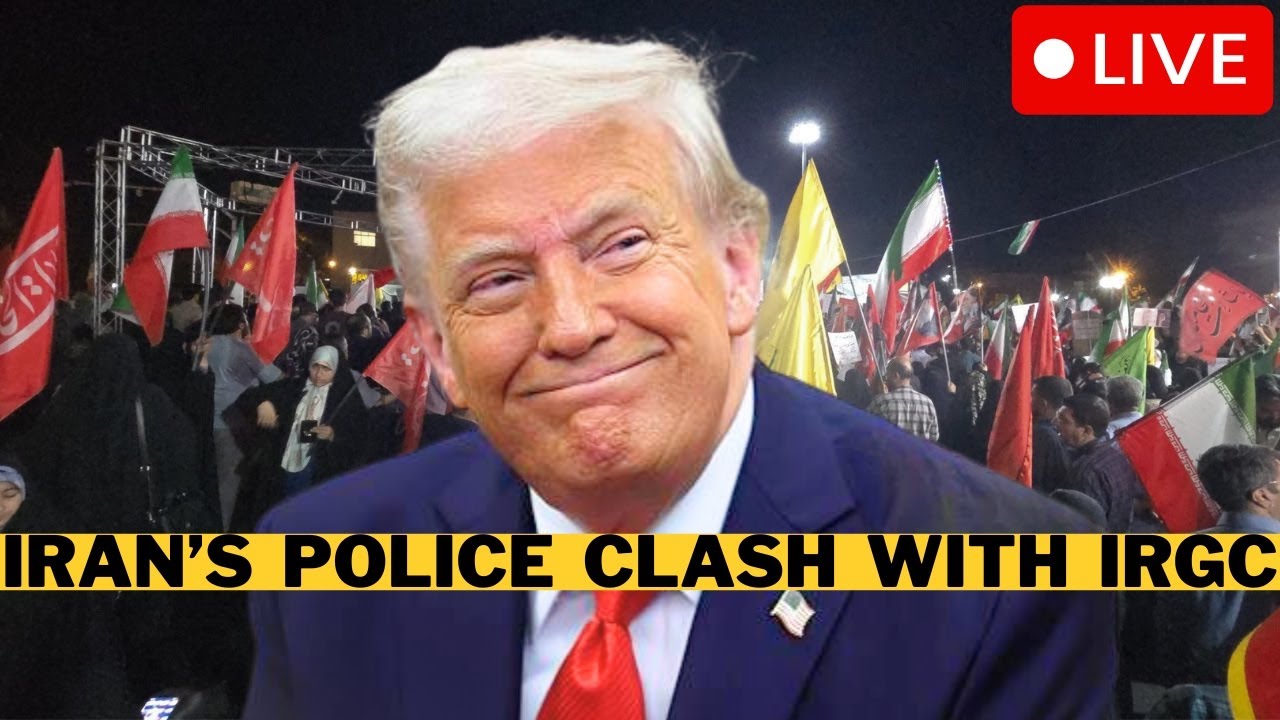
LIVE: Armed Clashes Between IRGC And Iran's Army - Trump Sends FINAL Offer To Tehran
YouTube · Z6Me2l6XnZQ
Quick Read
Summary
Takeaways
- ❖Armed clashes are occurring in major Iranian cities (Tehran, Tabriz, Ahvaz, Esfahan) between the IRGC and Iran's regular army, with Esfahan being home to major nuclear facilities.
- ❖Anti-IRGC rebels continue guerrilla warfare, eliminating regime figures, which the host claims is underreported by mainstream Western media.
- ❖The US has presented a 'final offer' to Tehran, which President Trump indicated requires '100% good answers' to avoid rapid escalation.
- ❖Iranian state media and Pakistani officials prematurely claimed a peace deal was imminent, which the US denied, stating Iran is still reviewing the offer.
- ❖The US Central Command confirmed its continued enforcement of a blockade in the Gulf of Oman, redirecting 91 commercial ships to ensure compliance with sanctions against Iran.
- ❖The host debunks a New York Times report alleging an Israeli strike to free former Iranian President Ahmadinejad as 'fake news' and pro-regime propaganda.
- ❖Iran's newly formed 'Persian Gulf Strait Management Authority' (PGSMA) declared new boundaries for supervising the Strait of Hormuz, demanding permission for passage, despite the ongoing US blockade.
Insights
1Internal Military Clashes in Iran
Armed confrontations are confirmed in multiple major Iranian cities, including Tehran, Tabriz, Ahvaz, and Esfahan, between the Islamic Revolutionary Guard Corps (IRGC) and the regular Iranian army. Esfahan is particularly notable as it hosts significant nuclear facilities like Natanz. These clashes are described as uncoordinated, smaller group actions, potentially testing the waters against the IRGC.
The host states, 'armed clashes and confrontations in multiple cities in Iran between the IRGC... and also the Iran's regular army' and specifies locations like Tehran, Tabriz, Ahvaz, and Esfahan, noting Esfahan's proximity to nuclear facilities. He later adds, 'these clashes... have been happening only in a few few locations. So clearly it's not really coordinated in that sense.'
2US 'Final Offer' to Tehran and Diplomatic Standoff
The US has sent a 'final offer' to Tehran after rejecting previous Iranian counter-proposals. President Trump indicated a short deadline for Iran to provide '100% good answers' to avoid rapid escalation. Iranian media, influenced by Pakistani officials, prematurely reported a completed peace deal, which the US quickly denied, clarifying that Iran is still reviewing the offer. The host interprets the US offer as a demand for Iran to surrender its nuclear program, which conflicts with the IRGC's core ideology of 'no submission'.
The host states, 'the US has sent a final offer to Tehran' [] and quotes President Trump saying, 'If we don't get the right answers, it goes very quickly. We're all ready to go. We have to get the right answers. It would have to be a complete 100% good answers.' [] He also notes, 'the Pakistanis are going around telling the media and the world, 'Everything is done... We now have peace.' Don't forget, even if this is actually agreed, which means that the IRGC are basically surrendering their nuclear program.' []
3US Naval Blockade and Iranian Counter-Assertion
The US Central Command confirmed that US Marines are actively enforcing a blockade in the Gulf of Oman, having redirected 91 commercial ships attempting to violate sanctions by transiting towards Iranian ports. In response, the Islamic Republic established a new 'Persian Gulf Strait Management Authority' (PGSMA) and declared new boundaries for supervising the Strait of Hormuz, demanding permission for passage through this critical waterway, effectively attempting to assert its own control over international shipping.
The host refers to a US Central Command statement and video: 'US Marines from the 31st Marine unit boarded a MT Celestial Sea, an Iranian commercial oil tanker suspected of attempting to violate the US blockade... American forces released the vessel after searching and directing the ship's crew to alter course. US forces continue to fully enforce the blockade and have now redirected 91 commercial ships to ensure compliance.' [] He then details Iran's counter-move: 'the Islamic Republic obviously recently set up this new body, which is called the Persian Gulf Strait Management Authority... they have published this important statement... The Islamic Republic of Iran has defined the boundaries of the supervision area for the management of the Strait of Hormuz as follows... Passage through this area via the Strait of Hormuz requires coordination with the waterway management authority... and obtaining permission from this institution.' []
4Debunking Mainstream Media 'Fake News'
The host dedicates a segment to exposing what he labels 'fake news' from legacy media, specifically a New York Times report. The report claimed an Israeli Air Force strike in Tehran aimed to free former President Ahmadinejad from house arrest to install him as a new leader after Khamenei, but accidentally injured him. The host dismisses this as an absurd, Hollywood-esque scenario, lacking common sense and verification from his sources within Iran, and attributes it to a pro-regime journalist, Farnaz Fassihi.
The host introduces a story he calls 'fake news' [] and reads from the report: 'On the first day of the war in Iran, the Israeli Air Force carried out a strike in the capital at the home of Ahmadinejad... which was designed to free him from his house arrest and place him in a position to take over the country following the elimination of Khamenei.' [] He then critiques it, saying, 'None of this made any sense. Obviously, I checked with everybody as well inside Iran... including our moles in the regime... And also basic common sense, none of this made any sense.' [] He identifies the author, Farnaz Fassihi, as 'pro-regime in Iran and she is a very much against the Iranian the current Iranian revolution.' []
Key Concepts
Guerrilla Warfare as a Precursor to Revolution
The host suggests that the ongoing, uncoordinated attacks by anti-IRGC rebels and internal military clashes represent an initial 'guerrilla warfare' phase, historically seen in revolutions to weaken a regime before a mass uprising. This 'foreplay phase' occurs during a ceasefire, preceding a potential 'final battle'.
Information Warfare and Propaganda
The episode highlights how both the Iranian regime and certain Western media outlets engage in propaganda and 'fake news' to manipulate public perception. The host argues that legacy media often aligns with liberal narratives that downplay US successes or support the Iranian regime, while the Iranian government uses its puppet president to issue 'gibberish' statements and accuses the US of media blackouts despite enforcing its own.
Lessons
- Critically evaluate news from legacy media outlets, especially concerning geopolitical conflicts like Iran, and seek out alternative sources for verification.
- Understand that internal conflicts within a regime, even if uncoordinated, can be early indicators of broader instability and potential revolutionary phases.
- Recognize the role of information warfare and propaganda from all sides in a conflict, and be wary of narratives that claim quick resolutions or paint one side as entirely victorious or defeated prematurely.
Quotes
"If we don't get the right answers, it goes very quickly. We're all ready to go. We have to get the right answers. It would have to be a complete 100% good answers and if we do, we save a lot of time, energy, and lives, most importantly."
"Forcing Iran to surrender through coercion is nothing but an illusion. Mutual respect in diplomacy is far wiser, safer and more sustainable than war."
"Iran's experience is indicative of America's inherent and perpetual bad faith. Therefore, we are prepared for every scenario. Even now, despite the severe media blackout, the American people know how much cost and damage their government has imposed on them. The world has felt Iran's astonishing power."
Q&A
Recent Questions
Related Episodes

Patrick Henningsen: Hezbollah JUST Fired Back at Israel - Iran Vows to “Crush” All Attacks
"Patrick Henningsen argues that the US and Israel initiated an illegal war against Iran, driven by Trump's incompetence and Israeli influence, leading to an inevitable escalation with severe global economic repercussions."
BREAKING: Protests ERUPT In Iran Over IRGC Surrendering To Trump - Infighting Clashes In Tehran
"Iran is experiencing severe internal infighting and protests as hardline IRGC elements clash with government figures over a perceived 'surrender' to the US, while mainstream Western media misrepresents the situation."

LIVE: Trump HIDES FROM PUBLIC as US SOLDIER KILLED!!! 6/2/2026
"The host exposes alleged government cover-ups regarding military casualties, Trump's unexplained public absence, and questionable political appointments, arguing these reflect a 'regime of loser babies' and a failing foreign policy."

🚨 THEY F*CKED AROUND FOR THE LAST TIME 😭😭😭
"This episode unleashes a torrent of highly opinionated commentary on the US-Iran deal, Israel's role, and a scathing critique of 'leftist' policies and immigration, particularly highlighting the UK grooming gang report as evidence of Western societal decay."