BREAKING: Israel Hits Iran’s ECONOMIC Heart; Trump Threatens Hormuz Action | TBN Israel
YouTube · ZJfxANmbX_0
Quick Read
Summary
Takeaways
- ❖Israel launched extensive strikes on Iranian petrochemical plants, shutting down 50 factories and causing damage estimated to require over two years for full recovery.
- ❖The U.S. issued a firm 48-hour ultimatum to Iran to reopen the Strait of Hormuz, threatening direct strikes on Iranian power stations and bridges if demands are not met.
- ❖A complex, multi-day operation successfully rescued a wounded American F-15E navigator from deep inside Iran, involving hundreds of U.S. commandos, advanced communication tech, CIA deception, and Israeli intelligence and air support.
- ❖The IDF and Israeli Air Force eliminated Muhammad Raz Ashrafi Khaki, a senior IRGC figure responsible for billions in trade financing Hamas and Houthi proxies.
- ❖The U.S. administration requested civilian satellite imagery providers to halt distribution of images from Iran and the Persian Gulf, citing security concerns.
- ❖Ukraine's President Zelensky claimed Russia is sharing satellite images of Israeli energy infrastructure with Iran, suggesting broader geopolitical intelligence sharing.
- ❖Hezbollah maintains the capability to launch approximately 200 rockets daily at Israel for another five months, managing its munitions stockpile despite ongoing military pressure.
- ❖Israel communicated to the U.S. that a ceasefire in Iran will not halt fighting in Lebanon until the area is demilitarized.
Insights
1Israel's Economic Warfare Against Iran's Petrochemical Industry
Israel conducted extensive air strikes targeting Iran's petrochemical plants in Mashar, including Fajar 1, Fajar 2, Razi, and Amir Kabir. These strikes were designed to systematically dismantle Iran's industrial backbone by hitting critical service infrastructure (gas, electricity, industrial water) that feeds entire complexes, not just individual buildings. The damage resulted in the shutdown of 50 factories, which produce materials for explosives, ballistic missiles, and civilian goods, with Iranian officials admitting a full return to production could take over two years. This represents a massive blow to Iran's economy and its ability to finance terror proxies.
Israeli Air Force attacked Fajar 1, Fajar 2, Razi, and Amir Kabir petrochemical plants in Mashar. 50 factories were shut down simultaneously. Senior Iranian officials admitted a massive economic blow, with a full return to production potentially taking more than two years. The IDF announced striking central infrastructure for producing materials for explosives and ballistic missiles.
2U.S. Ultimatum on Strait of Hormuz and Threat of Direct Strikes
U.S. President Donald Trump issued a forceful 48-hour ultimatum to Iran to reopen the Strait of Hormuz, a critical global energy choke point. Trump explicitly warned that if the strait is not opened, the U.S. would target Iranian power stations and bridges. This move is framed as a preparation for a broader military action against Iran's energy infrastructure, signaling a significant escalation of pressure beyond previous strikes.
Trump's statement: 'Open the damn straight, you bastards.' (). 'Open the straight, you crazy bastards, or you will live in hell.' (). 'Yesterday Trump gave Iran a 48-hour ultimatum to allow the passage of Ves through the strait.' (). 'Trump added, 'On Tuesday, we will be the power stations day.' (). 'The real test is whether Iran is in practice giving up its maritime chokeold weapon.' ().
3Complex U.S.-Israeli Rescue of Downed American Navigator in Iran
A highly complex and dangerous operation successfully rescued an American F-15E navigator who survived for over 36 hours (some reports say nearly 48 hours) deep inside Iranian territory after his aircraft was shot down. The navigator, despite being wounded, used a small, encrypted communication device to stay connected to an operations room thousands of kilometers away without exposing his position. The rescue involved hundreds of U.S. commandos, dozens of aircraft, Blackhawk helicopters, Reaper drones, cyber capabilities, and a CIA deception operation that spread false information to confuse Iranian forces. Israeli intelligence provided critical support, including intelligence, air superiority, and isolating strikes in the rescue zone. Some reports also suggest direct participation of Israeli special forces (Shaldag and Sayeret Matkal).
American navigator of downed F-15E survived for more than 36 hours (). Saved by a small communication device (, ). Operation involved hundreds of commandos, dozens of aircraft, rescue helicopters, transport planes, MK9 Reaper drones, cyber capabilities, intelligence deception, and a firefight (). CIA spread false information claiming the officer was already extracted (, ). Israeli Air Force assisted with intelligence, securing air superiority, and carrying out strikes to isolate the area (, ). Reports claim Shaldag and Sayeret Matkal units participated (, ).
4Elimination of Key IRGC Financial Figure
The IDF and Israeli Air Force eliminated Muhammad Raz Ashrafi Khaki, a senior figure within the Revolutionary Guards' oil headquarters. Khaki was responsible for billions of dollars in trade that directly financed the buildup of Iranian terror proxies, including Hamas and the Houthis. This elimination is framed as a critical blow to the financial pipeline funding Iran's regional destabilization efforts.
The economic brain of the Revolutionary Guards oil headquarters was eliminated. The IDF and the air force eliminated Muhammad Raz Ashrafi Khaki who was responsible for trade worth of billions of dollars that financed the buildup of Kamas and the Houthis ().
5U.S. Restricts Satellite Imagery and Russia's Alleged Intelligence Sharing
The U.S. administration requested Planet Labs to halt the distribution of civilian satellite images from Iran and the Persian Gulf, moving to a limited and managed distribution model. This highly unusual step indicates Washington's concern that real-time imagery could aid the enemy. Concurrently, Ukrainian President Zelensky claimed that Russia is sharing satellite images of Israeli energy infrastructure (50-53 facilities) with Iran, suggesting a deeper level of intelligence cooperation between these nations and expanding the conflict's 'battle over infrastructure' into space.
United States is stopping satellite images from Iran and the Persian Gulf (, ). Planet Labs announced stopping distribution at U.S. request (). Zelensky published that Russia is sharing satellite images of entry and energy infrastructure in Israel with Iran (, ).
Bottom Line
The U.S. decision to halt civilian satellite imagery from Iran and the Gulf indicates a strategic move to control information flow, potentially anticipating more sensitive military operations where public visibility could compromise objectives or provide intelligence to adversaries.
This restriction reduces independent verification of events, creating an information vacuum that could be exploited for narrative control by all parties and making it harder for the international community to assess the true scale and nature of military actions.
Develop alternative, secure, and verifiable intelligence gathering methods that are less susceptible to state control or manipulation, potentially leveraging non-traditional data sources or decentralized networks for transparency.
The podcast raises the question of Iran becoming the 'North Korea of the Middle East,' citing increased internal repression, isolation, information restriction, reliance on missiles and proxies, and military partnership with North Korea.
This trajectory suggests a future Iran that is more isolated, militarily aggressive, and less amenable to international diplomacy, posing a long-term, entrenched threat similar to North Korea's nuclear and ballistic missile programs.
International policy should anticipate and prepare for a highly resilient, isolated, and potentially nuclear-armed Iran, focusing on robust deterrence strategies, strengthening regional alliances, and developing sophisticated counter-proliferation measures, rather than solely relying on sanctions or diplomatic engagement.
In Lebanon, Israeli officials assess that the failure of the Lebanese state to control Hezbollah could lead to future understandings between Israel and Syria, where the IDF takes control of southern Lebanon and Syrians operate in the north against the organization.
This suggests a potential redrawing of security responsibilities in Lebanon, fundamentally altering the regional power balance and potentially leading to a de facto partition or new spheres of influence, with significant implications for Lebanon's sovereignty and regional stability.
Diplomatic efforts could explore such potential realignments to establish more stable security arrangements, but this also presents a high risk of further conflict and humanitarian crises if not managed carefully with international oversight.
Lessons
- Monitor official statements and independent reports regarding the Strait of Hormuz to anticipate potential shifts in global energy markets and supply chain disruptions.
- Analyze the economic impact of strikes on Iran's industrial and petrochemical sectors, considering potential ripple effects on global commodity prices and regional stability.
- Evaluate the implications of advanced U.S.-Israeli military cooperation and intelligence sharing for regional security dynamics and the future of military alliances.
Notable Moments
Donald Trump's blunt ultimatum to Iran to 'Open the damn straight, you bastards' and 'you will live in hell' if the Strait of Hormuz is not opened.
This aggressive rhetoric from a former U.S. President signals a potential shift towards more direct and forceful American military action against Iran's critical infrastructure, escalating the conflict significantly.
The American F-15E navigator surviving for over 36 hours in hostile Iranian territory, wounded, and communicating via a small encrypted device, leading to a complex multi-national rescue.
This highlights the advanced survival training and technology of military personnel, as well as the extraordinary lengths and sophisticated capabilities (including deception and international cooperation) employed in personnel recovery operations in high-risk environments.
The U.S. destroying two disabled transport aircraft (each worth $100 million) to prevent sensitive technological equipment from falling into Iranian hands during the navigator rescue operation.
This demonstrates the extreme strategic value placed on preventing technology transfer to adversaries, even at a significant financial cost, underscoring the high stakes of military technology in modern warfare.
Quotes
"Open the straight, you crazy bastards, or you will live in hell."
"On Tuesday, we will be the power stations day and bridges day in one package."
"We rescued the very brave and seriously wounded crew member from deep in the mountains of Iran."
Q&A
Recent Questions
Related Episodes
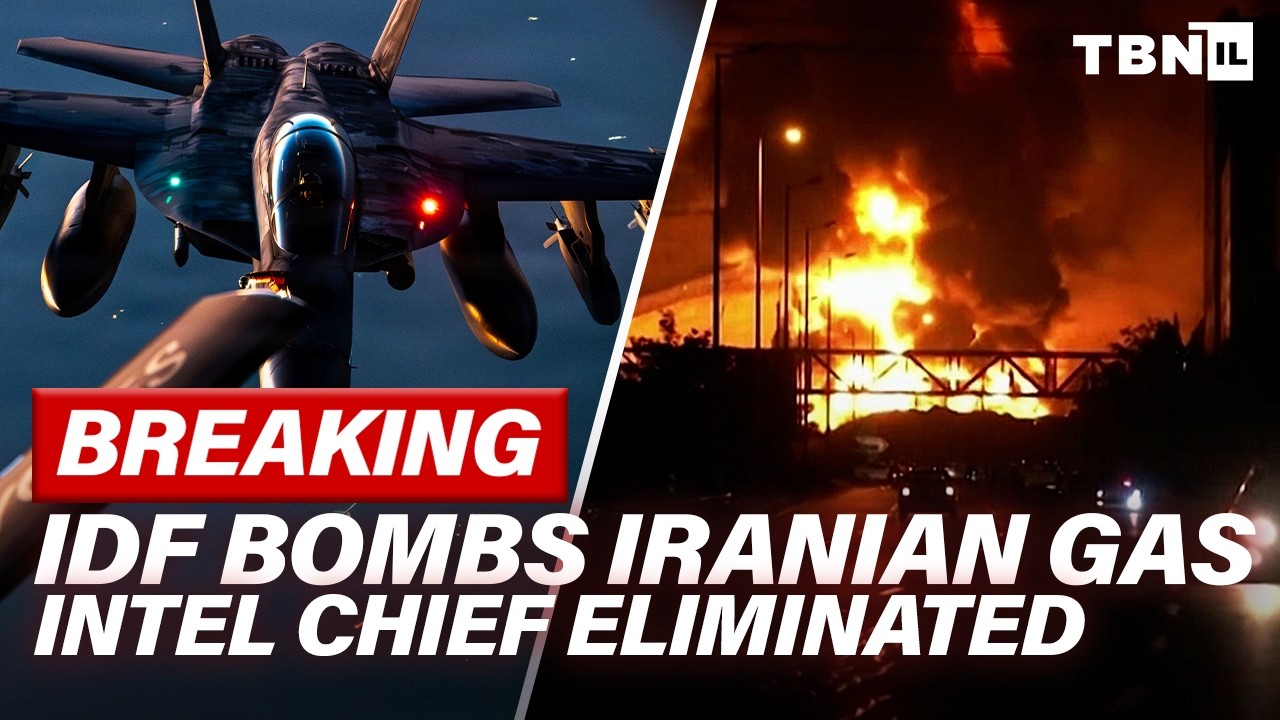
BREAKING: Israel BOMBS Major Iran Gas Site; Top Mullah ELIMINATED; Iran Vows VENGEACE | TBN Israel
"Israel and the United States have escalated their 'Roaring Lion War' against Iran, striking its largest gas facilities, eliminating key intelligence and military figures, and disrupting missile production, while Iran threatens a broader energy war in the Gulf."

BREAKING: Iran Threatens To END Talks; U.S. Vows Retaliation; Hezbollah Collapsing? | TBN Israel
"Iran is leveraging Hezbollah and the Strait of Hormuz to manipulate US negotiations, while Israel asserts its right to dismantle Hezbollah's eroding but still dangerous infrastructure in Lebanon, independent of international talks."

Patrick Henningsen: Hezbollah JUST Fired Back at Israel - Iran Vows to “Crush” All Attacks
"Patrick Henningsen argues that the US and Israel initiated an illegal war against Iran, driven by Trump's incompetence and Israeli influence, leading to an inevitable escalation with severe global economic repercussions."

Iran Update: Israel’s Newest Bombing Campaign, the Oncoming War With China and How to Avoid It
"Colonel Wilerson reveals how the US and Israel are actively bombing China's strategic infrastructure in Iran, escalating a covert economic war that Beijing intends to win without direct military conflict by dismantling the dollar's global dominance."