
Nima R. Alkhorshid: “TOTAL SURRENDER” – Trump Dares Iran, But They Just DISMANTLED His Every Move
YouTube · Zqs4c_dOCog
Quick Read
Summary
Takeaways
- ❖Israel's Iron Dome and other air defense systems are failing against Hezbollah's rockets and FPV drones, revealing a strategic vulnerability.
- ❖The US 'establishment' (deep state) is portrayed as a Zionist-aligned entity that initiates wars for geopolitical control, not for stated objectives like nuclear non-proliferation.
- ❖Donald Trump is depicted as a 'showman' whose actions are dictated by the 'establishment,' rather than an independent deal-maker.
- ❖Iran is a self-sufficient nation, capable of producing most of its food and leveraging regional allies like Pakistan to circumvent US sanctions.
- ❖The US strategy to control global energy markets, starting with Venezuela and extending to Iran, aims to bring China and Russia 'to their knees.'
- ❖Iran's cultural identity and historical pride make it resilient against external attempts to impose leadership or divide the country.
- ❖Iran possesses long-range missile capabilities, able to strike US bases as far as Australia, indicating preparation for global escalation.
- ❖The Wolfowitz Doctrine, which opposes the existence of regional or superpowers other than the US, is cited as the underlying framework for US policy against Iran and Russia.
Insights
1Israel's Strategic Vulnerability Against Hezbollah
The speaker argues that Israel's air defense systems, including Iron Dome, Patriot, and THAAD, are proving ineffective against Hezbollah's rockets and FPV drones in southern Lebanon. This is framed as a 'strategic problem' for Israel, not merely technical, leading to significant damage to Israeli vehicles and air defense batteries. The cost disparity between inexpensive drones and expensive interceptors further exacerbates Israel's challenge.
Hezbollah's FPV drones are hitting Israeli vehicles and Iron Dome batteries multiple times; Israel's own experts call it a 'strategic problem' with no solution [], [], [].
2Trump as a 'Showman' Controlled by the 'Establishment'
Donald Trump is portrayed as a figurehead, a 'showman' primarily interested in personal gain and media attention, whose foreign policy actions, particularly regarding Iran, are dictated by a 'Zionist establishment' or 'deep state' in Washington. This establishment is described as consistently pushing for wars and supporting Israel, even when it means going against Trump's initial inclinations.
Trump is 'just making noises,' a 'showman' who 'wants to be in the news' []. The 'establishment' is 'all Zionist' and supports Israel, running the show in Washington, not Trump [], [].
3Iran's Resilience and Self-Sufficiency Against US Pressure
Despite US sanctions and attempts to destabilize its economy and incite internal protests, Iran is depicted as a highly resilient and self-sufficient nation. The speaker highlights Iran's ability to produce 90-95% of its food and leverage neighboring countries like Pakistan to mitigate the impact of blockades, demonstrating its capacity to withstand external pressure.
Iran produces 90-95% of its food [] and Pakistan helps facilitate trade to reduce the influence of the American blockade in the Persian Gulf [].
4US Strategy to Dominate Global Energy and Weaken Rivals
The core motivation behind US actions in the Middle East and Latin America is identified as a desire to dominate the global energy system. By controlling oil and gas flows, particularly from countries like Venezuela and Iran, the US aims to bring rivals like China and Russia 'to their knees,' as they are heavily dependent on these energy sources.
Donald Trump 'wanted to dominate the global energy system' []. Overthrowing the Iranian government would be a 'huge loss for both' China and Russia, disrupting the 'equilibrium of this planet' [].
5Iran as a Civilization: Unbreakable Identity
The speaker emphasizes Iran's deep-rooted identity as an ancient empire and civilization, comparable to Russia or China, rather than just a country. This cultural pride and historical consciousness are presented as fundamental reasons why Iranians will fight to the last person and cannot be easily subjugated or divided by external forces, unlike countries like Iraq or Afghanistan.
Iran 'was an empire' and is a 'culture,' a 'civilization' like Russia or China []. Iranians are 'proud of their history' and 'know how to fight' []. The story of Rostam and Sohrab illustrates the cultural sentiment of sacrificing everything for Iran [].
Bottom Line
Israel's reliance on expensive interceptors against inexpensive drones and rockets is creating a strategic economic and military drain, making its air defense system unsustainable in prolonged conflict.
This cost asymmetry suggests a fundamental flaw in Israel's defense strategy against asymmetric threats, potentially leading to resource depletion and increased vulnerability over time.
Developing highly cost-effective counter-drone technologies or alternative defense strategies that don't rely on expensive interceptors could be a critical area for innovation in modern warfare.
The US 'establishment's' alleged strategy of using economic sanctions and proxy conflicts to destabilize nations and control resources is a modern form of colonialism, aimed at maintaining global hegemony by weakening rivals like China and Russia.
This perspective reframes current geopolitical conflicts not as isolated incidents but as part of a larger, long-term strategy of economic and political subjugation, impacting global stability and the sovereignty of developing nations.
Nations seeking to resist this perceived 'colonialism' are incentivized to develop greater economic self-sufficiency, diversify alliances (e.g., with China and Russia), and invest in asymmetric defense capabilities to counter traditional military superiority.
Iran's demonstrated capability to strike US military bases as far as Australia indicates a significant expansion of its strategic reach, transforming potential conflicts from regional to global.
This extended reach means that any future conflict with Iran would not be confined to the Middle East, posing a direct threat to US assets and personnel across vast distances and complicating US military planning and deployment.
US military strategists must re-evaluate global base security and defense postures, considering the long-range capabilities of adversaries, and potentially explore diplomatic off-ramps to avoid such widespread conflict.
Key Concepts
Wolfowitz Doctrine
A US foreign policy framework (as interpreted by the speaker) that dictates no regional power or superpower should exist other than the United States. This doctrine is presented as the core reason for US actions against countries like Iran and Russia, aiming to prevent their rise and maintain US hegemony.
Colonialism/Slavery (Modern Face)
The speaker frames US foreign policy, particularly economic sanctions and attempts to control resources and political systems in countries like Iraq, Syria, Venezuela, and Cuba, as a modern form of colonialism and slavery, where nations are exploited for their resources and sovereignty is undermined.
Lessons
- Recognize that geopolitical conflicts, particularly in the Middle East, may be driven by underlying economic and hegemonic objectives, such as controlling global energy markets, rather than solely stated humanitarian or security concerns.
- Critically evaluate information from mainstream media regarding international conflicts, considering alternative perspectives that challenge dominant narratives about the strength, motivations, and vulnerabilities of involved parties.
- Understand the deep cultural and historical factors that shape a nation's resolve and resilience, as these can significantly influence the outcome of conflicts and the effectiveness of external pressure tactics.
Quotes
"Lebanon is not going to be Syria. There is no, you know, Bashar al-Assad is gone. He's not there anymore."
"It's a strategic, as they call it in Israel. They say that this is not a technical problem. This is a strategic problem. And they have no solution for that."
"Donald Trump is nobody in Washington. He has no idea. He has no He's He's in the business of making money for himself and his family."
"Iran is not Iraq, Iran is not Afghanistan. Iran is a Iran was an empire. For God's sake. A huge chunk of this planet was under the control of the Iranian empire. This is a culture. This is a civilization."
"The Wolfowitz Doctrine, there are two important points in that doctrine. Say no regional power and no superpower. No one can exist as a regional power or superpower."
"This is the modern face of the colonialism and slavery. They want Venezuela to be their slave. They want Canada to be their slave. They want Greenland to be their slave. Mexico to be their slave. Everyone."
Q&A
Recent Questions
Related Episodes
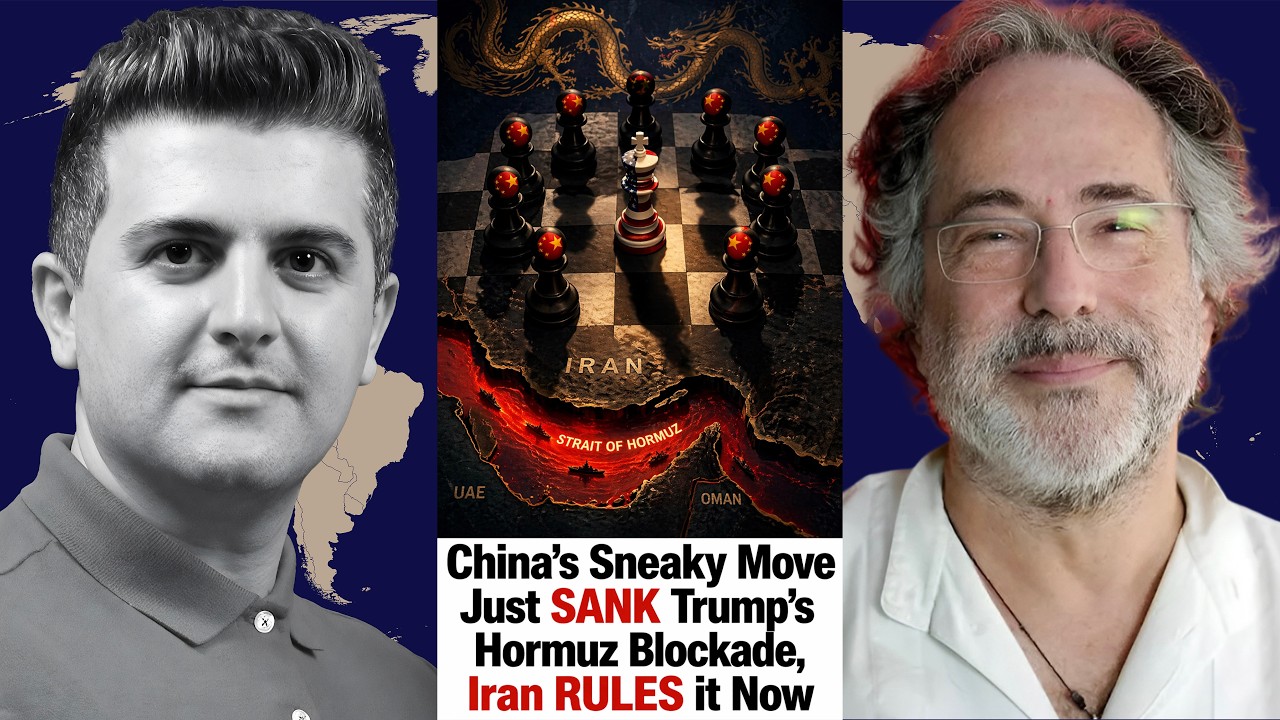
Pepe Escobar: “Total Failure”: Trump’s Blockade Just Backfired Disastrously
"Pepe Escobar argues that the US blockade against Iran, spearheaded by Donald Trump, has utterly failed and backfired, accelerating global economic chaos and challenging US geopolitical dominance."

Alex Krainer: US STRIKES Iran – Iran RETALIATES Against Kuwait, Bahrain & Jordan!
"Amidst escalating US-Iran conflict and Iranian retaliation against regional US allies, this episode argues that US foreign policy is deeply controlled by an 'Anglo-Zionist conspiracy' led by the Rothschild banking dynasty, prioritizing Israeli interests over American ones."

Iran Update: Israel’s Newest Bombing Campaign, the Oncoming War With China and How to Avoid It
"Colonel Wilerson reveals how the US and Israel are actively bombing China's strategic infrastructure in Iran, escalating a covert economic war that Beijing intends to win without direct military conflict by dismantling the dollar's global dominance."

Patrick Henningsen: Hezbollah JUST Fired Back at Israel - Iran Vows to “Crush” All Attacks
"Patrick Henningsen argues that the US and Israel initiated an illegal war against Iran, driven by Trump's incompetence and Israeli influence, leading to an inevitable escalation with severe global economic repercussions."