Who Is Curtis Yarvin? | PBD Podcast 717
YouTube · aHTNnlMjArU
Quick Read
Summary
Takeaways
- ❖The US political system is an oligarchy, not a democracy, with real power held by an unelected 'regime' or 'deep state'.
- ❖FDR's administration consolidated federal power, effectively creating the modern 'deep state' by allowing power to flow into the bureaucracy after his death.
- ❖American progressivism has historical ties to communism, with figures like Stanley Levison (CFO of Communist Party USA) being instrumental in the Civil Rights Movement and writing MLK's speeches.
- ❖Monarchy, or 'the rule of one,' is the most effective form of governance, superior to divided power structures like democracy or oligarchy, as evidenced by successful companies and nations like China.
- ❖The US government's bureaucratic nature leads to 'gain-of-function diplomacy' and 'mad scientist' incentives, as seen in NATO expansion and COVID-19 research, where self-interest outweighs public good.
- ❖Yarvin believes that both Barack Obama and Adolf Hitler were likely gay, based on his 'gaydar' and observations of their personal lives.
- ❖The US should adopt a realist, non-interventionist foreign policy, potentially including 'buying out' dictators like Kim Jong-un to free countries, rather than engaging in nation-building or 'missionary' diplomacy.
Insights
1American Governance as an Oligarchy in Disguise
Yarvin posits that the United States is not a functioning democracy but an oligarchy, where power is held by an unelected, administrative 'deep state.' He argues that terms like 'democracy' and 'politics' have acquired contradictory meanings, with 'democracy' signifying legitimacy and 'politics' implying corruption, despite being inherently linked. This linguistic distortion helps conceal the true nature of governance, which he describes as a process-based bureaucracy resistant to presidential influence.
Yarvin notes that the word 'democracy' means 'legitimate government' today, while 'political' has a negative connotation. He cites his experience growing up in the State Department, where 'politics' was seen as dirty. He claims presidential elections have minimal impact on foreign policy and almost zero on domestic policy, which is run by Congress and its unelected bureaucracy. (, , , )
2FDR's Legacy and the Birth of the Deep State
Yarvin asserts that Franklin D. Roosevelt (FDR) consolidated immense power, effectively running the government like a CEO. However, upon FDR's death, this power did not transfer to his successor, Harry Truman, but instead flowed into the administrative 'regime' or 'deep state.' This created an entrenched bureaucracy with no 'Darwinian constraint' on its performance, leading to declining effectiveness over 80 years.
FDR is described as 'pretty close to one' on the 0-1 power scale, running cabinet meetings like a CEO. Yarvin contrasts this with Trump's cabinet meetings. He states that Truman, a 'lightweight,' did not take over FDR's job, and power instead 'flowed down into the regime... into what we now call the deep state.' (, , )
3The Historical Lineage of American Progressivism
Yarvin argues that American progressivism has a continuous, deep-seated history, often intertwined with communist ideals, dating back to the early 20th century and even earlier. He suggests that many modern progressives are unaware of this heritage, likening them to 'conversos' in New Mexico who practice Jewish customs without knowing their heritage.
He traces Obama's connections to Bill Ayers (Weather Underground), SDS (Students for a Democratic Society), the League for Industrial Democracy, and the Intercollegiate Socialist Society (founded 1905 by figures like Upton Sinclair and Jack London). He further connects this to Thomas Wentworth Higginson, a financier of John Brown, linking modern leftism to 19th-century abolitionism and 17th-century Puritanism. He states that for about a hundred years, 'the word progressive has meant communist.' (, , , )
4Monarchy as the Superior Form of Governance
Yarvin advocates for monarchy, defining it as 'the rule of one,' as the most effective and historically universal form of political organization. He contrasts this with democracies and oligarchies, which he sees as inherently inefficient due to divided power and bureaucratic processes. He cites successful private companies and modern authoritarian states like China as examples of effective monarchical structures.
Yarvin states that monarchy is the 'universal form of political organization found throughout history' and in effective modern organizations (companies, military, film 'auteur theory'). He argues that divided power structures cannot build things like iPhones or high-speed rail, contrasting the efficiency of Elon Musk's companies with government agencies. He describes China and Russia as monarchies, despite not being hereditary, and claims China is 'beating us' due to its monarchical efficiency. (, , )
5COVID-19 and Foreign Policy as 'Gain-of-Function' Failures
Yarvin applies the concept of 'gain-of-function' (making something more dangerous) to both scientific research and foreign policy. He argues that the origins of COVID-19 likely stem from 'mad scientist' incentives within virology, where researchers are incentivized to create dangerous viruses for grants, rather than purely benign research. Similarly, he views NATO expansion as 'gain-of-function diplomacy,' unnecessarily provoking Russia due to bureaucratic compulsion.
He describes virologists' incentives to mutate bat coronaviruses to become dangerous for research papers and grants, leading to the creation of COVID-19. He calls Dr. Anthony Fauci's role 'truly insane.' He also cites the recreation of the 1918 flu virus by Jeffrey Taubenberger. He labels NATO expansion as 'gain-of-function diplomacy,' stating it had no clear benefit and was warned against by experts like George Kennan and William Burns. (, , , )
Bottom Line
The US political system, despite its democratic claims, is an 'institutional oligarchy' akin to the rule of priests in ancient Egypt, with elections serving a ceremonial role similar to the British monarchy.
This reframes political participation, suggesting that voting and traditional political engagement may be largely symbolic, with actual power residing in unelected institutional bodies. It implies that fundamental change would require addressing this entrenched oligarchy rather than merely changing elected officials.
Understanding this underlying structure could lead to alternative strategies for political influence or societal change that bypass traditional democratic mechanisms, focusing instead on influencing or reforming the 'institutional' power centers.
The 'new left' in America, including figures like Barack Obama, unknowingly carries the heritage of early 20th-century communism, with the term 'progressive' serving as a long-standing euphemism for 'communist.'
This challenges the perceived ideological distinctions within the American left and suggests a deeper, often unacknowledged, continuity of radical thought. It implies that current political discourse may be operating under a historical misunderstanding, potentially obscuring the true nature of ideological conflicts.
This perspective could be used to analyze contemporary progressive movements, identifying historical patterns and potential long-term goals that might not be explicitly stated or even consciously recognized by participants.
China's rapid economic and technological advancement is attributed to its 'monarchical' governance structure, which allows for decisive, long-term planning and execution, contrasting sharply with the US's bureaucratic inefficiency.
This suggests that the US's current political structure is a significant handicap in global competition, particularly against highly centralized states. It implies that without fundamental reforms to its governance model, the US risks falling further behind in key areas.
If the US were to adopt elements of monarchical efficiency (e.g., streamlined decision-making, long-term strategic planning) within its own context, it could significantly boost its national effectiveness and competitiveness.
Key Concepts
Truman Show Analogy
The idea that people live within a constructed reality or 'myth' about their political system, similar to Truman Burbank discovering his world is a set. Yarvin uses this to describe how citizens are misled about the true nature of American governance.
0 to 1 Power Scale
A conceptual scale where 0 represents no power and 1 represents absolute power. Yarvin uses this to argue that while figures like Trump might appear to gain significant power, their absolute power remains extremely low compared to historical monarchs like FDR, indicating the system's inherent resistance to change.
Conflict of Interest in Bureaucracy
When the nominal goals of an organization (e.g., virologists fighting viruses) are at cross-purposes with the actual incentives driving its members (e.g., creating more dangerous viruses for grants). This leads to 'mad scientist' behavior and systemic dysfunction.
Gain-of-Function Diplomacy
Applying the concept of 'gain-of-function research' (making viruses more dangerous) to foreign policy, where actions like expanding NATO to the east are seen as unnecessarily provoking adversaries without clear benefit, driven by bureaucratic self-interest rather than strategic necessity.
Notable Moments
Yarvin claims that Martin Luther King Jr.'s speeches were not written by him, but by a collaborative effort including Stanley Levison, who was the CFO of the Communist Party USA. He highlights that Levison's role in the SCLC is often omitted from historical accounts.
This challenges a widely held historical narrative about a pivotal figure in American civil rights, suggesting a deeper, unacknowledged communist influence on the movement. It reinforces Yarvin's theme of hidden truths and manipulated public perception.
Yarvin presents his opinion that Frank Marshall Davis, a black communist pornographer, was Barack Obama's biological father, and that the official narrative of Obama Sr. was a cover-up orchestrated with the help of communists in Hawaii's state government.
This is a highly controversial and speculative claim that directly challenges the identity and origins of a former US President, serving as a prime example of Yarvin's 'Truman Show' analogy where official stories hide more mundane or inconvenient truths.
Yarvin states his opinion that both Adolf Hitler and Barack Obama were likely gay, based on their personal lives and lack of female companions despite being charismatic world leaders.
This is a provocative and speculative claim that highlights Yarvin's willingness to apply unconventional interpretations to historical and public figures, reinforcing his 'question everything' approach to official narratives.
Yarvin details how Jeffrey Taubenberger, a US scientist, recreated the 1918 Spanish Flu virus by exhuming bodies from Alaskan permafrost, and published its genome, making it possible for others to recreate it. He uses this as an example of 'mad scientist' behavior driven by academic incentives.
This illustrates Yarvin's argument about the 'conflict of interest' within scientific bureaucracy, where the pursuit of grants and fame can lead to actions with potentially catastrophic consequences, even if not maliciously intended.
Quotes
"Democracy is not a solution. It is the problem. The United States should be run like a corporation. If Americans want change, they should stop voting. The democratic experiment has failed. Real power in America is held by an unelected regime. Equality is not a natural human condition. Order is more important than freedom."
"When you're the CEO of a company, one of the worst terms of like you're not a good CEO is to say that you're reactive. You're always reacting to things that happen. You're not making proactive decisions. You're not sort of steering. You're basically reacting to your inbound."
"What people don't really realize about the post 1945 American political system is that it goes from, of course, 1945 FDR dies. FDR is pretty close to one. He's pretty close to being to really having absolute power over the over the government... Truman is a lightweight... and he does not take over the job of FDR. He is not really in charge... power is going to flow down into the regime into the administration into what we now call the deep state and there's going to be no way no way to get it out."
"The new left doesn't know they're communists. They don't understand that this is completely their heritage. And that when and yet when you look at it, you see it all over the place."
"The tyranny of the lion is better than the justice of the mouse."
Q&A
Recent Questions
Related Episodes
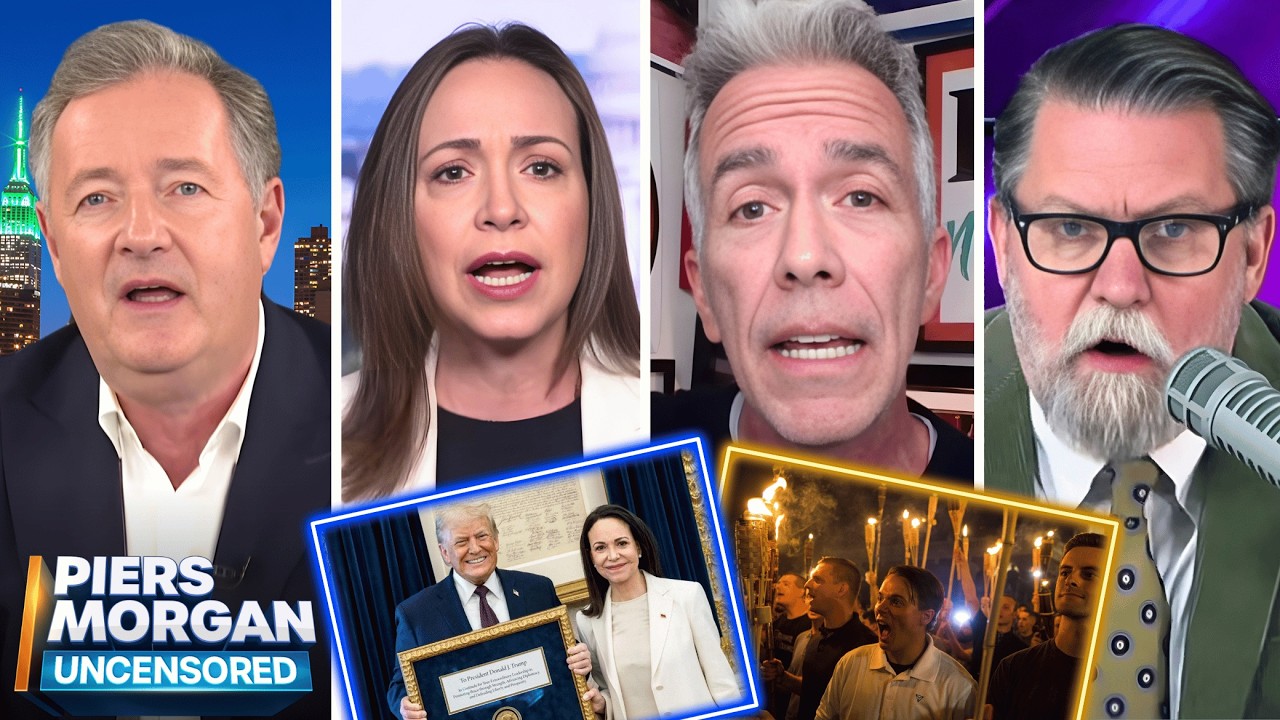
"Fighting Solves EVERYTHING!" Who's To Blame For Political Violence? + Maria Machado On Trump
"This episode dissects the escalating political violence in the US, with panelists fiercely debating the role of partisan rhetoric and media in radicalization, alongside an interview with Venezuelan opposition leader Maria Machado on US intervention and her country's future."

🚨 HOLY F*CK HE WAS RIGHT 😂😂😂
"The host celebrates perceived conservative victories and the exposure of 'leftist' and 'communist' elements in American politics and culture, from Trump's enduring influence to alleged government fraud and societal decay."

BREAKING: MAGA RIGS VIRGINIA As Trump THREATENS NUCLEAR HOLOCAUST & Kyle EXPLODES!!!
"Host Kyle Kulinski vehemently condemns Republican actions, from alleged gerrymandering and voter suppression to environmental negligence, while sharply criticizing Trump's rhetoric on Iran and other controversial political figures and policies."
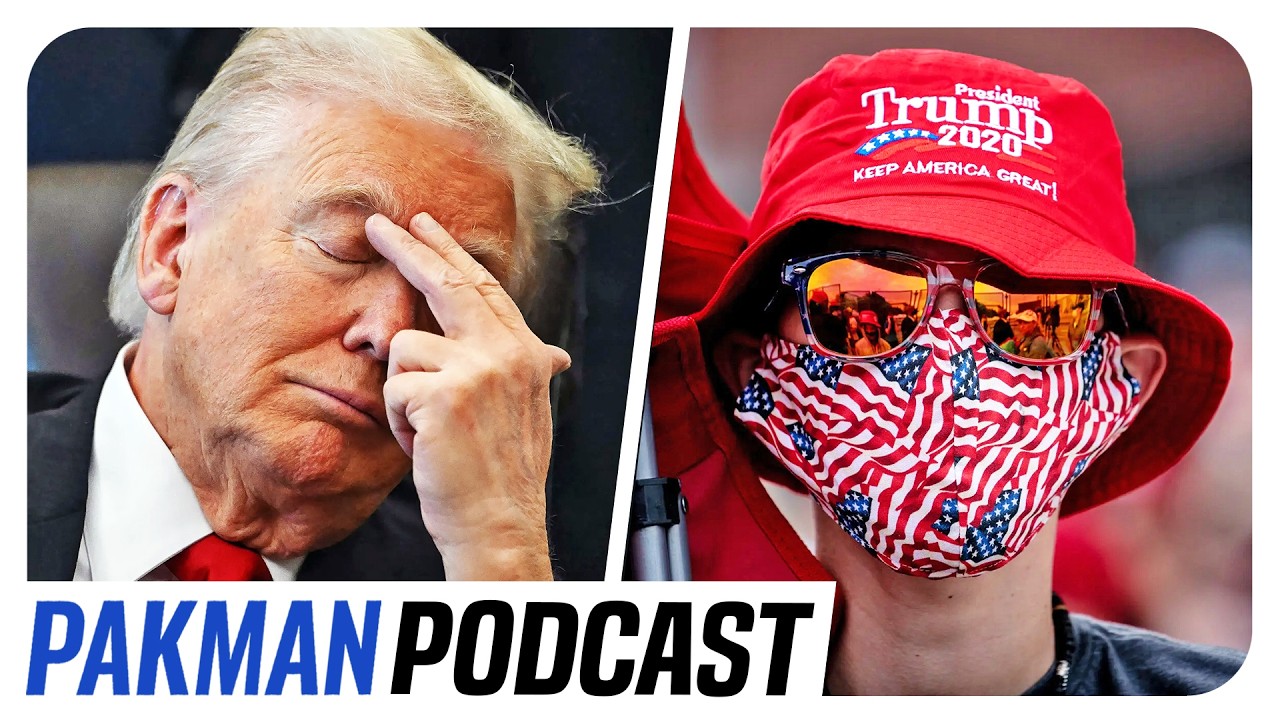
What happens to Trump voters when Trump is gone?
"The David Pakman Show explores the contentious path forward for Trump voters after his political era, exposing alleged corruption, economic misrepresentation, and the necessity of media literacy."