
Pepe Escobar: Iran Issues FINAL Warning to US & Israel – Immediate Decisive Response
YouTube · c-00GQ-X7qs
Quick Read
Summary
Takeaways
- ❖Iran has reportedly issued a 'final warning' to the US and Israel, threatening a nuclear device detonation on its own soil if American threats persist.
- ❖This alleged threat, conveyed by Iranian President Pzashkin to Pakistani Prime Minister Sharif, signals an end to Iran's nuclear ambiguity.
- ❖The US reportedly paused kinetic actions against Iran after being briefed on this warning, indicating its seriousness.
- ❖China is directly involved in supplying state-of-the-art strategic defense systems to Iran via third countries, forming a strategic triad with Pakistan.
- ❖Russia is considering a more aggressive military strategy in Ukraine, inspired by Iran's 'escalation dominance' model, due to growing domestic frustration over drone attacks.
- ❖The St. Petersburg forum highlights a strong 'Global South' alignment focused on business deals and challenging Western dominance, with Iran and China as key strategic partners for Russia.
Insights
1Iran's Nuclear 'Final Warning' and Shift to Capability Demonstration
Iranian President Pzashkin reportedly informed Pakistani Prime Minister Sharif that if American threats persist, Iran would conduct a nuclear device detonation on its own soil. This is framed not as an act of war, but as an 'irreversible sovereign demonstration of capability to control escalation dominance,' signaling an end to Iran's nuclear ambiguity. This message, cleared by Ayatollah Khamenei, was conveyed to the US via Pakistan, leading to a temporary halt in US kinetic actions against Iran and a change in rhetoric from threats of annihilation to offers of talks.
Pepe Escobar cites a 'top-shelf source' with a full briefing on a 105-minute phone call between President Pzashkin and Prime Minister Sharif. The source quoted Pzashkin stating, 'if American threats persist... we should conduct the detonation of a nuclear device on Iranian soil executed not as an act of war, but as an irreversible sovereign demonstration of capability to control escalation dominance.' This information was then relayed to Marco Rubio by Pakistan's Foreign Minister Dar, after which Trump's tone towards Iran changed. (, , )
2Russia Considers Adopting Iran's 'Escalation Dominance' Strategy in Ukraine
Growing frustration within Russia over the prolonged Ukraine war and drone attacks on Russian territory, including St. Petersburg, is leading to a consensus for a more aggressive strategy. Russian officials, from intel apparatus to think tanks, are looking to Iran's approach of 'escalation dominance' as an example. The sentiment is that the 'attrition war' is insufficient, and Russia needs to 'go for the jugular' by destroying Ukraine's industrial military complex and potentially targeting NATO sources of drone attacks. This shift is partly driven by public anxiety and criticism directed at Putin's party ahead of September elections.
Pepe Escobar notes a consensus in Moscow that the war 'has gone too long' and it's 'time to tweak the strategy,' moving beyond attrition to 'the next level' against NATO-organized drone warfare. He states, 'people who decide in Russia they look at Iran and they see Iran as an example.' The host adds that Russians 'don't see the response as immediate' and want 'something more direct or harder.' (, , )
3Emergence of China-Pakistan-Iran Strategic Triad Against US Influence
A strategic alignment is solidifying between China, Pakistan, and Iran, directly challenging US influence. Pakistan's Foreign Minister Dar reportedly confirmed to Marco Rubio that China is actively supplying Iran with 'state-of-the-art strategic defense systems,' including shoulder-fired man-pads, via third countries to maintain plausible deniability. This revelation, coupled with Iran's firm stance on not surrendering highly enriched uranium, indicates a coordinated effort to counter American demands and military pressure. China views Iran as a 'key strategic partner' in West Asia, betting on it for a 'post-American West Asia.'
Dar told Rubio that 'China is directly involved because China has delivered state-of-the-art strategic defense systems, specially shoulder fired man pads via third countries.' Escobar states, 'this strategic alignment is totally in effect and it's Iran, Pakistan and China working together.' He further emphasizes that 'the number one strategic partner for Iran is China.' (, , )
Bottom Line
Iran's alleged nuclear threat is not just a deterrent but a strategic move to 'break the cycle' of continuous, low-level conflict and American provocations, forcing a permanent end to the war on its terms.
This suggests Iran views nuclear capability as the ultimate tool to dictate the terms of peace, rather than just a weapon of last resort. It implies a calculated shift from enduring conflict to forcing a decisive resolution, bypassing endless negotiations.
Analysts should re-evaluate Iran's strategic calculus, considering that its nuclear program might be primarily aimed at achieving 'peace through strength' and ending perpetual conflict, rather than solely for offensive purposes. This could open new avenues for understanding regional stability dynamics.
The 'Global South' is increasingly rejecting traditional diplomatic frameworks and embracing a 'battlefield dictates paper' approach, where military outcomes precede and define political agreements.
This signifies a fundamental distrust in Western-led diplomacy and a preference for demonstrating strength and achieving objectives on the ground before negotiating. It implies that future international agreements will be less about shared values and more about power realities.
Western policymakers need to adapt to this new reality, recognizing that military and economic leverage might be more effective in shaping outcomes than diplomatic overtures alone. Understanding and anticipating battlefield dynamics will become paramount for effective foreign policy.
Key Concepts
Escalation Dominance
A strategy where one party demonstrates a clear ability to control the pace and intensity of conflict escalation, forcing the adversary to back down or face unacceptable consequences. Iran's alleged nuclear threat and its '1.5 times harder' response policy exemplify this, aiming to deter further provocations by making the cost of escalation too high for the US and Israel.
Deterrence by Denial/Punishment
Deterrence by denial aims to prevent an adversary's action by convincing them that their objectives cannot be achieved. Deterrence by punishment aims to prevent an action by threatening unacceptable costs. Iran's potential nuclear demonstration shifts its posture towards a strong form of deterrence by punishment, leveraging the 'North Korea lesson' to prevent attacks by demonstrating undeniable capability, rather than relying on conventional defense or ambiguity.
Lessons
- Monitor Iran's official response to the alleged nuclear threat, as it will provide further clarity on its strategic intentions and potential for de-escalation or further escalation.
- Analyze the implications of the China-Pakistan-Iran strategic alignment on regional security and global trade routes, especially in West Asia, for potential shifts in power and economic opportunities.
- Assess the potential for Russia to adopt more aggressive 'escalation dominance' tactics in Ukraine, considering the impact on global energy markets, supply chains, and the broader geopolitical landscape.
Notable Moments
Pepe Escobar reveals that Iran's President Pzashkin allegedly told Pakistan's Prime Minister Sharif that Iran would detonate a nuclear device on its own soil if American threats persist, marking a significant shift in Iran's nuclear posture.
This revelation, if true, represents an unprecedented escalation by Iran, moving beyond nuclear ambiguity to an explicit threat of capability demonstration. It could fundamentally alter US-Iran relations, regional stability, and global nuclear non-proliferation efforts, as evidenced by the immediate, albeit temporary, change in US kinetic actions.
Quotes
"If American threats persist... we should conduct the detonation of a nuclear device on Iranian soil executed not as an act of war, but as an irreversible sovereign demonstration of capability to control escalation dominance."
"The only language that Europeans and NATO understand is fear. So this means we have to tweak our approach."
"Each American attack, the response is going to be one and a half times more hardcore and this could go to two times more hardcore or three times hard. So now there are no rules and they're going for the jugular."
"Who holds the cards? Iran. Who controls the possible escalation or deescalation? Iran. Who controls when the war will actually end? Iran."
Q&A
Recent Questions
Related Episodes
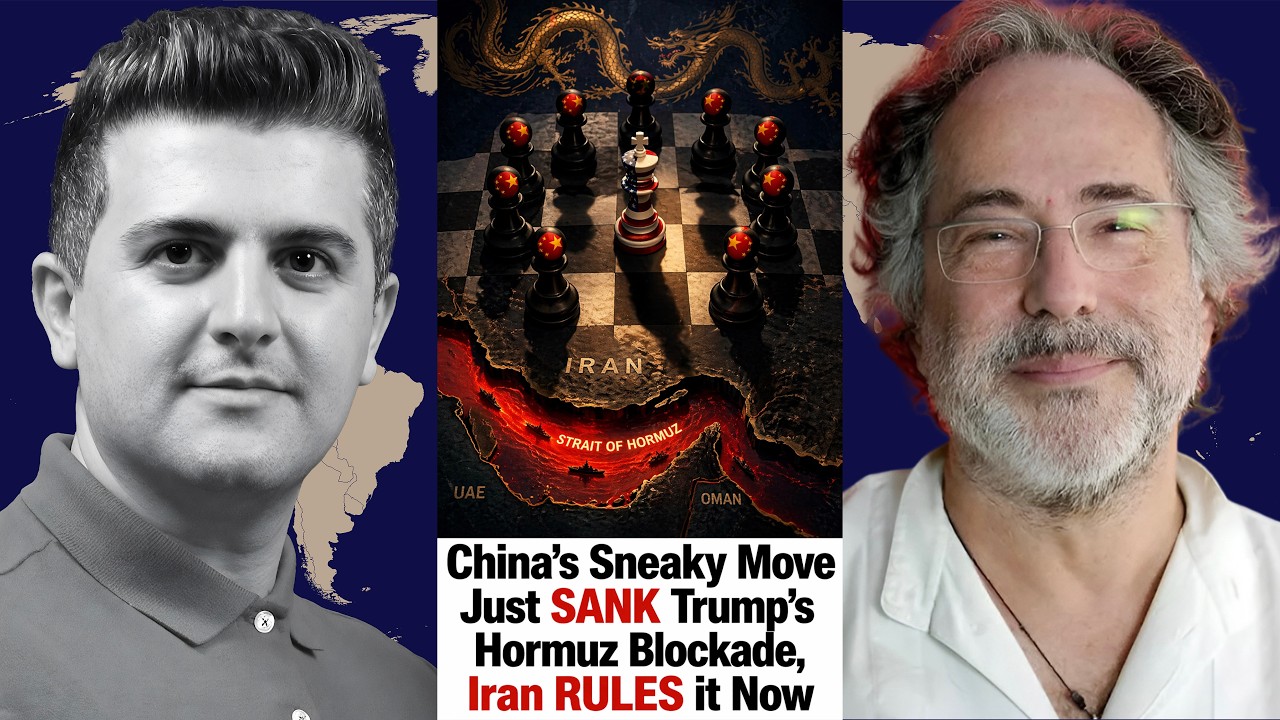
Pepe Escobar: “Total Failure”: Trump’s Blockade Just Backfired Disastrously
"Pepe Escobar argues that the US blockade against Iran, spearheaded by Donald Trump, has utterly failed and backfired, accelerating global economic chaos and challenging US geopolitical dominance."

Alex Krainer: US STRIKES Iran – Iran RETALIATES Against Kuwait, Bahrain & Jordan!
"Amidst escalating US-Iran conflict and Iranian retaliation against regional US allies, this episode argues that US foreign policy is deeply controlled by an 'Anglo-Zionist conspiracy' led by the Rothschild banking dynasty, prioritizing Israeli interests over American ones."

LIVE: Trump HIDES FROM PUBLIC as US SOLDIER KILLED!!! 6/2/2026
"The host exposes alleged government cover-ups regarding military casualties, Trump's unexplained public absence, and questionable political appointments, arguing these reflect a 'regime of loser babies' and a failing foreign policy."

🚨 LEFTISTS ARE F*CKING SEETHING 😂😂😂
"The host aggressively celebrates perceived 'wins' for the right-wing, from global conflicts and domestic politics to cultural shifts, framing them as a 'humiliation' for the 'leftist world order' and a testament to Donald Trump's influence."