
PBS News Hour full episode, May 20, 2026
YouTube · cdX3699VkHw
Quick Read
Summary
Takeaways
- ❖The U.S. Justice Department indicted Raul Castro for his alleged role in the 1996 shoot-down of Brothers to the Rescue planes, escalating U.S. pressure on Cuba.
- ❖President Trump's influence was decisive in GOP primaries, leading to the defeat of critics like Thomas Massie and Brad Raffensperger.
- ❖A controversial IRS settlement granted President Trump, his family, and businesses permanent immunity from audits on past tax returns.
- ❖China's Xi Jinping and Russia's Vladimir Putin cemented their alliance, jointly criticizing U.S. foreign policy and missile defense plans.
- ❖Denmark demonstrates economic success and energy security through its long-term investment in green energy, particularly wind and solar power.
- ❖Author Sophia Nelson argues for 'redefining freedom' in America, emphasizing civic engagement and shared responsibility to uphold founding principles.
- ❖Soman Chainani advocates for lowering the presidential age to 18, believing it would significantly boost youth political participation and representation.
Insights
1Raul Castro Indictment Escalates U.S.-Cuba Tensions
The U.S. Justice Department indicted 96-year-old Raul Castro for murder and conspiracy related to the 1996 shoot-down of Brothers to the Rescue planes. This action is part of the Trump administration's broader campaign of economic pressure on Cuba, timed to coincide with Cuban Independence Day and signaling a hardened stance against the communist regime.
Acting Attorney General Todd Blanche stated, 'If you kill Americans, we will pursue you, no matter who you are, no matter what title you hold, and in this case, no matter how much time has passed.' The indictment was timed with Cuban Independence Day and increased Trump administration rhetoric against Cuba.
2Trump's Unprecedented IRS Settlement Grants Audit Immunity
The Trump Justice Department created a $1.8 billion fund for presidential allies claiming mistreatment and, separately, permanently banned the IRS from examining President Trump's, his sons', his company's, or affiliated trusts' prior tax returns. This settlement, signed by Acting Attorney General Todd Blanche without an IRS representative, was quietly announced and is seen by critics as an unprecedented 'pardon on steroids' covering all tax-related conduct before the settlement date.
Former IRS Commissioner John Koskinen stated, 'I'm never aware of the IRS ever telling a taxpayer, we will just won't audit you as part of any settlement... I have never heard of the IRS in the future saying whatever you filed in the past, we're not going to take a look at.' He noted the settlement was 'almost a sham case giving cover' for the fund and audit immunity.
3Trump's Enduring Grip on the Republican Party Evident in Primaries
President Trump's influence proved decisive in high-profile Republican primaries, leading to the defeat of critics. Congressman Thomas Massie lost his reelection bid after Trump called him 'the worst congressman in the history of our country,' and Georgia Secretary of State Brad Raffensperger, a key opponent of Trump's election overturn attempts, lost his primary for governor. This demonstrates Trump's complete control over the GOP's political apparatus.
Republican strategist Melik Abdul noted, 'It's hard to now not argue that Donald Trump has complete control over the political apparatus of the Republican Party.' He also highlighted that Senator Bill Cassidy, who voted to convict Trump, lost his primary, further illustrating the consequences of disagreeing with the president.
4China-Russia Alliance Deepens, Challenges U.S. Hegemony
Chinese President Xi Jinping hosted Russian President Vladimir Putin in Beijing, cementing their alliance just one week after President Trump's visit. The two leaders jointly criticized U.S. foreign policy, including Trump's proposed 'Golden Dome' missile defense and the U.S.-Israel war on Iran, signaling a united front against perceived unilateralism and hegemonism.
Andrew Weiss of the Carnegie Endowment for International Peace stated, 'The split-screen image of chumminess between Vladimir Putin and Xi Jinping, and on the other hand Donald Trump's recent visit, could not be more stark.' Xi Jinping warned of 'unilateralism and hegemonism posing profound dangers' and the world facing 'the risk of regressing to the law of the jungle.'
5Denmark's Green Energy Model Debunks Economic Concerns
Denmark, consistently ranked in the world's top 10 economies, thrives on its expertise in green energy, particularly wind and solar. Despite President Trump's criticisms of wind turbines as 'losers' and economically unsound, Denmark's industry employs 107,000 people and generates $17 billion annually, demonstrating that renewable energy can be both environmentally beneficial and economically profitable.
Kristian Jensen, CEO of Green Power Denmark, countered Trump's 'stupid' jibe by stating, 'The price of power coming out of a wind turbine is cheaper than that of natural gas.' He emphasized, 'Solar is cheaper. Wind is cheaper. Electricity is more efficient than fossil energy.'
Bottom Line
The U.S. administration's Cuba strategy appears to be a 'two-track' approach, combining aggressive economic pressure and indictments with quiet diplomatic channels, aiming for negotiated outcomes but only on terms favorable to the U.S.
This suggests a high-stakes gamble where increased economic pain is expected to force Cuba's hand, but risks further entrenching the regime or leading to military escalation if demands are not met. Businesses considering engagement with Cuba should be wary of extreme volatility.
For analysts, understanding the subtle signals from both tracks is critical. For humanitarian organizations, anticipating increased need for relief due to economic hardship is important.
The IRS settlement granting audit immunity to President Trump and his entities for past tax returns, coupled with the 'anti-weaponization fund,' indicates a deliberate effort to shield the executive from financial scrutiny and reward political loyalty using government resources.
This sets a dangerous precedent for future administrations, potentially eroding public trust in independent institutions like the IRS and Justice Department. It suggests a move towards a system where political power can directly influence legal and financial oversight for personal benefit.
Legal and ethics watchdog groups have a clear mandate to challenge such precedents. Journalists should focus on uncovering the beneficiaries of the 'anti-weaponization fund' and the specific contents of the tax returns that required such sweeping immunity.
The deepening China-Russia alliance, explicitly framed as a counter to U.S. 'unilateralism and hegemonism,' extends beyond military cooperation to critical economic support, with China providing significant microelectronic and machine tool imports for Russia's war efforts.
This 'no-limits partnership' challenges the U.S.-led global order and complicates efforts to isolate Russia. It also highlights China's strategic patience in negotiating long-term energy deals, demonstrating its leverage over Russia.
Western policymakers need to develop more sophisticated strategies to counter this axis, potentially focusing on supply chain resilience and alternative markets for Russian resources. Businesses should assess geopolitical risks associated with both nations.
Opportunities
Investment in Green Energy Infrastructure for Energy Security
Denmark's success in becoming nearly 90% reliant on renewable energy, driven by two 1970s oil crises, demonstrates the long-term economic and security benefits of investing heavily in wind, solar, and energy storage solutions. This model can be replicated in other nations seeking to reduce dependency on volatile fossil fuel markets.
Development of Radar Technology for Coexistence with Wind Farms
A Danish defense company has developed software-driven radar systems capable of 'seeing through' the clutter created by wind farms to identify aircraft, ships, and drones. This technology addresses a key security concern raised against wind energy projects, opening up more areas for turbine development.
All-Electric Ferry and Maritime Electrification Solutions
The success of Ellen, Denmark's all-electric ferry, which has operated for almost seven years without blackouts, demonstrates the viability of fully electric maritime transport. This presents an opportunity for companies to develop and implement electric propulsion systems, battery technology, and charging infrastructure for ferries and other short-haul vessels globally.
Lessons
- Engage in local civic activities like school board meetings and PTA, as these mundane actions are essential for upholding democratic principles and holding politicians accountable.
- Re-evaluate personal definitions of freedom to ensure they do not impinge on others, fostering a 'shared freedom' that prioritizes community and civic responsibility.
- Consider the long-term economic and security benefits of transitioning to green energy, drawing lessons from Denmark's successful half-century commitment to self-sufficiency in renewables.
Quotes
"If you kill Americans, we will pursue you, no matter who you are, no matter what title you hold, and in this case, no matter how much time has passed."
"The world today is far from peaceful, with unilateralism and hegemonism posing profound dangers. The world faces the risk of regressing to the law of the jungle."
"The Russians and the Chinese are absolutely essential partners to each other in the political sphere and in the economic sphere. They are demonstrating in their rhetoric and in the imagery of today's visit deep apprehension about Donald Trump."
"It's hard to now not argue that Donald Trump has complete control over the political apparatus of the Republican Party. The question is, what does that mean for midterms, when Republicans actually need independents to vote for them?"
"You do have to wonder what's in those returns that makes it so important for them not to be audited."
"This is not a question of saving the polar bears. Don't look at the ideology. Look at the facts on the table. Solar is cheaper. Wind is cheaper. Electricity is more efficient than fossil energy. And if you look at that, it's a no-brainer to go into electrification of your businesses and your homes."
"We have a divided country in a way that I have not seen in my lifetime. Governing ourselves in the 21st century with an 18th century document is a little tricky. And I don't want to throw it away. I want to refresh it."
"You can take out a credit card, a mortgage, you can get married, you can vote, you can fight for your country, you can die for your country, but then you can't, like, ask your country in a democracy if you can lead it, right?"
Q&A
Recent Questions
Related Episodes
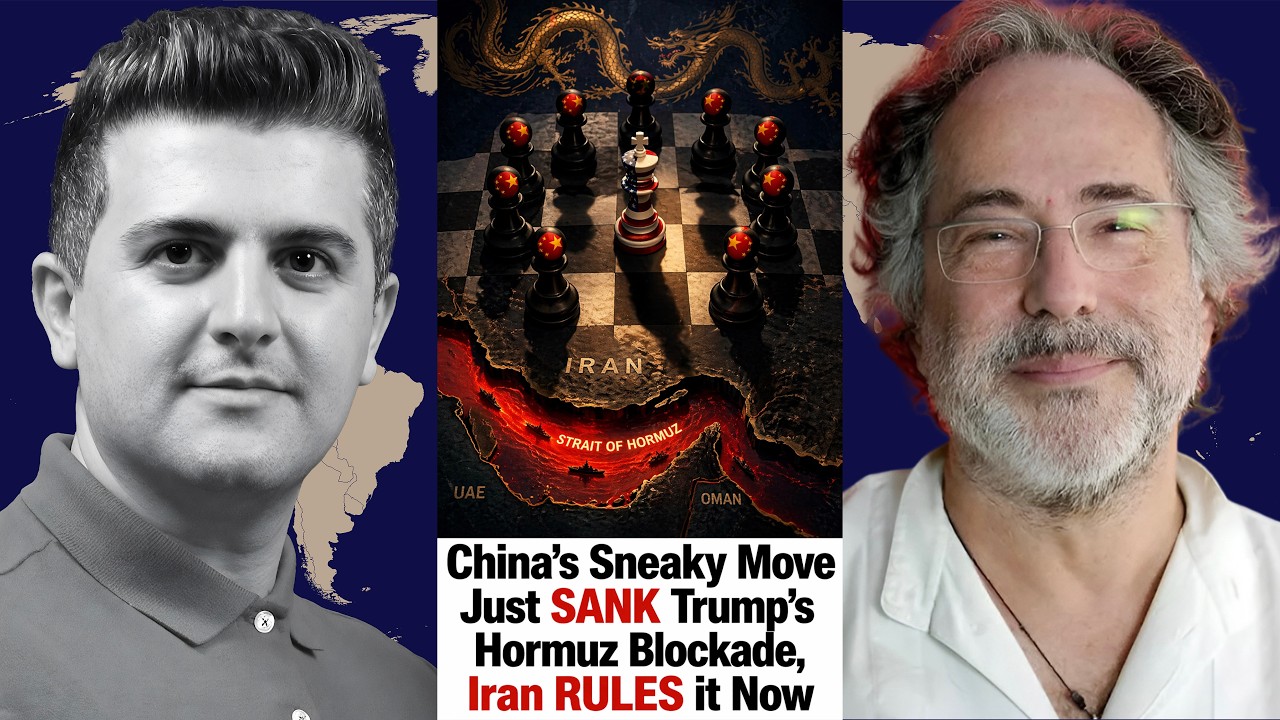
Pepe Escobar: “Total Failure”: Trump’s Blockade Just Backfired Disastrously
"Pepe Escobar argues that the US blockade against Iran, spearheaded by Donald Trump, has utterly failed and backfired, accelerating global economic chaos and challenging US geopolitical dominance."

Alex Krainer: US STRIKES Iran – Iran RETALIATES Against Kuwait, Bahrain & Jordan!
"Amidst escalating US-Iran conflict and Iranian retaliation against regional US allies, this episode argues that US foreign policy is deeply controlled by an 'Anglo-Zionist conspiracy' led by the Rothschild banking dynasty, prioritizing Israeli interests over American ones."

🚨 LEFTISTS ARE F*CKING SEETHING 😂😂😂
"The host aggressively celebrates perceived 'wins' for the right-wing, from global conflicts and domestic politics to cultural shifts, framing them as a 'humiliation' for the 'leftist world order' and a testament to Donald Trump's influence."

Iran Update: Israel’s Newest Bombing Campaign, the Oncoming War With China and How to Avoid It
"Colonel Wilerson reveals how the US and Israel are actively bombing China's strategic infrastructure in Iran, escalating a covert economic war that Beijing intends to win without direct military conflict by dismantling the dollar's global dominance."