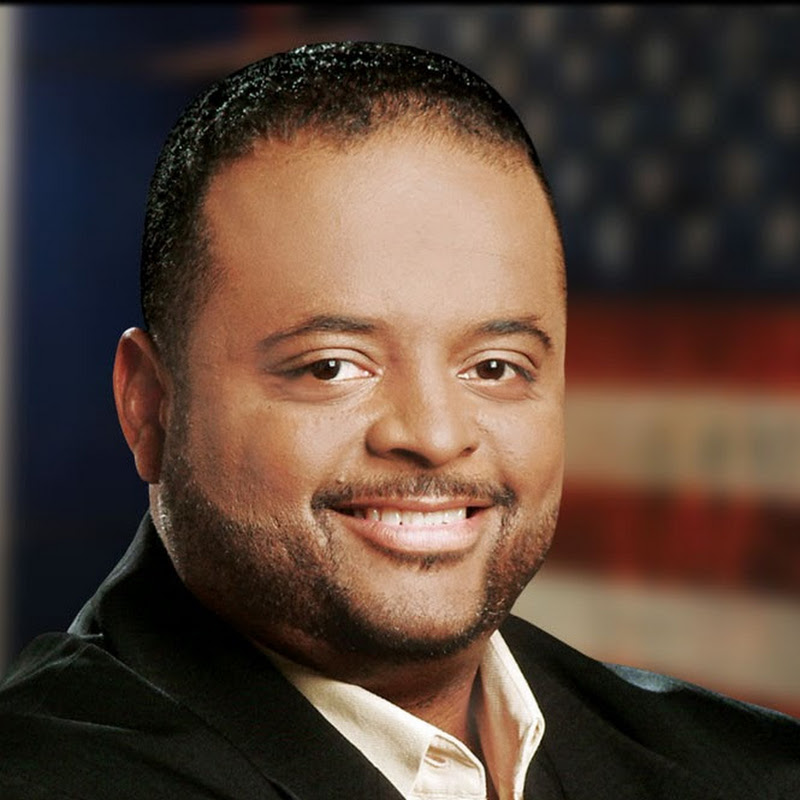
Roland gives Juneteenth speech in Memphis
YouTube · d_kmWrx2hD4
Quick Read
Summary
Takeaways
- ❖Many political and community leaders avoid accountability, preferring to protect reputations over fixing problems.
- ❖The original intent of 'defund the police' was to reallocate excessive police budgets to address root causes of crime like poverty and homelessness.
- ❖Current legislative and judicial actions, combined with economic shifts, represent a 'Jim Crow 2.0' targeting Black political and economic power.
- ❖Memphis, despite significant Black political representation, lags economically compared to other 'New South' cities like Atlanta.
- ❖All politics is identity politics; politicians inherently segment the electorate by identity groups to craft targeted agendas.
- ❖White rural communities are increasingly experiencing similar grievances (e.g., environmental pollution, economic hardship) that could foster cross-racial coalitions.
- ❖Dr. Martin Luther King Jr.'s final sermons emphasized economic withdrawal and collective economic power as a blueprint for Black liberation.
- ❖The future will remember those who actively worked for change, not those who remained passive or complained.
Insights
1Accountability Deficit in Black Leadership
Roland Martin asserts that many Black political and community leaders, even those who 'look like us,' avoid accountability for lack of progress. He cites the Memphis mayor's refusal to appear on his show after criticism regarding the city's non-participation in DOJ police oversight following the Tyrie Nichols case, and the general reluctance of organizations to demonstrate tangible economic achievements.
Martin recounts the Memphis airport commission's concern over his negative customer service comments (), the Memphis mayor's refusal to come on his show after criticism of the city's stance on DOJ police oversight (), and challenges community groups to point to economic achievements in the last 364 days ().
2Reinterpreting 'Defund the Police' and Crime Reduction
Martin clarifies that 'defund the police' was never about eliminating all law enforcement but about reallocating excessive police budgets (50-70% of city budgets) to address underlying causes of crime like poverty, homelessness, and lack of economic opportunity. He points to Baltimore's success under Mayor Brandon Scott and Governor Wes Moore, who achieved a dramatic drop in crime with a reduced police force by shifting resources to social programs.
He states, 'Defund police was never about get rid of all cops. it was you cannot continue as a city to spend 50 60 and 70% of your budget on police and fire.' () He references Baltimore's Mayor Brandon Scott and Governor Wes Moore reducing crime with a smaller police force by confronting root causes ().
3The 'Jim Crow 2.0' Agenda
Martin argues that current legislative, judicial, and corporate actions constitute a 'Jim Crow 2.0' aimed at systematically 'defunding Black America.' This includes attacks on Black political and economic power, civil rights groups, access to universities (e.g., affirmative action, race-based scholarships), and DEI initiatives, leading to job losses and reduced funding for marginalized groups.
He details the Supreme Court's contradictory rulings on voting rights (), the Project 2025 agenda as 'anti-black' (), the DOJ's warning about EEOC anti-discrimination efforts (), attacks on affirmative action and race-based scholarships (), and the FCC chairman scrutinizing company programs for 'black, Latino, women, gay' keywords, leading to 80-90% funding cuts for some groups ().
4Economic Disparity in Memphis Despite Political Power
Despite Memphis having a significant Black population and a history of Black political leadership comparable to Atlanta, the city is notably absent from discussions of the 'New South' due to a lack of corresponding economic power within the Black community. Martin challenges the audience to name the five largest Black-owned businesses in Memphis and their revenue, highlighting the disconnect between political representation and economic prosperity.
He asks, 'How can you have a high concentration of African-Americans in this city and you do not see the corresponding economic aspect?' () He notes that Memphis is 'never mentioned' in discussions of the 'New South' unlike Atlanta () and challenges the audience to name the five largest Black-owned businesses and their annual revenue ().
Bottom Line
The potential for cross-racial coalitions to fight shared grievances is growing, as white rural communities begin to experience similar issues previously confined to Black communities.
This suggests an opportunity to build broader political movements by highlighting common ground (e.g., environmental pollution, economic hardship, corporate exploitation) that transcends traditional racial divides, potentially shifting political power dynamics.
Organizers should actively seek out and engage white rural communities facing environmental degradation or economic distress, framing their struggles within a larger narrative of systemic exploitation and offering solidarity and shared solutions.
The 'defund Black America' agenda extends beyond overt political attacks to subtle corporate actions, such as the FCC scrutinizing company sponsorships for diversity keywords, leading to significant funding cuts for marginalized groups.
This reveals a sophisticated, multi-pronged attack that targets the financial infrastructure supporting Black and other marginalized communities, making it harder for these groups to sustain advocacy, education, and economic development efforts.
Advocacy groups and Black-owned businesses need to develop new funding models and strategies that are resilient to these indirect attacks, potentially focusing on direct community investment, alternative financing, and legal challenges against discriminatory funding practices.
Key Concepts
Accountability as a Catalyst for Change
The idea that progress is impossible without holding individuals and institutions responsible for their actions and inactions. Martin argues that avoiding accountability perpetuates denial and prevents problem-solving, whether in customer service, political leadership, or community organizations.
Identity Politics as Universal Strategy
Challenging the notion that 'identity politics' is solely a concern of marginalized groups. Martin asserts that all politicians engage in identity politics by segmenting the electorate into various demographic and interest groups to tailor their messages and appeal.
The Nehemiah Playbook
A biblical framework for community rebuilding and collective action. It involves acknowledging destruction, visualizing solutions, mobilizing people ('troops, not just generals'), ignoring 'haters,' and persevering with a 'weapon in one hand and building with the other' until the goal is achieved, ensuring those who built are remembered.
Lessons
- Demand accountability from political and community leaders by requiring them to demonstrate tangible economic and social progress in Black communities, not just rhetoric.
- Engage in massive mobilization and organization efforts, particularly in the South, to increase voter registration and turnout, recognizing that collective political power is essential to remove unresponsive officials.
- Form broad coalitions across racial and demographic lines, particularly with white rural communities experiencing similar economic and environmental injustices, to amplify collective power against shared oppressors.
- Reinvest in Black-owned businesses and institutions, practicing 'economic withdrawal' from corporations that do not reinvest in Black communities, as outlined in Dr. King's economic blueprint.
The Nehemiah Playbook for Community Rebuilding
Acknowledge the destruction: Honestly survey the 'destruction of neighborhoods' and current systemic attacks without denial or complaint.
Visualize a solution: Develop a clear vision for repairing the 'wall' – creating protection through healthcare, economic opportunities, and political power.
Mobilize the people: Recruit and empower 'troops,' not just 'generals,' to collectively commit to rebuilding and working towards the vision.
Ignore the haters: Recognize that opposition will arise from various groups; maintain focus on building despite criticism and attacks.
Fight while building: Be prepared to defend progress ('one hand on your weapon') while continuing the work ('keep building with your other').
Ensure legacy: Understand that active participation in the struggle ensures one's name will be remembered and celebrated by future generations for their contributions to freedom and prosperity.
Notable Moments
Roland Martin recounts confronting Senator Bernie Sanders about his criticism of 'identity politics,' explaining that all politics is identity politics.
This moment highlights Martin's direct engagement with national political figures and his firm stance on the importance of identity in political strategy, challenging a common progressive narrative.
Martin challenges white politicians to address 'broke white people' and question why they vote against their own economic interests, citing examples like Kentucky SNAP recipients voting for Trump.
He reframes Dr. King's sanitation worker strike as primarily an economic and healthcare fight, not just a civil rights battle, and emphasizes King's economic blueprint for Black liberation.
This recontextualization underscores the economic foundations of historical civil rights movements and provides a historical mandate for contemporary economic empowerment strategies.
Martin concludes by asking the audience to consider if their names will be called in 30 years as contributors to change, using the Nehemiah story as a call to action.
This is a powerful rhetorical device that personalizes the call for action, linking individual effort to a lasting legacy and the collective future of the community.
Quotes
"If you do good, I'mma talk about you. If you do bad, I'mma talk about you. At the end of the day, I'mma talk about you."
"You never fix a problem if you want to live in denial about what is going on."
"Nobody tries this hard to keep you from voting if it doesn't mean anything."
"If you are not meeting an agenda that speaks to our specific communal needs... then you will not get our vote."
"How is it that black folks in Memphis are so broke?"
"You are literally sitting in the midst of Jim Crow 2.0."
"Put one hand on your weapon and keep building with your other."
Q&A
Recent Questions
Related Episodes

Woman arrested for death of 2 Black girls. Explosives thrown at Mamdani. Growin' Good In The Hood.
"This episode unpacks critical news affecting the Black community, from a mother's arrest in a tragic child death and threats against a NYC mayor to the enduring legacy of Jesse Jackson Sr. and innovative community-led initiatives in food security and entrepreneurship."

LIVE! Love Forward Together Mass People’s Assembly & Moral March Mobilization In Raleigh, NC
"Thousands marched across North Carolina in the 'This Is Our Selma' movement, led by Reverend William Barber, to combat gerrymandering, voter suppression, and advocate for a proactive, love-driven vision of social and economic justice."
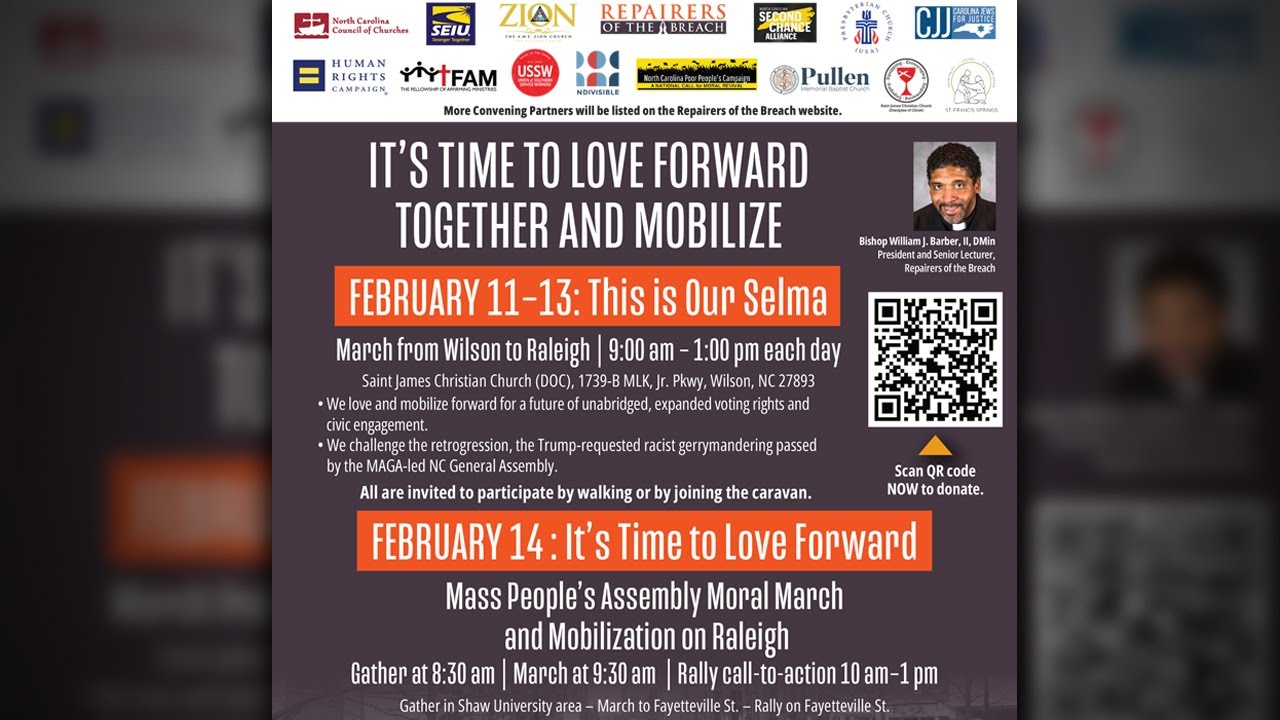
Love Forward Together Mass People’s Assembly & Moral March Mobilization | Day 2
"This episode documents Day 2 of the 'Love Forward Together' march in rural North Carolina, a mobilization against voter disenfranchisement and redistricting, emphasizing community unity and persistent activism."

Pimps, Hoes & Politicians
"This episode dissects the hypocrisy of online culture, political centrism, and corporate influence, arguing that identity politics often masks deeper corruption and that genuine progress requires holding politicians accountable, regardless of their declared affiliation."