
LIVE: DEMS HOLD J6 HEARINGS AS GOP HIDES!!!
YouTube · dySZlLRa29k
Quick Read
Summary
Takeaways
- ❖Donald Trump's pardons of over 1,500 January 6th rioters are described as an 'authoritarian playbook' move, rewarding violence and undermining justice.
- ❖The Department of Justice is alleged to have been politicized, with career prosecutors fired and individuals involved in January 6th appointed to senior roles.
- ❖The refusal to install a congressional plaque honoring Capitol Police officers who defended the Capitol is cited as an example of historical revisionism.
- ❖Misinformation and disinformation are identified as primary drivers of political violence, with conspiracy theories like 'fedsurrection' continuing to provoke unrest.
- ❖Pamela Hemphill, a convicted January 6th rioter, publicly rejected Trump's pardon, stating she was 'guilty' and that accepting it would be 'lying about what happened.'
- ❖The deployment of the National Guard during January 6th was solely under the President's authority, refuting claims that Speaker Pelosi or the DC Mayor were responsible.
- ❖The work of the January 6th Select Committee is presented as the definitive historical record, crucial for countering ongoing misinformation and ensuring future accountability.
- ❖State attorneys general are actively litigating against perceived executive overreach, successfully blocking attempts to federalize and deploy state National Guards without proper authority.
Insights
1Trump's Pardons Undermine Rule of Law and Empower Violence
Donald Trump's decision to pardon over 1,500 January 6th rioters, including those convicted of assaulting police officers and other serious crimes, is viewed as a direct attack on the rule of law. This action is framed as a reward for political violence, sending a message that loyalty to Trump supersedes legal accountability and potentially empowering future vigilante actions.
Former federal prosecutor Brendan Belaloo resigned from the Justice Department after the pardons, calling them part of an 'authoritarian playbook.' Officer Winston Pingen, who was assaulted, stated pardoning his attackers is 'completely unacceptable.' Pamela Hemphill, a convicted rioter, rejected her pardon, asserting her guilt and the wrongness of the events. Congresswoman Jahana Hayes noted that many pardoned individuals have since committed additional crimes, including child sexual assault and conspiracy to murder FBI agents.
2Ongoing Efforts to Rewrite January 6th History
Speakers repeatedly highlight a concerted effort by Donald Trump and his allies, including some Republicans in Congress, to 'rewrite' or 'whitewash' the history of January 6th. This includes downplaying the violence as a 'normal tourist visit' or 'peaceful protest,' and refusing to acknowledge Trump's role in inciting the attack.
Congressman Hakeem Jeffries stated Trump and 'far-right extremists in Congress have repeatedly attempted to rewrite history and whitewash the horrific events of January 6th.' Officer Pingen found the 'normal tourist visit' claim 'offensive.' Speaker Johnson's refusal to install a plaque honoring Capitol Police officers is cited as an example of this revisionism (). Professor Mary McCord mentioned theories like 'fedsurrection' and claims that pardoned individuals are 'victims' as part of this dangerous narrative ().
3Politicization of Justice and Government Institutions
The Trump administration is accused of systematically politicizing the Department of Justice and other government institutions. This includes firing or demoting career professionals who worked on January 6th cases, appointing individuals with ties to the attack to senior DOJ roles, and using government machinery to target political opponents and undermine election integrity.
Brendan Belaloo stated that dozens of nonpartisan career prosecutors and FBI agents working on January 6th cases were 'summarily fired' (). Jamie Raskin noted the appointment of Ed Martin (who tweeted from the Capitol on Jan 6) as interim US Attorney for DC and Jared Weiss (a J6 defendant caught yelling 'Kill him!') as a senior DOJ counselor (). Senator Adam Schiff detailed how the administration 'eliminated federal support systems' for election security and 'replaced trusted public servants with loyalists' ().
4Courage of Individuals as a Defense for Democracy
Despite the systemic challenges, the courage and integrity of individual civil servants, law enforcement officers, and even former rioters are presented as crucial 'guardrails' for democracy. These individuals, often facing personal threats and professional repercussions, prioritized their oaths and the truth over political loyalty.
Pamela Hemphill's testimony of rejecting a pardon and speaking out against Trump's lies, despite harassment, is highlighted as 'extraordinary courage' (). Lieutenant Governor Jeff Duncan of Georgia recounted resisting Trump's pressure to 'find 11,780 votes' and enduring death threats, stating his family motto: 'Doing the right thing will never be the wrong thing' (). Former Representatives Elaine Luria and Adam Kinzinger emphasized their oath to the Constitution over party loyalty, even as it ended their political careers ().
Lessons
- Remember and continually discuss the events of January 6th to counter misinformation and prevent historical revisionism, as 'simply remembering the past is an act of resistance.'
- Support and defend the rule of law by holding elected officials accountable for their actions and resisting attempts to politicize the justice system or other government institutions.
- Engage in civic participation, including legal challenges, to protect constitutional rights and democratic processes against executive overreach and political violence.
Quotes
"Donald Trump pardoned hundreds of violent felons who brutally beat police officers while storming the United States capital. The criminals and thugs that Donald Trump pardoned have flooded communities across the country, unleashing violence and mayhem."
"Anyone who can make you believe absurdities can make you commit atrocities."
"Pardoning criminals who severely beat me and my fellow officers that day is completely unacceptable. We cannot accept violent felons being pardoned and released back into our neighborhoods without consequence. That is not justice."
"I do not deserve a pardon for what I did on January the 6. I deserve to finish my sentence. I broke the law. To me, taking a pardon would be a slop in the Capitol police's face."
"The president sets the tempo for the country. And this country is desperate for a role model. For somebody who gets up every day, slightly left, slightly right, you pick it. But somebody who's a role model, who's respectable and honest and sets an example for kids and college kids and students and entrepreneurs and retirees and military officials, sets sets the example for everybody. That's what this country is in desperate need of. Donald Trump's not that example."
Q&A
Recent Questions
Related Episodes
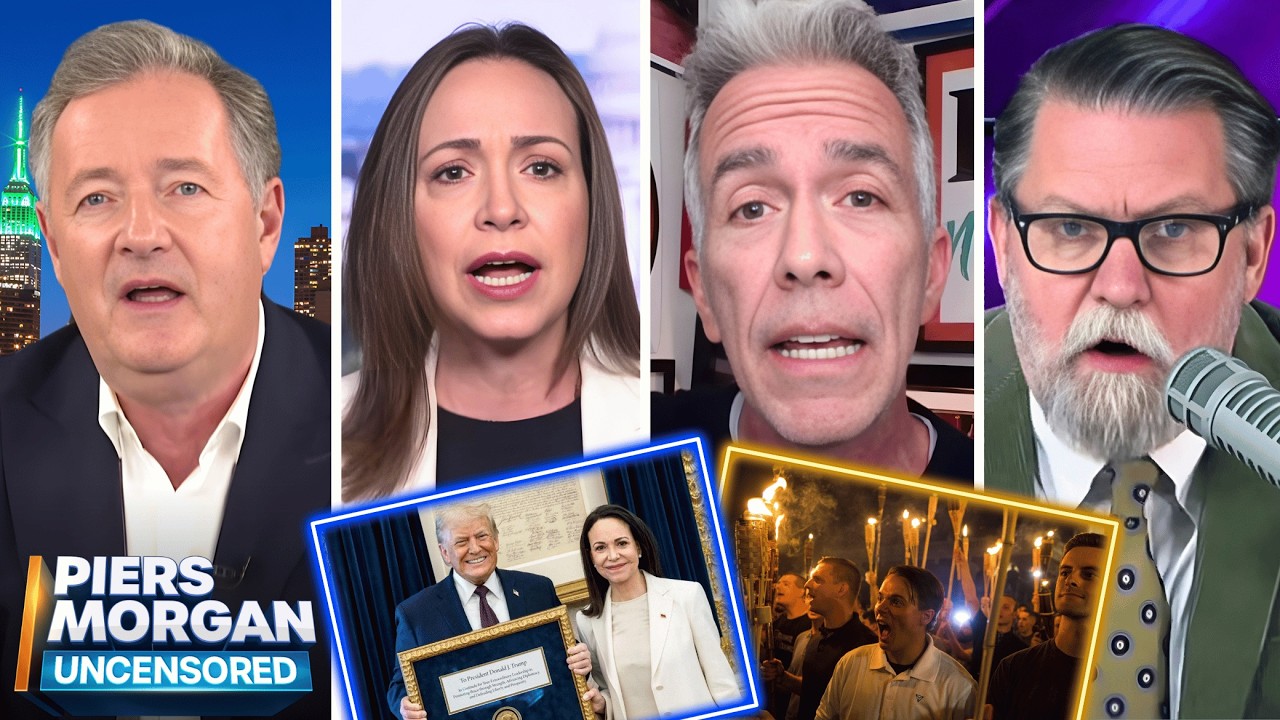
"Fighting Solves EVERYTHING!" Who's To Blame For Political Violence? + Maria Machado On Trump
"This episode dissects the escalating political violence in the US, with panelists fiercely debating the role of partisan rhetoric and media in radicalization, alongside an interview with Venezuelan opposition leader Maria Machado on US intervention and her country's future."

"CATASTROPHIC Failure!" Trump Dinner Assassination Attempt & Royal Visit | With Kari Lake
"Piers Morgan and Kari Lake dissect the catastrophic security failure during an assassination attempt on Donald Trump at the White House Correspondents Dinner, blaming media rhetoric while also discussing King Charles III's high-stakes US visit."

A major shift is happening right now
"Donald Trump is losing his grip on the Republican party and movement, evidenced by internal dissent and a broader political landscape grappling with a collapse of accountability and truth."

🚨 THEY F*CKED AROUND FOR THE LAST TIME 😭😭😭
"This episode unleashes a torrent of highly opinionated commentary on the US-Iran deal, Israel's role, and a scathing critique of 'leftist' policies and immigration, particularly highlighting the UK grooming gang report as evidence of Western societal decay."